2025年12月23日
3D ACADEMY offers affordable English study programs in Cebu, Philippines – perfect for beginners, professionals, and exam takers.

3D UNIVERSAL ENGLISH INSTITUTE INC
info.3d-universal.com
8:00-17:00(Mon-Fri)
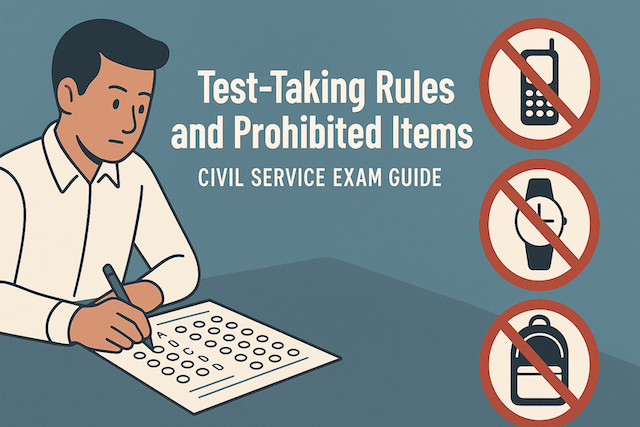
Test-Taking Rules and Prohibited Items: Civil Service Exam Guide
Contents
- Test-Taking Rules and Prohibited Items: Civil Service Exam Guide
- Importance of Following Civil Service Exam Rules
- General Test-Taking Rules for the Civil Service Exam
- Identity Verification and Seating Assignment
- Behavior Inside the Examination Room
- Instructions Before the Exam Starts
- Rules on Exam Materials
- Use of Writing Instruments
- Time Management Rules
- Prohibited Items Inside the Examination Room
- Bags, Notes, and Review Materials
- Food, Drinks, and Personal Items
- Clothing and Accessories Restrictions
- Prohibited Actions During the Exam
- Leaving the Examination Room
- Handling Emergencies or Special Situations
- Consequences of Violating Exam Rules
- Common Mistakes Examinees Should Avoid
- Tips to Ensure Compliance on Exam Day
- Final Checklist Before Entering the Exam Room
- Final Thoughts
- FAQs (Frequently Asked Questions)
- What should I bring on Civil Service Exam day?
- Are mobile phones allowed if they are turned off?
- Can I wear a smartwatch or fitness tracker?
- What happens if I accidentally bring prohibited items in my pocket?
- Are calculators allowed during the Civil Service Exam?
- Can I bring food or water into the exam room?
- Can I go to the restroom during the exam?
- What should I do if I notice a problem with my test booklet or answer sheet?
- Is talking allowed before the test starts?
- What if I arrive late to the exam?
- Can I leave the exam room early if I finish ahead of time?
- What are the consequences of cheating or breaking the rules?
Test-Taking Rules and Prohibited Items: Civil Service Exam Guide
Taking the Civil Service Exam (CSE) is a crucial step for individuals aiming to qualify for government positions. While most examinees focus heavily on reviewing test content, many overlook an equally important aspect: test-taking rules and prohibited items. Failing to follow these rules can lead to serious consequences, including disqualification, invalidation of results, or being barred from future exams.
This guide provides a comprehensive and practical explanation of the official test-taking rules, what you are allowed to bring, what items are strictly prohibited, and how to avoid common mistakes on exam day. Whether you are a first-time examinee or retaking the exam, understanding these rules will help ensure a smooth and stress-free testing experience.
Importance of Following Civil Service Exam Rules
The Civil Service Exam is administered by the Civil Service Commission (CSC) under standardized and strictly enforced conditions. These rules exist to:
-
Ensure fairness and integrity of the exam
-
Prevent cheating and misconduct
-
Maintain order and security at testing centers
-
Protect the validity of exam results
Any violation, whether intentional or accidental, may result in automatic disqualification, even if your test performance is excellent. This makes rule compliance just as important as exam preparation.
General Test-Taking Rules for the Civil Service Exam
All examinees are required to follow a standard set of rules once they enter the testing center. These apply to both Professional and Sub-Professional levels.
Arrival Time and Entry Rules
-
Examinees must arrive at least one hour before the scheduled exam time.
-
Late examinees are generally not allowed to enter once the exam has started.
-
Gates may close earlier to allow for identity verification and seating arrangements.
Arriving early helps reduce stress and gives you time to resolve any issues before the exam begins.
Identity Verification and Seating Assignment
Before entering the examination room:
-
You must present a valid ID that matches your application details.
-
Your name will be checked against the official master list.
-
You will be assigned a specific seat number and room.
Once seated, examinees are not allowed to change seats or move around unless instructed by the proctor.
Behavior Inside the Examination Room
Strict discipline is required throughout the exam.
Silence and Conduct
-
Talking, whispering, or communicating with other examinees is prohibited.
-
Any form of signaling, gestures, or passing notes is considered misconduct.
-
Examinees must follow all instructions given by proctors immediately.
Even seemingly harmless actions can be misinterpreted as cheating.
Instructions Before the Exam Starts
Before the exam officially begins, proctors will:
-
Read aloud the test instructions
-
Explain how to fill out answer sheets
-
Clarify time limits and break policies
Examinees are required to listen carefully. Asking questions is allowed only during this instruction period.
Rules on Exam Materials
Test Booklet and Answer Sheet
-
Do not open the test booklet until instructed.
-
Write only in designated areas on the answer sheet.
-
Do not make unnecessary marks, doodles, or symbols.
Tampering with test materials or attempting to remove them from the room is strictly prohibited.
Use of Writing Instruments
Only the following are allowed:
-
Black ballpen (recommended and often required)
-
No pencils unless explicitly stated
Using the wrong writing instrument may result in your answers not being read by the scanning system.
Time Management Rules
-
The exam duration is fixed and strictly enforced.
-
No extra time is given for late arrivals.
-
Once time is up, all writing must stop immediately.
Continuing to write after the time limit may lead to invalidation of your exam.
Prohibited Items Inside the Examination Room
One of the most critical aspects of exam day is knowing what not to bring. Many examinees are disqualified each year due to possession of prohibited items.
Electronic Devices
The following are strictly prohibited, even if turned off:
-
Mobile phones
-
Smartwatches and fitness trackers
-
Tablets and laptops
-
Bluetooth devices and earphones
-
Calculators (unless officially allowed, which is rare)
These items must be surrendered or left outside the examination room as instructed.
Bags, Notes, and Review Materials
-
Bags may be placed in a designated area, not beside your seat.
-
Review notes, books, and printed materials are not allowed inside the exam room.
-
Any written material found in your possession may be considered cheating.
Only items explicitly permitted by the CSC should be brought to your seat.
Food, Drinks, and Personal Items
Rules regarding food and drinks may vary slightly by testing center, but generally:
-
Light snacks may be allowed only with permission.
-
Bottled water is sometimes permitted, preferably clear and label-free.
-
No food wrappers, notes, or packaging should contain writing.
Always follow the proctor’s instructions regarding personal items.
Clothing and Accessories Restrictions
Some examinees are unaware that certain clothing and accessories may raise concerns.
Accessories to Avoid
-
Hats, caps, and hoodies (unless for medical or religious reasons)
-
Sunglasses or tinted glasses
-
Excessive jewelry
These items may be inspected or required to be removed to prevent concealment of notes or devices.
Prohibited Actions During the Exam
Even without prohibited items, certain actions are considered violations.
Forms of Misconduct
-
Copying answers from another examinee
-
Allowing others to copy your answers
-
Using codes, signals, or gestures
-
Looking at another examinee’s paper intentionally
-
Writing notes on hands, arms, or desks
Any of these actions may lead to immediate expulsion from the exam room.
Leaving the Examination Room
Rules regarding leaving the room are strict.
-
Leaving during the exam is generally not allowed unless there is an emergency.
-
Early finishers may be allowed to leave after a minimum time, depending on instructions.
-
Once you leave, you may not re-enter the exam room.
Always raise your hand and wait for proctor approval before standing or leaving.
Handling Emergencies or Special Situations
If you experience:
-
Sudden illness
-
Anxiety or panic
-
Equipment issues (e.g., damaged test booklet)
Immediately inform the proctor. Do not attempt to fix issues on your own, as this may be misinterpreted as misconduct.
Consequences of Violating Exam Rules
Violations are taken seriously and may result in:
-
Immediate removal from the exam room
-
Cancellation of exam results
-
Disqualification from future Civil Service Exams
-
Administrative sanctions under CSC rules
In many cases, there is no appeal once a violation is officially recorded.
Common Mistakes Examinees Should Avoid
Many violations occur unintentionally. Common mistakes include:
-
Forgetting to surrender mobile phones
-
Bringing notes inside pockets
-
Writing on scratch paper not provided by the CSC
-
Continuing to write after time is called
-
Ignoring verbal instructions from proctors
Awareness is the best way to avoid these issues.
Tips to Ensure Compliance on Exam Day
To avoid problems, follow these practical tips:
-
Prepare your allowed items the night before
-
Leave unnecessary belongings at home
-
Wear simple, comfortable clothing
-
Listen carefully to all instructions
-
Ask questions only when permitted
A calm and disciplined approach helps you focus on answering the exam itself.
Final Checklist Before Entering the Exam Room
Before you enter, make sure you have:
-
Valid ID
-
Exam notice or application receipt (if required)
-
Black ballpen
-
No prohibited items in pockets or bags
Double-checking these details can prevent last-minute stress and potential disqualification.
Final Thoughts
Understanding and following the test-taking rules and prohibited items guidelines is essential for anyone taking the Civil Service Exam. No matter how well-prepared you are academically, failing to comply with these rules can undo all your efforts.
By arriving early, bringing only permitted items, following instructions carefully, and maintaining proper conduct throughout the exam, you significantly increase your chances of completing the test smoothly and successfully. Treat exam rules with the same seriousness as exam preparation, and you will approach test day with confidence and peace of mind.
This knowledge is not just about avoiding penalties—it is about ensuring that your hard work and dedication are fully recognized through valid and credible exam results.
FAQs (Frequently Asked Questions)
What should I bring on Civil Service Exam day?
Bring only the essentials required to be admitted and to take the test properly. In most cases, you should prepare a valid government-issued ID that matches your application details, your exam notice or official confirmation (if your testing center requires it), and several black ballpens. It is also smart to bring a small, transparent envelope for your documents, and a simple analog wristwatch if allowed by the proctor. Keep your items minimal so you can pass inspection quickly and avoid confusion during seating. If you are unsure whether an item is allowed, do not bring it to your seat—leave it at home or keep it inside your bag in the designated area, following the room proctor’s instructions.
Are mobile phones allowed if they are turned off?
No. As a rule, mobile phones are treated as prohibited items inside the examination room, even if they are switched off or set to silent mode. Testing centers enforce strict controls because electronic devices can store notes, take photos, or connect to networks. If you bring a phone to the testing site, follow the proctor’s instructions on surrendering it, placing it in a designated area, or keeping it inside your bag away from your seat. To avoid problems, the safest practice is to leave your phone at home or with a companion outside the testing center.
Can I wear a smartwatch or fitness tracker?
Smartwatches and fitness trackers are generally prohibited because they are electronic devices that can store information and communicate wirelessly. Even if you only use the device for timekeeping, proctors may treat it as a potential cheating tool. If you need to track time, use a simple analog watch if permitted. If you arrive wearing a smartwatch, expect that you may be required to remove it and place it with your belongings. To avoid delays at entry and reduce stress, do not wear smart devices to the exam.
What happens if I accidentally bring prohibited items in my pocket?
Accidentally bringing prohibited items—such as a phone, written notes, or a small cheat sheet—can still be treated as a violation. Proctors may require you to surrender the item, and depending on the testing center’s rules and the severity of the situation, it may lead to disqualification or a formal report. That is why it is important to check all pockets, wallet compartments, and pencil cases before entering the room. Make it a habit to empty your pockets and keep only your allowed materials on your desk.
Are calculators allowed during the Civil Service Exam?
In most Civil Service Exam settings, calculators are not allowed. The exam is designed to measure reasoning, reading comprehension, and basic quantitative skills without additional tools. Even simple calculators can be considered prohibited because they store information and can be used to gain unfair advantage. Unless your official exam instructions explicitly allow calculators for a specific test type, assume they are not permitted and do not bring one.
Can I bring food or water into the exam room?
Policies vary by testing center, but many allow a small bottle of water, and some may allow light snacks as long as they do not disturb others. However, packaging that contains writing, notes, or printed content may be questioned. If food is permitted, choose something quiet and simple, and keep it sealed until allowed. Always follow the proctor’s instructions, and never leave trash on your desk or the floor. If you are unsure, eat before the exam and bring only water.
Can I go to the restroom during the exam?
Restroom breaks during the exam are often restricted and may be allowed only in emergencies. If permitted, you must raise your hand, wait for proctor approval, and follow escort procedures if required. You may not carry your test booklet or answer sheet out of the room. Because restroom access can be limited, it is best to use the restroom before the exam starts and avoid excessive liquids right before entry.
What should I do if I notice a problem with my test booklet or answer sheet?
If your test booklet has missing pages, unreadable print, or incorrect information, or if your answer sheet is damaged or misprinted, do not try to fix it yourself. Raise your hand immediately and report the issue to the proctor. The proctor will check the material and provide an official replacement or instructions. Acting quickly is important because delays can affect your time management, and unauthorized handling of test materials can be misinterpreted as misconduct.
Is talking allowed before the test starts?
In most testing rooms, talking is discouraged once you are seated and the proctor begins giving instructions. Some light conversation before official instructions may be tolerated, but it depends on the proctor and room environment. Once the instruction period starts, you should remain quiet, listen carefully, and only speak if the proctor allows questions. During the test itself, any talking or signaling is strictly prohibited and can lead to disqualification.
What if I arrive late to the exam?
Late arrival is risky because many testing centers close entry once the exam begins. Even if you are only a few minutes late, you may be refused entry for fairness and security reasons. To avoid this, plan to arrive at least one hour early, account for traffic and long lines, and prepare your documents the night before. If something unexpected happens, report to the testing center staff immediately, but understand that admission is not guaranteed.
Can I leave the exam room early if I finish ahead of time?
Early departure rules vary, but many exams require you to stay for a minimum period before leaving. If early exit is allowed, you must submit your materials properly and leave quietly without disturbing others. Once you leave, you are generally not allowed to re-enter the room. Never stand up or walk out without permission. Raise your hand, wait for the proctor, and follow the official dismissal procedure.
What are the consequences of cheating or breaking the rules?
Cheating and rule violations are treated seriously and may result in immediate removal from the exam room, cancellation of your results, and possible disqualification from future exams. Actions such as using notes, communicating with others, copying answers, taking photos of test materials, or continuing to write after time is called can lead to sanctions. Even behaviors that look suspicious—like repeated glancing at another examinee’s paper—can trigger investigation. The safest approach is to follow instructions strictly, keep your eyes on your own materials, and maintain calm, disciplined behavior throughout the exam.
Civil Service Exam Philippines: Complete Preparation and Passing Guide

How to Register for eTravel Philippines (2025 Guide)
Step-by-step guide to completing your eTravel registration before arriving in the Philippines, with images and tips.

Night Market in Cebu – Things You Don’t Know About Cebu Life
Discover the hidden charm of Cebu’s night markets, from street food stalls to local life tips you won’t find in tourist guides.

How to Use ChatGPT for IELTS Preparation: A Complete Guide
Learn how to prepare for IELTS using ChatGPT — including strategies for Writing, Reading, Listening, Speaking, and grammar support.

How to Build a Website Without Coding Using ChatGPT
Discover how to build your own website using AI—no coding skills needed. From structure planning to SEO and design, let ChatGPT guide you.