2026年4月3日
3D ACADEMY offers affordable English study programs in Cebu, Philippines – perfect for beginners, professionals, and exam takers.

3D UNIVERSAL ENGLISH INSTITUTE INC
info.3d-universal.com
8:00-17:00(Mon-Fri)
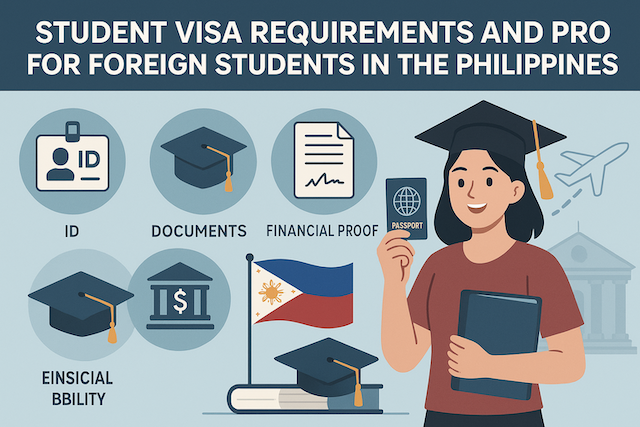
Student Visa Requirements and Process for Foreign Students in the Philippines
Contents
- Student Visa Requirements and Process for Foreign Students in the Philippines
- Overview of the Student Visa in the Philippines
- Types of Study-Related Visas
- Eligibility Criteria
- Required Documents for Student Visa Application
- Step-by-Step Process for Applying for a Student Visa
- Step 1: Secure Admission from a Philippine Institution
- Step 2: School Endorsement to the Department of Foreign Affairs (DFA)
- Step 3: Receive Visa Authorization from the DFA
- Step 4: Submit Requirements to the Embassy/Consulate
- Step 5: Pay the Visa Fee and Wait for Approval
- Step 6: Travel to the Philippines and Register with the Bureau of Immigration
- Step 7: Annual Report and Visa Extensions
- Applying for a Special Study Permit (SSP)
- Processing Time and Validity
- Conversion of Tourist Visa to Student Visa
- Financial Requirements and Proof of Support
- Health and Security Clearances
- Renewal and Maintenance of Student Visa
- Important Reminders for Foreign Students
- Conclusion
- FAQs
- What type of visa do I need to study in the Philippines?
- Can I enter on a tourist visa and convert to a student visa?
- What documents are typically required for a 9(f) Student Visa?
- How do I apply for a Special Study Permit (SSP)?
- How long does visa processing take and when should I start?
- Do I need an Alien Certificate of Registration (ACR I-Card)?
- Can I work while studying on a student visa?
- What financial evidence is acceptable?
- What medical and police clearances are required?
- How do renewals and extensions work?
- What is the Annual Report requirement?
- Can I transfer schools or change programs after visa issuance?
- Do dependents (spouse/children) have a pathway to stay with me?
- What happens if my visa expires or I overstay?
- Any tips to avoid common mistakes?
Student Visa Requirements and Process for Foreign Students in the Philippines
Studying in the Philippines offers international students an affordable, English-speaking environment with globally recognized universities. However, before you can begin your studies, obtaining the proper student visa is essential. This guide explains the requirements, step-by-step process, and important details foreign students need to know when applying for a student visa in the Philippines.
Overview of the Student Visa in the Philippines
The Philippine student visa allows foreign nationals to stay in the country for the purpose of studying in accredited institutions. It is issued by the Philippine Bureau of Immigration (BI) after recommendation from the Commission on Higher Education (CHED), Department of Education (DepEd), or Technical Education and Skills Development Authority (TESDA), depending on the type of program.
Who Needs a Student Visa
-
Foreign students enrolling in degree programs (college, graduate school, or post-graduate).
-
Foreign nationals taking non-degree or vocational courses for more than 6 months.
-
Students 18 years old and above.
Foreign minors below 18 years old who wish to study in the Philippines must apply for a Special Study Permit (SSP) instead.
Types of Study-Related Visas
1. Student Visa (9(f))
The 9(f) Student Visa is the most common visa for foreign nationals pursuing full-time studies in the Philippines. It is granted to students enrolled in universities, colleges, or accredited educational institutions recognized by CHED, DepEd, or TESDA.
2. Special Study Permit (SSP)
Issued to foreigners below 18 years old or those taking non-degree or short-term courses (less than one year). The SSP is applied for inside the Philippines and is valid for six months, renewable as needed.
Eligibility Criteria
To qualify for a student visa, applicants must:
-
Be at least 18 years old at the time of application.
-
Have proof of admission or acceptance from an accredited Philippine school.
-
Possess sufficient financial means to cover tuition, living expenses, and travel costs.
-
Be of good moral character and without criminal record.
-
Hold a valid passport from their home country.
Required Documents for Student Visa Application
Foreign students need to prepare the following documents before applying:
-
Letter of Acceptance from a CHED-accredited school in the Philippines.
-
Visa Application Form (FA Form No. 2) duly accomplished and signed.
-
Personal History Statement (PHS) signed by the applicant, with 2×2 photos.
-
Original passport valid for at least six (6) months beyond the intended stay.
-
Medical health certificate issued by an authorized physician (with laboratory results).
-
Police clearance certificate from applicant’s country of residence.
-
Certificate of Good Moral Character from the school or institution last attended.
-
Proof of financial capacity such as bank statements, scholarship certificate, or affidavit of support.
-
Transcript of Records or Scholastic Certificates authenticated by the Philippine Embassy or Consulate in the student’s home country.
-
Photocopy of birth certificate authenticated by the embassy or consulate.
-
Visa processing fee (varies depending on embassy or BI requirements).
Step-by-Step Process for Applying for a Student Visa
The student visa application can be done through a Philippine embassy or consulate abroad or within the Philippines (for certain eligible cases).
Step 1: Secure Admission from a Philippine Institution
The first step is to apply and be accepted by a recognized Philippine school. The school must be authorized by CHED, DepEd, or TESDA to accept foreign students.
Once accepted, the school will provide:
-
A Notice of Acceptance (NOA) with a dry seal.
-
A letter certifying that the student will comply with Philippine laws and school regulations.
Step 2: School Endorsement to the Department of Foreign Affairs (DFA)
The school endorses the accepted student to the DFA in Manila, requesting issuance of a student visa authorization.
Step 3: Receive Visa Authorization from the DFA
The DFA forwards the authorization to the Philippine Embassy or Consulate in the student’s home country.
Step 4: Submit Requirements to the Embassy/Consulate
The applicant then submits all required documents and undergoes a personal interview at the embassy or consulate.
Step 5: Pay the Visa Fee and Wait for Approval
The visa fee usually ranges between USD 250–400, depending on nationality and location. Processing time may take 2 to 4 weeks.
Step 6: Travel to the Philippines and Register with the Bureau of Immigration
Upon arrival, the student must register with the Bureau of Immigration (BI) and secure an Alien Certificate of Registration (ACR I-Card).
Step 7: Annual Report and Visa Extensions
Student visa holders are required to file an annual report at the BI and extend their stay as necessary, depending on their study program duration.
Applying for a Special Study Permit (SSP)
For students who will study short-term or non-degree programs, the Special Study Permit (SSP) can be applied for within the Philippines.
SSP Application Steps
-
Get an enrollment certificate from a recognized institution.
-
Prepare supporting documents:
-
Passport and visa copy.
-
Two passport-sized photos.
-
Proof of financial support.
-
Police or NBI clearance (for long-term stay).
-
-
Submit application to the Bureau of Immigration.
-
Pay the SSP fee (around PHP 6,000–8,000 per permit).
The SSP is usually valid for 6 months and can be renewed for as long as the student remains enrolled.
Processing Time and Validity
-
Student Visa (9f): Valid for 1 year, renewable annually.
-
Special Study Permit (SSP): Valid for 6 months, renewable.
-
Processing time: Typically 2–8 weeks, depending on completeness of documents and location of application.
It is advisable to start the process at least 2–3 months before the school semester starts to avoid delays.
Conversion of Tourist Visa to Student Visa
Foreign students who initially enter the Philippines on a temporary visitor visa (9a) can apply for conversion to a student visa while in the country, provided they have received acceptance from an accredited institution.
Requirements for Conversion
-
Valid tourist visa.
-
Notice of Acceptance (NOA) from an authorized school.
-
Endorsement from CHED/DepEd/TESDA to the BI.
-
Proof of financial capability and medical clearance.
Once approved, the BI will issue a student visa valid for the duration of the program, subject to renewal.
Financial Requirements and Proof of Support
Applicants must demonstrate that they can financially sustain themselves during their stay in the Philippines. This may include:
-
Bank statements for the past six months.
-
Affidavit of Support from a parent, guardian, or sponsor.
-
Scholarship certificate (if applicable).
-
Proof of accommodation (rental agreement or dormitory confirmation).
Health and Security Clearances
All applicants must undergo medical and police background checks to ensure they are fit for study and residence in the country.
Medical Examination Includes:
-
Physical exam.
-
Chest X-ray.
-
Blood test and drug test.
-
Psychological evaluation (for some institutions).
These results must be authenticated and attached to the visa application.
Renewal and Maintenance of Student Visa
Student visas must be renewed yearly at the Bureau of Immigration (BI). Renewal requires submission of updated school registration records, grades, and proof of continuous enrollment.
Required for Renewal:
-
Application form for extension.
-
Recent school registration certificate.
-
Transcript or certificate of grades.
-
Updated passport and ACR I-Card.
-
Payment of renewal fees (approx. PHP 5,000–7,000).
Important Reminders for Foreign Students
-
Always keep your visa and ACR I-Card valid. Overstaying without renewal can result in fines and deportation.
-
Report to the BI annually. All registered aliens are required to file an annual report within the first 60 days of each year.
-
Study only in authorized schools. Transferring schools requires prior approval from CHED and the BI.
-
Do not work while on a student visa. The visa does not permit employment.
-
Notify BI of address changes. Failure to update personal information may result in penalties.
Conclusion
The Philippines offers a welcoming academic environment for foreign students seeking quality education at affordable costs. Obtaining a student visa requires careful preparation, documentation, and adherence to immigration procedures, but the process is straightforward when done correctly.
By following the official guidelines—starting from securing school admission to maintaining legal status with the Bureau of Immigration—foreign students can enjoy a smooth and lawful study experience in the Philippines.
FAQs
What type of visa do I need to study in the Philippines?
Most full-time students 18 years old and above apply for the 9(f) Student Visa. If you are under 18 or taking a non-degree or short course (typically under one year), you usually need a Special Study Permit (SSP). Always confirm with your school which document applies to your program because the correct pathway depends on your age, course length, and the institution’s accreditation status.
Can I enter on a tourist visa and convert to a student visa?
Yes. Many students arrive on a temporary visitor (9a) visa, secure admission, and then apply for conversion to a 9(f) Student Visa with the Bureau of Immigration (BI). You will submit your Notice of Acceptance, proof of financial capacity, medical exam, and other BI forms. Until conversion is approved, you must keep your visitor status valid through timely extensions.
What documents are typically required for a 9(f) Student Visa?
Requirements vary by nationality and school, but expect to provide: a Notice/Letter of Acceptance from a CHED/DepEd/TESDA-recognized institution; accomplished visa forms; valid passport; recent photos; police clearance from your country of residence; medical examination results; proof of funds (bank statements, scholarship, or affidavit of support); transcripts and certificates (often authenticated); and payment receipts. Your school’s foreign student office will usually give you a checklist.
How do I apply for a Special Study Permit (SSP)?
SSP applications are filed in the Philippines through BI or accredited liaison partners. You’ll submit your passport bio page and valid entry stamp, enrollment certificate, photos, proof of funds, and fees. SSPs are commonly issued for six months and are renewable as long as you remain enrolled. Because processing is local, schools offering short courses often guide students through the steps upon registration.
How long does visa processing take and when should I start?
Timelines differ by embassy, season, and completeness of documents. A conservative estimate is several weeks from submission. If you are converting in-country, budget additional time for school endorsement and BI scheduling. To reduce risk, begin collecting documents as soon as you receive your acceptance and aim to start the visa or SSP process at least two to three months before your target intake.
Do I need an Alien Certificate of Registration (ACR I-Card)?
Yes, most non-citizens staying beyond a short visit must obtain an ACR I-Card after visa issuance or conversion. The ACR I-Card is your biometric identity card in the Philippines and is presented during renewals, travel, and annual reporting. Keep it safe and bring it, along with your passport, when dealing with immigration matters or campus registrars that require identity verification.
Can I work while studying on a student visa?
Student visas and SSPs do not grant open work authorization. Paid employment is generally restricted. Limited, school-sanctioned activities (e.g., internships required by your curriculum) may be permitted if properly coordinated with your institution and, where necessary, the BI. If you plan to do any work, ask your school’s international office first and obtain written approval before accepting any role.
What financial evidence is acceptable?
Show reliable means to cover tuition, living costs, and travel. Accepted proofs include recent bank statements, scholarship or sponsorship letters, and an affidavit of support from a parent or sponsor with supporting income documents. Consistency matters: your bank history and sponsor’s capacity should match tuition quotes and your stated budget for housing, food, insurance, and incidentals.
What medical and police clearances are required?
You will typically need a medical exam (often with chest X-ray and basic labs) and a police clearance from your country of residence. Documents must be recent and, in many cases, authenticated or apostilled per embassy/BI instructions. If you have a medical condition, bring treatment records and prescriptions; this helps you register for health insurance and avoid delays during evaluation.
How do renewals and extensions work?
Student visas are commonly renewed annually; SSPs are renewed every six months. For renewal, submit the BI form, current ACR I-Card, valid passport, proof of enrollment, and payment. File before expiry to avoid penalties. Retain copies of registration forms, official receipts, and your school’s certification of good standing; these documents are frequently requested during extensions.
What is the Annual Report requirement?
Registered foreign nationals must complete an Annual Report with BI, typically within the first 60 days of the calendar year. Bring your passport, ACR I-Card, and pay the prescribed fee. Missing the reporting window can result in fines, so add a calendar reminder and confirm dates each January with BI announcements or your school’s international office.
Can I transfer schools or change programs after visa issuance?
Yes, but you must follow formal procedures. Inform your current and new schools, obtain necessary clearances, and update BI so your visa record reflects the new institution/program. Unauthorized transfers can jeopardize your status. Plan ahead because release of records, new endorsements, and scheduling with BI can take time, especially near the start of semesters.
Do dependents (spouse/children) have a pathway to stay with me?
In some cases, qualified dependents may apply for appropriate visas (e.g., 9(a) visitor with extensions or other categories if eligible). Benefits and work/study permissions for dependents are limited. If you anticipate bringing family, consult your school and the nearest Philippine embassy for the most suitable route and documentation before purchasing tickets.
What happens if my visa expires or I overstay?
Overstays can lead to fines, proceedings, or removal. If you foresee delays—such as late release of grades, medical results, or scheduling—visit BI early to request an extension. Keep payment receipts and proof of pending applications. Proactive communication with BI and your school is the best way to avoid penalties and disruption to your studies.
Any tips to avoid common mistakes?
Use your school’s official checklist; keep digital and paper copies of every receipt and letter; track expiry dates for your visa, ACR I-Card, and passport; maintain full-time enrollment and satisfactory academic standing; report address changes; and never miss Annual Report. When in doubt, ask your registrar or international office—they interact with BI regularly and know current procedures.
Philippines University Guide: Top Universities, Admissions, Scholarships, and Student Life

How to Register for eTravel Philippines (2025 Guide)
Step-by-step guide to completing your eTravel registration before arriving in the Philippines, with images and tips.

Night Market in Cebu – Things You Don’t Know About Cebu Life
Discover the hidden charm of Cebu’s night markets, from street food stalls to local life tips you won’t find in tourist guides.

How to Use ChatGPT for IELTS Preparation: A Complete Guide
Learn how to prepare for IELTS using ChatGPT — including strategies for Writing, Reading, Listening, Speaking, and grammar support.

How to Build a Website Without Coding Using ChatGPT
Discover how to build your own website using AI—no coding skills needed. From structure planning to SEO and design, let ChatGPT guide you.