2025年12月23日
3D ACADEMY offers affordable English study programs in Cebu, Philippines – perfect for beginners, professionals, and exam takers.

3D UNIVERSAL ENGLISH INSTITUTE INC
info.3d-universal.com
8:00-17:00(Mon-Fri)
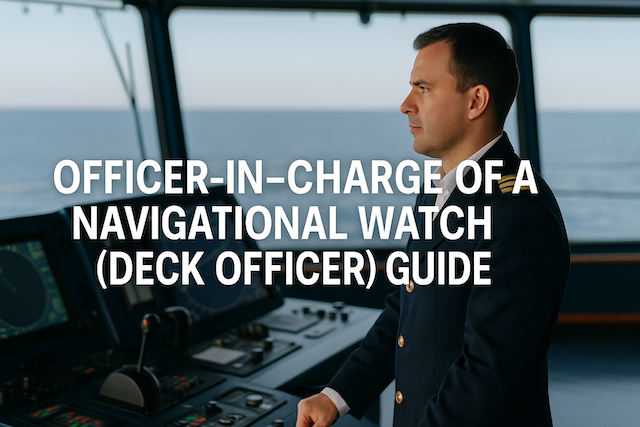
Officer-in-Charge of a Navigational Watch (Deck Officer) Guide
Contents
- Officer-in-Charge of a Navigational Watch (Deck Officer) Guide
- Understanding the Role of an Officer-in-Charge of a Navigational Watch
- Who Is Eligible to Become an OIC-NW?
- OIC-NW Licensing Process
- Training and Skills Required
- Duties and Responsibilities of an OIC-NW
- OIC-NW Salary and Employment Opportunities
- How to Pass the OIC-NW Exam and Assessment
- Life as an OIC-NW Onboard
- Conclusion
- FAQs (Frequently Asked Questions)
- What is an Officer-in-Charge of a Navigational Watch (OIC-NW)?
- What are the basic qualifications to become an OIC-NW?
- How much sea service is required before taking the OIC-NW assessment?
- Which STCW courses are mandatory for OIC-NW candidates?
- What subjects are covered in the OIC-NW written examination?
- What happens during the practical or simulator assessment?
- Is ECDIS knowledge really necessary for OIC-NW?
- How much is the typical salary of an OIC-NW?
- What are the career progression opportunities after becoming an OIC-NW?
- How can I improve my chances of passing the OIC-NW exams?
- What soft skills are important for an OIC-NW?
- Is being an OIC-NW a good career choice for the long term?
Becoming an Officer-in-Charge of a Navigational Watch (OIC-NW) is one of the most important milestones in a seafarer’s deck officer career. This role is essential for ensuring the safe navigation of vessels at sea, and it requires technical proficiency, leadership skills, and strict compliance with international maritime standards—especially those under the STCW Convention.
This comprehensive guide explains everything you need to know about the OIC-NW career path, qualifications, training requirements, examination coverage, duties onboard, salary expectations, employment opportunities, and practical tips for passing assessments and thriving at sea.
An OIC-NW is a licensed deck officer entrusted with the responsibility of maintaining the navigational watch and ensuring safety of life, property, and the marine environment. They are the bridge watchkeepers who execute the ship master’s orders and ensure the vessel follows its passage plan safely.
Their authority is grounded in the International Convention on Standards of Training, Certification, and Watchkeeping for Seafarers (STCW), particularly under Regulation II/1.
Key aspects of the role include:
-
Safe and effective operation of the ship
-
Navigation and vessel control
-
Emergency preparedness
-
Leadership and teamwork
-
Compliance with international maritime laws
This position is the starting point for future progression to roles such as Second Mate, Chief Mate, and Master Mariner.
Who Is Eligible to Become an OIC-NW?
Eligibility requirements may vary slightly depending on the maritime administration, but in the Philippines (MARINA), these are the general requirements:
Educational Background
-
Bachelor of Science in Marine Transportation (BSMT) or equivalent maritime navigation degree
-
Completion of required academic units, including navigation, seamanship, cargo handling, maritime law, meteorology, and ship stability
Sea Service Requirements
STCW mandates that candidates must have:
-
At least 12 months of approved seagoing service, including bridge watchkeeping duties
-
Completion of approved onboard training program (OBT) documented in a Training Record Book (TRB)
Required STCW Mandatory Courses
Candidates must complete required safety and operational courses such as:
-
Basic Training (BT)
-
Ship Security Awareness/SSO
-
Radar Navigation, Radar Plotting & ARPA
-
ECDIS
-
Bridge Resource Management (BRM)
-
GMDSS Radio Operator Course
-
Medical First Aid
Age and Health Requirements
-
At least 18 years old
-
Must have a valid Medical Certificate from a DOH-accredited clinic
OIC-NW Licensing Process
The licensing process in the Philippines typically involves multiple steps overseen by MARINA’s STCW Office.
Step 1: Completion of Academic and Shipboard Training
You must graduate from an accredited maritime school and finish your OBT/TRB requirements.
Step 2: Documentary Requirements
Common documents include:
-
Transcript of Records (TOR)
-
Sea service certificates
-
TRB or OBT completion certificate
-
Certificates of STCW mandatory courses
-
Medical certificate
-
Valid passport and seaman’s book
Step 3: Theoretical Examination (Management-Level Knowledge)
The MARINA OIC-NW exam covers:
-
Navigation
-
Cargo Handling and Stowage
-
Controlling the Operation of the Ship
-
Marine Engineering Basics (auxiliary systems)
-
Meteorology
-
Maritime Laws & Ship Management
Exams may be computer-based and include both multiple-choice and situational questions.
Step 4: Practical Assessment
Competency assessments involve:
-
Chartwork
-
Passage planning
-
Radar & ARPA usage
-
ECDIS operation
-
Bridge watchkeeping scenarios
-
COLREGS application
Step 5: Certificate of Competency (COC) Issuance
Once all requirements are passed, MARINA issues the Officer-in-Charge of a Navigational Watch Certificate of Competency under STCW II/1.
Training and Skills Required
To succeed as an OIC-NW, candidates must develop a combination of technical and operational skills.
These include:
-
Celestial and terrestrial navigation
-
Use of radar, ECDIS, AIS, GPS, and bridge equipment
-
Understanding of tides, currents, and chart symbols
-
Voyage and passage planning
Emergency Preparedness
An OIC-NW must be trained to respond to:
-
Man-overboard situations
-
Collision and grounding
-
Fire and flooding
-
Piracy and security threats
-
Abandon ship operations
Communication Skills
Effective communication using:
-
Standard Marine Communication Phrases (SMCP)
-
VHF radio protocols
-
Briefing and reporting to the master
Teamwork and Leadership
You will be the senior-most person on the bridge during watch, so leadership abilities are essential.
Duties and Responsibilities of an OIC-NW
Once onboard, an OIC-NW is responsible for the safe and efficient operation of the vessel during their watch. Their duties include:
-
Monitoring vessel position using all available means
-
Executing passage plans
-
Applying COLREGS to avoid collisions
-
Keeping lookout and ensuring proper watchkeeping
Bridge Management
-
Operating navigational instruments
-
Logging essential information in the deck logbook
-
Reporting anomalies, weather conditions, or hazards
Safety and Security
-
Maintaining security awareness
-
Conducting safety checks
-
Participating in emergency drills and muster duties
Cargo and Ship Operations
Although mainly a navigational position, OICs also assist in:
-
Cargo operations (especially on container or tanker ships)
-
Mooring and anchoring operations
-
Monitoring ballast operations
Being efficient, alert, and disciplined is crucial because the OIC-NW ensures the vessel remains safe at all times.
OIC-NW Salary and Employment Opportunities
Salary Expectations
Salaries vary based on vessel type, company, and nationality, but typical ranges are:
-
$1,500 to $3,500 USD per month on average
-
Higher on tankers, bulk carriers, and offshore vessels
Factors influencing salary:
-
Experience level
-
Type of vessel (oil/chemical tankers pay more)
-
Region of operation
-
Company reputation
Job Opportunities
OIC-NW officers are in demand worldwide due to increasing global trade. Typical vessel types include:
-
Container ships
-
Cargo/bulk carriers
-
Oil, chemical, and LPG tankers
-
Passenger ships and cruise liners
-
Offshore support vessels (AHTS, PSV, DP vessels)
Career progression paths:
-
OIC-NW (Third Officer)
-
Second Officer
-
Chief Officer
-
Master Mariner (Captain)
How to Pass the OIC-NW Exam and Assessment
Here are practical tips to help you pass:
1. Master the COLREGS
Collision regulations are one of the most heavily tested subjects.
Focus on:
-
Rules of the Road (Rules 4–19)
-
Lights and Shapes
-
Sound and Light Signals
2. Strengthen Chartwork Skills
Practice:
-
Dead reckoning
-
Position fixing
-
Plotting set and drift
-
Passage planning and corrections
3. Review Radar and ARPA Operations
Learn to interpret:
-
CPA/TCPA
-
Relative and true motion
-
Parallel indexing
4. ECDIS Familiarity
Know:
-
Safety contours
-
Alarms
-
Route creation and verification
-
ENC updates
5. Study Maritime Laws
Especially:
-
SOLAS
-
MARPOL
-
ISM Code
-
STCW Convention
6. Take Mock Exams
Simulate the exam environment to improve:
-
Time management
-
Situational analysis
-
Stress handling
Life as an OIC-NW Onboard
Life onboard is both rewarding and challenging. As an OIC-NW, expect:
Watchkeeping Duties
-
Usually “4-on/8-off” system (e.g., 0000–0400 and 1200–1600)
-
Night watches requiring extra alertness
Living Conditions
-
Private or shared cabins
-
Access to onboard facilities (gym, recreation room)
Workload
-
High responsibility
-
Need for continuous learning
-
Accountability in emergency situations
Personal Growth
-
Develop leadership skills
-
Gain global exposure
-
Experience maritime cultures
Conclusion
Becoming an Officer-in-Charge of a Navigational Watch (OIC-NW) is a prestigious achievement and a vital stepping stone in the maritime profession. It demands technical expertise, discipline, and strong leadership—but it also opens doors to high-paying jobs, global travel, and long-term career advancement.
If you aim to become a deck officer or eventually a ship captain, mastering the competencies required for OIC-NW is your essential first step.
FAQs (Frequently Asked Questions)
An Officer-in-Charge of a Navigational Watch (OIC-NW) is a licensed deck officer who is responsible for the safe navigation of a ship during their assigned watch. They monitor the vessel’s position, apply the collision regulations (COLREGS), operate navigational equipment, and ensure the safety of the crew, cargo, and marine environment. This role is usually equivalent to a Third Officer or Junior Officer on many merchant vessels and is regulated by the STCW Convention under Regulation II/1.
What are the basic qualifications to become an OIC-NW?
Typically, you need to complete a Bachelor of Science in Marine Transportation (or an equivalent navigation-related degree) from an accredited maritime school. You must also accomplish the required sea service, usually at least 12 months of approved seagoing service with watchkeeping duties, and complete all mandatory STCW training courses. In addition, you must pass the theoretical examinations and practical assessments conducted or authorized by your maritime administration.
How much sea service is required before taking the OIC-NW assessment?
Most maritime administrations, in line with STCW, require at least 12 months of approved seagoing service in the deck department, including bridge watchkeeping duties under the supervision of a qualified officer. This service must often be documented in a Training Record Book (TRB) or similar log, signed and verified by the ship’s officers and company. Some jurisdictions may require more sea time or a combination of cadetship and onboard training programs.
Which STCW courses are mandatory for OIC-NW candidates?
While requirements can differ slightly by country, common mandatory STCW courses include Basic Training (BT), Proficiency in Survival Craft and Rescue Boats (if applicable), Advanced Fire Fighting, Medical First Aid, Ship Security Awareness or Designated Security Duties, Radar Navigation and ARPA, Electronic Chart Display and Information System (ECDIS), Bridge Resource Management (BRM), and GMDSS Radio Operator training. You should always check the latest list of approved courses from your maritime authority.
What subjects are covered in the OIC-NW written examination?
The written examination usually tests your knowledge in navigation (including chartwork and passage planning), ship handling basics, cargo handling and stowage, meteorology, watchkeeping and COLREGS, ship construction and stability, marine safety and environmental protection, as well as basic maritime law and conventions such as SOLAS, MARPOL, and STCW. Questions may be multiple-choice, problem-solving, or scenario-based to assess both theory and practical decision-making.
What happens during the practical or simulator assessment?
During the practical or simulator assessment, you will typically be placed in a bridge simulator environment and asked to perform watchkeeping duties. This may include planning and executing a passage, avoiding collisions using COLREGS, handling traffic situations, responding to emergencies such as man-overboard or restricted visibility, and using equipment like radar, ARPA, ECDIS, and AIS. Assessors will evaluate your situational awareness, communication, use of bridge resources, and adherence to safety procedures.
Is ECDIS knowledge really necessary for OIC-NW?
Yes. Modern ships are increasingly reliant on ECDIS as a primary means of navigation, and STCW requires specific ECDIS training for officers whose ships use it to meet chart carriage requirements. As an OIC-NW, you must understand how to set safety contours, manage alarms, check route safety, use ENC updates, and cross-check ECDIS information with other navigational aids. Lack of ECDIS proficiency can be a serious safety risk and may negatively affect your assessments and employability.
How much is the typical salary of an OIC-NW?
Salaries vary widely depending on vessel type, shipping company, trade route, and your experience. However, many OIC-NW or Third Officer positions offer salaries in the range of approximately USD 1,500 to 3,500 per month, with tanker vessels and specialized ships often paying on the higher end. Additional benefits may include free accommodation and food onboard, travel allowances, and insurance, but exact figures depend on your employment contract and company policies.
What are the career progression opportunities after becoming an OIC-NW?
After gaining enough experience and additional training, an OIC-NW can progress to Second Officer (often focusing on navigation and passage planning), then to Chief Officer (responsible for cargo operations and deck management), and finally to Master (Captain) of the ship. Each step typically requires more sea service, advanced training courses, and higher-level certificates of competency. Some officers may also transition into shore-based roles such as marine superintendent, port captain, or maritime educator.
How can I improve my chances of passing the OIC-NW exams?
You can improve your chances by creating a structured study plan that covers all examination topics, using updated review materials, and regularly practicing chartwork and problem-solving questions. Joining review centers or study groups can also help. It is important to thoroughly understand, not just memorize, COLREGS, navigation principles, and maritime safety conventions. Practicing with mock examinations, attending simulator training, and reviewing real-world case studies of marine accidents can also strengthen your practical judgment and exam readiness.
What soft skills are important for an OIC-NW?
Beyond technical competence, an OIC-NW must have strong communication skills, teamwork, situational awareness, and leadership ability. You will frequently interact with multinational crew members, pilots, and shore-based personnel, so clear and respectful communication is essential. Good decision-making under pressure, adaptability to changing conditions, discipline, and a strong safety mindset are all critical to performing effectively and earning the trust of senior officers and the ship’s master.
Is being an OIC-NW a good career choice for the long term?
For many seafarers, becoming an OIC-NW is an excellent foundation for a long-term maritime career. It offers competitive income, international exposure, and clear pathways for advancement to higher ranks. However, it also involves long periods away from home, demanding responsibilities, and sometimes challenging working and living conditions at sea. If you enjoy technical work, problem-solving, leadership, and life in an international environment, this role can be both professionally and personally rewarding.
Philippines Board Exam Guide: Complete Overview for Students and Professionals

How to Register for eTravel Philippines (2025 Guide)
Step-by-step guide to completing your eTravel registration before arriving in the Philippines, with images and tips.

Night Market in Cebu – Things You Don’t Know About Cebu Life
Discover the hidden charm of Cebu’s night markets, from street food stalls to local life tips you won’t find in tourist guides.

How to Use ChatGPT for IELTS Preparation: A Complete Guide
Learn how to prepare for IELTS using ChatGPT — including strategies for Writing, Reading, Listening, Speaking, and grammar support.

How to Build a Website Without Coding Using ChatGPT
Discover how to build your own website using AI—no coding skills needed. From structure planning to SEO and design, let ChatGPT guide you.