2025年12月23日
3D ACADEMY offers affordable English study programs in Cebu, Philippines – perfect for beginners, professionals, and exam takers.

3D UNIVERSAL ENGLISH INSTITUTE INC
info.3d-universal.com
8:00-17:00(Mon-Fri)
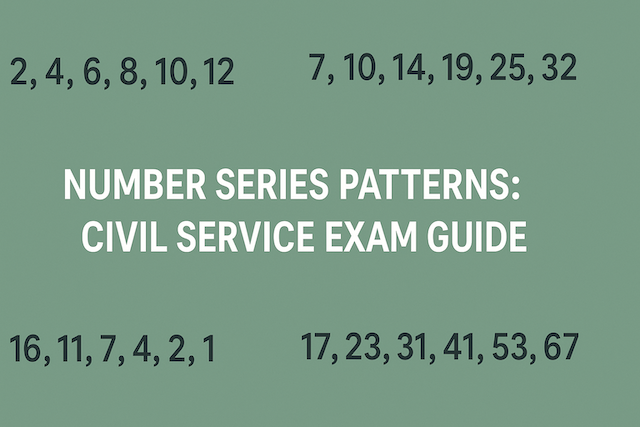
Number Series Patterns: Civil Service Exam Guide
Contents
- Number Series Patterns: Civil Service Exam Guide
- What Are Number Series?
- Why Number Series Appears in the Civil Service Exam
- General Strategy for Solving Number Series
- Common Number Series Patterns in the Civil Service Exam
- Arithmetic Series
- Geometric Series
- Incremental or Variable-Difference Series
- Mixed Operations (Addition + Multiplication)
- Alternating Patterns
- Square and Cube Series (Power Patterns)
- Fibonacci-Type Series
- Complex or Multi-Step Patterns
- How to Quickly Identify the Pattern
- Sample Civil Service Exam-Style Questions
- Practice Questions (No Answers Yet)
- Answer Key and Explanations
- Final Tips for the Number Series Section
- Problem Sets: Number Series Practice
- Answer Key and Explanations
Number Series Patterns: Civil Service Exam Guide
Number series questions are among the most common and scoring-friendly items on the Civil Service Exam. They test your ability to recognize patterns, apply numerical logic, and predict the next value based on mathematical relationships. While many examinees find this section intimidating, most number series follow predictable rules—once you understand these patterns, the questions become much easier to solve.
This guide provides a complete overview of the most frequently used number series patterns, step-by-step solving strategies, and sample problems that reflect the Civil Service Exam style. By the end of this guide, you will have the confidence to approach any sequence with clarity and accuracy.
What Are Number Series?
A number series is a set of numbers arranged in a specific order that follows a hidden rule or pattern. Your task is to identify the rule and determine the next number (or missing number) in the sequence.
Common number series formats include:
-
Increasing or decreasing sequences
-
Alternating patterns
-
Patterns involving arithmetic or geometric operations
-
Mixed operations
-
Square, cube, or power-based progressions
-
Fibonacci or additive patterns
-
Difference-based patterns
Understanding these categories allows you to quickly analyze and classify the series in front of you.
Why Number Series Appears in the Civil Service Exam
The Civil Service Exam includes number series questions to evaluate:
-
Numerical reasoning
-
Pattern recognition
-
Logical thinking
-
Attention to detail
-
Ability to analyze data quickly
These skills are essential for government work that involves interpreting information, solving problems, and making decisions under time pressure.
Number series questions are typically 10–15 items, depending on the exam type, and can significantly boost your score if you know the common patterns.
General Strategy for Solving Number Series
Before learning specific types of patterns, you must master a universal approach that applies to all number sequences.
1. Look for Differences Between Numbers
Subtract each term from the next. If the differences form a pattern (e.g., +2, +4, +6), you’re likely dealing with an arithmetic or incremental series.
2. Check for Multiplication or Division
If the numbers grow or shrink quickly, check for multiplication patterns (×2, ×3, ×1.5, etc.).
3. Examine Combined Operations
Some series use a combination (e.g., ×2 + 1).
4. Identify Alternating Patterns
Not all sequences are linear. Some alternate between two or more rules.
5. Consider Square or Cube Numbers
Look for sequences involving powers, like 2², 3², 4², or 2³, 3³, 4³.
6. Examine Fibonacci-Type Patterns
A common pattern involves adding the previous two numbers.
7. Always Verify Your Hypothesis
Check whether your assumed pattern works consistently across the entire sequence.
Common Number Series Patterns in the Civil Service Exam
Below are the patterns you must master, along with explanations and examples.
Arithmetic Series
An arithmetic series changes by adding or subtracting a constant number.
Example:
2, 6, 10, 14, 18, ___
Pattern: +4
Answer: 22
Another example:
50, 45, 40, 35, ___
Pattern: –5
Answer: 30
Arithmetic series are the simplest to solve and appear frequently in the exam.
Geometric Series
A geometric series multiplies or divides by a constant ratio.
Example:
3, 9, 27, 81, ___
Pattern: ×3
Answer: 243
Another example:
64, 32, 16, 8, ___
Pattern: ÷2
Answer: 4
These sequences grow or shrink rapidly, making them easy to spot.
Incremental or Variable-Difference Series
Some sequences use a changing difference (e.g., +1, +2, +3 …).
Example:
1, 3, 6, 10, 15, ___
Differences: +2, +3, +4, +5
Answer: Next difference is +6 → 21
Another variation:
4, 7, 12, 19, 28, ___
Differences: +3, +5, +7, +9
Next difference: +11 → 39
These are extremely common in Civil Service exams.
Mixed Operations (Addition + Multiplication)
Some sequences combine two operations repeatedly.
Example:
2, 5, 15, 45, ___
Pattern: ×3, then +?
Actually: ×3 → 2×3 = 6 but result is 5
So the pattern is: ×3 – 1
Thus: 45 × 3 – 1 = 134
But a more exam-accurate example:
3, 7, 15, 31, 63, ___
Pattern: ×2 + 1
Answer: 63 × 2 + 1 = 127
Alternating Patterns
Every second number follows the same rule.
Example:
10, 7, 9, 6, 8, 5, ___
Odd positions: –1
Even positions: –1
Answer: Next term = 7
Another example:
2, 10, 4, 20, 6, 30, ___
Pattern:
-
Odd terms: +2
-
Even terms: ×2
Answer: Even term next → 30 × 2 = 60
Alternating patterns require careful observation.
Square and Cube Series (Power Patterns)
These series use perfect squares or cubes.
Square-based
1, 4, 9, 16, 25, ___
Pattern: n²
Answer: 36
Cube-based
1, 8, 27, 64, 125, ___
Pattern: n³
Answer: 216
Mixed square operations
3, 12, 27, 48, 75, ___
Pattern: n² + 3
(2²+3=7? Not fitting. Let’s try difference)
Differences: 9, 15, 21, 27 → +6
Thus next difference +6 → 75 + 33 = 108
Fibonacci-Type Series
Each number is the sum of the previous two.
Example:
1, 1, 2, 3, 5, 8, ___
Answer: 5 + 8 = 13
Variant:
2, 3, 5, 8, 13, ___
Answer: 8 + 13 = 21
Fibonacci patterns appear occasionally.
Complex or Multi-Step Patterns
Some sequences combine multiple patterns across terms.
Example:
5, 10, 8, 16, 14, 28, ___
Observe:
5 → 10 (×2)
10 → 8 (–2)
8 → 16 (×2)
16 → 14 (–2)
Pattern: ×2, –2
Next term: 14 × 2 = 28
This type is common for trick questions.
How to Quickly Identify the Pattern
In exam settings, speed matters. Use this checklist:
-
Check the difference between numbers (simple or incremental?).
-
Check the ratio (multiplication or division?).
-
Look for alternating behavior (is every other term inconsistent?).
-
Check for patterns in differences (e.g., +2, +4, +6).
-
Consider powers or roots (squares, cubes).
-
Look for mixed operations (×2 + 1).
-
Check if it resembles Fibonacci.
Once you classify the type, solving becomes straightforward.
Sample Civil Service Exam-Style Questions
Below are 20 practice questions with explanations.
Practice Questions (No Answers Yet)
-
4, 8, 16, 32, ___
-
5, 12, 19, 26, ___
-
3, 6, 7, 14, 15, 30, ___
-
10, 7, 8, 5, 6, 3, ___
-
2, 3, 6, 18, 72, ___
-
1, 4, 9, 16, ___
-
11, 13, 17, 23, ___
-
100, 90, 81, 73, ___
-
7, 14, 28, 56, ___
-
4, 9, 19, 39, ___
-
20, 25, 35, 50, ___
-
2, 5, 10, 17, 26, ___
-
30, 20, 25, 15, 20, ___
-
1, 2, 3, 5, 8, 13, ___
-
3, 5, 10, 12, 24, 26, ___
-
90, 30, 10, 3.33, ___
-
8, 16, 24, 48, ___
-
15, 18, 24, 33, ___
-
6, 12, 21, 33, ___
-
4, 6, 9, 13, 18, ___
Answer Key and Explanations
-
64 (×2)
-
33 (+7)
-
31 (×2, +1 alternating)
-
4 (–3, +1 repeating)
-
360 (×1.5, ×2, ×3, ×4…)
-
25 (square numbers)
-
31 (add prime differences: +2, +4, +6, +8…)
-
66 (–10, –9, –8…)
-
112 (×2)
-
79 (+5, +10, +20, +40…)
-
70 (+5, +10, +15, +20…)
-
37 (incrementing differences +3, +5, +7, +9…)
-
25 (–10, +5 repeating)
-
21 (Fibonacci)
-
52 (×2, +2 repeating)
-
1.11 (÷3 repeatedly)
-
72 (+8, +8, ×2, +24…)
-
45 (+3, +6, +9, +12…)
-
48 (+6, +9, +12, +15…)
-
24 (+2, +3, +4, +5, +6…)
Final Tips for the Number Series Section
-
Do not overthink—patterns are usually simple.
-
Check both differences and ratios.
-
Write down small differences; they reveal the pattern quickly.
-
Review common patterns regularly until you recognize them instantly.
-
Practice under timed conditions to improve speed.
With mastery of these concepts, number series questions become some of the easiest items in the Civil Service Exam.
Problem Sets: Number Series Practice
Below are practice questions modeled on Civil Service Exam style. Choose the next number (?) in each series.
-
4, 8, 12, 16, ?
-
3, 9, 27, 81, ?
-
10, 7, 4, 1, ?
-
5, 10, 20, 40, ?
-
2, 5, 11, 23, 47, ?
-
7, 14, 21, 28, ?
-
1, 4, 9, 16, 25, ?
-
100, 90, 81, 73, ?
-
2, 3, 5, 8, 12, 17, ?
-
15, 12, 18, 15, 21, 18, ?
-
6, 12, 24, 48, ?
-
5, 11, 23, 47, 95, ?
-
1, 2, 4, 7, 11, 16, ?
-
9, 16, 25, 36, 49, ?
-
80, 70, 63, 57, 52, ?
-
3, 6, 12, 24, 48, ?
-
4, 7, 13, 25, 49, ?
-
2, 6, 18, 54, ?
-
11, 13, 17, 23, 31, ?
-
5, 8, 14, 26, 50, ?
-
30, 20, 25, 15, 20, 10, ?
-
1, 1, 2, 3, 5, 8, ?
-
4, 10, 22, 46, 94, ?
-
7, 9, 13, 21, 37, ?
-
90, 30, 10, 3.33, ?
Answer Key and Explanations
-
20
-
Pattern: +4 each time
-
4, 8, 12, 16, 20
-
-
243
-
Pattern: ×3
-
3, 9, 27, 81, 243
-
-
–2
-
Pattern: –3 each time
-
10, 7, 4, 1, –2
-
-
80
-
Pattern: ×2
-
5, 10, 20, 40, 80
-
-
95
-
Differences: +3, +6, +12, +24 (each difference ×2)
-
Next difference: 24 × 2 = 48 → 47 + 48 = 95
-
-
35
-
Pattern: +7
-
7, 14, 21, 28, 35
-
-
36
-
Perfect squares: 1², 2², 3², 4², 5², 6²
-
Next: 6² = 36
-
-
66
-
Differences: –10, –9, –8 → decreasing by 1
-
Next difference: –7 → 73 – 7 = 66
-
-
23
-
Differences: +1, +2, +3, +4, +5 …
-
2, 3, 5, 8, 12, 17, next +6 → 17 + 6 = 23
-
-
24
-
Two alternating series:
-
15, 18, 21, 24 (odd positions: +3)
-
12, 15, 18 (even positions: +3)
-
-
Next term is odd position → 21 + 3 = 24
-
-
96
-
Pattern: ×2
-
6, 12, 24, 48, 96
-
-
191
-
Differences: +6, +12, +24, +48 (doubling)
-
Next: +96 → 95 + 96 = 191
-
-
22
-
Differences: +1, +2, +3, +4, +5 …
-
Next difference: +6 → 16 + 6 = 22
-
-
64
-
Squares: 3², 4², 5², 6², 7², 8²
-
Next: 8² = 64
-
-
48
-
Differences: –10, –7, –6, –5, …
-
Next difference: –4 → 52 – 4 = 48
-
-
96
-
Pattern: ×2
-
3, 6, 12, 24, 48, 96
-
-
97
-
Differences: +3, +6, +12, +24 (doubling)
-
Next difference: +48 → 49 + 48 = 97
-
-
162
-
Pattern: ×3
-
2, 6, 18, 54, 162
-
-
41
-
Differences are increasing odd numbers: +2, +4, +6, +8 …
-
Next difference: +10 → 31 + 10 = 41
-
-
98
-
Differences: +3, +6, +12, +24 (doubling)
-
Next difference: +48 → 50 + 48 = 98
-
-
15
-
Alternating pattern: –10, +5, –10, +5, –10, +5 …
-
30 → 20 (–10), 20 → 25 (+5), 25 → 15 (–10),
15 → 20 (+5), 20 → 10 (–10), next: 10 → 15 (+5)
-
-
13
-
Fibonacci series: each term = sum of previous two
-
5 + 8 = 13
-
-
190
-
Differences: +6, +12, +24, +48 (doubling)
-
Next difference: +96 → 94 + 96 = 190
-
-
69
-
Differences: +2, +4, +8, +16 (doubling)
-
Next difference: +32 → 37 + 32 = 69
-
-
1.11
-
Pattern: ÷3 each time
-
90 ÷ 3 = 30, 30 ÷ 3 = 10, 10 ÷ 3 = 3.33,
3.33 ÷ 3 ≈ 1.11
-
Civil Service Exam Philippines: Complete Preparation and Passing Guide

How to Register for eTravel Philippines (2025 Guide)
Step-by-step guide to completing your eTravel registration before arriving in the Philippines, with images and tips.

Night Market in Cebu – Things You Don’t Know About Cebu Life
Discover the hidden charm of Cebu’s night markets, from street food stalls to local life tips you won’t find in tourist guides.

How to Use ChatGPT for IELTS Preparation: A Complete Guide
Learn how to prepare for IELTS using ChatGPT — including strategies for Writing, Reading, Listening, Speaking, and grammar support.

How to Build a Website Without Coding Using ChatGPT
Discover how to build your own website using AI—no coding skills needed. From structure planning to SEO and design, let ChatGPT guide you.