2025年12月23日
3D ACADEMY offers affordable English study programs in Cebu, Philippines – perfect for beginners, professionals, and exam takers.

3D UNIVERSAL ENGLISH INSTITUTE INC
info.3d-universal.com
8:00-17:00(Mon-Fri)
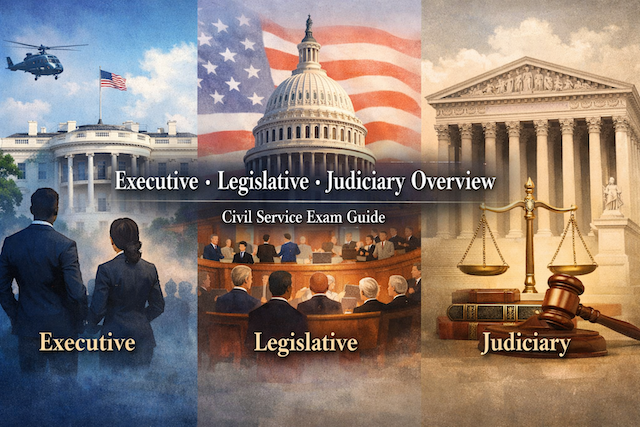
Executive, Legislative, Judiciary Overview: Civil Service Exam Guide
Contents
- Executive, Legislative, Judiciary Overview: Civil Service Exam Guide
- Purpose of the Three-Branch System
- Executive Branch: Role and Functions
- Head of the Executive Branch
- Executive Departments and Agencies
- Legislative Branch: Role and Functions
- Structure of the Legislative Branch
- Powers of the Legislative Branch
- Judiciary Branch: Role and Functions
- Structure of the Judiciary
- Power of Judicial Review
- Checks and Balances Explained
- Comparison of the Three Branches
- Common Civil Service Exam Traps
- Sample Exam-Oriented Scenarios
- Why This Topic Is Important for the Civil Service Exam
- Final Review Summary
- Problems Set 1: Basic Understanding (Multiple Choice)
- Problems Set 2: Branch Identification (Scenario-Based)
- Problems Set 3: Checks and Balances
- Problems Set 4: Analytical Questions
- Answer Keys
Executive, Legislative, Judiciary Overview: Civil Service Exam Guide
Understanding the three branches of government—Executive, Legislative, and Judiciary—is essential for anyone preparing for the Civil Service Exam. Questions related to government structure frequently appear in both the Professional and Subprofessional levels, often testing not only memorization but also comprehension of roles, powers, limitations, and checks and balances.
This guide provides a clear, exam-focused overview of each branch, explains how they interact, and highlights key points commonly tested in the Civil Service Exam.
Purpose of the Three-Branch System
The division of government into three branches is based on the principle of separation of powers. This system prevents the concentration of authority in one body and ensures accountability through checks and balances.
Each branch has:
-
Distinct functions
-
Independent authority
-
Mechanisms to limit the powers of the others
For exam purposes, always remember:
-
Separation of powers = division of responsibilities
-
Checks and balances = shared control to prevent abuse
Executive Branch: Role and Functions
The Executive Branch is responsible for implementing and enforcing laws. It manages the daily operations of government and ensures that laws passed by the legislature are carried out effectively.
Key Responsibilities of the Executive Branch
-
Enforce national laws
-
Administer public services
-
Conduct foreign relations
-
Command the armed forces
-
Ensure public order and national security
In exam questions, the executive branch is often described as the branch that executes the law.
Head of the Executive Branch
The President serves as the head of the Executive Branch.
Major Powers of the President
-
Enforces laws passed by Congress
-
Appoints heads of executive departments
-
Appoints judges and justices (subject to confirmation)
-
Acts as Commander-in-Chief of the armed forces
-
Conducts foreign diplomacy
-
Has veto power over legislation
Civil Service Exam tip:
If a question asks who implements laws or who manages government operations, the correct answer usually points to the Executive Branch or the President.
Executive Departments and Agencies
The Executive Branch includes various departments, bureaus, offices, and government-owned corporations.
Examples of Executive Departments
-
Department of Education
-
Department of Health
-
Department of Finance
-
Department of Labor and Employment
These departments:
-
Carry out policies
-
Deliver public services
-
Implement laws and executive orders
For exam scenarios, questions may describe an agency enforcing rules or delivering services—this almost always indicates an executive function.
Legislative Branch: Role and Functions
The Legislative Branch is responsible for making laws. It represents the people and determines national policies through legislation.
Core Functions of the Legislative Branch
-
Draft, debate, and pass laws
-
Allocate government funds
-
Conduct investigations in aid of legislation
-
Check the powers of the Executive and Judiciary
A common exam phrase associated with this branch is “lawmaking power.”
Structure of the Legislative Branch
The Legislature is composed of two chambers, making it a bicameral body.
Upper House: Senate
-
Senators are elected nationwide
-
Handles national-level legislation
-
Conducts impeachment trials
Lower House: House of Representatives
-
Members represent districts or party lists
-
Initiates revenue and tax bills
-
Brings impeachment cases
Exam reminder:
Questions may test your knowledge of which chamber initiates impeachment or tries impeachment cases.
Powers of the Legislative Branch
Lawmaking Power
-
Proposes bills
-
Debates policies
-
Passes statutes
Power of the Purse
-
Controls government spending
-
Approves the national budget
Oversight Power
-
Investigates executive agencies
-
Ensures laws are properly implemented
Impeachment Power
-
Holds public officials accountable
-
Can remove high-ranking officials for serious offenses
Civil Service Exam tip:
If the question involves budget approval, law creation, or investigations, the answer is usually Legislative Branch.
Judiciary Branch: Role and Functions
The Judiciary Branch is responsible for interpreting laws and resolving legal disputes. It ensures that laws are applied fairly and consistently.
Primary Responsibilities
-
Interpret the Constitution and laws
-
Settle legal disputes
-
Determine constitutionality of laws and acts
-
Protect individual rights
The Judiciary does not create laws or enforce them—it interprets and applies them.
Structure of the Judiciary
Supreme Court
-
Highest court in the land
-
Final interpreter of the Constitution
-
Has the power of judicial review
Lower Courts
-
Court of Appeals
-
Regional Trial Courts
-
Metropolitan and Municipal Trial Courts
-
Special courts (e.g., anti-corruption courts)
For exams, remember:
-
Judicial review belongs to the Judiciary
-
The Supreme Court has final authority in constitutional interpretation
Power of Judicial Review
Judicial review allows courts to:
-
Declare laws unconstitutional
-
Nullify executive acts that violate the Constitution
This power ensures that:
-
The Legislature does not pass unconstitutional laws
-
The Executive does not exceed its authority
Exam tip:
If a question mentions declaring a law unconstitutional, the answer is always Judiciary.
Checks and Balances Explained
Checks and balances ensure that no branch becomes too powerful.
Executive Checks
-
Can veto bills passed by Congress
-
Appoints judges (subject to confirmation)
Legislative Checks
-
Can override presidential vetoes
-
Confirms executive appointments
-
Impeaches executive and judicial officials
Judicial Checks
-
Can declare laws unconstitutional
-
Can review executive actions
Civil Service Exam questions often present scenarios where one branch limits another—identify which branch is exercising its check.
Comparison of the Three Branches
Executive Branch
-
Implements laws
-
Manages government operations
-
Headed by the President
Legislative Branch
-
Creates laws
-
Controls public funds
-
Composed of Senate and House
Judiciary Branch
-
Interprets laws
-
Settles disputes
-
Headed by the Supreme Court
A useful exam strategy is to associate each branch with one main verb:
-
Executive = Execute
-
Legislative = Legislate
-
Judiciary = Judge
Common Civil Service Exam Traps
Confusing Lawmaking and Implementation
-
Passing a law = Legislative
-
Enforcing a law = Executive
Misunderstanding Judicial Power
-
Courts do not make laws
-
Courts do not manage agencies
Overlooking Checks and Balances
-
Veto is not lawmaking
-
Judicial review is not enforcement
Carefully read scenario-based questions to determine which function is being performed, not just which official is involved.
Sample Exam-Oriented Scenarios
-
A government agency enforcing safety regulations → Executive Branch
-
A court ruling that a tax law violates the Constitution → Judiciary Branch
-
A congressional hearing investigating misuse of funds → Legislative Branch
These types of questions appear frequently and require functional understanding.
Why This Topic Is Important for the Civil Service Exam
The three branches of government form the foundation of:
-
Constitutional law
-
Public administration
-
Democratic governance
Understanding their roles helps candidates:
-
Answer multiple-choice questions accurately
-
Analyze situational problems
-
Avoid common conceptual mistakes
This topic also supports related exam areas such as:
-
Constitutional principles
-
Public office accountability
-
Government ethics
Final Review Summary
The Executive, Legislative, and Judiciary branches work together to govern effectively while limiting each other’s power.
-
The Executive Branch enforces laws and manages government operations
-
The Legislative Branch creates laws and controls public spending
-
The Judiciary Branch interprets laws and ensures constitutional compliance
Mastering these distinctions is essential for success in the Civil Service Exam. Focus on functions, powers, and interactions, and you will be well-prepared to handle both direct and scenario-based questions.
If you would like, I can also prepare problem sets with answer keys based on this topic, formatted specifically for Civil Service Exam practice.
Problems Set 1: Basic Understanding (Multiple Choice)
1. Which branch of government is primarily responsible for enforcing laws?
A. Legislative
B. Judiciary
C. Executive
D. Constitutional Commission
2. The power to declare a law unconstitutional belongs to which branch?
A. Executive
B. Legislative
C. Judiciary
D. Administrative
3. Which of the following best describes the main function of the Legislative Branch?
A. Interpreting laws
B. Implementing laws
C. Making laws
D. Enforcing court decisions
4. The President’s veto power is an example of:
A. Judicial review
B. Separation of powers
C. Checks and balances
D. Law enforcement
5. Which body initiates impeachment cases?
A. Senate
B. Supreme Court
C. House of Representatives
D. Office of the President
Problems Set 2: Branch Identification (Scenario-Based)
6. A government agency issues regulations to ensure workplace safety and inspects companies for compliance. Which branch is performing this function?
A. Legislative
B. Executive
C. Judiciary
D. Senate
7. Congress conducts an investigation on the misuse of public funds by a government office. This action falls under which power?
A. Judicial power
B. Executive authority
C. Legislative oversight
D. Administrative control
8. The Supreme Court nullifies an executive order for being unconstitutional. Which principle is being applied?
A. Law enforcement
B. Judicial review
C. Legislative supremacy
D. Executive privilege
9. A law passed by Congress is returned unsigned by the President with objections. This process is called:
A. Impeachment
B. Ratification
C. Veto
D. Judicial appeal
10. Who serves as the Commander-in-Chief of the armed forces?
A. Chief Justice
B. Senate President
C. Speaker of the House
D. President
Problems Set 3: Checks and Balances
11. Which action best demonstrates a legislative check on the Executive Branch?
A. Issuing executive orders
B. Declaring laws unconstitutional
C. Overriding a presidential veto
D. Appointing cabinet members
12. The confirmation of executive appointments is exercised by:
A. Supreme Court
B. Senate
C. House of Representatives
D. Office of the Ombudsman
13. When courts review the legality of acts done by the President, they are exercising:
A. Enforcement power
B. Legislative authority
C. Judicial review
D. Executive privilege
14. Which branch controls the national budget through the power of the purse?
A. Executive
B. Judiciary
C. Legislative
D. Administrative
15. Which situation violates the principle of separation of powers?
A. Courts interpreting laws
B. Congress passing new legislation
C. President enforcing laws
D. Courts creating laws
Problems Set 4: Analytical Questions
16. Why is the separation of powers important in a democratic government?
A. To speed up lawmaking
B. To centralize authority
C. To prevent abuse of power
D. To eliminate political opposition
17. Which branch is MOST involved in resolving disputes between citizens and the state?
A. Legislative
B. Executive
C. Judiciary
D. Electoral body
18. If Congress passes a bill and the President signs it, which branch is responsible for its implementation?
A. Legislative
B. Judiciary
C. Executive
D. Senate
19. Which statement is TRUE about the Judiciary?
A. It enforces laws
B. It creates public policy
C. It interprets the Constitution
D. It controls public funds
20. A case questioning the constitutionality of a tax law reaches the highest court. Which court has final authority?
A. Court of Appeals
B. Regional Trial Court
C. Senate
D. Supreme Court
Answer Keys
1. C
2. C
3. C
4. C
5. C
6. B
7. C
8. B
9. C
10. D
11. C
12. B
13. C
14. C
15. D
16. C
17. C
18. C
19. C
20. D
Civil Service Exam Philippines: Complete Preparation and Passing Guide

How to Register for eTravel Philippines (2025 Guide)
Step-by-step guide to completing your eTravel registration before arriving in the Philippines, with images and tips.

Night Market in Cebu – Things You Don’t Know About Cebu Life
Discover the hidden charm of Cebu’s night markets, from street food stalls to local life tips you won’t find in tourist guides.

How to Use ChatGPT for IELTS Preparation: A Complete Guide
Learn how to prepare for IELTS using ChatGPT — including strategies for Writing, Reading, Listening, Speaking, and grammar support.

How to Build a Website Without Coding Using ChatGPT
Discover how to build your own website using AI—no coding skills needed. From structure planning to SEO and design, let ChatGPT guide you.