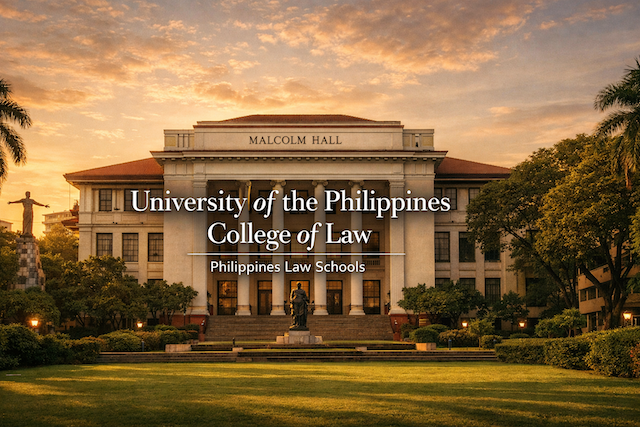
University of the Philippines (UP) College of Law: Philippines Law Schools
Overview of the University of the Philippines College of Law
The University of the Philippines (UP) College of Law is widely regarded as the most prestigious law school in the Philippines. Established in 1911, it is the oldest law school in the country and has played a central role in shaping Philippine legal education, jurisprudence, and public service for more than a century. As part of the University of the Philippines System, the national university of the Philippines, UP College of Law carries a strong mandate to produce lawyers who are not only academically excellent but also socially responsible and committed to public service.
UP College of Law has consistently produced top bar exam performers, legal scholars, Supreme Court justices, legislators, human rights advocates, and national leaders. Admission is highly competitive, and its academic culture is known for being rigorous, intellectually demanding, and deeply rooted in constitutionalism, critical thinking, and social justice.
History and Institutional Mission
UP College of Law was founded during the American colonial period, at a time when the Philippine legal system was transitioning from Spanish civil law traditions to a mixed system incorporating American common law principles. From its early years, the college became a training ground for Filipino lawyers who would later shape national policies, judicial doctrine, and constitutional frameworks.
The school’s mission goes beyond producing successful bar passers. It emphasizes:
-
Public service and nation-building
-
Defense of constitutional democracy and rule of law
-
Protection of human rights and civil liberties
-
Development of legal scholarship and reform-oriented lawyering
This mission has deeply influenced the curriculum, teaching methods, and student culture of UP Law.
Campuses and Locations
UP College of Law operates primarily through two main campuses:
UP Diliman College of Law (Quezon City)
The Diliman campus is the flagship and largest campus of UP College of Law. Located within UP Diliman, the country’s premier academic hub, it houses the majority of faculty members, research centers, law journals, and student organizations. It also hosts the main law library and administrative offices.
UP Bonifacio Global City (BGC) College of Law (Taguig)
The UP Law BGC campus was established to make legal education more accessible to working professionals and students based in Metro Manila’s business districts. Classes here are often scheduled in the evenings or weekends, attracting students with professional backgrounds in government, corporate, and NGO sectors.
Both campuses follow the same academic standards, curriculum, and degree programs.
Academic Programs and Degrees Offered
Juris Doctor (JD) Program
The Juris Doctor (JD) is the primary degree program offered by UP College of Law. It is a four-year program designed to provide students with a strong foundation in legal theory, doctrine, and practice.
Core subjects include:
-
Constitutional Law (I & II)
-
Civil Law (Persons, Property, Obligations, Contracts)
-
Criminal Law (I & II)
-
Political Law
-
Legal Ethics
-
Remedial Law (Civil Procedure, Criminal Procedure, Evidence)
-
Commercial Law
-
Labor Law
-
Taxation Law
The JD curriculum also includes elective courses, clinical legal education, and seminar-based classes that emphasize legal writing, research, and advocacy.
Graduate Law Programs (LLM and Advanced Studies)
UP College of Law offers graduate-level programs such as:
These programs are typically pursued by practicing lawyers, judges, academics, and government officials seeking advanced legal training.
Admission Requirements and Selection Process
Admission to UP College of Law is extremely competitive and selective.
UP Law Aptitude Examination (UP LAE)
Applicants must pass the UP Law Aptitude Examination (UP LAE), which tests:
-
Reading comprehension
-
Logical reasoning
-
Analytical thinking
-
Language proficiency
The exam is designed to assess not only academic readiness but also the applicant’s ability to handle the analytical rigor of legal education.
Interview and Final Screening
Shortlisted applicants are invited for panel interviews, where faculty members assess:
Academic background, undergraduate performance, and overall intellectual maturity are also considered.
Teaching Methodology and Academic Culture
UP College of Law is known for its Socratic teaching method, where professors engage students through intense questioning, case analysis, and legal reasoning exercises. Classes are discussion-heavy, demanding extensive preparation and deep understanding of assigned readings.
Key features of the academic culture include:
-
Heavy reading load (cases, statutes, commentaries)
-
Emphasis on original legal analysis rather than rote memorization
-
Strong focus on constitutional interpretation and jurisprudence
-
Encouragement of dissenting views and intellectual debate
The environment is challenging, but it is also known for fostering resilience, discipline, and sharp legal thinking.
Bar Examination Performance and Reputation
UP College of Law has one of the strongest bar exam records in the Philippines. It consistently produces:
-
High overall passing rates
-
Topnotchers and top-performing examinees
-
Graduates who excel in litigation, judiciary, government, and academia
While UP Law does not officially operate as a bar review school, its curriculum is considered one of the most comprehensive preparations for the Philippine Bar Examination.
Faculty and Legal Scholars
UP College of Law boasts a faculty composed of:
-
Renowned constitutionalists
-
Former Supreme Court justices
-
Senior government officials
-
Leading practitioners and academics
Faculty members are actively involved in:
-
Legal reform initiatives
-
Supreme Court rule-making
-
Constitutional commissions
-
Human rights advocacy
-
Academic research and publications
This ensures that students are taught not only legal theory but also real-world legal applications and policy perspectives.
Research, Publications, and Legal Journals
UP College of Law plays a major role in Philippine legal scholarship. It publishes influential journals such as:
Students are encouraged to participate in legal writing, research projects, and editorial boards, which significantly enhance analytical and writing skills.
Student Organizations and Extracurricular Activities
UP Law students are actively involved in various organizations, including:
-
Law fraternities and sororities
-
Legal aid clinics
-
Moot court and debate teams
-
Human rights and advocacy groups
These organizations provide networking opportunities, practical training, and community service experience. UP Law is especially known for its strong legal aid tradition, offering free legal services to marginalized communities.
Career Paths and Alumni Network
Graduates of UP College of Law pursue diverse career paths, including:
-
Litigation and private practice
-
Judiciary and prosecution
-
Corporate law and compliance
-
Government service and legislation
-
International organizations and NGOs
-
Legal academia and policy research
UP Law alumni form one of the most influential legal networks in the Philippines, with representation across all branches of government and major legal institutions.
Tuition Fees and Financial Considerations
As a state university, UP College of Law offers relatively affordable tuition compared to private law schools. Tuition rates are determined by the university’s socialized tuition system, which considers the student’s financial capacity.
Scholarships, grants, and financial aid programs are available for qualified students, helping ensure access to legal education regardless of economic background.
Strengths and Challenges of UP College of Law
Strengths
-
Prestigious national and international reputation
-
Strong bar exam performance
-
Distinguished faculty and alumni
-
Emphasis on public service and constitutional law
-
Affordable tuition
Challenges
-
Extremely competitive admissions
-
Heavy academic workload and high stress levels
-
Limited slots compared to demand
Despite these challenges, UP College of Law remains the top choice for aspiring lawyers who seek excellence, intellectual rigor, and a strong public service orientation.
Conclusion
The University of the Philippines College of Law stands as the gold standard of legal education in the Philippines. Its long history, rigorous academic training, strong bar performance, and deep commitment to public service have cemented its reputation as the country’s premier law school.
For students who are intellectually driven, socially conscious, and prepared to face the demands of legal scholarship, UP College of Law offers an unparalleled foundation for a successful and meaningful legal career.
FAQs (Frequently Asked Questions)
Is the University of the Philippines (UP) College of Law considered the best law school in the Philippines?
UP College of Law is widely considered the most prestigious law school in the Philippines because of its long history, strong academic reputation, consistent bar exam performance, and influential alumni network. Many legal scholars, Supreme Court justices, government officials, and national leaders are UP Law graduates. However, “best” can still depend on a student’s learning style, career goals, location, and preferred campus environment. UP Law is best known for its rigorous training, strong emphasis on constitutional law and public service, and a competitive academic culture.
What makes UP College of Law different from other Philippines law schools?
UP Law is known for its highly analytical approach, heavy reading load, and strong tradition of critical thinking. Many classes use discussion-based methods that push students to interpret cases, statutes, and legal principles beyond memorization. UP Law also has a strong public service orientation, which shows in its legal aid activities, research initiatives, and involvement in legal reform. Another distinction is its role in legal scholarship through journals and research centers, including publications that influence Philippine jurisprudence and policy debates.
Where are the UP College of Law campuses located?
UP College of Law operates mainly through two campuses: UP Diliman in Quezon City and UP Bonifacio Global City (BGC) in Taguig. UP Diliman is the flagship campus, and it houses major academic resources such as the main law library and many research units. The UP Law BGC campus offers a location that is convenient for students based in business districts and may appeal to working professionals. Both campuses follow the same academic standards and confer the same law degree.
What degree does UP College of Law offer for aspiring lawyers?
The main degree program for future lawyers is the Juris Doctor (JD), typically completed in four years. The JD curriculum includes core subjects aligned with the Philippine Bar Examination, such as Constitutional Law, Civil Law, Criminal Law, Remedial Law, Commercial Law, Labor Law, and Taxation. Students also take electives and may join clinical and seminar-based courses that develop legal writing, research, and advocacy skills. UP Law also offers graduate-level programs such as the Master of Laws (LLM) for advanced study.
How competitive is admission to UP College of Law?
Admission is highly competitive because UP Law attracts applicants from across the country and offers limited slots. Applicants are generally evaluated through the UP Law Aptitude Examination (UP LAE) and subsequent screening such as interviews. Competitive admissions reflect the school’s rigorous academic demands and high expectations. Applicants are expected to demonstrate strong reading comprehension, logical reasoning, and analytical thinking. Many successful applicants also show clear motivation, intellectual maturity, and a strong alignment with UP’s values of service and nation-building.
What is the UP Law Aptitude Examination (UP LAE), and what does it test?
The UP LAE is an entrance examination designed to assess a candidate’s readiness for law school. It typically tests skills needed for legal study, such as reading comprehension, logical reasoning, critical thinking, and language proficiency. Law school requires processing dense materials, identifying issues, and building structured arguments, so the exam focuses on these abilities rather than specialized legal knowledge. Preparing for the UP LAE usually involves practice with logic-based questions, reading drills, and timed tests to strengthen focus and accuracy.
Does UP Law have a strong bar exam track record?
UP College of Law is known for producing strong bar exam results over time, including high passing rates and bar topnotchers. While bar performance varies each year across all schools, UP Law’s reputation remains closely tied to the depth and rigor of its training. The JD curriculum covers bar subjects thoroughly, and the academic culture encourages careful case analysis and disciplined study habits. Many students also develop strong writing skills through research work, journals, and advocacy activities, which can be helpful for bar preparation.
Is UP College of Law affordable compared to private law schools?
As a state university, UP is generally more affordable than many private institutions. Tuition is typically structured under a socialized tuition system, where fees may vary depending on financial capacity and university policies. Students may also access scholarships, grants, and financial assistance programs, depending on eligibility and availability. Even with relatively lower tuition, students should still plan for additional costs such as books, printing, transportation, and daily living expenses, especially if relocating to Metro Manila.
What is the academic workload like at UP Law?
The workload is widely described as intense. Students are expected to read large volumes of cases, statutes, and commentaries, and to arrive in class prepared to discuss and analyze legal issues. Exams and recitations can be demanding, and many students develop disciplined study systems early to manage time and stress. Success often depends on consistency, strong reading strategies, and the ability to write clear, well-structured answers under time pressure. Many students also balance extracurricular activities, which can add to the workload.
What career paths do UP Law graduates typically pursue?
UP Law graduates enter a wide range of legal careers. Many work in litigation, corporate practice, and government service. Others pursue careers in the judiciary, prosecution, legislation, public policy, and academia. UP Law also has graduates active in human rights work, NGOs, international organizations, and regulatory agencies. The school’s strong alumni network can support mentorship and professional opportunities, but career outcomes still depend on individual performance, specialization, internships, and long-term professional development.
Law Schools in Manila: Top Universities for Aspiring Lawyers in the Philippines