2026年1月8日
3D ACADEMY offers affordable English study programs in Cebu, Philippines – perfect for beginners, professionals, and exam takers.

3D UNIVERSAL ENGLISH INSTITUTE INC
info.3d-universal.com
8:00-17:00(Mon-Fri)
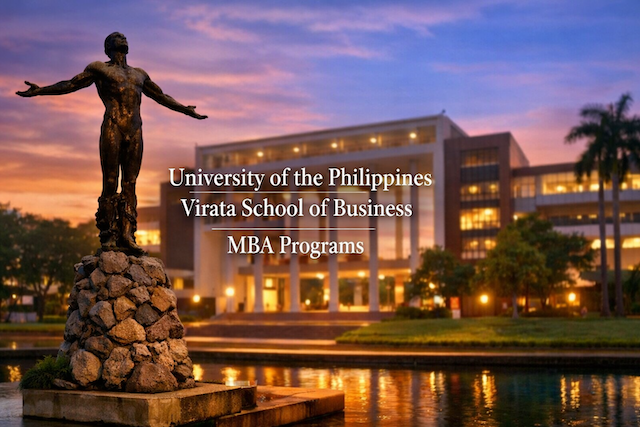
University of the Philippines – Virata School of Business (UP VSB): MBA Programs
Contents
- University of the Philippines – Virata School of Business (UP VSB): MBA Programs
- Overview of UP Virata School of Business
- Why Choose UP VSB for an MBA?
- MBA Program Structure and Learning Experience
- Specializations, Electives, and Areas of Focus
- Admissions: Who the Program Is For
- Working While Studying: Time Commitment and Study Style
- Career Outcomes and What an MBA from UP VSB Can Unlock
- The Value of UP VSB’s Network and UP’s Brand
- What to Prepare Before Applying
- Who Should Consider Another Option?
- Final Thoughts: Is UP VSB Right for Your MBA?
- FAQs (Frequently Asked Questions)
- Is the UP Virata School of Business (UP VSB) MBA internationally recognized?
- Who is the UP VSB MBA best suited for?
- Do I need a business undergraduate degree to apply?
- What kind of skills will I gain from an MBA at UP VSB?
- Can I work full-time while taking the MBA?
- How should I choose electives or focus areas?
- Does the MBA help with promotions and career switching?
- What are common challenges MBA students face, and how can I prepare?
- How can I maximize the value of the UP VSB network?
- What should I include in a strong application or personal statement?
University of the Philippines – Virata School of Business (UP VSB): MBA Programs
Overview of UP Virata School of Business
The University of the Philippines – Virata School of Business (UP VSB) is widely recognized as one of the Philippines’ most respected institutions for business education. As part of the University of the Philippines system—often considered the country’s premier public university—UP VSB carries a reputation for academic rigor, competitive admissions, and a strong commitment to public service and national development.
For prospective MBA students, UP VSB is often appealing for three big reasons. First, it offers a learning environment shaped by strong analytical training and research-based instruction. Second, its position within UP Diliman places students in a dynamic setting where academic, government, and industry networks overlap. Third, its alumni footprint across Philippine business, government, and entrepreneurship can create real advantages for career mobility—especially for those aiming to lead organizations in the Philippine market or in regional roles across Southeast Asia.
At its core, the MBA experience at UP VSB tends to emphasize disciplined thinking, structured problem-solving, and decision-making grounded in evidence. This makes the program particularly relevant for professionals who want more than “business inspiration” and instead want repeatable frameworks they can apply to strategy, finance, operations, and organizational leadership.
Why Choose UP VSB for an MBA?
Choosing an MBA is usually a trade-off between time, cost, and career upside. UP VSB often stands out as a value-driven option: the brand strength of UP, combined with a serious curriculum, can deliver high returns for students who are ready to engage deeply with the academic and practical demands of graduate business education.
Another reason many applicants look to UP VSB is its connection to the national business ecosystem. Many professionals in the Philippines interact directly or indirectly with UP networks—whether through corporate partnerships, consulting, government agencies, or entrepreneurship communities. Studying in that environment can help students build relationships that last beyond graduation.
UP VSB can also fit students who want credibility in roles where analytical strength matters: corporate finance, strategy, consulting, operations, analytics, and policy-adjacent leadership roles. If your career plan involves leading growth, shaping strategy, or managing complex organizations, an MBA program with a strong analytical base can be a strong match.
MBA Program Structure and Learning Experience
MBA programs generally blend core management foundations with specialization electives. At UP VSB, the core typically aims to build a shared managerial language: understanding how markets work, how organizations make decisions, how value is created and measured, and how leaders execute strategy through people and systems.
In most MBA formats, you can expect coursework in areas such as:
-
Managerial economics and business environment
-
Financial and managerial accounting
-
Corporate finance and valuation concepts
-
Marketing strategy and customer insights
-
Operations and supply chain fundamentals
-
Organizational behavior and leadership
-
Business policy, strategy, and competitive analysis
-
Quantitative methods, data interpretation, and decision tools
Beyond these foundations, the MBA experience often depends on electives and applied learning. Many MBA students look for opportunities to work on real business cases, solve organizational problems, and build leadership capabilities through team projects. In a school environment like UP VSB—where many students have strong academic backgrounds—the classroom dynamic may be both competitive and collaborative: students push each other, and discussions can become highly analytical.
In addition, MBA programs typically require some kind of culminating requirement—such as a capstone course, integrative project, or thesis-style output. If you prefer learning that results in a tangible professional deliverable, it’s worth preparing for a final stage where you synthesize concepts across finance, strategy, leadership, and operations.
Specializations, Electives, and Areas of Focus
Most MBA candidates want to tailor the degree to their career target. UP VSB students commonly aim for career tracks such as corporate leadership, entrepreneurship, banking and finance, consulting, marketing leadership, or operations management. The ability to choose electives helps students shape a portfolio of skills relevant to their target roles.
Potential elective themes may include:
-
Strategic management and competitive strategy
-
Advanced finance and investment analysis
-
Marketing management and brand strategy
-
Business analytics and decision modeling
-
Entrepreneurship, innovation, and venture building
-
Operations strategy and service management
-
Human capital, leadership, and organizational development
-
International business and regional market strategy
The best approach is to choose electives based on the job you want after graduation, not only based on what sounds interesting. For example, if you want a strategy role, pair analytics-oriented electives with corporate finance and competitive strategy. If you want to build a company, blend entrepreneurship courses with finance, marketing, and operations so you can run the whole system—not only one department.
Admissions: Who the Program Is For
MBA programs at top business schools typically attract applicants who already have professional experience and want to accelerate into leadership. UP VSB’s MBA path is often ideal for:
-
Early- to mid-career professionals seeking management responsibilities
-
Specialists (engineers, analysts, healthcare professionals, educators) shifting into leadership roles
-
Entrepreneurs who want structured training in strategy, finance, and execution
-
Professionals working in government or development sectors who need stronger management tools
-
Overseas Filipino professionals returning to the Philippines and building local credibility
Admissions requirements differ by program format and year, but MBA applicants should generally be prepared to demonstrate academic capability, readiness for graduate-level study, and professional maturity. Typical requirements may include academic records, an application form, a statement of purpose, recommendations, and an interview process depending on the intake.
Working While Studying: Time Commitment and Study Style
Many MBA students choose programs specifically because they can continue working. Even when an MBA is structured for working professionals, the time demand is real. Expect reading assignments, problem sets, group projects, presentations, and exams. A common mistake is treating the MBA like a “light credential.” In reality, the students who gain the most are those who treat each course as leadership training: they practice clear thinking, sharpen their communication, and learn how to make decisions under uncertainty.
To succeed, it helps to have a consistent weekly rhythm. Reserve fixed hours for reading and assignments, and plan group work early. MBA group projects can be one of the most valuable parts of the experience—because leadership is often learned through execution with others—but they can also become stressful if time management is weak.
Career Outcomes and What an MBA from UP VSB Can Unlock
An MBA is not a guarantee of a job offer, but it can significantly improve your positioning—especially when combined with a clear career story. UP VSB graduates often pursue paths such as:
-
Promotion into supervisory and managerial roles
-
Transition into strategy, planning, or corporate development
-
Roles in banking, financial services, and investment-related work
-
Brand, marketing, and growth leadership roles
-
Operations leadership and program management
-
Entrepreneurship and scaling a business
-
Consulting, advisory, and research-driven roles
-
Leadership roles in government agencies and NGOs
What often matters most is how you use the MBA. Students who network intentionally, build a strong project portfolio, and develop specific expertise (finance, analytics, strategy, operations, leadership) tend to experience stronger career outcomes. Your electives, internships or consulting projects, and capstone work can function like a professional “proof of skill” that you can present to employers.
The Value of UP VSB’s Network and UP’s Brand
In the Philippines, UP’s brand is powerful. It signals strong academic training and selective entry. For many hiring managers, UP is shorthand for talent that can handle complexity. UP VSB extends that reputation specifically into business leadership.
Beyond the name, the alumni network can matter in practical ways: mentorship, referrals, partnerships, and business opportunities. In emerging markets and fast-growing industries, networks often accelerate careers. If you are a professional who plans to stay in the Philippines long-term—or you want a leadership role covering the Philippines—studying at UP VSB can strengthen your local credibility.
What to Prepare Before Applying
Strong applicants usually do three things before they submit:
-
Clarify their career goal. You don’t need a perfect plan, but you need a direction.
-
Identify skill gaps. Decide whether your biggest gap is finance, strategy, leadership, communication, or execution.
-
Build a credible story. Explain why the MBA is necessary now, why UP VSB fits, and what you plan to do with the degree.
If you are switching industries, show that you understand your target field. If you want leadership, show leadership evidence—projects led, teams managed, initiatives launched, outcomes delivered. If you want entrepreneurship, show that you’ve tested ideas, built something, or have a clear market insight.
Who Should Consider Another Option?
UP VSB is an excellent option for many students, but it may not match everyone. You might consider a different MBA path if:
-
You prefer a heavily international cohort and global campus recruitment structure
-
You want a program with a strong focus on overseas placements
-
You prefer a less academically demanding, more “experience-focused” MBA style
-
You cannot commit sufficient time for coursework and group projects
The best MBA is not the most famous one—it’s the one that matches your constraints and goals.
Final Thoughts: Is UP VSB Right for Your MBA?
If you want an MBA that builds serious managerial skill—especially in analysis, strategy, and decision-making—UP Virata School of Business is a strong choice. It tends to reward students who are disciplined, curious, and ready to work. The credibility of the UP brand, combined with the graduate-level business training, can help unlock promotions, career switches, entrepreneurial growth, and deeper leadership capacity.
The smartest way to approach UP VSB is to treat it as a leadership laboratory. Go beyond completing requirements. Build relationships with classmates, take electives that align with your career plan, and use projects to develop a portfolio of real business results. If you do that, the MBA becomes more than a degree—it becomes a turning point in how you think, lead, and execute.
FAQs (Frequently Asked Questions)
Is the UP Virata School of Business (UP VSB) MBA internationally recognized?
UP VSB is part of the University of the Philippines system, which is widely recognized for academic rigor and strong standards. While “international recognition” can mean different things—brand awareness, employer perception, or degree portability—many graduates find that the UP name is respected, especially in Southeast Asia and among organizations familiar with Philippine higher education. For work overseas, recognition often depends on the employer, the role, and how you present your skills and experience. If you plan to use the MBA for international mobility, focus on building a strong portfolio (projects, measurable outcomes, leadership experience) and be ready to explain the program’s rigor, course content, and your personal results.
Who is the UP VSB MBA best suited for?
The program is generally a good fit for professionals who want structured business training rooted in analysis and practical decision-making. It suits early- to mid-career applicants aiming for promotion, leadership roles, or a shift into strategy, finance, operations, marketing leadership, or entrepreneurship. It can also work well for professionals from non-business backgrounds—such as engineering, IT, healthcare, education, or the public sector—who want to strengthen management fundamentals. The MBA is most valuable if you have a clear reason for taking it now and you can commit consistent time to reading, assignments, group work, and applied projects.
Do I need a business undergraduate degree to apply?
Many MBA programs accept applicants from a wide range of academic backgrounds. A business degree can help because you may already be familiar with accounting, economics, or management concepts, but it is not always required. What matters is your readiness for graduate-level coursework and your ability to handle quantitative and analytical subjects. If you are coming from a non-business field, it helps to review basic accounting, business math, and introductory economics concepts before classes begin. Being proactive early often reduces stress later, especially during finance, analytics, and strategy-heavy parts of the curriculum.
What kind of skills will I gain from an MBA at UP VSB?
Most students pursue an MBA to build leadership-ready skills that translate directly into the workplace. Expect to strengthen structured thinking, problem-solving, and decision-making using data and financial logic. You’ll typically improve your ability to read business situations, diagnose root causes, and propose realistic solutions. Many students also gain confidence in communication: presenting recommendations, defending assumptions, and persuading stakeholders. Group projects develop collaboration and execution skills—how to lead teams, manage deadlines, and handle disagreement professionally. If you choose the right electives, you can also build specialized capabilities in finance, strategy, marketing, operations, or analytics.
Can I work full-time while taking the MBA?
Many MBA students are working professionals, but the workload is still significant. You can often manage both if you set a stable weekly schedule and protect study time. Expect readings, case discussions, quantitative exercises, presentations, and team deliverables. The most time-consuming part is frequently group work, because coordination across multiple schedules can be challenging. If your job has seasonal peak periods, plan ahead and communicate early with your team. A realistic approach is to treat the MBA like a long-term project: consistent effort every week is better than last-minute cramming.
How should I choose electives or focus areas?
Choose electives based on the job you want after graduation and the skill gaps you need to close. For strategy roles, combine competitive strategy, analytics, and corporate finance. For finance-oriented careers, prioritize financial analysis, valuation, and investments. For entrepreneurship, balance innovation and venture courses with fundamentals like finance, marketing, and operations so you can run a whole business system. If your role is operational, focus on operations strategy, process improvement, and data-driven decision-making. A helpful method is to list your target job descriptions and identify repeated requirements, then pick electives that build those exact skills.
Does the MBA help with promotions and career switching?
An MBA can support promotions and career changes, but results depend on how you use the program. The degree can strengthen credibility for managerial roles, especially if you combine it with a clear professional narrative and measurable achievements. For career switching, you should treat the MBA as a bridge: build relevant skills through electives, develop a portfolio through class projects, and network with peers who work in your target industry. Employers often care more about proof of capability than the diploma alone, so aim to produce outputs you can show—strategic analyses, market studies, financial models, or operational improvement plans.
What are common challenges MBA students face, and how can I prepare?
Common challenges include time management, quantitative subjects, and group coordination. To prepare, review basics in accounting and finance if you feel rusty, and strengthen your spreadsheet and presentation skills. Build a weekly routine that includes reading time, assignment time, and buffer time for team tasks. Another challenge is adjusting to the discussion-based learning style: be ready to speak in class, defend your recommendations, and accept critique. The students who benefit most are those who show up prepared, contribute consistently, and focus on learning—not only on grades.
How can I maximize the value of the UP VSB network?
Networking works best when you approach it as relationship-building, not only as job hunting. Start by contributing value: share insights, help with group work, and be dependable. Join student initiatives, attend talks, and participate in activities where you meet classmates across industries. Build a simple system to stay connected—periodic check-ins, sharing useful resources, and collaborating on projects. Over time, these relationships can lead to mentorship, referrals, partnerships, and business opportunities. The most effective networkers are usually the most consistent contributors.
What should I include in a strong application or personal statement?
A strong application usually communicates three things clearly: why you want an MBA now, why UP VSB is the right fit, and what you plan to do after graduation. Use specific examples from your work experience—projects led, problems solved, results achieved—to show leadership and readiness. If you have a career goal, explain it in a focused way, but also show flexibility and learning mindset. If you lack business background, highlight your ability to learn fast and your preparation steps. Above all, keep your story coherent: your past experience, your MBA plan, and your future direction should connect logically.
Best MBA Programs in the Philippines 2026: Philippines University Guide
Recommend
2026年1月8日
University of Santo Tomas (UST) MBA Programs: A Comprehensive Guide for Aspiring Business Leaders
2026年1月8日
Mapúa University MBA Programs: A Comprehensive Guide for Aspiring Business Leaders
2026年1月8日
De La Salle University (DLSU) MBA Programs: A Comprehensive Guide for Future Business Leaders

How to Register for eTravel Philippines (2025 Guide)
Step-by-step guide to completing your eTravel registration before arriving in the Philippines, with images and tips.

Night Market in Cebu – Things You Don’t Know About Cebu Life
Discover the hidden charm of Cebu’s night markets, from street food stalls to local life tips you won’t find in tourist guides.

How to Use ChatGPT for IELTS Preparation: A Complete Guide
Learn how to prepare for IELTS using ChatGPT — including strategies for Writing, Reading, Listening, Speaking, and grammar support.

How to Build a Website Without Coding Using ChatGPT
Discover how to build your own website using AI—no coding skills needed. From structure planning to SEO and design, let ChatGPT guide you.