2026年4月3日
3D ACADEMY offers affordable English study programs in Cebu, Philippines – perfect for beginners, professionals, and exam takers.

3D UNIVERSAL ENGLISH INSTITUTE INC
info.3d-universal.com
8:00-17:00(Mon-Fri)
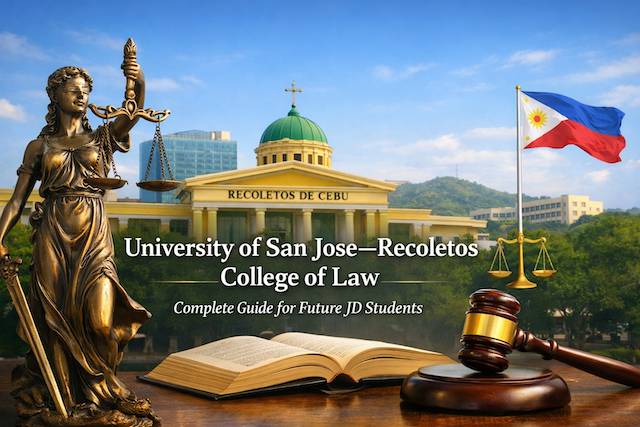
University of San Jose–Recoletos College of Law: Complete Guide for Future JD Students
Contents
- University of San Jose–Recoletos College of Law: Complete Guide for Future JD Students
- Overview: Why USJ-R for Law in Cebu
- Location and Campus Context
- Program Snapshot: The Juris Doctor Path
- Admission and Enrollment: What to Prepare
- Tuition, Fees, and Budget Planning
- Academic Life: What Studying Law Actually Feels Like
- Core Subjects You Should Expect
- Faculty, Teaching Style, and Classroom Culture
- Student Support, Culture, and Values
- Organizations, Leadership, and Networking
- Study Strategy: How to Survive and Perform Well
- Working While Studying: Realistic Planning
- Bar Exam Readiness: Starting Earlier Than You Think
- Career Paths After JD: What Graduates Commonly Do
- How to Apply: Practical Next Steps
- Final Thoughts: Who Will Thrive at USJ-R College of Law
- FAQs (Frequently Asked Questions)
- Is the University of San Jose–Recoletos College of Law a good choice for JD students in Cebu?
- What degree do I need before applying to a JD program in the Philippines?
- Does USJ-R College of Law require an entrance exam or interview?
- What documents are commonly required for law school enrollment at USJ-R?
- How difficult is law school, and what should I expect in the first semester?
- Can I work full-time while studying at USJ-R College of Law?
- What study methods work best for JD students?
- How should I budget for law school expenses in Cebu?
- Does studying in Cebu City provide any advantage for law students?
- How early should I start preparing for the bar exam?
- What career paths are common after completing a JD?
- What should I do next if I want to apply to USJ-R College of Law?
University of San Jose–Recoletos College of Law: Complete Guide for Future JD Students
Overview: Why USJ-R for Law in Cebu
The University of San Jose–Recoletos (USJ-R) is a long-established Catholic university in Cebu City that offers legal education through its College (School) of Law. For many aspiring lawyers in the Visayas, USJ-R is attractive for three practical reasons: (1) it is based in a major regional hub where courts, government offices, and private practice opportunities are accessible; (2) it operates within a values-driven, community-oriented Recoletos tradition that many students find grounding during the intensity of law school; and (3) it is part of a comprehensive university environment, which can be helpful if you want access to broad student services, library support, and campus life beyond the law building.
This guide is written for prospective Juris Doctor (JD) students who want a realistic picture of what to prepare, what to expect academically, and how to plan your law school journey—from application to bar readiness and early career paths.
Location and Campus Context
USJ-R’s main campus is located along Magallanes Street in Cebu City (often referenced with nearby cross streets such as P. Lopez and Magallanes). Studying law in a city center comes with advantages: you are closer to courthouses, government agencies, and many legal workplaces where internships, clerkships, or part-time roles may be available. It also means daily life logistics matter—traffic patterns, commuting time, and reliable study spaces can affect your consistency.
If you are not from Cebu City, plan your housing and commuting early. Many law students prefer living within a manageable distance so they can stay late for library work, group reviews, or organization meetings without worrying about long travel at night.
Program Snapshot: The Juris Doctor Path
Philippine law schools generally follow a Juris Doctor (JD) program structure designed to meet national legal education standards. While course sequencing and unit loads vary by institution, your JD journey typically includes foundational subjects (e.g., Constitutional Law, Criminal Law, Civil Law, Legal Ethics), procedural subjects (e.g., Civil Procedure, Criminal Procedure, Evidence), and advanced/review components aimed at bar exam readiness.
Expect a program that is reading-heavy and discussion-based. Law school performance is less about memorizing isolated facts and more about building legal reasoning: identifying issues, applying rules, arguing both sides, and writing clearly under time pressure.
Admission and Enrollment: What to Prepare
Admission rules can change by academic year, so always verify the latest requirements with the university. However, USJ-R has historically provided structured enrollment documentation for law applicants. Based on the university’s posted “Requirements for Enrolment” for law, common items include:
- Transcript of Records (TOR) or academic records from your previous institution (or through the USJ-R Registrar’s Office if you are an alumnus/alumna).
- Good Moral Character certification (often coordinated through student affairs or the appropriate office, depending on your status).
- Recent photo requirements (commonly 2”x2” photos with specified number of copies).
- Form C-1 / Certificate of Eligibility to take the Law Course (noted as requested through the Registrar’s Office in the posted requirement document).
- Clearance or certificate of no balance (particularly relevant to returnees or students with prior school records to clear).
In addition to documents, some law programs may have interviews, orientation requirements, or internal evaluations. If you are a working professional, ask early about class schedules and policies that affect attendance, exams, and academic standing.
Tuition, Fees, and Budget Planning
Law school is a multi-year commitment, so your financial plan should be realistic. USJ-R has publicly shared news about tuition and fee adjustments (for example, implementing increases effective in certain academic years subject to approvals). This matters because tuition can change mid-cycle across multi-year study plans.
Rather than relying on informal estimates, do these steps:
- Request the latest tuition and fee table for JD students from the appropriate office.
- Ask about payment terms per semester (installments, deadlines, surcharges, and refund policies).
- Estimate hidden costs: books, printing, bar review savings, transportation, and internet.
- If you are employed, also budget for opportunity costs (reduced work hours, fewer projects, or career pauses).
If scholarships or financial assistance are available, confirm eligibility requirements and renewal conditions. Some aid programs require a minimum grade average or unit load that can be challenging in law school—make sure the terms match your capacity.
Academic Life: What Studying Law Actually Feels Like
Many JD students enter law school with strong motivation but underestimate the daily grind. A realistic weekly rhythm often includes:
- Pre-class reading: case assignments and codal provisions (often hours per subject).
- Recitations: oral questioning that tests comprehension and analysis, not just memory.
- Writing work: digests, case briefs, issue-spotting exercises, and exam essays.
- Exams under pressure: timed essays require fast structure and clean rule application.
Success tends to come from consistency. Law school rewards students who show up prepared every week, not only those who “cram well.” Build routines early: a reading system, a note system, and a weekly review habit that consolidates what you learned before the next topic arrives.
Core Subjects You Should Expect
While exact course catalogs vary, most Philippine JD programs include a strong core that shapes bar readiness. You should expect major coverage in:
- Constitutional Law and Political Law foundations
- Civil Law subjects (Persons and Family Relations, Property, Obligations and Contracts, etc.)
- Criminal Law and related special penal laws
- Remedial Law (Civil Procedure, Criminal Procedure, Evidence)
- Commercial/Business-related law foundations
- Legal Ethics, legal forms, and practice-oriented components
Your job as a student is to learn the “logic” of each area: what questions to ask, what elements to prove, what defenses exist, and how procedure shapes outcomes. This is why codal familiarity matters—rules and definitions become tools you use repeatedly.
Faculty, Teaching Style, and Classroom Culture
Law faculty in the Philippines often include practicing lawyers, litigators, government counsel, and judges. That mix can be a huge advantage: classroom discussion becomes practical and grounded in real legal work. The tradeoff is that teaching styles vary widely—some professors emphasize strict recitation and discipline; others focus on problem-solving and writing.
To adapt, treat each subject like its own “game” with rules:
- Learn your professor’s exam format (issue-spotting vs. direct questions vs. essays).
- Observe how recitations are conducted (case method, codal-based questioning, policy discussions).
- Adjust your preparation (some classes demand heavy case digestion; others demand codal mastery and hypotheticals).
Student Support, Culture, and Values
USJ-R positions itself as a Christian, community-oriented institution guided by “Caritas et Scientia” (charity and knowledge). For law students, values-based culture can matter in practical ways: it influences how the community treats professionalism, ethics, service, and peer support.
Even if you are not deeply religious, you may appreciate an environment that emphasizes integrity and responsibility—two traits that matter not only for the bar exam but for long-term legal practice.
Organizations, Leadership, and Networking
Law school organizations can become your support system and professional network. Joining student groups helps you build skills that directly translate to legal work: drafting, public speaking, negotiation, event management, and teamwork under deadlines.
However, be strategic. It is easy to overcommit and lose academic stability. A good approach is to prioritize one meaningful organization role, then add activities only after your grades and routines are stable.
Study Strategy: How to Survive and Perform Well
Here are practical strategies that tend to work across most law schools:
- Codal-first habit: start with the legal provision, then read cases to see how courts apply it.
- Case digestion system: keep briefs short but consistent (facts, issue, ruling, reasoning, doctrine).
- Weekly consolidation: rewrite your notes into a clean outline every week before topics pile up.
- Practice essays early: don’t wait for finals—timed writing is a separate skill you must train.
- Recitation preparation: anticipate “why” questions, not only “what happened” questions.
Also protect your health. Burnout is common in JD programs. Your mental clarity affects reading speed, writing quality, and exam performance. Sleep, nutrition, and small breaks are not luxuries; they are performance tools.
Working While Studying: Realistic Planning
Many JD students work while studying, especially in Cebu where professionals return for law to upgrade careers or shift paths. If you plan to work:
- Choose a job with predictable hours when possible.
- Communicate exam weeks early to your employer.
- Accept that some semesters will require reduced work intensity.
- Build a “minimum viable routine” you can maintain even during busy work weeks.
The biggest risk for working students is inconsistency: missing readings leads to weak recitations, which leads to anxiety, which leads to falling behind. Your plan must protect study time as a non-negotiable schedule block.
Bar Exam Readiness: Starting Earlier Than You Think
Bar readiness does not begin after graduation—it begins when you learn how to outline and write exams in first year. The bar exam rewards students who can spot issues quickly, recall the right rule, and apply it clearly in a structured answer.
Start building bar-friendly habits now:
- Create outlines that look like bar reviewers: clean headings, elements, exceptions, and examples.
- Collect “classic” issue patterns in each subject and practice answering them under time limits.
- Train your handwriting/typing speed and clarity (depending on exam format policies).
- Track your weak areas honestly and revisit them monthly.
Career Paths After JD: What Graduates Commonly Do
A JD can open multiple paths, even before you pass the bar (depending on role requirements). After completing law school and eventually passing the bar, common directions include:
- Litigation and private practice: working with law firms or building a solo practice over time.
- Corporate and in-house roles: compliance, contracts, corporate governance, and risk management.
- Government service: prosecutor’s office, public attorney roles, agencies, and local government units.
- Advocacy and non-profit work: policy, human rights, community legal assistance.
- Business leadership: entrepreneurs and executives often pursue law for strategic advantage.
If you already have a career (e.g., HR, finance, engineering, healthcare), law can become a multiplier. The strongest graduates often combine legal skills with domain expertise and become specialists.
How to Apply: Practical Next Steps
If you are serious about enrolling, do a simple, organized checklist:
- Visit USJ-R’s official website and locate the latest JD/Law enrollment guidance.
- Secure your TOR and Good Moral Character documents early (these often take time).
- Confirm the process for Form C-1 / Certificate of Eligibility and where to request it.
- Ask about orientation dates, enrollment schedules, and payment deadlines.
- Plan your housing/commute and set up a study environment before classes begin.
For official inquiries, USJ-R maintains a contact page for the university, and the Registrar/administrative offices can direct you to the law program’s current procedures.
Final Thoughts: Who Will Thrive at USJ-R College of Law
You will likely thrive at the University of San Jose–Recoletos College of Law if you are willing to commit to disciplined weekly preparation, value a community-oriented university environment, and want to study law in a Cebu City setting with practical access to legal institutions. Law school is not about being the “smartest” person in the room—it is about becoming the most consistent learner, the clearest writer, and the most resilient problem-solver.
If you choose this path, start with the basics: get your documents ready, build a realistic schedule, and enter your first semester with a system. The earlier you build strong habits, the smoother your JD journey will be—and the closer you will be to your goal of becoming a lawyer.
FAQs (Frequently Asked Questions)
Is the University of San Jose–Recoletos College of Law a good choice for JD students in Cebu?
For many students in Cebu and the wider Visayas region, USJ-R is a practical choice because it is located in Cebu City, close to courts, government offices, and many legal workplaces. This can make internships, observations, and networking more accessible compared with schools located far from major legal centers. It is also part of a long-established Catholic university, which means students often benefit from broader campus services such as libraries, student support offices, and a structured academic environment. Whether it is “good” for you depends on your learning style, schedule, budget, and willingness to handle a heavy reading and recitation culture typical of Philippine law schools.
What degree do I need before applying to a JD program in the Philippines?
In the Philippines, applicants to a Juris Doctor program generally need a completed bachelor’s degree (or an equivalent qualification accepted by the institution and regulators). Because policies can change and schools may have specific documentation rules, it is best to confirm the current admission requirements directly with the university. If you studied outside the Philippines, you may need additional documents, credential evaluation, or authentication depending on your academic background and the school’s latest procedures.
Does USJ-R College of Law require an entrance exam or interview?
Law school admission processes vary by institution and by academic year. Some schools require entrance examinations, interviews, or internal assessments, while others focus mainly on documentary requirements and eligibility screening. The safest approach is to check the most recent announcements from USJ-R and contact the appropriate office for the updated process. If an interview is required, it typically evaluates your readiness for the workload, your communication skills, and your motivation to pursue legal education.
What documents are commonly required for law school enrollment at USJ-R?
Requirements can be updated, but commonly requested documents include your Transcript of Records (TOR), proof of graduation, certificates such as Good Moral Character, and enrollment forms or eligibility certificates processed through the Registrar. Schools also typically request recent identification photos and may require clearances (especially for returning students or applicants with prior school records). Because documentary processing can take time, it is smart to start collecting requirements weeks ahead of enrollment.
How difficult is law school, and what should I expect in the first semester?
Law school is challenging mainly because it demands consistent preparation, not because any single topic is impossible to understand. In the first semester, you should expect heavy reading assignments, case digests or briefs, and recitations where professors ask questions to test your understanding and analysis. Exams are usually essay-based and time-pressured, so clear writing and structured answers matter. The students who adjust fastest are those who develop a routine early: daily reading blocks, weekly outline-building, and regular practice with hypothetical questions.
Can I work full-time while studying at USJ-R College of Law?
Many JD students work, but balancing a full-time job with law school is demanding. The key issue is time consistency: you need predictable study hours for readings and review, plus flexibility during exam weeks. If your job has irregular shifts or frequent overtime, staying prepared for recitations becomes difficult. If you must work full-time, consider building a strict weekly plan, reducing other commitments, and choosing a study system that helps you keep pace even when work becomes busy.
What study methods work best for JD students?
Most successful law students combine three habits. First, they develop a codal-first approach: reading the legal provisions and elements before diving into cases. Second, they create concise case digests that focus on doctrine and reasoning, not long storytelling. Third, they build outlines continuously rather than waiting until finals. In addition, practicing essay writing early is critical because it trains you to spot issues, state rules accurately, and apply them clearly under time limits. Study groups can help, but only if they stay focused and do not replace personal reading time.
How should I budget for law school expenses in Cebu?
Budgeting should include more than tuition. You should plan for books and materials, printing and photocopying, transportation, meals, and reliable internet. Some students also budget for a quieter study space, whether that means better housing, coworking access, or occasional café study costs. Over the long term, it is wise to set aside funds for bar review and related expenses. Since tuition and fees may change by academic year, check the most current fee schedule and payment terms before committing to a multi-year plan.
Does studying in Cebu City provide any advantage for law students?
Studying in a major city can be helpful because courts, agencies, and legal offices are more accessible. This may make it easier to attend hearings for learning purposes, apply for internships, and build professional connections. Cebu also has a wide range of legal practice areas due to its business activity and regional importance. However, city life also brings challenges such as traffic and distractions, so your personal discipline and logistics planning matter.
How early should I start preparing for the bar exam?
Bar preparation effectively begins in your first year. The bar rewards consistent mastery of fundamentals, strong issue-spotting, and clear, organized writing. If you build outlines throughout law school, practice timed essays, and regularly review core doctrines, you reduce the pressure later. Many students wait until graduation to “start bar review,” but those who perform best usually treat every semester exam as training for bar-style answers. If your school offers review-focused subjects or mock exams, take them seriously and use the results to identify weak areas early.
What career paths are common after completing a JD?
After law school and eventually passing the bar, graduates commonly enter private practice, litigation, corporate or in-house roles, government service, or advocacy work. Some also move into compliance, contracts, and policy roles where legal training is valuable. If you already have a professional background, law can become a specialization tool—for example, combining business experience with corporate law, or combining HR experience with labor law. Your best path depends on your interests, strengths, and the network you build during school.
What should I do next if I want to apply to USJ-R College of Law?
Start by checking the university’s official channels for the latest JD enrollment guidelines and timelines. Then collect your TOR and other documents early, because processing can take time. Next, confirm whether there are interviews, orientation requirements, or additional forms you must request through the Registrar. Finally, plan your schedule and logistics: commuting, housing, and your weekly study routine. Entering your first semester with a system is one of the most reliable ways to reduce stress and stay consistent.

How to Register for eTravel Philippines (2025 Guide)
Step-by-step guide to completing your eTravel registration before arriving in the Philippines, with images and tips.

Night Market in Cebu – Things You Don’t Know About Cebu Life
Discover the hidden charm of Cebu’s night markets, from street food stalls to local life tips you won’t find in tourist guides.

How to Use ChatGPT for IELTS Preparation: A Complete Guide
Learn how to prepare for IELTS using ChatGPT — including strategies for Writing, Reading, Listening, Speaking, and grammar support.

How to Build a Website Without Coding Using ChatGPT
Discover how to build your own website using AI—no coding skills needed. From structure planning to SEO and design, let ChatGPT guide you.