
Contents
- Cambridge English vs TOEIC: Business vs Academic English
- What Is Cambridge English?
- What Is TOEIC?
- Key Purpose: Academic vs Business English
- Test Format Differences
- Scoring System Comparison
- Recognition Around the World
- Difficulty Level Comparison
- Which Test Is Better for Students?
- Which Test Is Better for Professionals?
- Test Preparation Differences
- When Should You Choose Cambridge English?
- When Should You Choose TOEIC?
- Final Thoughts
- FAQs (Frequently Asked Questions)
- What is the main difference between Cambridge English and TOEIC?
- Is Cambridge English better for academic purposes?
- Is TOEIC mainly for business English?
- Do Cambridge English certificates expire?
- How long is a TOEIC score valid?
- Which test is easier: Cambridge English or TOEIC?
- Which test should I choose for university admission?
- Which test is better for getting a job?
- Can I take both Cambridge English and TOEIC?
- How should I decide between Cambridge English and TOEIC?
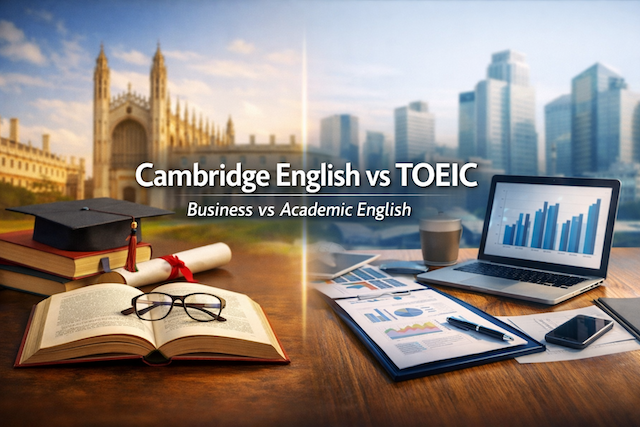
Cambridge English vs TOEIC: Business vs Academic English
English proficiency tests are widely used around the world for education, immigration, and employment. Among the most recognized exams are Cambridge English exams and TOEIC (Test of English for International Communication). While both tests measure English ability, they serve very different purposes and are designed for different audiences.
Many students, professionals, and international learners often wonder which test they should take. Should you choose a Cambridge English certificate, which is commonly associated with academic and long-term English proficiency? Or should you take the TOEIC test, which focuses on business communication in professional environments?
In this guide, we will explore the key differences between Cambridge English and TOEIC, including their purposes, structure, scoring systems, recognition, and which test is best for your goals.
What Is Cambridge English?
Cambridge English exams are a group of internationally recognized English proficiency tests developed by Cambridge Assessment English, part of the University of Cambridge.
These exams evaluate English ability across reading, writing, listening, and speaking, and they follow the Common European Framework of Reference for Languages (CEFR).
Popular Cambridge English exams include:
-
B2 First (FCE) – Upper-intermediate level
-
C1 Advanced (CAE) – Advanced level
-
C2 Proficiency (CPE) – Near-native level
Cambridge exams are designed to measure real-life English skills and are commonly used for:
-
University admission
-
Academic preparation
-
Immigration requirements
-
Professional certification
-
Long-term proof of English proficiency
One important feature of Cambridge exams is that certificates never expire, which makes them valuable for long-term academic and professional use.
What Is TOEIC?
The TOEIC (Test of English for International Communication) is an English proficiency test designed specifically for workplace communication.
The test was created by ETS (Educational Testing Service) and focuses on English used in business and professional environments.
TOEIC evaluates how well a person can understand and communicate in typical work situations such as:
-
Meetings
-
Emails
-
Business conversations
-
Workplace announcements
-
Office documentation
The most common version is the TOEIC Listening and Reading Test, which uses a multiple-choice format.
TOEIC is widely used by:
-
International companies
-
Human resource departments
-
Government organizations
-
Employers in Asia and Europe
Many companies use TOEIC scores when hiring employees or evaluating staff for promotion.
Key Purpose: Academic vs Business English
The biggest difference between Cambridge English and TOEIC lies in their purpose and focus.
Cambridge English Focus
Cambridge exams measure comprehensive English proficiency suitable for:
-
Academic environments
-
International education
-
Professional communication
-
Everyday English usage
The exams test how well candidates can:
-
Write essays
-
Participate in discussions
-
Understand complex texts
-
Express ideas clearly in speech
Because of this, Cambridge English exams are often considered more academic and comprehensive.
TOEIC Focus
TOEIC focuses specifically on English used in business settings.
The test evaluates how well someone can:
-
Understand workplace conversations
-
Read emails and reports
-
Interpret schedules or announcements
-
Communicate in professional situations
However, TOEIC generally does not test advanced writing or speaking skills unless you take the optional TOEIC Speaking and Writing test.
Test Format Differences
The structure of the exams is another major difference.
Cambridge English Exam Structure
Cambridge exams include four main skill areas:
-
Reading
-
Writing
-
Listening
-
Speaking
For example, the C1 Advanced exam includes:
-
Reading and Use of English
-
Writing tasks
-
Listening comprehension
-
Face-to-face speaking interview
The speaking test is usually conducted with another candidate and an examiner, simulating real-life communication.
This makes Cambridge exams more interactive and practical.
TOEIC Test Structure
The most common TOEIC test consists of two sections:
Listening Section
-
Conversations
-
Announcements
-
Workplace discussions
Reading Section
-
Emails
-
Reports
-
Business documents
-
Grammar questions
The test is entirely multiple-choice.
Optional tests include:
-
TOEIC Speaking
-
TOEIC Writing
However, many companies only require the Listening and Reading test.
Scoring System Comparison
Another major difference between Cambridge English and TOEIC is the scoring system.
Cambridge English Scores
Cambridge exams use a CEFR-based grading system.
For example:
| Cambridge Exam | CEFR Level |
|---|---|
| B2 First | B2 |
| C1 Advanced | C1 |
| C2 Proficiency | C2 |
Results are typically reported as:
-
Grade A
-
Grade B
-
Grade C
Candidates also receive a Cambridge English Scale score.
Most importantly, Cambridge certificates never expire.
TOEIC Scores
TOEIC scores range from:
10 to 990 points
The score is based on the combined results of:
-
Listening section
-
Reading section
Typical score interpretations include:
| Score Range | Level |
|---|---|
| 905–990 | Professional proficiency |
| 785–900 | Advanced working proficiency |
| 605–780 | Intermediate working proficiency |
| 405–600 | Basic working proficiency |
However, TOEIC scores are usually considered valid for two years.
Recognition Around the World
Both exams are recognized internationally, but they are popular in different contexts.
Cambridge English Recognition
Cambridge English exams are recognized by:
-
Universities worldwide
-
Immigration authorities
-
Professional institutions
-
Governments
They are particularly popular in:
-
Europe
-
Latin America
-
Academic institutions
Many universities accept C1 Advanced or C2 Proficiency as proof of English proficiency.
TOEIC Recognition
TOEIC is widely used by companies and corporations.
Major industries using TOEIC include:
-
Airlines
-
Hospitality
-
Technology companies
-
International trade companies
TOEIC is especially popular in:
-
Japan
-
South Korea
-
Taiwan
-
Thailand
-
France
Many Asian companies use TOEIC scores as part of their employee evaluation systems.
Difficulty Level Comparison
The perceived difficulty of the tests also differs.
Cambridge English Difficulty
Cambridge exams are often considered more challenging because they test:
-
Writing ability
-
Speaking skills
-
Grammar and vocabulary usage
-
Academic reading comprehension
Candidates must demonstrate active English production, not just passive understanding.
TOEIC Difficulty
TOEIC mainly measures listening and reading comprehension.
Because it uses multiple-choice questions, many test-takers find it easier to prepare for.
However, achieving a very high score (900+) still requires strong professional English skills.
Which Test Is Better for Students?
For students planning to study abroad, Cambridge English is usually the better option.
Reasons include:
-
Strong academic recognition
-
Balanced language skill assessment
-
Lifetime certificate
-
Accepted by many universities
Students preparing for international education often choose C1 Advanced or B2 First.
Which Test Is Better for Professionals?
For professionals working in multinational companies, TOEIC may be more practical.
Reasons include:
-
Business-focused English content
-
Widely used by employers
-
Quick score reporting
-
Easy comparison between candidates
Many companies also set minimum TOEIC score requirements for:
-
Hiring
-
Promotions
-
Overseas assignments
Test Preparation Differences
Preparing for Cambridge English and TOEIC also requires different strategies.
Cambridge English Preparation
Preparation often focuses on:
-
Essay writing
-
Speaking practice
-
Grammar accuracy
-
Academic vocabulary
Students usually take structured English courses or preparation programs.
TOEIC Preparation
TOEIC preparation often focuses on:
-
Business vocabulary
-
Listening comprehension
-
Reading speed
-
Test-taking strategies
Many learners use practice tests and exam simulations.
When Should You Choose Cambridge English?
Cambridge English is a good choice if you:
-
Plan to study abroad
-
Need academic English certification
-
Want a permanent certificate
-
Need proof of overall English proficiency
-
Want to demonstrate speaking and writing ability
It is particularly useful for students and long-term English learners.
When Should You Choose TOEIC?
TOEIC is better if you:
-
Work in an international company
-
Need English certification for employment
-
Want to measure workplace English ability
-
Need a quick, standardized score
-
Are applying for jobs in Asia
Many professionals take TOEIC because it is widely recognized by employers.
Final Thoughts
Both Cambridge English and TOEIC are respected English proficiency tests, but they serve different purposes.
Cambridge English exams focus on academic and comprehensive language ability, while TOEIC focuses on practical workplace communication.
If your goal is university study or long-term English certification, Cambridge exams are often the better choice.
If your goal is career advancement or employment in international companies, TOEIC may be the more practical option.
Ultimately, the best test depends on your personal goals, career plans, and the requirements of your school or employer.



