
Contents
- Cambridge English CEFR Levels Explained
- What Is CEFR and Why It Matters
- The Structure of CEFR Levels
- A1 Level – Beginner
- A2 Level – Elementary
- B1 Level – Intermediate
- B2 Level – Upper-Intermediate
- C1 Level – Advanced
- C2 Level – Proficiency
- How Cambridge Exams Align With CEFR Levels
- Why CEFR Levels Are Important for Students
- How to Choose the Right Cambridge Level
- Final Thoughts
- FAQs (Frequently Asked Questions)
- What are Cambridge English CEFR levels?
- Why is the CEFR important for English learners?
- What does A1 level mean in Cambridge English?
- What can a student do at A2 level?
- Is B1 considered a good English level?
- What is special about B2 level?
- What is the difference between C1 and C2?
- How do Cambridge English exams match CEFR levels?
- How can learners choose the right Cambridge English level?
Cambridge English CEFR Levels Explained
What Is CEFR and Why It Matters
The Common European Framework of Reference for Languages (CEFR) is an international standard used to measure language proficiency. It provides a clear system for describing how well someone can use a language in real-life situations. Originally developed by the Council of Europe, the CEFR framework is widely used around the world in schools, universities, and language certification systems.
Cambridge English exams are closely aligned with the CEFR framework. Each Cambridge exam corresponds to a specific CEFR level, allowing learners, teachers, and employers to understand a student’s English ability in a standardized way.
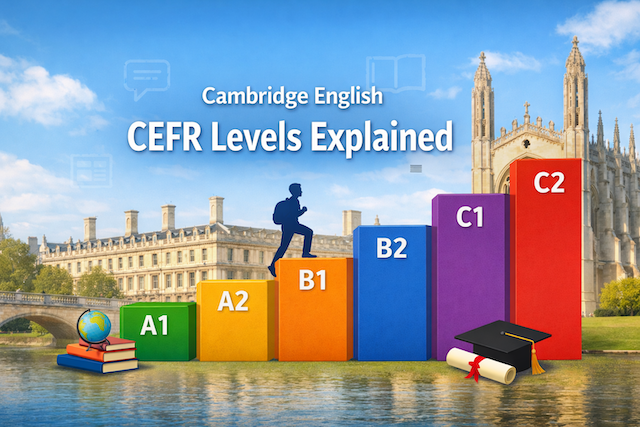
The CEFR divides language ability into six levels, ranging from beginner to near-native proficiency:
-
A1 – Beginner
-
A2 – Elementary
-
B1 – Intermediate
-
B2 – Upper-Intermediate
-
C1 – Advanced
-
C2 – Proficient
These levels describe what learners can actually do with the language, rather than simply how much vocabulary or grammar they know.
Understanding CEFR levels is essential for students preparing for Cambridge English exams because it helps them choose the right test and set realistic learning goals.
The Structure of CEFR Levels
The CEFR framework organizes language proficiency into three main categories:
Basic User
-
A1 – Beginner
-
A2 – Elementary
At this stage, learners can handle simple communication in everyday situations.
Independent User
-
B1 – Intermediate
-
B2 – Upper-Intermediate
Learners at this level can communicate more independently and handle a wider range of real-life conversations.
Proficient User
-
C1 – Advanced
-
C2 – Proficiency
These levels indicate high fluency and the ability to understand complex or academic language.
Cambridge English exams map directly onto these levels, making it easier for students to demonstrate their proficiency to universities, employers, and immigration authorities.
A1 Level – Beginner
The A1 level represents the most basic stage of English learning.
At this level, learners can understand and use very simple expressions related to everyday needs.
Typical Abilities at A1
Learners at the A1 level can:
-
Introduce themselves and others
-
Ask and answer simple personal questions
-
Understand basic greetings and instructions
-
Use simple phrases related to daily life
For example, an A1 learner might be able to say:
-
“My name is Maria.”
-
“I am from Spain.”
-
“Where is the station?”
Communication is still very limited, and learners often rely on slow speech and repetition.
Cambridge Exam for A1
The main Cambridge exam at this level is:
Cambridge English: A1 Movers (for young learners)
This exam is typically taken by children who are beginning their English learning journey.
A2 Level – Elementary
The A2 level represents elementary English ability. Learners can communicate in simple situations and understand frequently used expressions.
Typical Abilities at A2
At the A2 level, learners can:
-
Understand simple sentences about everyday topics
-
Ask and answer basic questions
-
Describe their background and daily routines
-
Handle simple travel situations
Example communication at this level might include:
-
Talking about hobbies
-
Ordering food at a restaurant
-
Asking for directions
Although communication is still basic, learners begin to feel more comfortable using English in predictable situations.
Cambridge Exams for A2
Two major Cambridge exams correspond to this level:
A2 Key (KET)
This exam tests basic English ability in reading, writing, listening, and speaking.
A2 Flyers
This exam is part of the Cambridge Young Learners English Tests.
Passing an A2-level exam demonstrates that a learner can use English in everyday situations.
B1 Level – Intermediate
The B1 level marks the beginning of independent language use. Learners can communicate with more confidence and handle a wider variety of situations.
Typical Abilities at B1
At this level, learners can:
-
Understand the main points of clear standard speech
-
Write simple connected texts
-
Describe experiences, events, and goals
-
Deal with most travel situations
A B1 learner might be able to:
-
Explain their opinions
-
Tell a story
-
Write emails about daily life
For many students, B1 represents an important milestone because it allows them to function in English-speaking environments more independently.
Cambridge Exam for B1
The main exam at this level is:
B1 Preliminary (PET)
This exam evaluates practical English skills for everyday communication. It is often used as proof that a learner can handle daily tasks in English.
B2 Level – Upper-Intermediate
The B2 level is considered an upper-intermediate level of English. Learners at this stage can communicate fluently in many situations and understand more complex texts.
Typical Abilities at B2
A learner at the B2 level can:
-
Understand the main ideas of complex texts
-
Interact with native speakers with relative fluency
-
Write detailed texts on various topics
-
Express opinions and arguments clearly
Communication becomes much more natural at this level. Learners can participate in discussions and understand a wide range of topics.
For example, a B2 learner can:
-
Debate ideas in a classroom
-
Write reports or essays
-
Follow news articles and documentaries
Cambridge Exam for B2
The corresponding Cambridge exam is:
B2 First (FCE – First Certificate in English)
This exam is widely recognized by universities and employers. Many academic programs require B2-level English proficiency.
C1 Level – Advanced
The C1 level represents advanced English ability. Learners at this stage can use English effectively for academic and professional purposes.
Typical Abilities at C1
At the C1 level, learners can:
-
Understand long and complex texts
-
Express ideas fluently and spontaneously
-
Use language flexibly in social and professional contexts
-
Produce well-structured written texts
Communication becomes very natural and efficient.
For example, a C1 learner can:
-
Participate in academic discussions
-
Deliver presentations in English
-
Write analytical essays or reports
Many universities require students to demonstrate C1-level English proficiency for admission.
Cambridge Exam for C1
The exam for this level is:
C1 Advanced (CAE – Certificate in Advanced English)
This exam is recognized by thousands of universities and companies worldwide.
Passing C1 Advanced shows that a student has strong academic English skills.
C2 Level – Proficiency
The C2 level is the highest level in the CEFR framework. It indicates near-native mastery of English.
Learners at this level can understand almost everything they hear or read.
Typical Abilities at C2
At the C2 level, learners can:
-
Understand highly complex texts
-
Express ideas precisely and fluently
-
Summarize information from multiple sources
-
Use language with subtlety and accuracy
Communication at this level is extremely sophisticated.
A C2 learner can easily:
-
Follow academic lectures
-
Read research papers
-
Write professional or scholarly documents
Cambridge Exam for C2
The corresponding exam is:
C2 Proficiency (CPE – Certificate of Proficiency in English)
This is the highest-level Cambridge English qualification.
Passing the C2 Proficiency exam demonstrates exceptional command of English.
How Cambridge Exams Align With CEFR Levels
Cambridge English exams are specifically designed to match CEFR proficiency levels.
Here is a simplified overview:
| CEFR Level | Cambridge Exam |
|---|---|
| A1 | Young Learners Movers |
| A2 | A2 Key (KET) |
| B1 | B1 Preliminary (PET) |
| B2 | B2 First (FCE) |
| C1 | C1 Advanced (CAE) |
| C2 | C2 Proficiency (CPE) |
Each exam evaluates four key language skills:
-
Reading
-
Writing
-
Listening
-
Speaking
The exams are designed to reflect real-world communication, ensuring that certified learners can use English in practical situations.
Why CEFR Levels Are Important for Students
Understanding CEFR levels helps students plan their learning journey more effectively.
Clear Learning Goals
The CEFR framework allows learners to see their current level and identify the next step in their language development.
For example:
-
A2 learners aim to reach B1
-
B1 learners aim for B2
This structure makes language learning more organized and measurable.
International Recognition
CEFR levels are recognized worldwide.
Universities, employers, and immigration authorities often use CEFR levels to determine English proficiency requirements.
For example:
-
Many universities require B2 or C1
-
Some professional roles require C1-level English
Cambridge certificates aligned with CEFR provide internationally recognized proof of English ability.
Better Course Placement
Language schools often use CEFR levels to place students in appropriate classes.
Without a standardized framework, it would be difficult to determine whether a student is beginner, intermediate, or advanced.
CEFR provides a consistent benchmark for teachers and institutions.
How to Choose the Right Cambridge Level
Choosing the right Cambridge exam depends on a learner’s current ability and goals.
For Beginners
Students who are just starting English should aim for A1 or A2 levels.
These exams help build confidence and basic communication skills.
For General Communication
Learners who want to function comfortably in English-speaking environments should aim for B1 or B2.
B2 is often considered the minimum level for academic study in English.
For Academic or Professional Use
Students planning to study at international universities or work in global companies should target C1 or C2.
These levels demonstrate advanced language ability.
A placement test or teacher evaluation can help determine which exam is most appropriate.
Final Thoughts
The CEFR framework provides a clear and internationally recognized way to measure English proficiency. By dividing language ability into six levels—from A1 beginner to C2 proficiency—it allows learners to understand their progress and set meaningful goals.
Cambridge English exams are closely aligned with these CEFR levels, offering reliable certification for students, universities, and employers around the world.
Whether a learner is just starting their English journey or aiming for near-native fluency, the CEFR system provides a structured path for improvement.
By understanding how Cambridge exams correspond to CEFR levels, students can choose the right test, prepare effectively, and demonstrate their English skills with confidence.



