
Contents
- Cambridge English Scoring System Explained
- What Is the Cambridge English Scale?
- Why the Cambridge English Scale Matters
- Cambridge English Grades Explained
- How Scores Are Calculated
- Component Scores Explained
- How the CEFR Connects to Cambridge Scores
- Understanding the Statement of Results
- Passing Scores and Certification
- Differences Between Cambridge and Other Scoring Systems
- Advantages of the Cambridge Scoring System
- Common Misunderstandings About Cambridge Scores
- How to Improve Your Cambridge English Score
- Final Thoughts
- FAQs (Frequently Asked Questions)
- What is the Cambridge English scoring system?
- What is the Cambridge English Scale?
- How is the overall Cambridge English score calculated?
- Do candidates receive separate scores for each skill?
- How do Cambridge grades work?
- What happens if I score above the target exam level?
- Can I still receive a result if I do not pass the exam?
- How does the Cambridge scoring system relate to the CEFR?
- Why do many people consider Cambridge scores reliable?
- How should I use my Cambridge English score after the exam?
Cambridge English Scoring System Explained
Cambridge English exams are widely recognized around the world as reliable assessments of English language proficiency. Unlike many other English tests that simply provide a single score, Cambridge English exams use a structured scoring system that connects test results to the Cambridge English Scale and the CEFR (Common European Framework of Reference for Languages).
Understanding how the Cambridge English scoring system works can help candidates interpret their results, evaluate their English proficiency level, and plan their future learning goals. Whether you are preparing for B2 First (FCE), C1 Advanced (CAE), or C2 Proficiency (CPE), knowing how scores are calculated will make the exam process clearer and less stressful.
In this guide, we will explain the Cambridge English scoring system in detail, including the Cambridge English Scale, score ranges, CEFR alignment, component scoring, and how to interpret your final results.
What Is the Cambridge English Scale?
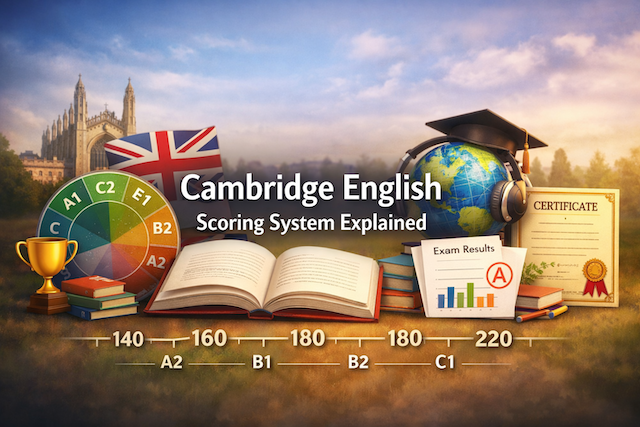
The Cambridge English Scale is a standardized scoring system used across all Cambridge English exams. It was introduced to create a consistent way to report results across different test levels.
Before the scale was introduced, different Cambridge exams used different grading systems. The Cambridge English Scale solved this problem by allowing results from different exams to be compared more easily.
The scale generally ranges from 80 to 230, depending on the exam level.
Each Cambridge exam corresponds to a specific range on the scale. For example:
| Exam | Typical Scale Score Range | CEFR Level |
|---|---|---|
| A2 Key | 120–140 | A2 |
| B1 Preliminary | 140–160 | B1 |
| B2 First | 160–180 | B2 |
| C1 Advanced | 180–200 | C1 |
| C2 Proficiency | 200–230 | C2 |
This means that every candidate receives a Cambridge English Scale score, regardless of which exam they take.
Why the Cambridge English Scale Matters
The Cambridge English Scale provides several advantages:
Consistency Across Exams
Because the same scale is used for multiple exams, it becomes easier to compare English ability across different test levels.
For example:
-
A score of 180 always represents approximately C1-level English, even if the candidate took B2 First or C1 Advanced.
Clearer Progress Tracking
Students and teachers can monitor progress more accurately.
For example:
-
160 → B2 level
-
175 → strong B2 approaching C1
-
185 → solid C1 level
This makes it easier to set learning goals.
Recognition by Universities and Employers
Many institutions now request Cambridge English Scale scores rather than just the exam grade.
Cambridge English Grades Explained
In addition to the numerical score, Cambridge English exams also provide grades.
Grades summarize performance within a certain score range.
For example, in B2 First, the grades are typically:
| Cambridge English Scale Score | Grade | CEFR Level |
|---|---|---|
| 180–190 | Grade A | C1 |
| 173–179 | Grade B | B2 |
| 160–172 | Grade C | B2 |
| 140–159 | Level B1 | B1 |
Candidates who score 160 or above pass the exam and receive the certificate.
If a candidate scores slightly below the pass level, they may still receive a CEFR-level certificate indicating their actual ability.
How Scores Are Calculated
Cambridge English exams assess four core language skills:
-
Reading
-
Writing
-
Listening
-
Speaking
Each skill is scored separately and contributes to the overall result.
The final score is calculated by taking the average of the component scores.
Example Score Breakdown
A candidate might receive:
| Skill | Score |
|---|---|
| Reading | 172 |
| Writing | 168 |
| Listening | 175 |
| Speaking | 170 |
Average:
(172 + 168 + 175 + 170) ÷ 4 = 171.25
This would usually be reported as 171, resulting in Grade C (B2 level).
This method ensures that all language skills are evaluated fairly.
Component Scores Explained
Each section of the exam is evaluated differently depending on the skill.
Reading
The reading section measures:
-
comprehension accuracy
-
vocabulary understanding
-
ability to interpret meaning in context
Scores depend on the number of correct answers.
Writing
Writing tasks are assessed by trained examiners using several criteria:
-
Content
-
Communicative achievement
-
Organization
-
Language use
Each criterion contributes to the final writing score.
Listening
Listening tests evaluate the ability to:
-
understand spoken English
-
identify key information
-
interpret meaning and attitude
Scores are based on correct responses.
Speaking
Speaking is assessed during a face-to-face interview with examiners.
Evaluation includes:
-
pronunciation
-
grammar and vocabulary
-
discourse management
-
interactive communication
Two examiners typically assess speaking to ensure fairness.
How the CEFR Connects to Cambridge Scores
The CEFR is an international framework that describes language proficiency across six levels:
| Level | Description |
|---|---|
| A1 | Beginner |
| A2 | Elementary |
| B1 | Intermediate |
| B2 | Upper-intermediate |
| C1 | Advanced |
| C2 | Proficient |
Cambridge English exams are aligned with these levels.
For example:
-
B2 First targets the B2 level.
-
C1 Advanced targets the C1 level.
-
C2 Proficiency targets the highest level.
However, the scoring system allows candidates to receive results above or below the target level.
Example:
A B2 First candidate might receive:
-
B1 result if performance is below B2
-
C1 result if performance exceeds B2 expectations
This flexibility provides a more accurate picture of language ability.
Understanding the Statement of Results
After completing a Cambridge English exam, candidates receive a Statement of Results.
This document includes several important elements.
Overall Score
The overall score is the average Cambridge English Scale score across all skills.
Individual Skill Scores
Separate scores are provided for:
-
Reading
-
Writing
-
Listening
-
Speaking
This allows candidates to see their strengths and weaknesses.
Grade
The grade indicates the performance band within the exam.
For example:
-
Grade A
-
Grade B
-
Grade C
CEFR Level
The CEFR level confirms the candidate’s overall English proficiency.
Passing Scores and Certification
Each Cambridge exam has a minimum score required to pass.
For most exams:
160 or above = pass
If the candidate passes, they receive a Cambridge English certificate.
These certificates have several advantages:
-
They do not expire
-
They are recognized globally
-
They are accepted by universities and employers
Unlike IELTS or TOEFL, which typically expire after two years, Cambridge certificates remain valid indefinitely.
Differences Between Cambridge and Other Scoring Systems
Many English tests use different scoring methods.
IELTS
IELTS uses a band score from 0 to 9.
Example:
-
6.5
-
7.0
-
8.0
Each section receives a band score, and the average becomes the overall score.
TOEFL
TOEFL iBT uses a 0–120 scoring scale.
Each section is scored out of 30.
Cambridge English
Cambridge uses:
-
Cambridge English Scale (approx. 80–230)
-
Grades (A, B, C)
-
CEFR level
This multi-layered system provides a more detailed evaluation of proficiency.
Advantages of the Cambridge Scoring System
The Cambridge scoring system offers several key benefits.
Accurate Skill Assessment
Because each skill is evaluated separately, candidates receive detailed feedback.
International Recognition
Cambridge English scores are recognized by thousands of institutions worldwide.
Lifetime Certification
Unlike many other tests, Cambridge certificates do not expire.
Clear Alignment with CEFR
The scoring system directly connects to internationally recognized language levels.
Common Misunderstandings About Cambridge Scores
Some test takers misunderstand how Cambridge scoring works.
Misconception 1: Only the Grade Matters
In reality, the scale score is more precise than the grade.
Many institutions look directly at the scale score.
Misconception 2: You Fail Completely Below 160
Even if a candidate scores below the passing threshold, they still receive a CEFR-level result reflecting their English ability.
Misconception 3: Higher Exams Always Mean Higher Scores
Because the scale overlaps across exams, a candidate can achieve similar scores on different tests.
For example:
-
180 on B2 First
-
180 on C1 Advanced
Both indicate strong English ability.
How to Improve Your Cambridge English Score
If you want to achieve a higher score, consider the following strategies.
Practice with Official Materials
Cambridge publishes official preparation books and practice exams.
These resources provide realistic exam conditions.
Focus on Weak Skills
Because scores are averaged across skills, improving weaker areas can significantly raise the overall result.
Develop Academic Vocabulary
Advanced exams require strong vocabulary and precise grammar.
Take Mock Exams
Mock tests help identify weaknesses and improve time management.
Final Thoughts
The Cambridge English scoring system is designed to provide a detailed and reliable measurement of English proficiency. By using the Cambridge English Scale, grades, and CEFR alignment, the system ensures that candidates receive clear and internationally recognized results.
Unlike many other English tests, Cambridge exams evaluate language ability across multiple dimensions and provide lifelong certification. This makes them a valuable option for students, professionals, and academic applicants.
Understanding how the scoring system works can help test takers interpret their results more accurately, identify areas for improvement, and plan their English learning journey more effectively.
Whether you are preparing for B2 First, C1 Advanced, or C2 Proficiency, knowing how your performance will be evaluated is an important step toward achieving your target score and demonstrating your English proficiency to the world.



