3D UNIVERSAL ENGLISH INSITUTE INC
info.3duniversal.com@gmail.com
8:00-17:00(Mon-Fri)

Notre Dame University College of Law: Complete Guide for Prospective Students
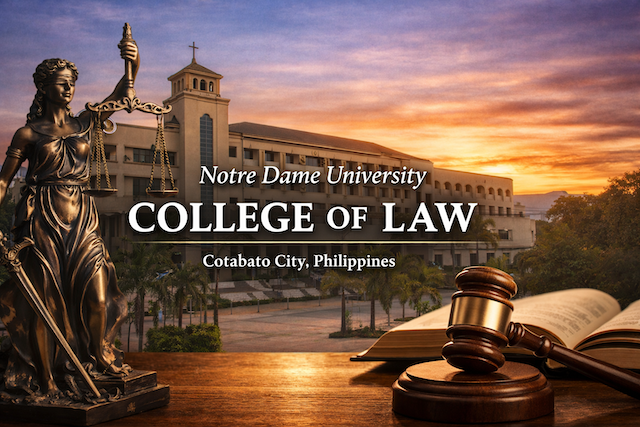
Notre Dame University College of Law: Complete Guide for Prospective Students

Contents

Introduction

Notre Dame University College of Law (NDU College of Law), located in Cotabato City, Philippines, is one of the most respected law schools in Mindanao. Known for its strong academic foundation, ethical formation, and commitment to social justice, the institution has produced many successful lawyers, judges, and public servants over the years.

For students considering legal education in the Philippines—especially in Mindanao—Notre Dame University offers a unique combination of academic rigor, affordability, and mission-driven education. This guide provides a comprehensive overview of the college, including its history, programs, admission requirements, facilities, and career prospects.

Overview of Notre Dame University

Notre Dame University (NDU) is a private Catholic institution founded in 1948 by the Oblates of Mary Immaculate (OMI). The university is well-known for its strong emphasis on values-based education, particularly in promoting peace, intercultural dialogue, and leadership in Mindanao.

The College of Law is one of the university’s flagship programs. It aims to produce competent, ethical, and socially responsible legal professionals who can contribute to nation-building.

Key Highlights

  • Location: Cotabato City, Philippines

  • Type: Private Catholic University

  • Established: 1948 (University), Law program established later

  • Focus: Legal education with strong ethical and social orientation

  • Language of Instruction: English

History and Development of the College of Law

The Notre Dame University College of Law was established to address the growing demand for legal education in Mindanao. At the time, many aspiring lawyers had to travel to major cities like Manila or Cebu to pursue law degrees.

Since its founding, the College of Law has steadily developed its curriculum, faculty, and facilities. It has also gained recognition for producing graduates who pass the Philippine Bar Examination and excel in various legal fields.

The institution has maintained its commitment to serving underserved communities, particularly in Mindanao, where access to justice remains a critical issue.

Academic Programs Offered

Juris Doctor (JD) Program

The primary program offered by the College of Law is the Juris Doctor (JD), which is the standard law degree in the Philippines.

Program Features

  • Duration: Typically 4 years

  • Curriculum: Covers core legal subjects such as:

    • Constitutional Law

    • Civil Law

    • Criminal Law

    • Labor Law

    • Commercial Law

    • Remedial Law

  • Electives: Specialized courses depending on faculty availability

  • Thesis/Research: Required in some cases

The JD program is designed to prepare students for the Philippine Bar Examination while also equipping them with practical legal skills.

Special Focus Areas

Notre Dame University emphasizes:

  • Human rights law

  • Peace and conflict resolution

  • Indigenous peoples’ rights

  • Islamic law (Shari’ah-related topics)

This focus reflects the unique socio-political environment of Mindanao.

Admission Requirements

Admission to the Notre Dame University College of Law is competitive but accessible compared to top-tier schools in Metro Manila.

Basic Requirements

Applicants typically need:

  • A bachelor’s degree from a recognized institution

  • Transcript of records

  • Certificate of good moral character

  • Entrance examination (if required)

  • Interview with the admissions committee

Preferred Background

While any undergraduate degree is accepted, the following are advantageous:

  • Political Science

  • Legal Management

  • Philosophy

  • Business-related courses

However, students from diverse academic backgrounds are also welcomed.

Tuition Fees and Affordability

One of the key advantages of studying at Notre Dame University is its relatively affordable tuition compared to major law schools in Manila.

Estimated Costs

  • Tuition: Lower than top private universities

  • Miscellaneous fees: Moderate

  • Cost of living in Cotabato City: Generally affordable

This makes NDU an attractive option for students seeking quality legal education without the high financial burden.

Scholarships and Financial Aid

The university offers:

  • Academic scholarships

  • Grants for financially disadvantaged students

  • Church-supported assistance programs

These opportunities help make legal education more accessible.

Faculty and Teaching Approach

The College of Law boasts a mix of experienced academics and practicing lawyers.

Faculty Composition

  • Judges

  • Practicing attorneys

  • Legal scholars

  • Government officials

Teaching Style

The teaching approach combines:

  • Lecture-based learning

  • Case method analysis

  • Recitation (a traditional law school practice in the Philippines)

  • Legal writing and research training

Students are trained not only to understand the law but also to apply it effectively.

Facilities and Learning Environment

Notre Dame University provides a supportive academic environment conducive to learning.

Key Facilities

  • Law Library: Contains legal books, journals, and case digests

  • Classrooms: Designed for interactive discussions

  • Moot Court Room: For simulated court proceedings

  • Study Areas: Quiet spaces for reading and preparation

Campus Environment

The campus promotes:

  • Discipline and professionalism

  • Cultural diversity

  • Peace-oriented values

Cotabato City itself offers a unique multicultural setting, enriching the student experience.

Student Life and Organizations

Law school is demanding, but Notre Dame University encourages student engagement beyond academics.

Student Organizations

  • Law Student Government

  • Debate and Moot Court Teams

  • Legal Aid Groups

  • Religious and community service organizations

Activities

Students participate in:

  • Moot court competitions

  • Legal aid missions

  • Community outreach programs

  • Seminars and workshops

These activities help students develop practical skills and professional networks.

Bar Examination Performance

Passing the Philippine Bar Examination is the ultimate goal for law students.

Notre Dame University College of Law has a respectable track record in producing bar passers, especially within Mindanao.

Factors Contributing to Success

  • Strong foundational curriculum

  • Focused bar review support

  • Dedicated faculty mentorship

While it may not consistently rank among top-performing schools nationally, it remains a reliable institution for bar preparation.

Career Opportunities for Graduates

Graduates of Notre Dame University College of Law have diverse career paths.

Common Career Options

  • Private legal practice

  • Government service

  • Judiciary (after years of experience)

  • Corporate legal departments

  • Non-governmental organizations (NGOs)

Regional Advantage

Many graduates choose to work in Mindanao, where there is a strong demand for legal professionals, particularly in areas such as:

  • Land disputes

  • Human rights advocacy

  • Local governance

Strengths of Notre Dame University College of Law

1. Affordable Legal Education

Compared to law schools in Metro Manila, NDU offers a more budget-friendly option without compromising quality.

2. Strong Ethical Foundation

The institution emphasizes moral values, integrity, and service to society.

3. Regional Relevance

Its curriculum is tailored to the realities of Mindanao, including cultural diversity and conflict resolution.

4. Community-Oriented Approach

Students are encouraged to engage in legal aid and community service.

Challenges and Considerations

1. Limited National Exposure

Compared to top law schools in Manila, NDU may have less national visibility.

2. Resource Limitations

Facilities and resources, while adequate, may not match those of larger universities.

3. Competitive Bar Performance

Students need to be self-driven to excel in the bar exam.

Why Choose Notre Dame University College of Law?

Choosing a law school is a major decision, and Notre Dame University offers a unique value proposition.

Ideal for Students Who:

  • Want affordable legal education

  • Prefer studying in Mindanao

  • Are interested in public service and social justice

  • Value ethical and mission-driven education

It is particularly suitable for students who plan to build their legal careers in Mindanao.

Tips for Prospective Students

1. Prepare Academically

  • Strengthen your reading and comprehension skills

  • Familiarize yourself with basic legal concepts

2. Develop Discipline

Law school requires:

  • Consistent study habits

  • Time management

  • Mental resilience

3. Engage in the Community

Take advantage of:

  • Legal aid programs

  • Student organizations

  • Networking opportunities

4. Plan for the Bar Exam Early

Start building a strong foundation from your first year.

Conclusion

Notre Dame University College of Law stands as a solid choice for aspiring lawyers, particularly those who wish to study in Mindanao. With its combination of affordability, ethical education, and community focus, it provides a meaningful pathway into the legal profession.

While it may not have the prestige of some Metro Manila institutions, its strengths lie in its mission-driven approach and regional relevance. For students committed to making a difference—especially in underserved communities—Notre Dame University offers not just a legal education, but a purpose.

Ultimately, success in law school depends not only on the institution but also on the student’s dedication, discipline, and passion for justice. Notre Dame University College of Law provides the foundation—what you build on it is up to you.

FAQs (Frequently Asked Questions)

What is Notre Dame University College of Law known for?

Notre Dame University College of Law is known for offering legal education in Cotabato City with a strong emphasis on academic discipline, ethics, and social responsibility. Many students consider it an attractive option because it provides access to law education in Mindanao without requiring them to move to Metro Manila or other major urban centers. The college is also associated with values-based formation, which appeals to students who want a legal education that is not limited to technical knowledge of statutes and cases. In addition to preparing students for the bar examination, the school is often viewed as a place where future lawyers are trained to think about justice, service, and the role of law in diverse communities.

What degree does Notre Dame University College of Law offer?

The college primarily offers the Juris Doctor, or JD, which is the standard professional law degree in the Philippines. This program is designed to prepare students for legal practice and for the Philippine Bar Examination. The curriculum usually includes major areas of law such as civil law, criminal law, constitutional law, remedial law, labor law, taxation, and commercial law. Students are expected to complete classroom study, legal research, writing requirements, and other academic obligations over several years. The JD program is intended not only to build knowledge of legal rules but also to develop analytical thinking, oral recitation skills, and professional judgment.

How long does it take to finish law school at Notre Dame University?

For most students, completing the Juris Doctor program takes around four years if they follow the standard full-time academic load. However, the actual duration may vary depending on the student’s circumstances, subject availability, and academic performance. Some working students may take a lighter load each term, which can extend the time needed to graduate. Law school in the Philippines is academically demanding, so students often balance class attendance, case reading, recitations, examinations, and personal responsibilities. Because of this, the timeline is not exactly the same for everyone, but four years remains the typical path for those who stay on track.

Can students from any undergraduate course apply to Notre Dame University College of Law?

Yes, students from a wide variety of undergraduate backgrounds can generally apply to law school, including those who finished courses in business, education, engineering, political science, psychology, philosophy, accounting, and many others. A specific pre-law degree is not always required. What matters more is whether the applicant has completed a bachelor’s degree and can meet the school’s admission requirements. That said, applicants who already have strong reading, writing, and analytical skills may find it easier to adjust during their first year. Law school is open to students from many academic paths, which is one reason why classes often include people with diverse experiences and career goals.

What are the usual admission requirements for Notre Dame University College of Law?

Admission requirements generally include a completed bachelor’s degree, official academic records, and other supporting documents such as proof of good moral character. Applicants may also be required to go through an interview and, depending on the school’s current process, an entrance examination or internal screening procedure. Some schools also ask for identification documents, recent photos, and properly completed application forms. Because admission policies can change, applicants should always verify the latest requirements directly with the university before applying. Preparing documents early is a practical step, especially for graduates coming from other schools or from places outside Cotabato City.

Is Notre Dame University College of Law a good option for students in Mindanao?

Yes, it is often considered a strong option for students in Mindanao who want to study law closer to home. One of its major advantages is location. Instead of relocating to Luzon or other faraway cities, students in the region can pursue a legal education in an institution that understands the realities of Mindanao. This may include greater awareness of local cultures, regional issues, and community needs. For students who want to build their future legal careers in Mindanao, studying in a regional law school can also help them create local networks, gain familiarity with local institutions, and develop a deeper understanding of the communities they may eventually serve.

Is law school at Notre Dame University expensive?

Many prospective students view Notre Dame University College of Law as a more affordable choice compared with some high-cost law schools in larger metropolitan areas. However, the total cost of legal education still includes more than tuition alone. Students should also consider miscellaneous fees, books, photocopies or printed materials, transportation, meals, internet access, and bar preparation expenses in the future. Even when a school is relatively affordable, law school remains a serious financial commitment. For this reason, students are encouraged to ask about current tuition rates, installment options, scholarships, and any available financial assistance so they can make realistic plans before enrollment.

What kind of student is the best fit for Notre Dame University College of Law?

The best fit is usually a student who is academically committed, disciplined, and genuinely interested in the study of law and justice. Since law school involves heavy reading loads, frequent recitations, and sustained pressure over several years, students who manage time well and remain consistent tend to adapt better. Notre Dame University may be especially suitable for applicants who value ethical formation, public service, and regional relevance. It can also be a good choice for students who want to become lawyers while staying connected to Mindanao communities. Ultimately, success depends not only on intelligence, but also on perseverance, humility, and the willingness to keep learning under pressure.

Complete List of Law Schools in the Philippines



