2026年3月30日
3D ACADEMY offers affordable English study programs in Cebu, Philippines – perfect for beginners, professionals, and exam takers.

3D UNIVERSAL ENGLISH INSTITUTE INC
info.3d-universal.com
8:00-17:00(Mon-Fri)
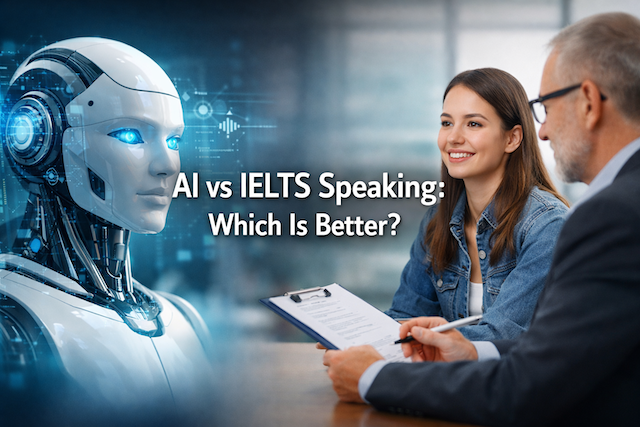
AI vs IELTS Speaking: Which Is Better?
Contents
- AI vs IELTS Speaking: Which Is Better?
- Introduction
- Understanding IELTS Speaking Requirements
- What Is AI Speaking Practice?
- What Is Traditional IELTS Speaking Practice?
- Advantages of AI for IELTS Speaking
- Limitations of AI for IELTS Speaking
- Advantages of Traditional IELTS Speaking Practice
- Limitations of Traditional IELTS Practice
- AI vs Traditional Practice: Direct Comparison
- Which Is Better for IELTS Speaking?
- The Best Strategy: Combine Both
- Practical Tips for Using AI Effectively
- Practical Tips for Traditional Practice
- Conclusion
- FAQs (Frequently Asked Questions)
- Is AI better than traditional IELTS speaking practice?
- Can AI really help improve IELTS speaking scores?
- What are the biggest advantages of using AI for IELTS speaking?
- What are the disadvantages of relying only on AI?
- Is AI good for beginners preparing for IELTS speaking?
- Can AI give accurate feedback on pronunciation?
- How should I combine AI and traditional IELTS speaking practice?
- Should I memorize answers suggested by AI?
- What is the best final answer to the question “AI vs IELTS speaking: which is better?”
AI vs IELTS Speaking: Which Is Better?
Introduction
In recent years, artificial intelligence (AI) has rapidly transformed the way people learn languages, especially English speaking skills. Tools like ChatGPT, speech recognition apps, and AI-powered tutors are now widely used by learners preparing for exams such as IELTS. At the same time, traditional IELTS speaking preparation methods—such as practicing with teachers, partners, or structured courses—remain highly relevant.
This raises an important question: Which is better for improving your IELTS speaking performance—AI or traditional IELTS speaking practice?
The answer is not as simple as choosing one over the other. Both approaches have unique strengths and limitations. In this article, we will compare AI-based speaking practice and traditional IELTS speaking preparation in detail, helping you understand which method suits your goals, level, and study style.
Understanding IELTS Speaking Requirements
Before comparing AI and traditional methods, it is important to understand what the IELTS speaking test actually evaluates.
The IELTS speaking test consists of three parts:
- Part 1: Introduction and interview (basic personal questions)
- Part 2: Long turn (cue card speaking for 1–2 minutes)
- Part 3: Discussion (abstract and analytical questions)
Examiners evaluate your performance based on four criteria:
- Fluency and coherence
- Lexical resource (vocabulary)
- Grammatical range and accuracy
- Pronunciation
To succeed, you need more than just speaking practice. You must also:
- Structure your answers clearly
- Use varied vocabulary
- Maintain fluency under pressure
- Respond naturally to unpredictable questions
This complexity is where both AI and traditional methods play different roles.
What Is AI Speaking Practice?
AI speaking practice refers to using artificial intelligence tools to simulate conversations, provide feedback, and help improve speaking skills.
Common AI tools include:
- ChatGPT (conversation practice)
- Speech recognition apps (pronunciation correction)
- AI language apps (e.g., ELSA, Speak, Duolingo AI features)
- Voice-based chatbots
These tools allow learners to:
- Practice anytime without a partner
- Receive instant feedback
- Simulate IELTS-style questions
- Repeat exercises as many times as needed
AI has made speaking practice more accessible than ever before.
What Is Traditional IELTS Speaking Practice?
Traditional IELTS speaking preparation involves human interaction and structured learning methods.
Examples include:
- Practicing with a teacher
- Speaking with a study partner
- Attending IELTS preparation classes
- Participating in mock interviews
This approach focuses on:
- Real human communication
- Personalized feedback
- Test strategies and techniques
- Emotional and psychological preparation
Traditional methods have been used for decades and are still widely trusted.
Advantages of AI for IELTS Speaking
1. Unlimited Practice Anytime
One of the biggest advantages of AI is availability. You can practice:
- Early morning or late at night
- Every day without scheduling
- As many times as you want
This is especially useful for learners who do not have access to native speakers or teachers.
Consistency is key in language learning, and AI makes daily practice easy.
2. Instant Feedback
AI tools can provide immediate feedback on:
- Grammar mistakes
- Sentence structure
- Pronunciation (in some apps)
This allows learners to correct errors quickly and improve faster.
Unlike human teachers, AI does not require waiting time or appointments.
3. Reduced Anxiety
Many learners feel nervous when speaking English with others. AI creates a stress-free environment where:
- There is no judgment
- You can make mistakes freely
- You can repeat answers without pressure
This helps build confidence, especially for beginners and intermediate learners.
4. Customizable Practice
With AI, you can:
- Request specific IELTS questions
- Focus on weak areas
- Practice Part 2 or Part 3 repeatedly
For example, you can ask:
“Give me 10 IELTS Part 3 questions about education.”
This level of customization is difficult to achieve in traditional settings.
5. Cost-Effective
Many AI tools are free or low-cost compared to:
- IELTS coaching classes
- Private tutors
- Language schools
This makes AI an attractive option for budget-conscious learners.
Limitations of AI for IELTS Speaking
1. Lack of Real Human Interaction
AI cannot fully replicate real conversations with humans.
In IELTS:
- You interact with a real examiner
- You must respond to natural reactions
- You deal with interruptions or follow-up questions
AI conversations may feel predictable and less dynamic.
2. Limited Pronunciation Feedback (in some tools)
While some apps offer pronunciation analysis, many AI tools:
- Do not accurately detect subtle pronunciation errors
- Cannot fully evaluate accent or intonation
Human teachers are still better at identifying these nuances.
3. No Emotional or Social Feedback
Human communication includes:
- Facial expressions
- Tone and emotion
- Natural conversation flow
AI lacks these elements, which are important for real-life speaking and test situations.
4. Risk of Over-Reliance
Some learners may:
- Memorize AI-generated answers
- Depend too much on structured responses
This can lead to unnatural speaking during the actual test.
Advantages of Traditional IELTS Speaking Practice
1. Real Exam Simulation
Practicing with a teacher or partner closely resembles the real IELTS test.
You experience:
- Real-time interaction
- Unexpected questions
- Natural conversation flow
This prepares you mentally and emotionally for the exam.
2. High-Quality Feedback
Experienced teachers can provide:
- Detailed corrections
- Band score evaluation
- Personalized advice
They can identify:
- Weak grammar patterns
- Limited vocabulary usage
- Pronunciation issues
This level of feedback is difficult for AI to match.
3. Interactive Communication Skills
Traditional practice improves:
- Listening and response timing
- Turn-taking in conversation
- Handling interruptions
These are essential skills for IELTS speaking and real-life communication.
4. Motivation and Accountability
Working with a teacher or partner helps you:
- Stay consistent
- Follow a structured plan
- Remain motivated
Many learners struggle to maintain discipline when studying alone with AI.
Limitations of Traditional IELTS Practice
1. Limited Availability
You cannot always practice:
- Whenever you want
- As frequently as needed
Scheduling sessions can be inconvenient.
2. Higher Cost
IELTS preparation courses and private lessons can be expensive, especially for long-term study.
3. Anxiety and Pressure
Some learners feel:
- Nervous speaking in front of others
- Afraid of making mistakes
This can reduce speaking confidence during practice.
4. Less Repetition
Unlike AI, you cannot easily repeat the same question multiple times in one session.
AI vs Traditional Practice: Direct Comparison
| Feature | AI Practice | Traditional Practice |
|---|---|---|
| Availability | 24/7 | Limited |
| Cost | Low | High |
| Feedback Speed | Instant | Delayed |
| Feedback Quality | Moderate | High |
| Real Interaction | Low | High |
| Anxiety Level | Low | Medium/High |
| Customization | High | Medium |
| Exam Simulation | Low | High |
Which Is Better for IELTS Speaking?
For Beginners
AI is often better because:
- It reduces fear
- Allows repeated practice
- Builds basic confidence
However, beginners should eventually transition to human interaction.
For Intermediate Learners
A combination works best:
- Use AI for daily practice
- Use teachers for feedback
This balanced approach accelerates improvement.
For Advanced Learners
Traditional practice becomes more important because:
- Fine-tuning pronunciation matters
- Natural fluency is critical
- Real interaction is essential
AI alone is not enough at this stage.
The Best Strategy: Combine Both
The most effective IELTS preparation strategy is not choosing one over the other, but combining both methods.
Example Study Plan
Daily (AI Practice):
- 20–30 minutes speaking with AI
- Practice Part 1, 2, and 3 questions
- Focus on fluency and idea generation
Weekly (Traditional Practice):
- 2–3 sessions with a teacher or partner
- Mock speaking tests
- Detailed feedback
This hybrid approach provides:
- High practice volume
- High-quality corrections
- Real exam preparation
Practical Tips for Using AI Effectively
To maximize AI benefits:
- Ask for IELTS-style questions
- Record your answers
- Review and improve responses
- Avoid memorizing AI-generated answers
- Focus on natural speaking
Example prompt:
“Act as an IELTS examiner and ask me Part 2 questions. Then give feedback on my answer.”
Practical Tips for Traditional Practice
To get the most from human practice:
- Simulate real test conditions
- Time your responses
- Ask for band score evaluation
- Focus on weak areas
Consistency is more important than intensity.
Conclusion
So, which is better—AI or traditional IELTS speaking practice?
The reality is that both are powerful tools, but they serve different purposes.
- AI is excellent for daily practice, confidence building, and convenience
- Traditional methods are essential for real interaction, advanced feedback, and exam readiness
If you rely only on AI, you may lack real communication skills.
If you rely only on traditional methods, you may not get enough practice.
The best approach is clear: combine both strategically.
By using AI for consistent practice and human interaction for refinement, you can significantly improve your IELTS speaking performance and achieve your target band score more efficiently.
Ultimately, success in IELTS speaking comes not from the tool you choose, but from how consistently and intelligently you use it.
FAQs (Frequently Asked Questions)
Is AI better than traditional IELTS speaking practice?
AI is not always better, but it is often more convenient. AI tools are useful because they let you practice anytime, repeat questions as often as you want, and receive immediate feedback on grammar, vocabulary, or fluency. Traditional IELTS speaking practice, however, is still very important because the real IELTS test is a live interview with a human examiner. Human practice helps you get used to natural conversation, unexpected follow-up questions, and the pressure of speaking in real time. In most cases, the best option is not to choose only one. A combination of AI practice and traditional speaking practice is usually the most effective way to prepare for the IELTS speaking test.
Can AI really help improve IELTS speaking scores?
Yes, AI can help improve IELTS speaking scores when used properly. It can support learners in developing fluency, organizing answers, and expanding vocabulary. For example, AI can generate IELTS-style Part 1, Part 2, and Part 3 questions and can also suggest better ways to express ideas. This is especially useful for learners who do not have access to a teacher every day. However, AI should not be treated as a complete replacement for real practice. It is best used as a daily training tool that helps you build confidence and consistency, while human feedback and mock interviews help you refine your performance for the actual exam.
What are the biggest advantages of using AI for IELTS speaking?
The biggest advantages of AI are flexibility, affordability, and repetition. You can practice at any time without needing a speaking partner, which makes it easier to build a daily study habit. AI tools are also helpful for learners who feel shy or nervous because they create a low-pressure environment where making mistakes feels less embarrassing. Another major benefit is customization. You can ask AI to focus on a specific topic such as education, travel, technology, or environment, and you can request band-style feedback or sample follow-up questions. This level of convenience makes AI an excellent support tool for IELTS speaking preparation.
What are the disadvantages of relying only on AI?
If you rely only on AI, you may miss several important parts of real IELTS speaking preparation. First, AI cannot fully reproduce the feeling of speaking with a real examiner. Human conversations include interruptions, tone shifts, and subtle reactions that AI still cannot perfectly simulate. Second, some AI tools may give feedback that is too general or not fully accurate, especially for pronunciation, intonation, or naturalness. Third, some learners start depending too much on AI-generated model answers, which can make their speaking sound memorized or unnatural. Because of these limits, AI should be used as part of a wider study plan rather than as the only preparation method.
Is AI good for beginners preparing for IELTS speaking?
Yes, AI is especially useful for beginners. Many beginners feel nervous when they first try to speak English, and AI gives them a private space to practice without fear of judgment. Beginners can use AI to answer simple questions, learn how to extend their responses, and become more comfortable speaking in full sentences. It is also a good way to build vocabulary and get used to common IELTS topics. That said, beginners should gradually add human interaction to their study routine. Once they feel more confident with AI, they should start practicing with a teacher, tutor, or partner so they can adjust to real communication and test conditions.
Can AI give accurate feedback on pronunciation?
AI can help with pronunciation, but its accuracy depends on the tool. Some speech-based apps are specifically designed to evaluate pronunciation, stress, and clarity, and these can be useful for identifying obvious pronunciation mistakes. However, AI is still limited when it comes to more advanced features such as intonation, natural rhythm, connected speech, and whether your pronunciation sounds clear in real conversation. A human teacher is usually better at explaining why something sounds unnatural and how to fix it. For this reason, AI pronunciation feedback can be helpful for daily correction, but learners should still include human feedback if possible.
How should I combine AI and traditional IELTS speaking practice?
A practical approach is to use AI for daily speaking practice and traditional methods for weekly review. For example, you could spend 20 to 30 minutes each day answering AI-generated IELTS questions, practicing cue cards, and improving your fluency. Then, once or twice a week, you could do a live mock speaking test with a teacher or study partner. This combination works well because AI increases your speaking volume, while human practice improves your ability to perform under realistic conditions. The more consistently you combine both, the more balanced your speaking development becomes.
Should I memorize answers suggested by AI?
No, memorizing AI-generated answers is not a good strategy. IELTS examiners are trained to notice memorized responses, especially when answers sound too perfect, unnatural, or unrelated to the actual question. Instead of memorizing full answers, use AI to learn useful vocabulary, topic ideas, linking phrases, and answer structures. Then practice expressing those ideas in your own words. Your goal should be to sound natural, flexible, and confident rather than robotic. AI is most effective when it helps you develop your speaking ability, not when it becomes a source of scripts to copy word for word.
What is the best final answer to the question “AI vs IELTS speaking: which is better?”
The best final answer is that neither one is completely better on its own. AI is better for convenience, daily repetition, confidence building, and affordable practice. Traditional IELTS speaking practice is better for realistic interaction, detailed correction, and final exam preparation. If you want the strongest results, use both. Let AI help you practice regularly and build fluency, and let teachers or speaking partners help you prepare for the real pressure and flow of the IELTS speaking test. In other words, the most effective method is not AI alone or traditional practice alone, but a smart combination of both.
How to Improve English Speaking Using AI Apps (Complete Guide 2026)

How to Register for eTravel Philippines (2025 Guide)
Step-by-step guide to completing your eTravel registration before arriving in the Philippines, with images and tips.

Night Market in Cebu – Things You Don’t Know About Cebu Life
Discover the hidden charm of Cebu’s night markets, from street food stalls to local life tips you won’t find in tourist guides.

How to Use ChatGPT for IELTS Preparation: A Complete Guide
Learn how to prepare for IELTS using ChatGPT — including strategies for Writing, Reading, Listening, Speaking, and grammar support.

How to Build a Website Without Coding Using ChatGPT
Discover how to build your own website using AI—no coding skills needed. From structure planning to SEO and design, let ChatGPT guide you.