2026年3月30日
3D ACADEMY offers affordable English study programs in Cebu, Philippines – perfect for beginners, professionals, and exam takers.

3D UNIVERSAL ENGLISH INSTITUTE INC
info.3d-universal.com
8:00-17:00(Mon-Fri)
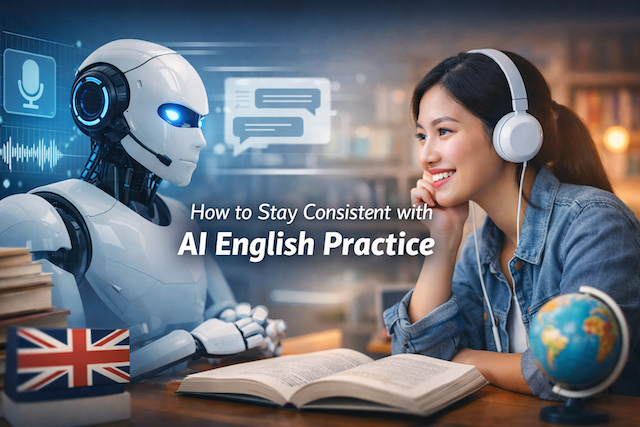
How to Stay Consistent with AI English Practice
Contents
- How to Stay Consistent with AI English Practice
- Why Consistency Matters More Than Talent
- The Real Problem: Why Most People Quit
- Step 1: Define a Clear and Simple Goal
- Step 2: Build a Fixed Daily Routine
- Step 3: Keep It Simple (Avoid Overengineering)
- Step 4: Make Practice Enjoyable
- Step 5: Track Progress (Even Small Wins)
- Step 6: Accept Imperfection
- Step 7: Use AI as a Coach, Not Just a Tool
- Step 8: Reduce Friction as Much as Possible
- Step 9: Create a “Minimum Effort Rule”
- Step 10: Combine AI with Real-Life Exposure
- Common Mistakes That Break Consistency
- A Simple 30-Minute Daily AI Routine
- Final Thoughts
- FAQs (Frequently Asked Questions)
- How often should I practice English with AI to see real improvement?
- What is the best type of AI English practice for consistency?
- Can AI really help me improve my English speaking skills?
- What should I do on days when I feel unmotivated?
- How can I make AI English practice less boring?
- Should I use multiple AI tools or just one?
- How do I know if my AI English practice is actually working?
- Is it okay to make mistakes when practicing with AI?
How to Stay Consistent with AI English Practice
Why Consistency Matters More Than Talent
When it comes to learning English, especially speaking skills, consistency is far more important than natural talent. Many learners believe that fluency comes from intelligence, exposure, or even luck. In reality, fluency is built through repeated, daily engagement with the language.
AI tools have made English practice more accessible than ever. You can now speak, write, and receive feedback anytime without needing a human partner. However, access alone does not guarantee progress. The real challenge is staying consistent.
Consistency transforms small daily efforts into long-term fluency. Practicing for 20–30 minutes every day is far more effective than studying for 5 hours once a week. AI can support this consistency—but only if you use it regularly and with intention.
The Real Problem: Why Most People Quit
Before discussing how to stay consistent, it’s important to understand why most learners fail to maintain their practice.
The most common reasons include:
- Lack of clear goals
- Overcomplicated study methods
- Loss of motivation
- Boredom with repetitive practice
- Unrealistic expectations
- No visible progress
AI tools sometimes make this worse. Because they are easy to use, learners jump between apps, try too many features, and never build a stable routine.
Consistency fails not because of difficulty—but because of confusion and lack of structure.
Step 1: Define a Clear and Simple Goal
Consistency begins with clarity. If your goal is vague like “I want to improve my English,” you will struggle to stay motivated.
Instead, define a specific and achievable goal such as:
- Speak English for 15 minutes daily
- Practice 5 conversation topics per week
- Improve pronunciation using AI feedback for 10 minutes a day
Clear goals reduce decision fatigue. You no longer ask, “What should I do today?” You already know.
With AI, you can create structured prompts like:
- “Let’s do a 10-minute conversation about travel.”
- “Correct my grammar and suggest better expressions.”
- “Act as an English teacher and ask me questions.”
This turns AI into a daily practice partner rather than a random tool.
Step 2: Build a Fixed Daily Routine
Consistency is not about motivation—it’s about routine.
Instead of relying on how you feel, create a fixed schedule. For example:
- Morning (10 minutes): Speak with AI
- Afternoon (5 minutes): Review corrections
- Evening (10 minutes): Free conversation
The key is to attach your English practice to an existing habit. For example:
- After breakfast
- During commute
- Before sleeping
This is called habit stacking. When your practice becomes part of your daily rhythm, you no longer need willpower.
AI makes this easier because it removes barriers. You don’t need to book a class or find a partner. You just open your device and start.
Step 3: Keep It Simple (Avoid Overengineering)
One of the biggest mistakes learners make is creating overly complex systems.
They use multiple apps, track too many metrics, and follow complicated study plans. This leads to burnout.
Instead, simplify your system:
- Use one or two AI tools only
- Focus on speaking, not perfection
- Repeat similar exercises daily
For example, a simple routine could be:
- Talk with AI for 15 minutes
- Get corrections
- Repeat improved sentences
That’s it.
Consistency thrives on simplicity. The easier your routine, the more likely you are to stick with it.
Step 4: Make Practice Enjoyable
If your practice feels like a chore, you will eventually quit.
AI gives you the flexibility to make learning fun. You can:
- Role-play real-life situations (job interviews, travel, dating)
- Discuss your favorite topics (movies, business, sports)
- Simulate real conversations with different personalities
Instead of studying “English,” you are using English.
For example:
- “Let’s simulate a business meeting.”
- “Pretend you are a friend and talk casually with me.”
- “Debate with me about technology.”
Enjoyment increases engagement, and engagement drives consistency.
Step 5: Track Progress (Even Small Wins)
Many learners quit because they feel like they are not improving.
The problem is not lack of progress—but lack of visibility.
You need to track your improvement, even in small ways:
- Record your speaking once a week
- Save corrected sentences
- Measure how long you can speak without stopping
AI can help by:
- Providing feedback history
- Showing repeated mistakes
- Highlighting improvements over time
When you see progress, even small improvements, your motivation increases naturally.
Step 6: Accept Imperfection
Perfection is the enemy of consistency.
Many learners hesitate to speak because they are afraid of making mistakes. This leads to procrastination and inconsistency.
AI is the perfect environment to overcome this fear. There is no judgment.
You can:
- Speak incorrectly
- Try new expressions
- Experiment with different styles
The goal is not to speak perfectly—but to speak regularly.
Consistency builds fluency. Perfection comes later.
Step 7: Use AI as a Coach, Not Just a Tool
Most learners use AI passively. They ask questions and receive answers.
To stay consistent, you need to use AI actively.
Turn AI into a coach:
- Ask it to give you daily tasks
- Request feedback on your weaknesses
- Create structured practice sessions
For example:
- “Give me a daily speaking challenge.”
- “Correct my mistakes and explain them.”
- “Track my progress and suggest improvements.”
When AI acts as a coach, your learning becomes guided and structured.
Step 8: Reduce Friction as Much as Possible
Every small obstacle reduces consistency.
If your setup is complicated, you will skip practice.
Reduce friction by:
- Keeping your AI tool easily accessible (phone, browser shortcut)
- Preparing prompts in advance
- Using voice input for faster interaction
The easier it is to start, the more consistent you will be.
Your goal is to make practice almost automatic.
Step 9: Create a “Minimum Effort Rule”
Some days, you won’t feel motivated. That’s normal.
Instead of skipping practice, create a minimum rule:
- Speak for at least 5 minutes
- Do one simple exercise
- Review one correction
Even on bad days, you maintain the habit.
Consistency is not about intensity—it’s about continuity.
Missing one day can lead to missing a week. A 5-minute session prevents that.
Step 10: Combine AI with Real-Life Exposure
While AI is powerful, relying on it alone can limit your progress.
To stay consistent and improve faster, combine AI with real-world input:
- Watch English videos
- Listen to podcasts
- Read articles
Then use AI to practice what you learned.
For example:
- Summarize a video using AI
- Discuss a podcast topic
- Practice new vocabulary in conversation
This creates a feedback loop between input and output, which is essential for fluency.
Common Mistakes That Break Consistency
Even with good intentions, certain habits can destroy your consistency.
Be aware of these:
Switching Tools Too Often
Constantly trying new AI apps prevents routine building.
Focusing Only on Passive Learning
Watching videos without speaking leads to slow progress.
Setting Unrealistic Goals
Trying to practice for 2 hours daily often leads to burnout.
Ignoring Feedback
If you don’t review corrections, you repeat the same mistakes.
Waiting for Motivation
Motivation is unreliable. Systems are reliable.
Avoiding these mistakes is just as important as building good habits.
A Simple 30-Minute Daily AI Routine
Here is a practical example you can follow:
Part 1: Speaking (15 minutes)
Talk with AI about a topic (travel, work, daily life)
Part 2: Feedback (10 minutes)
Review corrections and improved sentences
Part 3: Repetition (5 minutes)
Repeat corrected sentences aloud
This simple structure is enough to build fluency over time.
Final Thoughts
Staying consistent with AI English practice is not about finding the perfect method. It is about creating a system that is simple, enjoyable, and sustainable.
AI gives you unlimited opportunities to practice—but only consistency turns those opportunities into results.
If you focus on small daily actions, remove friction, and build a routine, you will see progress faster than you expect.
Fluency is not built in a day. But it is built every day.
And with AI, you now have everything you need—anytime, anywhere.
FAQs (Frequently Asked Questions)
How often should I practice English with AI to see real improvement?
You should aim to practice English with AI as often as possible, but daily practice is usually the most effective approach. Even 15 to 30 minutes a day can produce strong results over time if you stay consistent. The main reason daily practice works so well is that it keeps English active in your mind. When you use the language regularly, you strengthen vocabulary recall, sentence formation, listening habits, and speaking confidence.
Many learners think they need long study sessions to improve, but that is not always true. A short daily routine is often better than a very long practice session once or twice a week. Consistency helps you build momentum. It also makes English feel like part of your normal life rather than a separate academic task.
If daily practice feels difficult at first, start with a smaller target. For example, you can speak with AI for 10 minutes every morning or do one writing prompt every evening. The important thing is not to create a perfect schedule. The important thing is to create a routine you can actually keep.
What is the best type of AI English practice for consistency?
The best type of AI English practice is the one that feels simple, useful, and realistic for your daily life. For most learners, speaking practice is the most effective place to start because it directly builds fluency, confidence, and sentence production. However, speaking is not the only option. You can also use AI for pronunciation correction, grammar feedback, writing support, vocabulary review, or conversation simulation.
If your main goal is to stay consistent, choose one or two core activities and repeat them regularly. For example, you might use AI for a 15-minute conversation each day and then spend 5 minutes reviewing corrected sentences. This is simple, practical, and sustainable. You do not need to use every feature an AI tool offers.
The best practice style is one that removes confusion. If you constantly change apps, prompts, or study methods, you may lose focus and stop practicing. A simple system is easier to maintain. When practice becomes easy to begin, consistency becomes much more natural.
Can AI really help me improve my English speaking skills?
Yes, AI can be very helpful for improving English speaking skills, especially if you do not have a conversation partner or teacher available every day. AI allows you to practice anytime, repeat topics as often as you want, and receive instant feedback. This makes it especially useful for building speaking habits and reducing fear.
One major benefit is that AI creates a low-pressure environment. Many learners hesitate to speak English because they are worried about mistakes or embarrassment. With AI, you can practice freely without feeling judged. This helps you speak more often, and frequent speaking leads to faster progress.
That said, AI works best when used actively. If you only ask grammar questions or read explanations, your speaking may not improve much. To build real speaking skill, you need to produce language. Ask AI to role-play conversations, ask follow-up questions, correct your answers, and help you say things more naturally. AI is most powerful when it becomes an interactive speaking partner rather than just an information tool.
What should I do on days when I feel unmotivated?
On unmotivated days, the best strategy is to reduce the size of your task instead of skipping practice completely. Many learners fail because they believe every session must be long or productive. In reality, even a very short session helps preserve the habit. A 5-minute conversation with AI is much better than doing nothing.
You can create a minimum-effort rule for difficult days. For example, tell yourself that you only need to answer three questions in English, review one correction, or read one short paragraph aloud. These tiny actions keep your routine alive. Once you begin, you may even continue longer than expected.
Motivation naturally rises and falls. That is normal. Consistency depends more on systems than feelings. If your practice routine is easy to start and flexible enough for low-energy days, you are much more likely to continue over the long term. The goal is not to be perfect every day. The goal is to avoid breaking the habit.
How can I make AI English practice less boring?
You can make AI English practice less boring by using topics and situations that actually interest you. One of the biggest advantages of AI is flexibility. You are not forced to follow the same textbook dialogue every day. You can ask AI to discuss travel, work, movies, business, relationships, technology, or any subject you enjoy.
Role-play is also a great way to make practice more engaging. For example, you can ask AI to act as a job interviewer, a hotel receptionist, a customer, a business client, or a friend having a casual conversation. These situations feel more realistic and can make practice more dynamic.
Another useful method is to vary the purpose of each session while keeping the same overall routine. One day you can do free conversation. Another day you can focus on pronunciation. Another day you can summarize a video or article. Variety inside a stable system helps you stay interested without losing consistency.
Should I use multiple AI tools or just one?
For most learners, using one main AI tool is the better choice, especially if consistency is your priority. Too many tools often create confusion, distraction, and wasted time. Instead of practicing English, you may end up comparing apps, testing features, and changing methods every few days.
A single reliable tool is usually enough for conversation practice, corrections, vocabulary support, and idea generation. Once you become comfortable with one system, practice becomes faster and easier to start. This reduces mental friction and helps you stay regular.
You can still add a second tool if it serves a very specific purpose, such as pronunciation scoring or speaking transcription. However, your daily routine should remain simple. The more decisions you need to make before practicing, the more likely you are to postpone it. Consistency becomes much easier when your setup is clear and familiar.
How do I know if my AI English practice is actually working?
You can tell your AI English practice is working by looking for small but clear signs of progress. For example, you may notice that you can answer questions faster, speak for a longer time without stopping, make fewer grammar mistakes, or express your thoughts more naturally. These changes are often gradual, so it is important to track them.
One useful method is to record yourself speaking once a week on the same topic. After a few weeks, compare the recordings. You may hear better pronunciation, smoother rhythm, or more confidence. You can also keep a list of corrected sentences and notice whether you start using improved patterns naturally in later conversations.
Progress in language learning is not always dramatic from one day to the next. It often becomes visible only when you compare yourself over time. That is why simple tracking is helpful. If you measure your speaking regularly, even in a basic way, you will be more likely to stay motivated and consistent.
Is it okay to make mistakes when practicing with AI?
Yes, it is completely okay to make mistakes when practicing with AI. In fact, making mistakes is a necessary part of language learning. If you wait until you can speak perfectly, you will practice less, hesitate more, and progress more slowly. AI gives you a safe place to make errors, get corrections, and try again immediately.
Mistakes show you what needs improvement. They are not proof that you are failing. They are part of the learning process. When AI corrects your grammar, vocabulary, sentence structure, or pronunciation, it gives you information you can use in your next session.
The key is not to avoid mistakes. The key is to notice them, understand them, and keep practicing. Learners who accept imperfection usually improve faster because they speak more often. Fluency grows through repeated use, not through fear. AI works best when you treat it as a space for active practice, experimentation, and steady growth.
How to Improve English Speaking Using AI Apps (Complete Guide 2026)

How to Register for eTravel Philippines (2025 Guide)
Step-by-step guide to completing your eTravel registration before arriving in the Philippines, with images and tips.

Night Market in Cebu – Things You Don’t Know About Cebu Life
Discover the hidden charm of Cebu’s night markets, from street food stalls to local life tips you won’t find in tourist guides.

How to Use ChatGPT for IELTS Preparation: A Complete Guide
Learn how to prepare for IELTS using ChatGPT — including strategies for Writing, Reading, Listening, Speaking, and grammar support.

How to Build a Website Without Coding Using ChatGPT
Discover how to build your own website using AI—no coding skills needed. From structure planning to SEO and design, let ChatGPT guide you.