
Medical English Course
A practical medical English course for doctors, nurses, pharmacists and other healthcare professionals, and for students at medical and health science universities. Study step by step with Medical English 1–3, our original textbook series, then move on to the OET Preparation Course.
From basic hospital situations to nursing practice and OET-style role plays, this course builds the medical terms and patient communication skills you need, at a level that matches your English.
We have also officially launched our OET Preparation Course, which we offered on request until now. If you want to build a solid base first, start with the Medical English Course. If your English is already strong, you can start directly with OET preparation.
Course overview
| Item | Details |
|---|---|
| Lesson plans | Choose one of two plans: (1) Medical English one-to-one lessons, 5 classes a day; (2) Medical English one-to-one lessons, 4 classes a day + ESL group class. |
| Fees | The same as our existing exam preparation courses. |
| Eligibility | Limited to healthcare professionals (doctors, nurses, pharmacists, etc.) and students enrolled at medical or health science universities. We will confirm this when you apply. |
| Teachers | Lessons are taught by the teachers of our current OET Preparation Course. |
| Textbooks | Our original series, Medical English 1–3. You learn medical terms and patient communication step by step, from the basics. |
| Bridge to OET | If your English is not yet ready for OET preparation, the course is designed so that you can move smoothly into OET study after you finish. |
A step-by-step pathway from medical English to OET
With the Medical English Course, you can now study step by step, from basic medical English to OET preparation, according to your English level and goals. We recommend a starting book based on your English level.
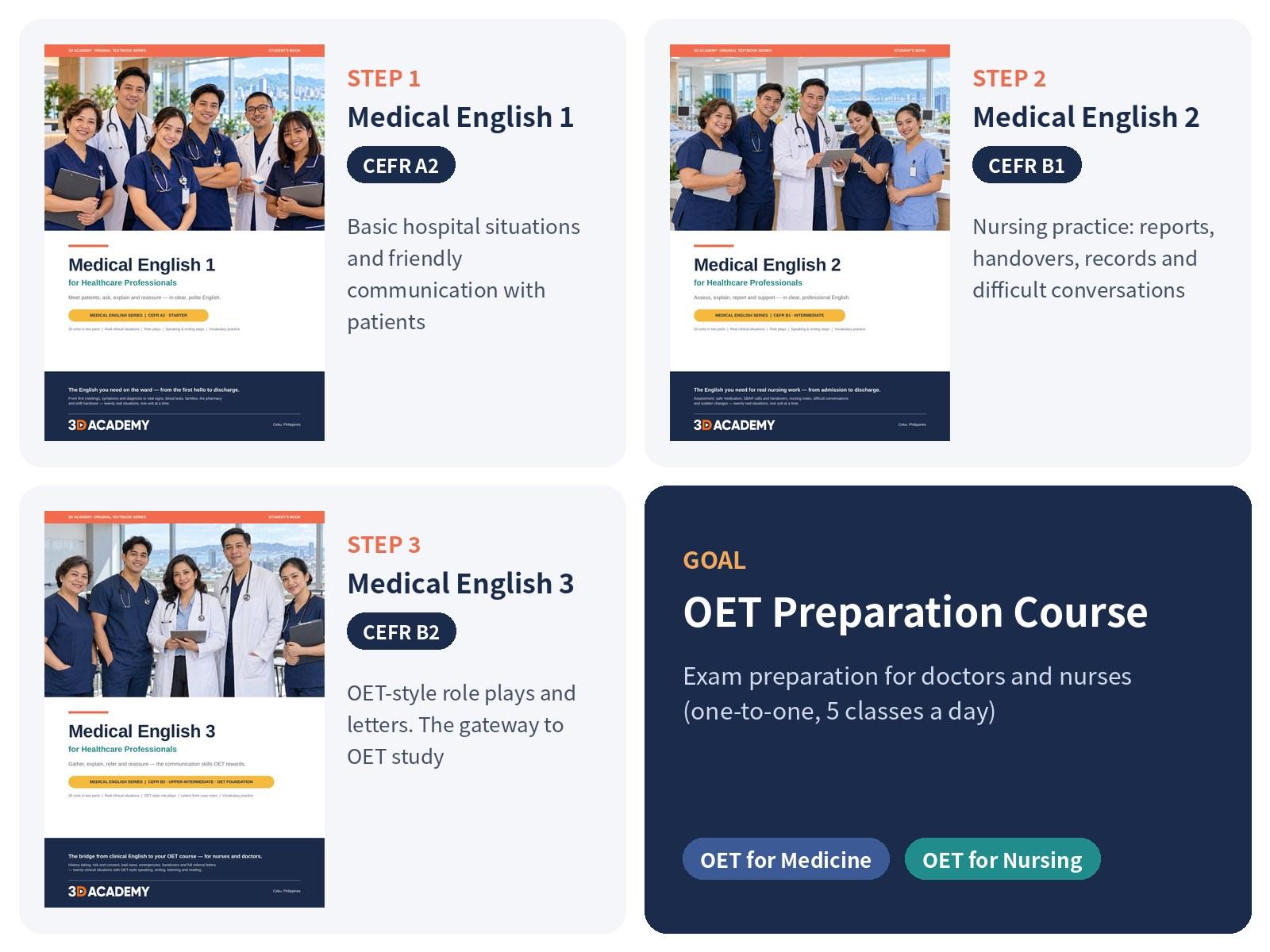
* CEFR levels are a guide to each book's target level.
Where to start (guide)
| English level | Starting point | Main goals |
|---|---|---|
| Basic everyday English; new to medical English | Medical English 1 (A2) | Handle basic situations in simple English: greeting patients, asking about symptoms, explaining medication and discharge |
| Can manage basic conversations | Medical English 2 (B1) | Explain nursing care, report with SBAR, write nursing notes, and deal with upset patients and families |
| Intermediate or above, with OET in mind | Medical English 3 (B2) | Get used to OET-style role plays and writing referral and discharge letters from case notes |
| English level ready for OET | OET Preparation Course | Prepare for the test in the format for doctors or nurses |
Who is it for?
Healthcare professionals planning to work or train abroad
You want to feel confident talking with patients in English, or you plan to take the OET later but need a solid base first.
Medical and health science students
You want medical English before studying or training abroad, and want to learn terms and patient communication systematically.
Doctors and nurses aiming for the OET
If your English is strong, start with the OET Preparation Course. If you are not ready yet, start with the Medical English Course.
Our original textbooks: Medical English 1–3
A three-book series developed by 3D ACADEMY for the Medical English Course. The situations and tasks become more challenging with each level.
| Medical English 1 | Medical English 2 | Medical English 3 | |
|---|---|---|---|
| Level | CEFR A2 (elementary) | CEFR B1 (intermediate); B1+ in Units 11–20 | CEFR B2 (upper-intermediate); gateway to OET |
| For | Healthcare workers and students | Mainly nurses (doctors also appear) | Nurses and doctors |
| Units | 20 units | 20 units | 20 units |
| Student's Book | 103 pages | 103 pages | 103 pages |
| Main content | Greetings, history taking, symptoms and pain, vital signs, explaining medication and discharge, handover | Admission assessment, safe medication, SBAR, nursing notes, a deteriorating patient, discharge teaching | SOCRATES, SPIKES, ISBAR, OET-style role cards, referral and discharge letters |
Features of the series
- The same 5-page flow in every unit: dialogue, expressions, role play, writing, vocabulary. A clear routine that makes preparation and review easy.
- A focus on speaking: role plays and pair work in every unit, so new expressions are used in conversation right away.
- A Teacher's Guide for each book: lesson plans, teaching points, full answer keys and role-play rubrics.
- Safe, realistic language: explanations that respect each professional role (for example, nurses do not diagnose; they report to the doctor). Photos show each situation at a glance.
Medical English 1 (CEFR A2, elementary)
An introductory book that helps you handle basic hospital situations in simple English. From the first greeting to asking about symptoms and explaining medication and discharge, you learn the expressions you need every day at work. Short dialogues introduce each situation and its language, followed by pair work and short writing practice.
Units: 1. Meeting a Patient for the First Time 2. Taking Basic Patient Information 3. Asking About Symptoms 4. Pain Assessment 5. Explaining a Diagnosis 6. Giving Instructions 7. Explaining Medication 8. Talking About Test Results 9. Reassuring a Patient 10. Giving Discharge Instructions 11. Showing a Patient Around the Ward 12. Checking Vital Signs 13. Asking About Medical History 14. Preparing for a Blood Test 15. Helping a Patient Move Safely 16. Talking About Meals and Diet 17. Talking with a Patient's Family 18. At the Pharmacy Counter 19. Making a Follow-Up Appointment 20. Handing Over to the Next Shift
Medical English 2 (CEFR B1, intermediate)
An intermediate book that takes you deeper into the English of real nursing work, from admission assessment to emergency response and discharge teaching. The second half covers SBAR reports, nursing notes and difficult conversations. In Units 1–10 the writing tasks are supported; in Units 11–20 you write 80–120 word notes and explanations on your own, and the later role plays have no script, so you learn to respond on the spot.
Units: 1. Admitting a New Patient 2. Taking a Pain History 3. Asking About Breathing Problems 4. Checking on a Patient After Surgery 5. Giving Medication Safely 6. Explaining an IV Drip 7. Caring for a Patient with Diabetes 8. Preventing Falls 9. Changing a Wound Dressing 10. Teaching a Patient to Use an Inhaler 11. Calling the Doctor About a Patient 12. Giving a Handover with SBAR 13. Writing a Short Nursing Note 14. Talking to an Angry Patient 15. Working with an Interpreter 16. Preparing a Patient for a Scan 17. Supporting a Worried Family 18. Caring for a Confused Older Patient 19. Responding When a Patient Gets Worse 20. Discharge Teaching and Follow-Up
Medical English 3 (CEFR B2, upper-intermediate; OET foundation)
An upper-intermediate book that bridges to the OET Preparation Course for both nurses and doctors. In every unit you practice the two skills assessed in the OET: role plays with patients, and letters written from case notes. Each unit has two OET-style role cards (one for nurses, one for doctors), a letter from case notes (partly guided in the first half, a full 180–200 word letter in the second half), and OET-style listening and reading.
Units: 1. Taking a Detailed Symptom History 2. Explaining Risks and Gaining Consent 3. Breaking Bad News with Care 4. Responding to a Distressed Patient 5. Communicating Across Cultures 6. Discussing Treatment Options 7. Assessing a Deteriorating Patient 8. Handover and Escalation with ISBAR 9. Medication Counseling and Adherence 10. Talking with Parents About a Sick Child 11. Supporting Lifestyle Change: Smoking 12. Explaining Test Results 13. Post-operative Pain and Wound Care 14. Living with Diabetes at Home 15. Low Mood and Anxiety 16. A Patient with Dementia and Their Carer 17. Open Disclosure After an Incident 18. Pre-operative Assessment and Anxiety 19. Palliative Care Conversations 20. OET-Style Integrated Simulation
Our OET Preparation Course
The OET (Occupational English Test) is an English test for healthcare professionals. It assesses the English communication skills needed in healthcare settings in English-speaking countries. In our OET Preparation Course, you prepare for the OET for your own profession in one-to-one lessons.
- Lesson plan: OET one-to-one lessons, 5 classes a day
- Professions: OET for Medicine (doctors) and OET for Nursing (nurses)
- Based on our experience since the early launch, the course is now officially available.
Notes
- This course is limited to healthcare professionals (doctors, nurses, pharmacists, etc.) and students enrolled at medical or health science universities.
- Drug doses and test values in the books are examples for language learning.
- Course and textbook details may change.
Ask us about the Medical English Course.
We will suggest the right starting book and course for your English level. We usually reply within 1–2 business days.