2025年10月18日
3D ACADEMY offers affordable English study programs in Cebu, Philippines – perfect for beginners, professionals, and exam takers.

3D UNIVERSAL ENGLISH INSTITUTE INC
info.3d-universal.com
8:00-17:00(Mon-Fri)
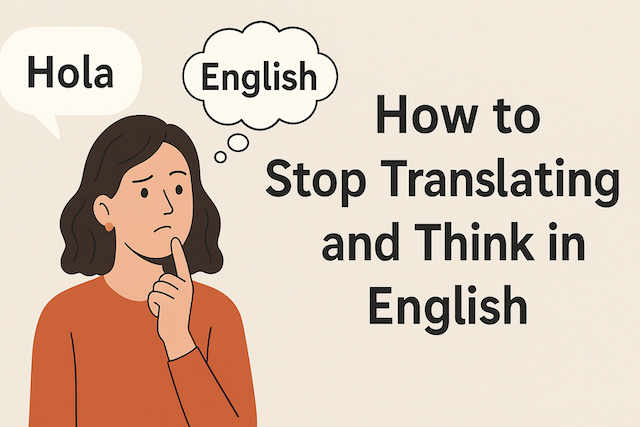
How to Stop Translating and Think in English
Contents
- How to Stop Translating and Think in English
- Why Your Brain Translates (and Why It’s Okay at First)
- Start Small: Think with Simple English
- Label Your World in English (Physically or Mentally)
- Run an English Inner Monologue
- Think in Pictures, Not Dictionaries
- Immerse: Fill the Day with Input You Actually Enjoy
- Use English Even When You Don’t “Need” To
- Learn Chunks, Not Single Words
- Upgrade Your Output with “Easy Upgrades”
- React in English (Not in Your L1)
- Build Tolerance for Ambiguity
- Correct Strategically: Two-Pass Method
- Set Tiny, Trackable Challenges
- Practical Tools You Can Use Right Now
- Common Traps to Avoid
- How Long Does the Shift Take?
- A 10-Minute Daily Routine (No Prep Needed)
- Mindset: Treat English as a Tool You Live In
- Conclusion
- What does “thinking in English” actually mean?
- Why is translating in my head a problem?
- How can I start thinking in English if I’m a beginner?
- What daily exercises train my brain to stop translating?
- Should I avoid my first language completely?
- What are “chunks,” and why are they so powerful?
- How do I learn chunks efficiently?
- What’s the best way to handle words I don’t know in the moment?
- How can I react quickly without freezing or translating?
- What input should I consume to reinforce thinking in English?
- How do I balance fluency and accuracy while avoiding translation?
- How long will it take to notice real change?
- What common mistakes keep learners stuck in translation?
- Can I design a simple daily plan to build the habit?
- How do I measure progress without test scores?
- What mindset helps the transition stick long-term?
How to Stop Translating and Think in English
Many English learners struggle with one habit that quietly slows everything down: translating from their native language before speaking or writing. It feels safe—your first language is familiar—but that extra mental step creates hesitations, awkward pauses, and sentences that don’t quite sound natural. The real goal of fluency is to connect ideas directly to English, without passing through another language first. This shift doesn’t happen overnight, but with the right daily practices you can train your brain to think in English. Below is a practical, step-by-step guide you can start using today.
Why Your Brain Translates (and Why It’s Okay at First)
Your brain relies on the system it already knows best—your first language—to process new information. In early stages, translation is a bridge. The problem is staying on that bridge too long. The longer you rely on word-for-word conversion, the more you’ll struggle with speed, idioms, and natural rhythm. The solution is to build direct links between English words/phrases and their meanings, so English triggers meaning—not your L1 equivalent.
Start Small: Think with Simple English
Don’t try to think in perfect, textbook sentences from day one. Begin with micro-thoughts: single words, short phrases, simple clauses.
-
“Coffee first.”
-
“Check email.”
-
“Nice weather.”
-
“Meeting at 3.”
This isn’t “broken English.” It’s deliberate training. You’re cutting the translation step and wiring English straight to the idea. Over time, those micro-thoughts naturally grow into fuller sentences: “I’ll grab a coffee first, then check my email.”
Label Your World in English (Physically or Mentally)
Turn everyday objects and actions into an English map of your life.
-
Objects: mug, charger, keys, wallet, notebook, backpack
-
Actions: unlock door, tap card, rinse cup, send file
-
Situations: missed bus, long line, no signal, low battery
Use sticky notes if it helps, or simply say the words in your head as you interact with them. Repetition builds a direct association between object/action and English, bypassing translation.
Run an English Inner Monologue
Narrate your day in English. Keep it light and constant.
-
“I’m a bit tired. Quick stretch.”
-
“What’s the fastest route? Try the side street.”
-
“I’ll write the summary after lunch.”
If you’re unsure of a word, paraphrase: instead of “umbrella,” think “rain thing—keeps me dry.” Paraphrasing keeps you in English and trains flexibility.
Think in Pictures, Not Dictionaries
When you hear apple, picture an apple. When you think run, see the motion. Visual thinking reduces your dependence on translations and accelerates comprehension. Pair this with sound: hear the word as you picture it. You’re building a multi-sensor English memory, which is faster and stickier than bilingual word lists.
Immerse: Fill the Day with Input You Actually Enjoy
Make English the background music of your life. Choose content that’s slightly below or at your current level so you can stay in English without constantly switching back.
-
Short YouTube videos with English subtitles
-
Podcasts with transcripts (listen first, skim transcript later)
-
Easy news digests, graded readers, or web forums on your hobbies
-
Phone, apps, maps, and device settings switched to English
Aim for consistency over intensity. Fifteen minutes of focused input every day beats one marathon session per week.
Use English Even When You Don’t “Need” To
Thinking in English isn’t a school task—it’s a lifestyle tweak. Inject small uses of English into routines:
-
Write your to-do list and calendar notes in English
-
Draft quick journal entries: “Three wins today…”
-
Talk to a pet, a plant, or your reflection for 60 seconds
-
Send short messages to an AI or language partner
These micro-moments keep you inside the language loop all day.
Learn Chunks, Not Single Words
Native-like fluency comes from chunks—ready-made pieces that carry meaning as a unit.
-
Social: “How’s it going?”, “Sounds good to me.”
-
Planning: “I’m aiming to…”, “Let’s pencil it in.”
-
Work: “Quick heads-up: …”, “I’ll loop you in.”
When you store and recall language as chunks, you stop translating word by word and start speaking in natural, pre-assembled patterns.
Upgrade Your Output with “Easy Upgrades”
You can lift simple thoughts into more natural English using tiny add-ons:
-
Add a softener: “Maybe,” “I guess,” “I’m not sure but…”
-
Add a connector: “so,” “but,” “actually,” “by the way”
-
Add a time frame: “right now,” “later today,” “for now”
Example: “I call you later” → “I’ll call you later, maybe around six.”
These mini-upgrades keep you in English while nudging your phrasing toward fluency.
React in English (Not in Your L1)
Train fast, context-based responses:
-
“What’s up?” → “Not much,” “All good,” “Just finishing something.”
-
“Can you make it?” → “I think so,” “Should be fine,” “I might be late.”
-
“Any thoughts?” → “A couple,” “I’m leaning toward A,” “I need a bit more context.”
You don’t need perfect accuracy—just a quick, plausible reaction in English. Speed reduces the chance of slipping back into translation.
Build Tolerance for Ambiguity
You won’t understand every word, even at advanced levels. That’s normal. Focus on gist: who, what, where, when, why. Use context clues, tone, and visuals to fill gaps. The more comfortable you are with partial understanding, the less you’ll run to your first language for rescue.
Correct Strategically: Two-Pass Method
When speaking or writing:
-
Flow first. Stay in English and get your idea out.
-
Polish second. Tidy grammar, replace weak words, and upgrade chunks.
This protects fluency while still improving accuracy. If you correct mid-sentence, you’ll trigger translation mode and lose momentum.
Set Tiny, Trackable Challenges
Make progress visible. Example weekly sprint:
-
Day 1–2: 5 minutes of inner monologue during breakfast
-
Day 3: Write your schedule in English + one voice memo
-
Day 4: Watch a 5–7 minute video—repeat key phrases aloud
-
Day 5: Two short English text messages or comments
-
Day 6: Record a 60-second summary of your day
-
Day 7: Journal reflection: wins, tricky moments, next tweaks
The goal is not perfection; it’s staying in English across different contexts.
Practical Tools You Can Use Right Now
-
Paraphrase ladder: If a word won’t come, explain around it: “thing you use to…,” “the opposite of…,” “like…, but…”
-
Time anchors: “right now,” “earlier,” “in a bit,” “these days,” “since last week”
-
Opinion frames: “From my point of view…,” “I’d argue that…,” “It seems like…”
-
Fix-it starters: “Let me rephrase,” “What I meant was…,” “To be clearer…”
These keep you speaking English while solving problems in English.
Common Traps to Avoid
-
Bilingual bingeing: Consuming content with L1 subtitles on by default. Switch to English subs or none.
-
Word-list obsession: Memorizing isolated words without context or chunks.
-
Perfection paralysis: Refusing to speak until the sentence is flawless. Fluency grows from messy practice.
-
Over-translating idioms: If a phrase doesn’t map cleanly to your language, accept the English meaning as a whole.
How Long Does the Shift Take?
It varies. With daily micro-practice (10–20 minutes), many learners feel a noticeable shift within a few weeks: fewer pauses, faster retrieval, more automatic responses. The key is frequency. Short, frequent exposures produce better results than occasional long sessions. Think “habit,” not “project.”
A 10-Minute Daily Routine (No Prep Needed)
-
1 minute: Label your environment silently in English.
-
2 minutes: Inner monologue while making a drink or prepping for the day.
-
2 minutes: Shadow a short audio/video—mimic rhythm and chunks.
-
2 minutes: Speak a quick summary of what you’ll do today.
-
2 minutes: Write a tiny note (to-do, reminder, gratitude).
-
1 minute: Review one chunk and use it in a new sentence.
This routine fits into a commute, coffee break, or cooldown after work.
Mindset: Treat English as a Tool You Live In
Fluency arrives when English stops being a “subject” and becomes the medium of your thoughts. That means tolerating mistakes, celebrating clarity over correctness, and measuring progress by ease and speed, not just grammar scores. You don’t have to think in English 100% of the time. Aim for more and more moments where English is the default—especially for the simple thoughts that run your day.
Conclusion
To stop translating and start thinking in English, shrink the task. Begin with micro-thoughts, label your world, run an inner monologue, lean on chunks, and react quickly in context. Immerse with content you enjoy, correct in a second pass, and track tiny, repeatable wins. Over weeks of consistent practice, you’ll feel the click: ideas surface in English, speech flows faster, and translation becomes the exception—not the rule. That’s the moment you’re not just learning English; you’re living in it.
ChatGPT said:
What does “thinking in English” actually mean?
Thinking in English means your brain connects ideas directly to English words and chunks without translating from your first language first. Instead of converting each word, you access meaning through ready-made patterns like “I’m not sure,” “That works for me,” or “I’ll get back to you.” This speeds up response time, reduces errors caused by word-for-word translation, and helps your speech sound natural because you’re using language in the same units native speakers do.
Why is translating in my head a problem?
Translation inserts a time-consuming step. While you’re converting, conversations move on, your confidence drops, and your sentences can sound unnatural because grammar, idioms, and word order rarely map 1:1 across languages. It also overloads your working memory. By removing the translation step, you free up attention for tone, rhythm, word choice, and the actual message—exactly what improves fluency and comprehension in real time.
How can I start thinking in English if I’m a beginner?
Begin with micro-thoughts. Use single words or short phrases for daily actions: “Coffee first,” “Send email,” “Take bus,” “Call mom later.” Label objects and routine actions in English as you interact with them. Keep a tiny set of essential chunks—“I need…,” “I don’t have…,” “I’m going to…”—and reuse them constantly. This builds a direct link between simple ideas and English, which later expands into full, natural sentences.
What daily exercises train my brain to stop translating?
Use a three-part micro-routine: (1) one minute of labeling your surroundings out loud or silently; (2) two minutes of inner monologue narrating what you’re doing; and (3) two minutes of shadowing a short audio, copying rhythm and stress. Add a one-minute “upgrade” where you take a basic thought—“I’m busy”—and expand it with a time anchor or hedging: “I’m a bit busy right now, maybe after lunch.” Consistency beats length.
Should I avoid my first language completely?
No. Your L1 is a tool, not the enemy. Use it strategically for quick clarifications or to check a crucial concept. The key is to keep practice segments fully in English—five to ten minutes at a time—so you maintain an English-only mental context. Think of L1 as a quick reference dictionary, not the operating system. Over time, you’ll need it less because English pathways become faster and more automatic.
What are “chunks,” and why are they so powerful?
Chunks are multi-word expressions you recall and use as single units: “a heads-up,” “makes sense,” “I’ll look into it,” “as far as I know.” They carry grammar and meaning together, so you don’t assemble sentences word by word. Learning 200–300 high-frequency chunks dramatically improves your flow because you start speaking in native-like building blocks that fit many contexts with minimal editing.
How do I learn chunks efficiently?
Create mini-lists by situation—greetings, scheduling, feedback, clarifying. For each chunk, write two original sentences you’d actually say this week. Record yourself using five chunks in a 60-second voice note daily. When you hear a natural phrase in a podcast or video, pause, repeat it three times, and note the context. Review in short sessions and aim to use each chunk once the same day. Use beats and rhythm to remember them.
What’s the best way to handle words I don’t know in the moment?
Paraphrase to stay in English: “the tool for tightening screws” (for “screwdriver”), “the place where they fix cars” (for “garage”), “a small, quick meeting” (for “huddle”). Use contrast (“the opposite of formal”), similarity (“kind of like a shortcut”), purpose (“you use it to track spending”). This keeps you communicating while your brain searches or learns the missing word, and it trains flexibility—critical for fluent speech.
How can I react quickly without freezing or translating?
Prepare short, high-coverage response frames: “I think so,” “Not sure yet,” “That could work,” “I’m leaning toward A,” “Can you clarify?” Practice rapid-fire Q&A with a timer for two minutes: answer each prompt in under three seconds using any frame. Speed matters more than detail at first. As your confidence grows, add a second sentence for nuance: “I think so. Let’s double-check the timing.”
What input should I consume to reinforce thinking in English?
Choose content slightly below or at your level so you can stay in English without constant lookup: short videos with English subtitles, podcasts with transcripts, graded readers, and articles on your hobbies. Do “listen first, read later” cycles: first for gist, second with transcript to catch missed chunks, and a third pass to shadow key lines. Enjoyable, comprehensible input sustains motivation and builds automaticity faster than dense materials.
How do I balance fluency and accuracy while avoiding translation?
Use a two-pass workflow. Pass one is for flow: speak or write continuously for one to three minutes without stopping or editing. Pass two is for polish: swap weak words for better ones, fix one or two grammar patterns, and upgrade a sentence with a stronger chunk. This preserves momentum while gradually improving accuracy. If you edit too early, you’ll trigger translation mode and lose speed.
How long will it take to notice real change?
With daily micro-practice (10–20 minutes), many learners feel faster retrieval and fewer L1 intrusions within two to four weeks. The timeline depends on your starting level, the quality of your input, and how often you produce language. The most reliable predictor is frequency: short, frequent, English-only bursts create stronger, more durable neural pathways than occasional long study sessions.
What common mistakes keep learners stuck in translation?
Four culprits: (1) relying on bilingual subtitles by default; (2) memorizing isolated word lists rather than chunks; (3) pausing mid-sentence to perfect grammar; and (4) forcing literal equivalents for idioms. Replace them with English subtitles or none, chunk-based study, two-pass production, and meaning-first thinking. If an expression doesn’t map neatly to your L1, accept the English meaning as a unit and move on.
Can I design a simple daily plan to build the habit?
Yes—try this 10-minute stack: 1 minute object/action labeling; 2 minutes inner monologue; 2 minutes shadowing a short clip; 2 minutes speaking your plan for the day; 2 minutes writing a micro-journal; 1 minute reviewing three chunks and using one in a new sentence. Keep it friction-free and track streaks. Add optional “power-ups” like a 60-second voice message to a friend or quick AI chat for extra output.
How do I measure progress without test scores?
Track functional signals: time to first word (how fast you start speaking), number of pauses per minute, how often you paraphrase successfully, and how many new chunks you used this week. Keep a tiny weekly reflection: wins, sticking points, next week’s tweak. When you notice your inner monologue switching to English for simple thoughts—planning, decisions, reactions—you’re crossing the bridge from translating to thinking.
What mindset helps the transition stick long-term?
Treat English as a tool you live in, not a school subject you “finish.” Prioritize clarity over perfection, tolerate ambiguity, and see mistakes as information. Celebrate small moments when you stayed in English despite gaps. Fluency is the accumulation of tiny wins: quick reactions, flexible paraphrases, and natural chunks used in real contexts. Keep showing up for short, enjoyable, English-first sessions, and the habit will lock in.

How to Register for eTravel Philippines (2025 Guide)
Step-by-step guide to completing your eTravel registration before arriving in the Philippines, with images and tips.

Night Market in Cebu – Things You Don’t Know About Cebu Life
Discover the hidden charm of Cebu’s night markets, from street food stalls to local life tips you won’t find in tourist guides.

How to Use ChatGPT for IELTS Preparation: A Complete Guide
Learn how to prepare for IELTS using ChatGPT — including strategies for Writing, Reading, Listening, Speaking, and grammar support.

How to Build a Website Without Coding Using ChatGPT
Discover how to build your own website using AI—no coding skills needed. From structure planning to SEO and design, let ChatGPT guide you.