
Contents
- How to Speak English Without Hesitation
- Understand Why You Hesitate
- Shift from Perfection to Communication
- Think in English
- Practice Speaking Every Day
- Expand Your Vocabulary Naturally
- Use Simple Sentences
- Improve Pronunciation and Intonation
- Prepare for Common Situations
- Practice with Real People
- Manage Your Anxiety
- Build Automatic Responses
- Use Technology to Help You
- Celebrate Progress
- Final Thoughts
- FAQs
- What causes hesitation when speaking English?
- How can I stop translating and start thinking in English?
- Is grammar accuracy more important than fluency?
- What daily routine builds fluency quickly?
- How do I practice if I have no partner?
- What are good fillers to keep my flow?
- How can I expand vocabulary without slowing down?
- What is shadowing and why does it help?
- How do I reduce fear of mistakes?
- What simple sentence strategy prevents freezing?
- How can I prepare for common situations?
- Which pronunciation areas matter most for clarity?
- How can I use recording effectively without cringing?
- What mindset keeps me speaking under pressure?
- How can I answer when I don’t know the word?
- What if I freeze mid-sentence?
- How do I practice for meetings and presentations?
- Which tech tools should I use?
- How do I build automatic responses?
- What weekly plan keeps me progressing?
- How can I measure improvement without tests?
- How do I keep motivation high?
- What should I do right before speaking?
- Any final advice to overcome hesitation long-term?
How to Speak English Without Hesitation
Speaking English fluently and confidently is a dream for many learners, but hesitation often stands in the way. You may know the right words, but when it’s time to speak, your mind goes blank, or you worry about grammar and pronunciation. The good news is that hesitation is completely normal—and it can be overcome with the right strategies. This guide will show you practical ways to speak English smoothly and naturally.
Understand Why You Hesitate
Before improving, it’s important to understand the cause of hesitation. Most learners hesitate because of three common reasons:
-
Fear of making mistakes – You might feel embarrassed if you use the wrong grammar or pronunciation.
-
Translating from your native language – Thinking in your own language before speaking English slows you down.
-
Lack of speaking practice – Without regular speaking opportunities, your brain doesn’t build the quick response needed for conversation.
Knowing why you hesitate helps you find the best method to fix it.
Shift from Perfection to Communication
Many English learners aim to speak perfectly. They pause to remember grammar rules or exact vocabulary, which interrupts their flow. Instead, focus on communication. The goal of speaking is to express ideas, not perfection.
If you can make yourself understood, that’s already success. Even native speakers make small mistakes. When you stop worrying about errors, you’ll notice that your speech becomes faster and smoother.
Try this mindset:
-
Don’t correct yourself mid-sentence.
-
Keep talking, even if you use simple words.
-
Use fillers like “you know,” “actually,” “well,” to keep your flow.
Think in English
Thinking in your native language first and translating into English causes delay. To avoid hesitation, train your brain to think directly in English.
Here’s how to start:
-
Describe your day in English in your head: “I’m brushing my teeth,” “I need to buy milk.”
-
Change your phone’s language setting to English.
-
When you see an object, name it in English: “door,” “notebook,” “coffee mug.”
Gradually, your mind will stop translating, and English will come naturally.
Practice Speaking Every Day
Fluency comes from speaking often, not just studying. Even five minutes of daily practice makes a difference.
You can try these simple methods:
-
Talk to yourself – Describe what you’re doing or planning.
-
Shadowing practice – Listen to native speakers and repeat their sentences exactly.
-
Online language exchanges – Platforms like HelloTalk or Tandem let you chat with real people.
-
Record yourself – Listen to your speech and identify where you pause.
The more you use English, the more automatic it becomes.
Expand Your Vocabulary Naturally
Hesitation often happens when you can’t find the right word. To reduce this, focus on learning words and phrases that match your daily life.
Instead of memorizing long word lists, learn vocabulary in context:
-
Watch YouTube videos or movies with subtitles and note useful expressions.
-
Read short articles or blogs and underline natural phrases.
-
Group words by topic—food, travel, work, emotions, etc.
Most importantly, use new words in your speaking practice. When you actively use vocabulary, it moves from passive memory to active recall.
Use Simple Sentences
Many learners hesitate because they try to speak in complex sentences. Instead, start with short and clear ones.
For example:
❌ “Although it was raining heavily and I didn’t bring an umbrella, I decided to go shopping because I needed groceries.”
✅ “It was raining, but I went shopping. I needed some groceries.”
When you use short sentences, your ideas flow more easily, and your confidence grows.
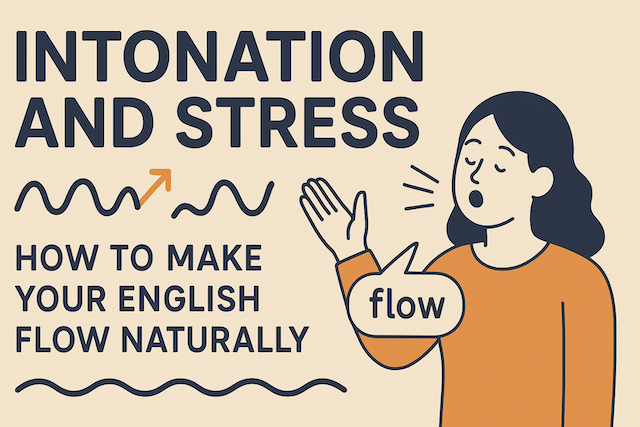
Improve Pronunciation and Intonation
Hesitation can also happen when you’re unsure how to pronounce a word. The key is to develop your ear and rhythm.
Try this routine:
-
Listen to short audio clips (podcasts, movies, or YouTube).
-
Repeat exactly what you hear—match the speaker’s tone and stress.
-
Record and compare your version.
Apps like Elsa Speak or YouGlish can help you check pronunciation. Focus on clarity, not accent.
When your mouth and ears become familiar with English sounds, you’ll speak more automatically.
Prepare for Common Situations
If you often hesitate in daily conversations—ordering food, small talk, meetings—prepare ready-made sentences.
Examples:
-
Ordering: “Could I get a coffee, please?”
-
Small talk: “How was your weekend?” “I really like your idea.”
-
Meetings: “I’d like to add something to that.” “Let’s discuss this later.”
Having these phrases memorized gives you instant responses, reducing hesitation.
Practice with Real People
Speaking to real people builds confidence faster than anything else. Find small, low-pressure opportunities to use English in real life:
-
Join English-speaking clubs or online meetups.
-
Talk to tourists or classmates in English.
-
Attend free conversation events or online discussion groups.
Don’t wait until you feel “ready.” Fluency comes through practice, not before it.
Manage Your Anxiety
Even with good skills, anxiety can cause hesitation. Try calming techniques before speaking:
-
Take a deep breath.
-
Smile—it helps you sound relaxed and friendly.
-
Remind yourself that everyone makes mistakes.
Confidence grows through small victories. Every successful conversation, even short ones, strengthens your speaking habit.
Build Automatic Responses
Native speakers don’t “think” about every sentence—they respond automatically. You can train this skill through repetition and pattern practice.
For example, practice variations of common responses:
-
“That’s great!” → “That sounds amazing!” / “Really? That’s awesome!”
-
“I don’t know.” → “I’m not sure.” / “Let me think about that.”
-
“Sorry, can you repeat that?” / “Could you say that again, please?”
Repeating patterns helps your brain respond without hesitation during real conversations.
Use Technology to Help You
Technology makes practice easy and convenient.
-
Voice assistants (Siri, Alexa, Google Assistant): Ask questions in English daily.
-
AI conversation tools: Practice with AI chat partners to simulate real dialogue.
-
Speech-to-text apps: See if your pronunciation is recognized correctly.
These tools help you track progress and get instant feedback.
Celebrate Progress
Overcoming hesitation doesn’t happen overnight. Track your journey—record your speaking once a week and compare your old recordings. Notice your improvement in speed, confidence, and tone.
Celebrate small wins:
-
You finished a full English conversation.
-
You didn’t switch to your native language.
-
You spoke for one minute without stopping.
Each success builds momentum toward fluency.
Final Thoughts
Hesitation in speaking English is a temporary challenge, not a permanent weakness. With consistent practice, the right mindset, and daily exposure, your confidence will grow naturally. Remember—fluency is not about speaking fast, but speaking comfortably.
Keep practicing, keep speaking, and one day you’ll realize you’re no longer hesitating—you’re just communicating naturally.
FAQs
What causes hesitation when speaking English?
Hesitation typically comes from three sources: fear of making mistakes, translating from your first language before speaking, and lack of real speaking practice. Anxiety narrows your working memory, so access to words and grammar slows. If you train your brain to prioritize meaning over perfection and practice often in low-pressure ways, hesitation naturally decreases.
How can I stop translating and start thinking in English?
Use micro-habits that force instant recall in English: narrate your actions (“I’m making coffee”), label objects around you, and journal short notes without a dictionary. Switch your phone and apps to English and shadow short clips daily. The goal is frequency, not difficulty. Small, frequent exposures build automatic pathways faster than occasional “intense” sessions.
Is grammar accuracy more important than fluency?
In conversation, clarity and flow are usually more important than perfect grammar. Aim for “good enough to be understood,” then improve precision over time. Treat mistakes as data: note recurring errors after the conversation, practice the exact pattern with three to five examples, and return to speaking. This cycle preserves fluency while improving accuracy.
What daily routine builds fluency quickly?
Use the 5–5–5 method: five minutes of shadowing (imitate audio exactly), five minutes of speaking prompts (describe your day or respond to a question), and five minutes of recording + quick review. Do it every day, preferably at the same time. Consistency compounds: fifteen minutes daily outperforms a single long session each week.
How do I practice if I have no partner?
Speak to yourself, record monologues, use AI chat partners for prompts, and read dialogues aloud. Do “call and response” with podcasts: pause after a sentence, repeat it, then add your own comment. Join language exchange apps for short voice messages. Solo practice builds speed; even two to three minutes between tasks keeps your tongue “warmed up.”
What are good fillers to keep my flow?
Natural fillers buy time without stopping: “Well…,” “Let me think,” “That’s a good question,” “So basically…,” “You know,” “Actually…,” “I mean…,” and “What I’m trying to say is….” Practice these in short bursts so they sound smooth. Use them strategically; too many fillers can distract, but a few prevent long, awkward pauses.
How can I expand vocabulary without slowing down?
Prioritize high-frequency chunks (multiword phrases) tied to situations you face: work meetings, small talk, service encounters. Build “ready packs” of 10–15 phrases per context, then recycle them daily in speech. Learn words in collocations—“make a decision,” “raise a concern,” “run late”—so retrieval is faster and usage is more natural.
What is shadowing and why does it help?
Shadowing is repeating speech immediately after you hear it, matching rhythm, stress, and intonation. It links listening and speaking, training your mouth to produce sequences automatically. Start with 10–20 second clips at comfortable speed, aim for 80–90% accuracy, then gradually increase complexity. Record yourself to check timing and melody.
How do I reduce fear of mistakes?
Adopt a “communication-first” contract with yourself: your job is to be understood, not perfect. Set process goals (minutes spoken, prompts completed) instead of outcome goals (no mistakes). After a conversation, write three quick notes: one win, one improvement point, and one phrase to reuse tomorrow. Confidence grows from repeated, small wins.
What simple sentence strategy prevents freezing?
Use the “Short. Then Add.” method. First, deliver the core message in a short sentence: “I disagree.” Then add one supporting detail: “Because the data is incomplete.” If needed, add a softener or example. Short sentences reduce cognitive load, keep the conversation moving, and buy time to build the next idea.
How can I prepare for common situations?
Create mini-scripts for your top five scenarios. Example: ordering—“Could I get a small latte, please?”; small talk—“How’s your week going?”; meetings—“I’d like to add a quick point.” Practice them aloud until they’re automatic. Then personalize variants: swap nouns, verbs, and softeners to keep them flexible and natural.
Which pronunciation areas matter most for clarity?
Focus on word stress, sentence stress, and linking. Correct stress often fixes intelligibility even with an accent. Practice minimal pairs that frequently confuse meaning (ship/sheep, live/leave). Use slow, exaggerated drills first, then return to normal speed. Record two versions—slow/clear and normal—to confirm that clarity survives speed.
How can I use recording effectively without cringing?
Follow a quick cycle: record 60–90 seconds; identify just one pronunciation or phrasing target; rerecord immediately implementing that single change. Keep each loop under five minutes. You’ll desensitize to your voice, and the rapid feedback tightens your learning. Archive a weekly sample to track long-term progress and stay motivated.
What mindset keeps me speaking under pressure?
Use the “three C’s”: Center (one deep breath), Connect (look at the person or imagine them), and Continue (start with a memorized opener like “Here’s how I see it”). Preloading an opener reduces startup friction, after which your natural language habits take over.
How can I answer when I don’t know the word?
Paraphrase and bridge. Use templates: “It’s like…,” “It’s the opposite of…,” “Another way to say this is…,” “It’s a kind of… that….” Describe features, purpose, or examples until your partner suggests the exact word. This keeps you fluent and often teaches you the term in context—no pause, no panic.
What if I freeze mid-sentence?
Pause gracefully and reboot. Use: “Let me rephrase that,” “To put it another way,” or “The main point is…” Then deliver a short, clear sentence and continue. Smiling and keeping eye contact signal confidence. Training this recovery move is crucial; even native speakers use it to navigate complex ideas smoothly.
How do I practice for meetings and presentations?
Build a modular outline with spoken headers: “First, context… Next, options… Finally, recommendation….” Rehearse each module as a 30–45 second chunk. During delivery, stitch modules in order. If interrupted, jump back to the nearest header. This structure preserves fluency under stress and reduces the memory load of full scripts.
Which tech tools should I use?
Combine three categories: listening source (short YouTube news or explainers), shadowing player (any app with easy rewind/0.75× speed), and speech feedback (speech-to-text to check intelligibility). Optional: pronunciation apps for targeted sounds and AI chat for prompt variety. Keep your stack simple to ensure daily use.
How do I build automatic responses?
Create a “Reaction Bank” of 20–30 lines grouped by function: agreeing (“That makes sense”), disagreeing politely (“I see it differently”), buying time (“Give me a second”), clarifying (“Do you mean…?”), and closing (“So, to wrap up…”). Drill two groups per day for one week. Automaticity comes from spaced, spoken repetition.
What weekly plan keeps me progressing?
Mon–Fri: 15 minutes/day (shadowing → prompt speaking → quick record). Saturday: 20–30 minutes of conversation exchange or live practice. Sunday: Review your best clips, extract five phrases to reuse next week, and refresh your two weakest sounds. This cadence balances fluency, feedback, and motivation.
How can I measure improvement without tests?
Track three indicators: (1) average seconds you can speak without pausing; (2) number of “um/uh” fillers per minute; (3) successful paraphrases when a word is missing. Log once weekly. Visible evidence of progress reduces anxiety and encourages you to keep practicing through plateaus.
How do I keep motivation high?
Focus on identity, not outcomes: “I’m the kind of person who speaks English daily.” Celebrate process milestones—seven-day streaks, 100 minutes this month, first full meeting in English. Stack practice onto an existing habit (after coffee, during commute). Motivation follows momentum; design the routine to be too small to skip.
What should I do right before speaking?
Run a 60-second warm-up: lip trills or tongue twisters (slowly), two deep breaths, then one Reaction Bank line said with confident intonation. Preview your first sentence. This tiny ritual primes breathing, articulation, and mindset, so you start strong and avoid early stumbles that can trigger hesitation.
Any final advice to overcome hesitation long-term?
Treat fluency as a skill built by reps, not talent. Speak daily, prefer short sentences, paraphrase missing words, and review one improvement point after each conversation. Your goal is comfort, not speed. With consistent, low-friction routines and real interactions, hesitation fades and natural communication takes its place.



