2025年12月29日
3D ACADEMY offers affordable English study programs in Cebu, Philippines – perfect for beginners, professionals, and exam takers.

3D UNIVERSAL ENGLISH INSTITUTE INC
info.3d-universal.com
8:00-17:00(Mon-Fri)
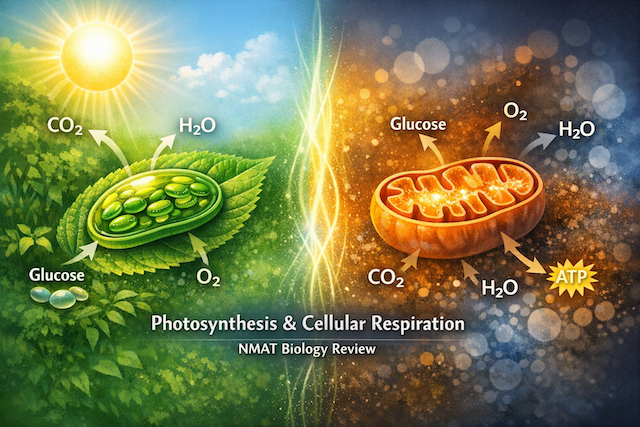
Photosynthesis and Cellular Respiration: NMAT Biology Review
Contents
- Photosynthesis and Cellular Respiration: NMAT Biology Review
- Introduction to Energy Transformation in Living Organisms
- Overview of Photosynthesis
- Structure of the Chloroplast
- Light-Dependent Reactions
- Calvin Cycle (Light-Independent Reactions)
- Importance of Photosynthesis
- Overview of Cellular Respiration
- Glycolysis
- Link Reaction (Pyruvate Oxidation)
- Krebs Cycle (Citric Acid Cycle)
- Electron Transport Chain and Oxidative Phosphorylation
- Anaerobic Respiration and Fermentation
- Mitochondrial Structure and Function
- Relationship Between Photosynthesis and Cellular Respiration
- Comparison of Photosynthesis and Cellular Respiration
- Common NMAT Exam Focus Points
- Conclusion
- Photosynthesis and Cellular Respiration
- NMAT Biology – Problem Sets
- Part I: Multiple Choice Questions (MCQs)
- Part II: Conceptual & Application Questions
- Answer Keys
Photosynthesis and Cellular Respiration: NMAT Biology Review
Introduction to Energy Transformation in Living Organisms
Energy is the foundation of all biological processes. Every movement, growth, repair, and metabolic reaction within living organisms requires a continuous supply of energy. In biology, this energy is not created but transformed from one form to another. Two of the most important biochemical processes responsible for energy transformation are photosynthesis and cellular respiration. These processes are central topics in the NMAT Biology syllabus and are frequently tested due to their conceptual depth and interrelationship.
Photosynthesis captures light energy from the sun and converts it into chemical energy stored in glucose, while cellular respiration releases the energy stored in glucose to produce ATP, the usable energy currency of the cell. Understanding how these two processes work individually and how they are interconnected is essential for NMAT success.
Overview of Photosynthesis
Photosynthesis is the process by which green plants, algae, and certain bacteria convert light energy into chemical energy in the form of carbohydrates. This process occurs in the chloroplasts of plant cells and involves a series of complex reactions.
The overall chemical equation of photosynthesis is:
6CO₂ + 6H₂O + light energy → C₆H₁₂O₆ + 6O₂
This equation highlights two important points:
-
Carbon dioxide and water are converted into glucose.
-
Oxygen is released as a byproduct.
Photosynthesis can be divided into two main stages: the light-dependent reactions and the Calvin cycle (light-independent reactions).
Structure of the Chloroplast
The chloroplast is a specialized organelle designed for photosynthesis. It has a double membrane structure consisting of an outer membrane and an inner membrane. Inside the chloroplast is a fluid-filled region called the stroma, which contains enzymes, DNA, and ribosomes.
Within the stroma are flattened membranous sacs called thylakoids, which are stacked into structures known as grana. The thylakoid membranes contain chlorophyll and other pigments that absorb light energy.
Understanding the structure of the chloroplast is crucial because:
-
Light-dependent reactions occur in the thylakoid membranes.
-
The Calvin cycle occurs in the stroma.
Light-Dependent Reactions
The light-dependent reactions take place in the thylakoid membranes and require light energy directly. The primary purpose of these reactions is to convert light energy into chemical energy in the form of ATP and NADPH.
When light strikes chlorophyll molecules, electrons become excited and move through an electron transport chain. This movement of electrons leads to:
-
The production of ATP through photophosphorylation
-
The reduction of NADP⁺ to NADPH
Water molecules are split in a process called photolysis, releasing:
-
Electrons to replace those lost by chlorophyll
-
Hydrogen ions (protons)
-
Oxygen gas, which diffuses out of the plant as a waste product
The light-dependent reactions are essential because they generate the ATP and NADPH required for the Calvin cycle.
Calvin Cycle (Light-Independent Reactions)
The Calvin cycle occurs in the stroma of the chloroplast and does not require light directly. However, it depends on ATP and NADPH produced during the light-dependent reactions.
The Calvin cycle consists of three main phases:
-
Carbon fixation
-
Reduction
-
Regeneration of RuBP (ribulose-1,5-bisphosphate)
During carbon fixation, carbon dioxide is attached to RuBP with the help of the enzyme RuBisCO, forming an unstable compound that quickly breaks down into 3-phosphoglycerate (3-PGA).
In the reduction phase, ATP and NADPH are used to convert 3-PGA into glyceraldehyde-3-phosphate (G3P), a three-carbon sugar.
Some G3P molecules leave the cycle to form glucose and other carbohydrates, while the rest are used to regenerate RuBP, allowing the cycle to continue.
Importance of Photosynthesis
Photosynthesis is essential for life on Earth because it:
-
Produces oxygen needed for aerobic respiration
-
Serves as the primary source of organic molecules in food chains
-
Converts solar energy into chemical energy usable by living organisms
Without photosynthesis, heterotrophic organisms, including humans, would not have access to food energy.
Overview of Cellular Respiration
Cellular respiration is the process by which cells break down glucose and other organic molecules to release energy in the form of ATP. Unlike photosynthesis, cellular respiration occurs in almost all living organisms, including plants, animals, fungi, and bacteria.
The overall equation for aerobic cellular respiration is:
C₆H₁₂O₆ + 6O₂ → 6CO₂ + 6H₂O + ATP
This equation shows that glucose and oxygen are used to produce carbon dioxide, water, and energy.
Cellular respiration can be divided into three main stages:
-
Glycolysis
-
Krebs cycle (Citric Acid Cycle)
-
Electron transport chain and oxidative phosphorylation
Glycolysis
Glycolysis is the first stage of cellular respiration and occurs in the cytoplasm of the cell. It does not require oxygen and is therefore considered an anaerobic process.
During glycolysis:
-
One glucose molecule (6 carbons) is broken down into two molecules of pyruvate (3 carbons each)
-
A net gain of 2 ATP molecules is produced
-
2 NADH molecules are formed
Although glycolysis produces relatively little ATP, it is crucial because it provides substrates for the subsequent stages of respiration.
Link Reaction (Pyruvate Oxidation)
Before entering the Krebs cycle, pyruvate molecules produced in glycolysis undergo the link reaction in the mitochondrial matrix.
During this process:
-
Pyruvate is converted into acetyl-CoA
-
Carbon dioxide is released
-
NAD⁺ is reduced to NADH
This step connects glycolysis to the Krebs cycle and is essential for aerobic respiration.
Krebs Cycle (Citric Acid Cycle)
The Krebs cycle occurs in the mitochondrial matrix and involves a series of enzyme-controlled reactions.
For each acetyl-CoA molecule entering the cycle:
-
Two molecules of carbon dioxide are released
-
One ATP (or GTP) is produced
-
Three NADH and one FADH₂ are generated
Since one glucose molecule produces two acetyl-CoA molecules, the Krebs cycle runs twice per glucose molecule.
The main function of the Krebs cycle is not ATP production directly, but the generation of reduced electron carriers (NADH and FADH₂) that will be used in the electron transport chain.
Electron Transport Chain and Oxidative Phosphorylation
The electron transport chain (ETC) is located on the inner mitochondrial membrane. It consists of a series of protein complexes that transfer electrons from NADH and FADH₂ to oxygen.
As electrons move through the ETC:
-
Energy is released and used to pump protons across the inner mitochondrial membrane
-
A proton gradient is established
The return flow of protons through ATP synthase drives the production of ATP in a process called chemiosmosis.
Oxygen acts as the final electron acceptor, combining with electrons and protons to form water. This explains why oxygen is essential for aerobic respiration.
The majority of ATP in cellular respiration is produced during this stage.
Anaerobic Respiration and Fermentation
When oxygen is not available, cells cannot use the electron transport chain. Instead, they rely on fermentation to regenerate NAD⁺ so that glycolysis can continue.
There are two main types of fermentation:
-
Lactic acid fermentation (in animal cells)
-
Alcoholic fermentation (in yeast and plant cells)
Fermentation produces much less ATP than aerobic respiration but allows cells to survive temporarily in low-oxygen conditions.
Mitochondrial Structure and Function
The mitochondrion is often called the “powerhouse of the cell.” Its structure is closely related to its function.
Key features include:
-
Outer membrane: permeable to small molecules
-
Inner membrane: folded into cristae, increasing surface area for ATP production
-
Intermembrane space: site of proton accumulation
-
Matrix: contains enzymes for the Krebs cycle
Understanding mitochondrial structure helps explain how ATP synthesis occurs efficiently.
Relationship Between Photosynthesis and Cellular Respiration
Photosynthesis and cellular respiration are complementary processes.
Photosynthesis:
-
Uses carbon dioxide, water, and light energy
-
Produces glucose and oxygen
Cellular respiration:
-
Uses glucose and oxygen
-
Produces carbon dioxide, water, and ATP
The products of one process serve as the reactants of the other, creating a continuous cycle of energy flow and matter recycling in ecosystems.
Comparison of Photosynthesis and Cellular Respiration
Photosynthesis occurs in chloroplasts and stores energy, while cellular respiration occurs in mitochondria and releases energy. Photosynthesis is anabolic, building complex molecules, whereas cellular respiration is catabolic, breaking them down.
Both processes involve:
-
Electron transport chains
-
Chemiosmosis
-
ATP synthase
These similarities suggest an evolutionary connection and are frequently tested in NMAT conceptual questions.
Common NMAT Exam Focus Points
For NMAT Biology, students should focus on:
-
Key enzymes such as RuBisCO and ATP synthase
-
Locations of each stage of both processes
-
ATP yield comparisons
-
The role of oxygen and carbon dioxide
-
Conceptual links between photosynthesis and respiration
NMAT questions often test understanding rather than memorization, so grasping the logic behind each step is essential.
Conclusion
Photosynthesis and cellular respiration are fundamental biological processes that sustain life by managing energy flow within and between organisms. Photosynthesis captures and stores energy, while cellular respiration releases that energy to power cellular activities.
For NMAT examinees, mastering these topics requires a clear understanding of structures, stages, chemical reactions, and the interdependence of these processes. A strong conceptual foundation will not only help in answering direct questions but also in tackling application-based and integrative NMAT Biology questions.
Photosynthesis and Cellular Respiration
NMAT Biology – Problem Sets
Part I: Multiple Choice Questions (MCQs)
1. Photosynthesis – Light Reactions
Q1. The primary function of the light-dependent reactions of photosynthesis is to:
A. Produce glucose
B. Generate ATP and NADPH
C. Fix carbon dioxide
D. Release oxygen as the main product
Q2. In which structure of the chloroplast do the light reactions occur?
A. Stroma
B. Inner membrane
C. Thylakoid membrane
D. Outer membrane
Q3. What molecule acts as the final electron acceptor in the light reactions?
A. Oxygen
B. Carbon dioxide
C. NADP⁺
D. ADP
2. Photosynthesis – Calvin Cycle
Q4. The Calvin cycle occurs in the:
A. Thylakoid lumen
B. Thylakoid membrane
C. Stroma
D. Cytoplasm
Q5. Which enzyme catalyzes the first step of carbon fixation?
A. ATP synthase
B. RuBisCO
C. Cytochrome oxidase
D. NADP⁺ reductase
Q6. How many molecules of CO₂ are required to produce one molecule of glucose?
A. 3
B. 4
C. 6
D. 12
3. Cellular Respiration – Glycolysis
Q7. Glycolysis occurs in the:
A. Mitochondrial matrix
B. Inner mitochondrial membrane
C. Cytoplasm
D. Nucleus
Q8. The net yield of ATP from glycolysis per glucose molecule is:
A. 1 ATP
B. 2 ATP
C. 4 ATP
D. 6 ATP
Q9. What is the final product of glycolysis?
A. Acetyl-CoA
B. Lactate
C. Pyruvate
D. Oxaloacetate
4. Cellular Respiration – Krebs Cycle
Q10. The Krebs cycle takes place in the:
A. Cytoplasm
B. Inner mitochondrial membrane
C. Intermembrane space
D. Mitochondrial matrix
Q11. Which molecule enters the Krebs cycle after being converted from pyruvate?
A. Acetyl-CoA
B. NADH
C. ATP
D. CO₂
Q12. How many ATP molecules are produced directly by the Krebs cycle per glucose?
A. 1
B. 2
C. 4
D. 6
5. Electron Transport Chain (ETC)
Q13. The electron transport chain is located in the:
A. Cytoplasm
B. Mitochondrial matrix
C. Inner mitochondrial membrane
D. Outer mitochondrial membrane
Q14. What is the final electron acceptor in the electron transport chain?
A. Carbon dioxide
B. Oxygen
C. NAD⁺
D. Water
Q15. The primary role of oxygen in cellular respiration is to:
A. Produce ATP directly
B. Accept electrons and form water
C. Break down glucose
D. Pump protons across membranes
Part II: Conceptual & Application Questions
Q16. Explain why photosynthesis and cellular respiration are considered complementary processes.
Q17. What would happen to ATP production if oxygen were unavailable in aerobic organisms?
Q18. Compare the role of electron carriers in photosynthesis and cellular respiration.
Answer Keys
Part I: Multiple Choice Answers
1. B – Generate ATP and NADPH
2. C – Thylakoid membrane
3. C – NADP⁺
4. C – Stroma
5. B – RuBisCO
6. C – 6
7. C – Cytoplasm
8. B – 2 ATP
9. C – Pyruvate
10. D – Mitochondrial matrix
11. A – Acetyl-CoA
12. B – 2 ATP
13. C – Inner mitochondrial membrane
14. B – Oxygen
15. B – Accept electrons and form water
Part II: Sample Answers (NMAT-Style)
16.
Photosynthesis stores energy by converting light energy into chemical energy in glucose, while cellular respiration releases this stored energy to produce ATP. The products of one process are the reactants of the other, making them complementary.
17.
Without oxygen, the electron transport chain cannot function, leading to a halt in oxidative phosphorylation. Cells rely only on glycolysis, producing significantly less ATP.
18.
In photosynthesis, NADP⁺ carries high-energy electrons as NADPH, while in cellular respiration, NAD⁺ and FAD carry electrons as NADH and FADH₂ to the electron transport chain for ATP production.
NMAT Study Guide: Complete Preparation Guide for Medical School in the Philippines

How to Register for eTravel Philippines (2025 Guide)
Step-by-step guide to completing your eTravel registration before arriving in the Philippines, with images and tips.

Night Market in Cebu – Things You Don’t Know About Cebu Life
Discover the hidden charm of Cebu’s night markets, from street food stalls to local life tips you won’t find in tourist guides.

How to Use ChatGPT for IELTS Preparation: A Complete Guide
Learn how to prepare for IELTS using ChatGPT — including strategies for Writing, Reading, Listening, Speaking, and grammar support.

How to Build a Website Without Coding Using ChatGPT
Discover how to build your own website using AI—no coding skills needed. From structure planning to SEO and design, let ChatGPT guide you.