2026年1月10日
3D ACADEMY offers affordable English study programs in Cebu, Philippines – perfect for beginners, professionals, and exam takers.

3D UNIVERSAL ENGLISH INSTITUTE INC
info.3d-universal.com
8:00-17:00(Mon-Fri)
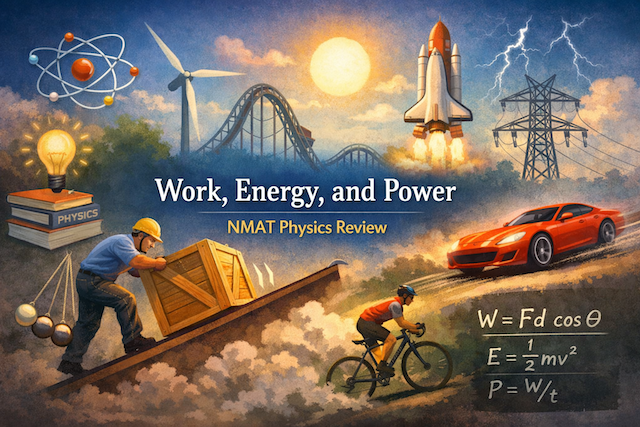
Work, Energy, and Power: NMAT Physics Review
Contents
- Work, Energy, and Power: NMAT Physics Review
- Concept of Work in Physics
- Positive, Negative, and Zero Work
- Work Done by Variable Forces
- Energy: Definition and Forms
- Kinetic Energy
- Work-Energy Theorem
- Potential Energy
- Gravitational Potential Energy
- Elastic Potential Energy
- Conservative and Non-Conservative Forces
- Mechanical Energy
- Law of Conservation of Mechanical Energy
- Effect of Non-Conservative Forces
- Power: Definition and Formula
- Instantaneous Power
- Efficiency of Machines
- Common NMAT Applications
- Problem-Solving Tips for NMAT
- Summary
- Problem Sets
- Answer Keys
Work, Energy, and Power: NMAT Physics Review
The topics of work, energy, and power form a core part of the NMAT Physics syllabus and frequently appear in quantitative problem-solving questions. These concepts connect motion, forces, and time, making them essential for understanding both classical mechanics and real-life physical processes. In this review, we will explore the fundamental definitions, formulas, and applications of work, energy, and power, with an emphasis on NMAT-style reasoning and problem-solving.
Concept of Work in Physics
In physics, work is done when a force causes an object to move in the direction of the force. This definition is more precise than the everyday use of the word “work.” Mathematically, work is defined as the dot product of force and displacement.
The general formula for work is:
W = F d cos θ
where F is the applied force, d is the displacement, and θ is the angle between the force and displacement vectors.
Important points to remember for NMAT:
- If the force is in the same direction as displacement (θ = 0°), work is maximum.
- If the force is perpendicular to displacement (θ = 90°), work is zero.
- If the force opposes motion (θ = 180°), work is negative.
The SI unit of work is the joule (J), where 1 joule is the work done when a force of 1 newton moves an object by 1 meter in the direction of the force.
Positive, Negative, and Zero Work
Understanding the sign of work is crucial in NMAT problem-solving.
Positive work occurs when the force has a component in the direction of motion. For example, gravity does positive work on a falling object.
Negative work occurs when the force opposes motion. Friction acting on a sliding object does negative work.
Zero work occurs when there is no displacement or when the force is perpendicular to displacement, such as centripetal force in circular motion.
Work Done by Variable Forces
Not all forces remain constant. When a force varies with position, the work done is calculated using integration or by finding the area under a force-displacement graph.
For NMAT purposes, common examples include:
- Work done by a spring
- Work done by gravitational force at varying heights
For a spring obeying Hooke’s Law, the force is proportional to displacement:
F = kx
The work done in stretching or compressing a spring from zero displacement to x is:
W = ½ kx²
Energy: Definition and Forms
Energy is the capacity to do work. Like work, energy is measured in joules. Energy can exist in many forms, but NMAT Physics focuses primarily on mechanical energy.
The two main forms of mechanical energy are:
- Kinetic Energy
- Potential Energy
Kinetic Energy
Kinetic energy is the energy possessed by an object due to its motion. It depends on both mass and velocity.
The formula for kinetic energy is:
KE = ½ mv²
where m is the mass and v is the speed of the object.
Key NMAT insights:
- Kinetic energy depends on the square of velocity.
- Doubling the speed increases kinetic energy by four times.
- An object at rest has zero kinetic energy.
Work-Energy Theorem
The work-energy theorem states that the net work done on an object is equal to the change in its kinetic energy.
Wnet = ΔKE
This theorem is extremely useful in NMAT problems because it allows you to analyze motion without directly using kinematic equations. It applies even when forces vary or when motion is not along a straight line.
Potential Energy
Potential energy is the energy possessed by an object due to its position or configuration.
The two most common types of potential energy tested in NMAT are:
- Gravitational Potential Energy
- Elastic Potential Energy
Gravitational Potential Energy
Near the surface of the Earth, gravitational potential energy is given by:
PE = mgh
where m is mass, g is gravitational acceleration, and h is height above a reference level.
Important points:
- The choice of reference level is arbitrary.
- Only changes in potential energy are physically meaningful.
- Gravitational force is conservative.
Elastic Potential Energy
Elastic potential energy is stored in objects like springs when they are stretched or compressed.
The formula is:
PE = ½ kx²
This energy is fully recoverable in an ideal spring with no energy losses.
Conservative and Non-Conservative Forces
A conservative force is one where the work done depends only on the initial and final positions, not on the path taken.
Examples include:
- Gravitational force
- Spring force
A non-conservative force depends on the path taken and usually dissipates mechanical energy.
Examples include:
- Friction
- Air resistance
Mechanical Energy
Mechanical energy is the sum of kinetic and potential energies.
E = KE + PE
When only conservative forces act on a system, mechanical energy remains constant.
Law of Conservation of Mechanical Energy
The law of conservation of mechanical energy states that if no non-conservative forces do work, the total mechanical energy of a system remains constant.
KEinitial + PEinitial = KEfinal + PEfinal
This principle is widely used in NMAT problems involving falling objects, pendulums, roller coasters, and springs.
Effect of Non-Conservative Forces
When non-conservative forces like friction act, mechanical energy is not conserved. Some energy is transformed into heat, sound, or deformation.
In such cases:
Initial mechanical energy = Final mechanical energy + Energy lost
NMAT problems often require accounting for work done by friction explicitly.
Power: Definition and Formula
Power is the rate at which work is done or energy is transferred.
The average power is given by:
P = W / t
The SI unit of power is the watt (W), where 1 watt equals 1 joule per second.
Instantaneous Power
Instantaneous power refers to power at a specific moment in time and is especially useful when force or velocity changes.
It is given by:
P = F · v
This expression is important in NMAT questions involving moving vehicles, engines, and machines.
Efficiency of Machines
In real systems, not all input energy is converted into useful output due to losses.
Efficiency is defined as:
Efficiency = (Useful output energy / Input energy) × 100%
NMAT problems may involve calculating efficiency for motors, lifts, or mechanical systems.
Common NMAT Applications
Typical NMAT questions on work, energy, and power involve:
- Objects sliding on rough surfaces
- Objects falling under gravity
- Spring-mass systems
- Power output of engines
- Energy conversion scenarios
A strong grasp of energy methods often simplifies complex motion problems that would otherwise require lengthy kinematic calculations.
Problem-Solving Tips for NMAT
To perform well in NMAT Physics:
- Identify all forces acting on the system.
- Decide whether energy conservation applies.
- Check if friction or air resistance is present.
- Choose energy methods over kinematics when possible.
- Pay attention to units and reference levels.
Summary
Work, energy, and power are deeply interconnected concepts that provide powerful tools for analyzing physical systems. For NMAT preparation, mastering definitions, formulas, and conservation principles is essential. By practicing energy-based problem-solving and understanding how forces transfer and transform energy, students can tackle a wide range of NMAT Physics questions efficiently and accurately.
Problem Sets
- A 20 N horizontal force pushes a box 5 m across a frictionless floor. What work is done by the force?
- A 50 N force is applied to pull a sled 10 m, but the force is directed 30° above the horizontal. How much work is done by the applied force?
- A person carries a 15 kg backpack up a flight of stairs that is 4 m high at constant speed. How much work is done against gravity? (Use g = 9.8 m/s²)
- A 2 kg object initially at rest is acted on by a net force that does 36 J of work on it. What is the object’s final speed?
- A 1200 kg car is moving at 20 m/s. What is its kinetic energy?
- A 0.5 kg ball is thrown upward with a speed of 12 m/s. Ignoring air resistance, what maximum height does it reach above the launch point? (Use g = 9.8 m/s²)
- A spring with spring constant k = 200 N/m is compressed by 0.15 m. How much elastic potential energy is stored in the spring?
- A 3 kg block slides down a frictionless ramp from a vertical height of 2.5 m. What is its speed at the bottom? (Use g = 9.8 m/s²)
- A 10 kg crate is pulled across a rough floor for 8 m. The coefficient of kinetic friction is 0.20. The pulling force is horizontal and the motion is at constant speed. How much work is done by friction? (Use g = 9.8 m/s²)
- A 5 kg box is pulled 6 m along a horizontal surface with a constant force of 40 N. The coefficient of kinetic friction is 0.25. Starting from rest, what is the box’s speed after moving 6 m? (Use g = 9.8 m/s²)
- A motor does 15,000 J of work in 25 s. What is the motor’s average power output?
- An elevator lifts a 600 kg load upward at a constant speed of 2.0 m/s. What power is required to lift the load? (Use g = 9.8 m/s²)
- A machine takes in 500 J of energy and outputs 360 J of useful work. What is the efficiency of the machine?
- A 2.5 kg block is pushed up a rough incline to a vertical height of 1.2 m. The work done by friction is 18 J (negative). If the block starts from rest, how much work must the applied force do to bring it to rest at the top? (Use g = 9.8 m/s²)
- A 4 kg object has speed 6 m/s on a level surface. If friction does -30 J of work while it moves, what is the new speed of the object?
Answer Keys
- W = Fd (θ = 0°) = 20 × 5 = 100 J
- W = Fd cos θ = 50 × 10 × cos 30° = 500 × 0.866 ≈ 433 J
- Work against gravity: W = mgh = 15 × 9.8 × 4 = 15 × 39.2 = 588 J
- Work-energy theorem: W = ΔKE = ½mv² – 0 = 36
½(2)v² = 36 → v² = 36 → v = 6 m/s - KE = ½mv² = ½(1200)(20²) = 600 × 400 = 240,000 J
- Use energy: ½mv² = mgh → h = v²/(2g) = 12²/(2×9.8) = 144/19.6 ≈ 7.35 m
- PE = ½kx² = ½(200)(0.15²) = 100 × 0.0225 = 2.25 J
- Conservation of energy: mgh = ½mv² → v = √(2gh) = √(2×9.8×2.5) = √49 = 7.0 m/s
- Friction force: fk = μkmg = 0.20 × 10 × 9.8 = 19.6 N
Work by friction: W = -fkd = -19.6 × 8 = -156.8 J - Friction force: fk = 0.25 × 5 × 9.8 = 12.25 N
Net force: Fnet = 40 – 12.25 = 27.75 N
Net work: W = Fnetd = 27.75 × 6 = 166.5 J
ΔKE = ½mv² = 166.5 → v² = (2×166.5)/5 = 333/5 = 66.6 → v ≈ 8.16 m/s - P = W/t = 15000/25 = 600 W
- Power required: P = Fv = (mg)v = (600×9.8)×2.0 = 5880×2 = 11,760 W (≈ 11.8 kW)
- Efficiency = (output/input)×100% = (360/500)×100% = 0.72×100% = 72%
- Starts and ends at rest, so ΔKE = 0. Required work = gain in PE + energy lost to friction
Wapplied = mgh + 18 = (2.5×9.8×1.2) + 18 = 29.4 + 18 = 47.4 J - Initial KE = ½mv² = ½(4)(6²) = 2×36 = 72 J
W = ΔKE → KEfinal = 72 – 30 = 42 J
½(4)v² = 42 → 2v² = 42 → v² = 21 → v ≈ 4.58 m/s
NMAT Study Guide: Complete Preparation Guide for Medical School in the Philippines

How to Register for eTravel Philippines (2025 Guide)
Step-by-step guide to completing your eTravel registration before arriving in the Philippines, with images and tips.

Night Market in Cebu – Things You Don’t Know About Cebu Life
Discover the hidden charm of Cebu’s night markets, from street food stalls to local life tips you won’t find in tourist guides.

How to Use ChatGPT for IELTS Preparation: A Complete Guide
Learn how to prepare for IELTS using ChatGPT — including strategies for Writing, Reading, Listening, Speaking, and grammar support.

How to Build a Website Without Coding Using ChatGPT
Discover how to build your own website using AI—no coding skills needed. From structure planning to SEO and design, let ChatGPT guide you.