2026年1月10日
3D ACADEMY offers affordable English study programs in Cebu, Philippines – perfect for beginners, professionals, and exam takers.

3D UNIVERSAL ENGLISH INSTITUTE INC
info.3d-universal.com
8:00-17:00(Mon-Fri)
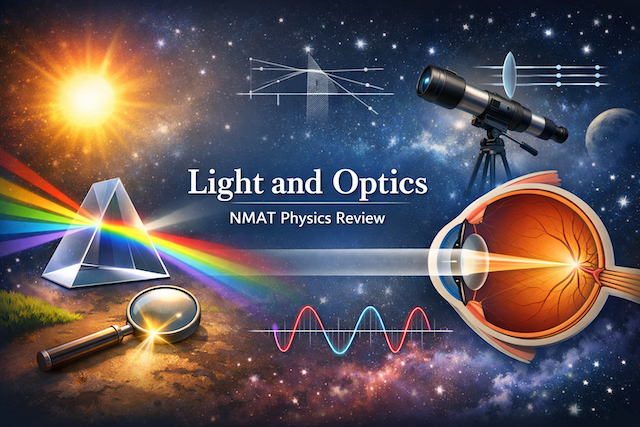
Light and Optics: NMAT Physics Review
Contents
- Light and Optics: NMAT Physics Review
- Nature of Light
- Reflection of Light
- Plane Mirrors
- Spherical Mirrors
- Refraction of Light
- Snell’s Law
- Total Internal Reflection
- Dispersion of Light
- Lenses
- Lens Equation and Magnification
- Optical Power of a Lens
- Optical Instruments
- Common NMAT Exam Tips for Light and Optics
- Summary
- Problem Set 1: Reflection and Mirrors
- Problem Set 2: Refraction and Snell’s Law
- Problem Set 3: Lenses and Image Formation
- Problem Set 4: Mixed Concepts and Applications
Light and Optics: NMAT Physics Review
Light and optics form an essential part of the NMAT Physics coverage, testing your understanding of wave behavior, image formation, reflection, refraction, and optical instruments. Questions in this area often require both conceptual clarity and the ability to apply formulas correctly under time pressure. This review provides a comprehensive explanation of light and optics concepts aligned with NMAT expectations, with emphasis on definitions, laws, equations, and common exam traps.
Nature of Light
Light is an electromagnetic wave that does not require a medium to propagate. In physics, light exhibits both wave-like and particle-like properties, a concept known as wave-particle duality. For NMAT-level problems, light is usually treated as a wave when dealing with reflection, refraction, interference, and diffraction, and as particles (photons) when discussing energy.
The speed of light in vacuum is constant and denoted by c, with a value of approximately 3.0 × 10⁸ m/s. When light travels through a medium such as glass or water, its speed decreases, but its frequency remains constant.
Reflection of Light
Reflection occurs when light bounces off a surface. The behavior of reflected light is governed by the laws of reflection:
- The incident ray, reflected ray, and the normal all lie in the same plane.
- The angle of incidence is equal to the angle of reflection.
There are two main types of reflection:
- Regular (specular) reflection: Occurs on smooth surfaces like mirrors, producing clear images.
- Diffuse reflection: Occurs on rough surfaces, scattering light in many directions.
In NMAT problems, reflection is commonly applied to plane mirrors and spherical mirrors.
Plane Mirrors
A plane mirror produces an image that is:
- Virtual
- Upright
- Same size as the object
- Located behind the mirror at the same distance as the object is in front
- Laterally inverted
For plane mirrors, no mirror equation is needed. Simple geometry is often enough to determine image position or distance.
Spherical Mirrors
Spherical mirrors are curved mirrors and are classified into:
- Concave mirrors (converging)
- Convex mirrors (diverging)
Key terms used with spherical mirrors include:
- Center of curvature (C)
- Radius of curvature (R)
- Focal point (F)
- Focal length (f), where f = R/2
The mirror equation is:
1/f = 1/do + 1/di
Where:
- f = focal length
- do = object distance
- di = image distance
The magnification is given by:
m = -di / do
Sign conventions are important. Concave mirrors have positive focal lengths, while convex mirrors have negative focal lengths.
Refraction of Light
Refraction occurs when light passes from one medium to another and changes speed, causing the light to bend. This bending depends on the optical density of the media.
The index of refraction (n) is defined as:
n = c / v
Where:
- c = speed of light in vacuum
- v = speed of light in the medium
A higher refractive index means light travels more slowly in that medium.
Snell’s Law
The relationship between angles and refractive indices during refraction is described by Snell’s Law:
n₁ sin θ₁ = n₂ sin θ₂
Where:
- n₁ and n₂ are the refractive indices of the first and second media
- θ₁ is the angle of incidence
- θ₂ is the angle of refraction
When light enters a denser medium, it bends toward the normal. When it enters a less dense medium, it bends away from the normal.
Total Internal Reflection
Total internal reflection occurs when light travels from a denser medium to a less dense medium and the angle of incidence exceeds a certain value called the critical angle.
The critical angle (θc) is given by:
sin θc = n₂ / n₁
Where n₁ > n₂.
This phenomenon is the principle behind fiber optics, which is often mentioned conceptually in NMAT questions.
Dispersion of Light
Dispersion occurs when white light separates into its component colors due to different wavelengths refracting by different amounts. This is commonly observed when light passes through a prism.
Key points:
- Violet light bends the most
- Red light bends the least
- This occurs because refractive index depends on wavelength
Dispersion explains natural phenomena such as rainbows.
Lenses
Lenses are transparent optical devices that refract light. There are two main types:
- Convex lenses (converging)
- Concave lenses (diverging)
Convex lenses bring parallel rays to a focal point, while concave lenses cause rays to spread out.
Lens Equation and Magnification
The lens equation is similar to the mirror equation:
1/f = 1/do + 1/di
The magnification is:
m = di / do
Sign conventions differ slightly from mirrors, but the interpretation of positive and negative values remains crucial for determining image type.
Convex lenses can form both real and virtual images depending on object position. Concave lenses always form virtual, upright, and diminished images.
Optical Power of a Lens
The optical power (P) of a lens is defined as:
P = 1 / f
Where f is in meters and P is measured in diopters (D).
Convex lenses have positive power, while concave lenses have negative power.
Optical Instruments
Basic understanding of optical instruments may appear in NMAT questions:
- Human eye: Functions like a converging lens system with image formed on the retina.
- Camera: Uses a convex lens to form real images on film or sensors.
- Magnifying glass: A convex lens that produces a magnified virtual image.
Detailed ray tracing is rarely required, but conceptual understanding is important.
Common NMAT Exam Tips for Light and Optics
- Always apply sign conventions carefully.
- Identify whether the image is real or virtual before solving.
- Memorize key formulas but focus on conceptual understanding.
- Watch for unit consistency, especially in focal length and refractive index problems.
- Draw simple ray diagrams when unsure.
Summary
Light and optics questions in the NMAT test your understanding of fundamental physical principles rather than advanced mathematics. Mastery of reflection, refraction, mirrors, lenses, and optical laws will significantly improve your performance. Focus on understanding how light behaves in different situations, practice solving numerical problems efficiently, and familiarize yourself with common question patterns to gain confidence on exam day.
Problem Set 1: Reflection and Mirrors
- A light ray strikes a plane mirror at an angle of incidence of 35°. What is the angle of reflection?Answer Key: 35°
- An object is placed 2.0 m in front of a plane mirror. How far is the image from the object?Answer Key: 4.0 m (image is 2.0 m behind the mirror, so object-to-image distance is 2.0 + 2.0)
- A concave mirror has a radius of curvature of 40 cm. Find its focal length.Answer Key: f = R/2 = 20 cm
- A concave mirror has focal length 15 cm. An object is placed 30 cm in front of it. Find the image distance.Answer Key: Use 1/f = 1/do + 1/di → 1/15 = 1/30 + 1/di → 1/di = 1/15 – 1/30 = 1/30 → di = 30 cm
- For the situation in Problem 4, determine the magnification.Answer Key: m = -di/do = -30/30 = -1 (image is same size and inverted)
- A convex mirror has focal length -20 cm. An object is placed 40 cm in front of it. Find the image distance.Answer Key: 1/f = 1/do + 1/di → 1/(-20) = 1/40 + 1/di → 1/di = -1/20 – 1/40 = -3/40 → di = -13.3 cm (virtual image)
Problem Set 2: Refraction and Snell’s Law
- Light travels from air (n = 1.00) into glass (n = 1.50) with an incidence angle of 30°. Find the angle of refraction.Answer Key: n1 sin θ1 = n2 sin θ2 → 1.00 sin 30 = 1.50 sin θ2 → 0.5 = 1.5 sin θ2 → sin θ2 = 0.333 → θ2 ≈ 19.5°
- A ray goes from water (n = 1.33) into air (n = 1.00) at an incidence angle of 40°. Find the refraction angle.Answer Key: 1.33 sin 40 = 1.00 sin θ2 → sin θ2 = 1.33(0.643) = 0.855 → θ2 ≈ 58.7°
- The speed of light in a certain material is 2.0 × 10⁸ m/s. Find its refractive index.Answer Key: n = c/v = (3.0 × 10⁸)/(2.0 × 108) = 1.5
- Light enters a medium where its speed becomes 1.5 × 10⁸ m/s. By what factor does its wavelength change compared to vacuum?Answer Key: Frequency stays constant, so λ ∝ v. Factor = v/c = (1.5 × 10⁸)/(3.0 × 108) = 0.5 (wavelength halves)
- Light passes from air into a medium and bends toward the normal. What can you conclude about the refractive index of the second medium?Answer Key: n2 > n1 (the second medium is optically denser)
- A ray goes from glass (n = 1.50) into air (n = 1.00). Find the critical angle.Answer Key: sin θc = n2/n1 = 1.00/1.50 = 0.667 → θc ≈ 41.8°
Problem Set 3: Lenses and Image Formation
- A converging (convex) lens has focal length 10 cm. An object is placed 30 cm from the lens. Find the image distance.Answer Key: 1/f = 1/do + 1/di → 1/10 = 1/30 + 1/di → 1/di = 1/10 – 1/30 = 2/30 = 1/15 → di = 15 cm
- For Problem 1, find the magnification.Answer Key: m = di/do = 15/30 = 0.5 (image is reduced; for a real image it is inverted conceptually)
- A diverging (concave) lens has focal length -12 cm. An object is 24 cm from the lens. Find the image distance.Answer Key: 1/(-12) = 1/24 + 1/di → 1/di = -1/12 – 1/24 = -3/24 = -1/8 → di = -8 cm (virtual)
- A lens has optical power of +2.0 D. Find its focal length in meters and centimeters.Answer Key: P = 1/f → f = 1/2.0 = 0.50 m = 50 cm
- A lens has focal length 20 cm. If the object is placed at 10 cm from the lens, will the image be real or virtual?Answer Key: For a converging lens, if do < f, image is virtual (magnified and upright)
- A convex lens forms an image 40 cm from the lens when the object is 20 cm away. Find the focal length.Answer Key: 1/f = 1/20 + 1/40 = 2/40 + 1/40 = 3/40 → f = 40/3 ≈ 13.3 cm
Problem Set 4: Mixed Concepts and Applications
- A student sees their image in a plane mirror and takes one step forward (toward the mirror) by 0.5 m. By how much does the image move relative to the student?Answer Key: Image moves 0.5 m toward the mirror (behind it), but relative distance between student and image decreases by 1.0 m (twice the movement)
- Light travels from medium A (n = 1.40) to medium B (n = 1.20). If the angle of incidence is 60°, does total internal reflection occur?Answer Key: Compute critical angle: sin θc = 1.20/1.40 = 0.857 → θc ≈ 59.0°. Since 60° > 59.0°, total internal reflection occurs.
- A concave mirror produces a virtual and magnified image. Where must the object be placed relative to the focal point?Answer Key: Between the mirror and the focal point (do < f)
- A convex mirror always forms what type of image?Answer Key: Virtual, upright, and diminished
- In dispersion through a prism, which color deviates the most and why?Answer Key: Violet deviates most because it has shorter wavelength and experiences higher refractive index
- A lens forms an image that is upright and magnified. Name one lens type and a condition that makes this possible.Answer Key: Convex (converging) lens with object placed inside the focal length (do < f)
NMAT Study Guide: Complete Preparation Guide for Medical School in the Philippines

How to Register for eTravel Philippines (2025 Guide)
Step-by-step guide to completing your eTravel registration before arriving in the Philippines, with images and tips.

Night Market in Cebu – Things You Don’t Know About Cebu Life
Discover the hidden charm of Cebu’s night markets, from street food stalls to local life tips you won’t find in tourist guides.

How to Use ChatGPT for IELTS Preparation: A Complete Guide
Learn how to prepare for IELTS using ChatGPT — including strategies for Writing, Reading, Listening, Speaking, and grammar support.

How to Build a Website Without Coding Using ChatGPT
Discover how to build your own website using AI—no coding skills needed. From structure planning to SEO and design, let ChatGPT guide you.