2026年1月11日
3D ACADEMY offers affordable English study programs in Cebu, Philippines – perfect for beginners, professionals, and exam takers.

3D UNIVERSAL ENGLISH INSTITUTE INC
info.3d-universal.com
8:00-17:00(Mon-Fri)
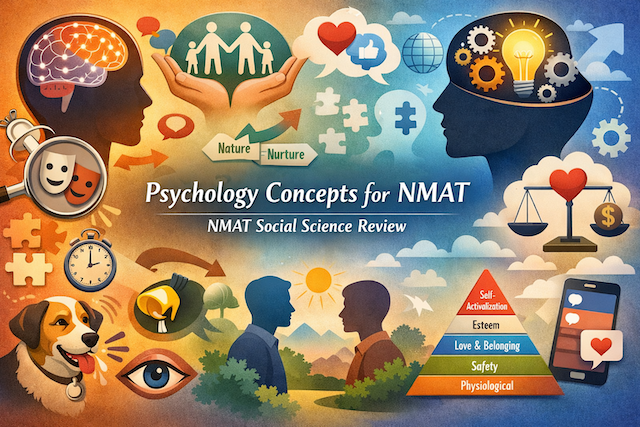
Psychology Concepts for NMAT: NMAT Social Science Review
Contents
- Psychology Concepts for NMAT: NMAT Social Science Review
- Introduction to Psychology
- Branches of Psychology
- Learning Theories
- Classical Conditioning
- Operant Conditioning
- Insight and Observational Learning
- Memory and Forgetting
- Stages of Memory
- Types of Memory
- Forgetting
- Motivation
- Maslow’s Hierarchy of Needs
- Intrinsic and Extrinsic Motivation
- Emotion
- Theories of Emotion
- Intelligence
- Theories of Intelligence
- Personality
- Major Personality Theories
- Attitude and Attitude Change
- Social Influence and Group Behavior
- Conformity and Obedience
- Group Dynamics
- Stress and Coping
- Psychology and Everyday Life
- Preparation Tips for NMAT Psychology
- Conclusion
- FAQs (Frequently Asked Questions)
- How much psychology is actually tested in the NMAT Social Science section?
- Do I need to memorize names of psychologists and experiments?
- What is the fastest way to differentiate classical and operant conditioning?
- Which memory concepts are most important for NMAT?
- How should I study motivation and Maslow’s hierarchy without overcomplicating it?
- What emotion theory is most likely to appear, and how do I remember the differences?
- How deep do I need to go into personality theories for NMAT?
- What social psychology topics are most helpful for NMAT test-taking?
- How can I answer NMAT psychology questions faster during the exam?
Psychology Concepts for NMAT: NMAT Social Science Review
Psychology is an important component of the NMAT Social Science section. It tests your understanding of human behavior, mental processes, and how individuals interact with their environment and society. The questions are usually conceptual rather than highly technical, making it essential to master definitions, theories, and real-life applications. This article provides a comprehensive review of key psychology concepts frequently tested in NMAT, with clear explanations and examples to help you strengthen both accuracy and speed during the exam.
Introduction to Psychology
Psychology is the scientific study of behavior and mental processes. It seeks to understand how people think, feel, learn, and act in different situations. In NMAT, psychology questions often assess your ability to apply psychological principles to everyday scenarios rather than recall isolated facts.
Psychology has several major goals:
- To describe behavior and mental processes
- To explain why behavior occurs
- To predict future behavior
- To control or influence behavior in positive ways
Understanding these goals helps you interpret questions that involve decision-making, motivation, learning, and social interaction.
Branches of Psychology
Psychology is divided into multiple branches, each focusing on a specific aspect of behavior or mental functioning. NMAT often includes questions that test awareness of these branches and their applications.
- Clinical Psychology: Focuses on diagnosing and treating mental disorders.
- Cognitive Psychology: Studies mental processes such as memory, thinking, perception, and problem-solving.
- Developmental Psychology: Examines psychological changes across the lifespan.
- Social Psychology: Studies how individuals influence and are influenced by others.
- Industrial-Organizational Psychology: Applies psychology to workplace behavior and productivity.
- Educational Psychology: Focuses on learning processes and teaching methods.
Questions may ask you to match a real-life situation with the correct branch of psychology.
Learning Theories
Learning refers to a relatively permanent change in behavior due to experience. Several learning theories are commonly tested in NMAT.
Classical Conditioning
Classical conditioning, proposed by Ivan Pavlov, involves learning through association. A neutral stimulus becomes associated with a meaningful stimulus, eliciting a learned response.
Key terms include:
- Unconditioned stimulus (UCS)
- Unconditioned response (UCR)
- Conditioned stimulus (CS)
- Conditioned response (CR)
NMAT questions may describe everyday examples, such as fear or emotional reactions, and ask you to identify the elements of conditioning.
Operant Conditioning
Operant conditioning, developed by B.F. Skinner, focuses on learning through consequences. Behavior is shaped by reinforcement and punishment.
- Positive reinforcement: Adding a pleasant stimulus to increase behavior
- Negative reinforcement: Removing an unpleasant stimulus to increase behavior
- Punishment: Decreasing behavior by applying negative consequences
Understanding the difference between reinforcement and punishment is crucial, as NMAT often tests this distinction.
Insight and Observational Learning
Insight learning involves sudden understanding or problem-solving without trial and error. Observational learning, proposed by Albert Bandura, occurs by watching others and imitating their behavior.
Questions may involve role models, imitation, or learning by observation in social contexts.
Memory and Forgetting
Memory is the process of encoding, storing, and retrieving information. NMAT psychology questions frequently assess basic memory models and reasons for forgetting.
Stages of Memory
- Sensory memory: Holds information briefly from sensory organs
- Short-term memory: Limited capacity and duration
- Long-term memory: Stores information for extended periods
Understanding the flow of information between these stages is essential for conceptual questions.
Types of Memory
- Explicit memory: Conscious recall of facts and events
- Implicit memory: Unconscious memory, such as skills and habits
Forgetting
Common reasons for forgetting include decay, interference, retrieval failure, and repression. NMAT may test your ability to identify the cause of forgetting in a given scenario.
Motivation
Motivation explains why individuals initiate, persist in, or stop certain behaviors. Understanding motivation theories helps interpret questions related to goal-setting, effort, and performance.
Maslow’s Hierarchy of Needs
Abraham Maslow proposed that human needs are arranged in a hierarchy:
- Physiological needs
- Safety needs
- Love and belongingness
- Esteem needs
- Self-actualization
NMAT questions often focus on identifying which need is driving a particular behavior.
Intrinsic and Extrinsic Motivation
Intrinsic motivation arises from internal satisfaction, while extrinsic motivation depends on external rewards. Understanding this distinction is important for workplace and educational scenarios.
Emotion
Emotion involves physiological arousal, subjective experience, and behavioral expression. NMAT tests basic emotion theories and emotional intelligence concepts.
Theories of Emotion
- James-Lange theory: Emotion follows physiological arousal
- Cannon-Bard theory: Emotion and arousal occur simultaneously
- Schachter-Singer theory: Emotion depends on arousal and cognitive interpretation
Questions may describe emotional reactions and ask you to identify the underlying theory.
Intelligence
Intelligence refers to the ability to learn, reason, solve problems, and adapt to the environment. NMAT focuses on conceptual models rather than numerical IQ calculations.
Theories of Intelligence
- Spearman’s two-factor theory: General and specific intelligence
- Gardner’s multiple intelligences: Linguistic, logical, interpersonal, and others
- Sternberg’s triarchic theory: Analytical, creative, and practical intelligence
Understanding these theories helps in classification-based questions.
Personality
Personality refers to enduring patterns of thoughts, feelings, and behaviors. NMAT often tests basic personality theories and traits.
Major Personality Theories
- Trait theory: Focuses on stable personality traits
- Psychoanalytic theory: Proposed by Freud, emphasizing unconscious processes
- Humanistic theory: Emphasizes self-growth and free will
Basic knowledge of concepts like id, ego, superego, and defense mechanisms is useful.
Attitude and Attitude Change
An attitude is a learned tendency to respond favorably or unfavorably toward an object, person, or idea. Attitudes consist of cognitive, affective, and behavioral components.
NMAT questions may involve persuasion, advertising, or social influence affecting attitudes.
Social Influence and Group Behavior
Social psychology concepts are frequently tested in NMAT due to their relevance to management and organizational settings.
Conformity and Obedience
Conformity involves adjusting behavior to match group norms, while obedience refers to following authority figures. Classic studies by Asch and Milgram are commonly referenced.
Group Dynamics
Group behavior includes phenomena such as groupthink, social facilitation, and social loafing. Understanding these concepts helps in scenario-based questions involving teamwork and leadership.
Stress and Coping
Stress is the psychological and physiological response to perceived challenges or threats. NMAT may test basic stress models and coping strategies.
- Problem-focused coping
- Emotion-focused coping
Questions often focus on identifying healthy versus unhealthy coping mechanisms.
Psychology and Everyday Life
One of the most important aspects of NMAT psychology preparation is applying concepts to daily life. Questions may involve workplace behavior, academic performance, interpersonal relationships, and decision-making.
Rather than memorizing definitions, focus on understanding how psychological principles operate in real-world situations.
Preparation Tips for NMAT Psychology
- Focus on concepts and applications, not rote memorization
- Practice scenario-based questions
- Revise definitions and key theorists
- Use examples to strengthen understanding
Conclusion
Psychology in NMAT Social Science is highly scoring if approached conceptually. By understanding core theories, branches, and real-life applications, you can confidently tackle a wide range of questions. Consistent revision and practice will help you recognize patterns and apply psychological principles effectively during the exam.
FAQs (Frequently Asked Questions)
How much psychology is actually tested in the NMAT Social Science section?
The NMAT Social Science section typically includes a meaningful number of questions based on psychology concepts, but the exact proportion can vary depending on the exam version. In most cases, psychology appears through short scenarios and conceptual items that test your understanding of human behavior, learning, motivation, emotions, and social influence. Rather than requiring advanced academic detail, NMAT tends to focus on broad, foundational principles that can be applied to everyday situations such as studying, working in teams, handling stress, or making decisions. If you build strong mastery of core topics like conditioning, memory, personality, and group dynamics, you will be able to answer most psychology-related questions confidently and quickly.
Do I need to memorize names of psychologists and experiments?
You do not need to memorize an extensive list of names, but knowing the most commonly referenced theorists and what they are known for is very helpful. NMAT questions sometimes mention a theory directly (for example, “Maslow’s hierarchy of needs”) or describe a situation that clearly matches a well-known concept (like operant conditioning). Key names worth knowing include Ivan Pavlov (classical conditioning), B.F. Skinner (operant conditioning), Albert Bandura (observational learning), Sigmund Freud (psychoanalytic ideas), and Abraham Maslow (motivation and needs). Instead of memorizing biographies, focus on linking each name to one or two main concepts and being able to apply them in context.
What is the fastest way to differentiate classical and operant conditioning?
A quick way to differentiate them is to focus on what is being learned. In classical conditioning, an organism learns an association between two stimuli, resulting in an automatic or reflexive response. The key idea is “stimulus leads to response,” usually involving involuntary reactions like fear, salivation, or anxiety. In operant conditioning, an organism learns an association between behavior and consequences, meaning actions are strengthened or weakened based on reinforcement or punishment. The key idea is “behavior leads to consequence.” If the scenario highlights rewards, penalties, or consequences following an action, it is usually operant conditioning. If it highlights pairing a neutral cue with a meaningful cue to trigger an automatic response, it is usually classical conditioning.
Which memory concepts are most important for NMAT?
The most test-relevant memory concepts include the stages of memory (sensory, short-term, and long-term), the processes of encoding, storage, and retrieval, and the basic reasons people forget information. You should also understand the difference between explicit memory (facts and events you can consciously recall) and implicit memory (skills and habits). NMAT questions often present simple academic or everyday situations, such as forgetting what you studied, confusing two similar topics, or remembering a skill without thinking about it. In these cases, concepts like interference, decay, and retrieval failure become useful. You do not need complex brain anatomy, but you should be able to identify what part of the memory process is likely failing in a scenario.
How should I study motivation and Maslow’s hierarchy without overcomplicating it?
For motivation, focus on identifying the “need” or “goal” behind behavior. Maslow’s hierarchy is especially test-friendly because it provides a clear structure: physiological needs and safety needs are more basic, while esteem and self-actualization are higher-level motivations. To study it effectively, practice classifying behaviors. For example, working overtime to pay rent is likely tied to safety and security, while joining a student organization to make friends relates to belongingness. Seeking awards or recognition can relate to esteem. Pursuing personal growth, creativity, or purpose is often connected to self-actualization. When you study, create short examples for each level. NMAT questions rarely require debate about the theory; they mainly test recognition and application.
What emotion theory is most likely to appear, and how do I remember the differences?
The James-Lange, Cannon-Bard, and Schachter-Singer (two-factor) theories are common in basic psychology reviews and may appear in NMAT-style conceptual questions. A simple way to remember them is to focus on timing and interpretation. James-Lange suggests the body reacts first and the emotion is experienced afterward (arousal then emotion). Cannon-Bard suggests the body and emotion happen at the same time (arousal and emotion simultaneously). Schachter-Singer suggests that arousal occurs, and then you label the emotion based on context (arousal plus cognitive interpretation). If a scenario emphasizes “I felt my heart race, then I felt fear,” it aligns with James-Lange. If it emphasizes “I felt fear and my body reacted together,” it aligns with Cannon-Bard. If it emphasizes “I felt aroused and decided what I was feeling based on the situation,” it aligns with Schachter-Singer.
How deep do I need to go into personality theories for NMAT?
For NMAT, you mainly need a broad understanding of the major approaches: trait theory (stable characteristics), psychoanalytic theory (unconscious motives and inner conflict), and humanistic theory (growth, self-concept, and free will). Freud’s model (id, ego, superego) and defense mechanisms may appear, but typically in a simplified form. Trait theory questions may involve identifying stable behavioral patterns or recognizing that traits can predict tendencies. Humanistic theory often appears in ideas about personal growth and self-actualization. You do not need advanced clinical detail; instead, practice recognizing which approach best explains a given scenario and what assumptions each theory makes about human behavior.
Social influence concepts are highly practical for NMAT because they relate to leadership, teamwork, persuasion, and group behavior. The most useful topics include conformity (changing behavior to match group norms), obedience (following authority), groupthink (poor decisions due to pressure for agreement), social loafing (reduced effort in groups), and social facilitation (performance changes in the presence of others). Many questions describe workplace or classroom situations and ask why someone behaved a certain way. If you can identify the social pressure, authority cue, or group dynamic in the scenario, you can answer efficiently. These topics also overlap with basic organizational behavior, which makes them extra valuable for NMAT preparation.
How can I answer NMAT psychology questions faster during the exam?
Speed improves when you train yourself to match keywords in the question to the correct concept. First, read the scenario and identify what is being tested: learning, memory, motivation, emotion, personality, or group behavior. Second, look for cues: rewards and punishments suggest operant conditioning; involuntary reactions and paired cues suggest classical conditioning; pressure to agree suggests conformity or groupthink. Third, eliminate choices that are too extreme or unrelated to the scenario’s main idea. Finally, practice timed sets so that concept recognition becomes automatic. NMAT psychology is often less about complicated computation and more about quick classification, so consistent exposure to question patterns is one of the most effective strategies.
NMAT Study Guide: Complete Preparation Guide for Medical School in the Philippines

How to Register for eTravel Philippines (2025 Guide)
Step-by-step guide to completing your eTravel registration before arriving in the Philippines, with images and tips.

Night Market in Cebu – Things You Don’t Know About Cebu Life
Discover the hidden charm of Cebu’s night markets, from street food stalls to local life tips you won’t find in tourist guides.

How to Use ChatGPT for IELTS Preparation: A Complete Guide
Learn how to prepare for IELTS using ChatGPT — including strategies for Writing, Reading, Listening, Speaking, and grammar support.

How to Build a Website Without Coding Using ChatGPT
Discover how to build your own website using AI—no coding skills needed. From structure planning to SEO and design, let ChatGPT guide you.