2026年1月11日
3D ACADEMY offers affordable English study programs in Cebu, Philippines – perfect for beginners, professionals, and exam takers.

3D UNIVERSAL ENGLISH INSTITUTE INC
info.3d-universal.com
8:00-17:00(Mon-Fri)
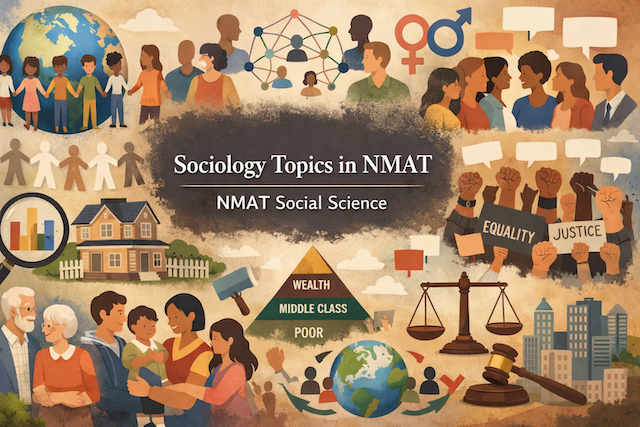
Sociology Topics in NMAT: NMAT Social Science
Contents
- Sociology Topics in NMAT: NMAT Social Science
- Introduction to Sociology
- Society, Community, and Social Groups
- Culture and Socialization
- Norms, Values, and Social Control
- Social Institutions
- Social Stratification
- Caste, Class, and Gender
- Social Change and Development
- Population and Demography
- Urbanization and Rural Society
- Social Problems
- Globalization and Society
- Media and Society
- Social Movements and Collective Behavior
- Applied Sociology and Contemporary Issues
- Importance of Sociology for NMAT Preparation
- Conclusion
- FAQs (Frequently Asked Questions)
- How is sociology tested in the NMAT Social Science section?
- What sociology topics should I prioritize if I have limited time?
- How is sociology different from psychology in NMAT questions?
- What is the easiest way to remember norms, values, and social control?
- How do I handle questions about social stratification and inequality?
- Are caste-related questions likely to appear in NMAT sociology?
- What are common NMAT question patterns in sociology?
- How should I study sociology: memorization or concept practice?
- How can I improve my accuracy in sociology scenario-based questions?
- Do I need to study sociological theorists for NMAT?
- What is a practical last-week plan for sociology NMAT review?
Sociology Topics in NMAT: NMAT Social Science
Sociology is an important component of the NMAT Social Science section. It examines how individuals interact within society, how social institutions function, and how culture, norms, and structures influence human behavior. NMAT sociology questions test not only factual knowledge but also conceptual understanding, application, and analytical thinking. A strong foundation in sociology helps NMAT aspirants interpret social situations, analyze trends, and evaluate real-world issues using sociological perspectives.
This article provides a comprehensive review of key sociology topics commonly tested in NMAT, structured for effective exam preparation.
Introduction to Sociology
Sociology is the systematic study of society, social relationships, and social institutions. It focuses on patterns of social interaction and how these patterns shape individual and collective behavior.
Key concepts include society, social interaction, social structure, and social change. Sociology differs from psychology in that it emphasizes group behavior rather than individual mental processes. NMAT questions often test the basic definition of sociology, its scope, and its relevance to understanding social phenomena.
Society, Community, and Social Groups
Society refers to a group of people who share a common territory, culture, and social organization. Communities are smaller social units within society, often defined by geographical location or shared interests.
Social groups are collections of individuals who interact regularly and share a sense of identity. Sociology distinguishes between primary groups (such as family and close friends) and secondary groups (such as workplaces and institutions). Questions may test understanding of group dynamics, in-groups and out-groups, and the functions of social groups.
Culture and Socialization
Culture includes the beliefs, values, norms, symbols, language, and practices shared by members of a society. It shapes how individuals perceive the world and behave within it.
Socialization is the process through which individuals learn culture and become functioning members of society. Agents of socialization include family, school, peers, media, and religion. NMAT often includes questions on cultural diversity, cultural lag, ethnocentrism, and the role of socialization in personality development.
Norms, Values, and Social Control
Values are shared beliefs about what is desirable or undesirable, while norms are rules and expectations that guide behavior. Norms can be formal (laws) or informal (customs and traditions).
Social control refers to mechanisms used by society to regulate individual behavior and maintain order. These mechanisms may be informal, such as social pressure, or formal, such as legal systems. NMAT questions may ask about deviance, conformity, and the role of sanctions in maintaining social stability.
Social Institutions
Social institutions are organized systems that meet basic societal needs. Major social institutions include family, education, religion, economy, government, and healthcare.
The family is responsible for reproduction, socialization, and emotional support. Education transmits knowledge and social values. Religion provides moral guidance and social cohesion. The economy manages production and distribution of resources, while government ensures order and governance. NMAT questions often test the functions and interrelationships of these institutions.
Social Stratification
Social stratification refers to the hierarchical arrangement of individuals and groups in society based on factors such as wealth, power, and prestige. It results in social inequality.
Common systems of stratification include class, caste, and race-based systems. NMAT sociology frequently includes questions on social mobility, poverty, income inequality, and the impact of stratification on access to opportunities.
Caste, Class, and Gender
Caste is a traditional form of social stratification based on birth, especially prominent in South Asian societies. Class systems are more flexible and are based on economic factors.
Gender refers to socially constructed roles and expectations associated with being male or female. Sociology examines gender inequality, gender roles, and discrimination. NMAT questions may test awareness of social inequalities, gender bias, and the changing roles of men and women in modern society.
Social Change and Development
Social change refers to significant alterations over time in social structures, cultural patterns, and institutions. Factors contributing to social change include technological advancement, economic development, education, and globalization.
Development involves improvements in quality of life, economic growth, and social welfare. NMAT may test understanding of modernization, urbanization, industrialization, and their social consequences.
Population and Demography
Demography is the statistical study of population characteristics such as size, density, distribution, birth rates, death rates, and migration.
Population growth affects resources, employment, education, and healthcare. NMAT questions may focus on population trends, demographic transition, aging populations, and migration patterns.
Urbanization and Rural Society
Urbanization refers to the growth of cities and the movement of people from rural to urban areas. It brings economic opportunities but also challenges such as overcrowding, pollution, and social inequality.
Rural society is typically characterized by close-knit communities, agriculture-based economies, and traditional lifestyles. NMAT questions may compare rural and urban social structures and examine the impact of urbanization on social life.
Social Problems
Social problems are issues that negatively affect large numbers of people and require collective solutions. Examples include poverty, unemployment, crime, substance abuse, and environmental degradation.
Sociology examines the causes, consequences, and possible solutions to social problems. NMAT may test problem-solving ability by presenting real-life scenarios related to social issues.
Globalization and Society
Globalization refers to the increasing interconnectedness of societies through trade, communication, and cultural exchange. It influences economies, cultures, and social relationships worldwide.
While globalization promotes economic growth and cultural exchange, it can also lead to inequality and cultural homogenization. NMAT questions may focus on the social impact of globalization and its advantages and disadvantages.
Media and Society
Mass media plays a crucial role in shaping public opinion, cultural norms, and social behavior. Traditional media includes newspapers, radio, and television, while digital media includes social networking platforms.
Sociology studies the influence of media on identity, politics, and social interaction. NMAT questions may assess understanding of media effects, information dissemination, and social influence.
Social Movements and Collective Behavior
Collective behavior refers to actions taken by groups of people in response to shared experiences or goals, such as crowds, protests, and riots.
Social movements are organized efforts aimed at bringing about social change, such as civil rights movements or environmental activism. NMAT may test knowledge of the characteristics, causes, and outcomes of social movements.
Applied Sociology and Contemporary Issues
Applied sociology uses sociological theories and methods to address real-world problems in areas such as education, healthcare, business, and public policy.
Contemporary issues include digitalization, climate change, aging populations, and changing family structures. NMAT questions often emphasize the application of sociological concepts to current social challenges.
Importance of Sociology for NMAT Preparation
Sociology enhances analytical thinking, social awareness, and decision-making skills, all of which are crucial for NMAT. Understanding sociological concepts helps aspirants interpret case-based questions and make informed judgments.
A well-rounded preparation strategy should include conceptual clarity, real-world examples, and regular practice of NMAT-style questions. Mastery of sociology topics not only improves NMAT scores but also builds a strong foundation for management education and leadership roles.
Conclusion
Sociology is a vital component of the NMAT Social Science section, offering insights into human behavior and social structures. By mastering core concepts such as culture, social institutions, stratification, and social change, NMAT aspirants can confidently tackle sociology-related questions.
Consistent study, conceptual understanding, and application-oriented practice are key to success. A strong grasp of sociology not only supports NMAT performance but also prepares candidates for future challenges in management and society.
FAQs (Frequently Asked Questions)
How is sociology tested in the NMAT Social Science section?
Sociology in NMAT is usually tested through concept-based and application-based questions. You may see definitions and examples of key terms like culture, norms, socialization, and social stratification. Many items also appear in short scenarios where you must identify the sociological concept involved, such as deviance, social control, group dynamics, or institutional influence. To prepare well, focus on understanding concepts clearly and practicing how to apply them to everyday situations and social issues.
What sociology topics should I prioritize if I have limited time?
If time is limited, prioritize the most frequently tested foundations: culture and socialization, norms and deviance, social groups, social institutions, and social stratification. These topics connect to many other areas, so mastering them gives you strong coverage. Next, review social change, population and demography, and social problems because they often show up in applied questions involving modernization, migration, and inequality. If you still have time, add media and society, globalization, and social movements for broader context.
How is sociology different from psychology in NMAT questions?
Psychology focuses on individual behavior, mental processes, and personality, while sociology focuses on groups, institutions, culture, and social structures. In NMAT questions, psychology may ask about memory, learning, motivation, or emotions, whereas sociology may ask how norms influence behavior, how social class affects opportunity, or how institutions shape choices. A good trick is to ask: “Is this about what happens inside a person?” (psychology) or “Is this about society and group patterns?” (sociology).
Use a simple chain: values create norms, and norms are reinforced by social control. Values are broad beliefs about what is good or important (such as honesty or respect). Norms are the practical rules that guide behavior (such as not cheating, greeting elders politely, or following classroom rules). Social control is how society encourages conformity and discourages deviance, using rewards and punishments. Remember that sanctions can be positive (praise, promotions) or negative (fines, criticism).
Start by identifying the basis of inequality in the question: wealth, power, prestige, gender, caste, or ethnicity. Then connect it to outcomes such as access to education, healthcare, employment, or political influence. NMAT questions may test whether you understand social mobility (movement between social classes) and how systems like caste differ from class in flexibility. Practice reading examples carefully because the same scenario can involve multiple factors, such as class and gender intersecting.
They can appear, especially because caste is a well-known example of a rigid stratification system in South Asia. However, NMAT sociology is not limited to caste; it also covers class systems, gender inequality, and broader concepts of social hierarchy. If caste appears, questions often focus on features like hereditary status, restricted mobility, social boundaries, and occupational traditions. It is helpful to compare caste (more rigid) with class (more flexible) to answer contrast-type items.
What are common NMAT question patterns in sociology?
Common patterns include: identifying the concept in a short scenario, selecting the best example of a sociological idea, distinguishing between similar terms (like community vs society, primary vs secondary groups), and applying a concept to a social issue (like poverty or migration). Some questions use simple logic, such as recognizing how institutions influence behavior or how norms regulate social life. Train yourself to look for keywords like “shared beliefs,” “rules,” “roles,” “status,” “inequality,” and “social change.”
How should I study sociology: memorization or concept practice?
You need both, but concept practice should lead. Memorize clear definitions for core terms, then immediately apply them using examples. For instance, learn what “socialization” means, then practice identifying agents of socialization in real-life situations. Create a one-page glossary, but also answer practice questions that require application. Sociology becomes easier when you connect terms to everyday experiences like school, family expectations, workplace roles, and media influence.
How can I improve my accuracy in sociology scenario-based questions?
First, read the scenario and identify the main social force: culture, norms, institutions, stratification, or group influence. Second, eliminate distractor options that are too individual-focused or purely psychological when the question is about society. Third, check whether the question is asking about cause, effect, or definition. Finally, choose the option that best matches the sociological level of analysis. Practicing with timed sets helps you build speed without losing accuracy.
Do I need to study sociological theorists for NMAT?
In many NMAT-style reviews, heavy emphasis on theorists is not required, but basic perspectives can be useful. You may benefit from knowing the general idea of functionalism (institutions maintain stability), conflict perspective (inequality and power struggles shape society), and symbolic interactionism (meaning is created through interaction). Even if theorist names are not asked, these frameworks help you interpret questions about social order, inequality, and identity.
What is a practical last-week plan for sociology NMAT review?
In the final week, aim for high-yield coverage and repeated practice. Spend the first two days reviewing culture, socialization, norms, deviance, and groups. Next, cover institutions and stratification, including class, caste, and gender. Then review social change, globalization, population, and social problems. Each day, solve a small set of questions and review mistakes. On the last day, do a mixed practice set and revise your glossary. Focus on clarity and speed rather than trying to learn overly detailed material.
NMAT Study Guide: Complete Preparation Guide for Medical School in the Philippines

How to Register for eTravel Philippines (2025 Guide)
Step-by-step guide to completing your eTravel registration before arriving in the Philippines, with images and tips.

Night Market in Cebu – Things You Don’t Know About Cebu Life
Discover the hidden charm of Cebu’s night markets, from street food stalls to local life tips you won’t find in tourist guides.

How to Use ChatGPT for IELTS Preparation: A Complete Guide
Learn how to prepare for IELTS using ChatGPT — including strategies for Writing, Reading, Listening, Speaking, and grammar support.

How to Build a Website Without Coding Using ChatGPT
Discover how to build your own website using AI—no coding skills needed. From structure planning to SEO and design, let ChatGPT guide you.