2026年1月11日
3D ACADEMY offers affordable English study programs in Cebu, Philippines – perfect for beginners, professionals, and exam takers.

3D UNIVERSAL ENGLISH INSTITUTE INC
info.3d-universal.com
8:00-17:00(Mon-Fri)
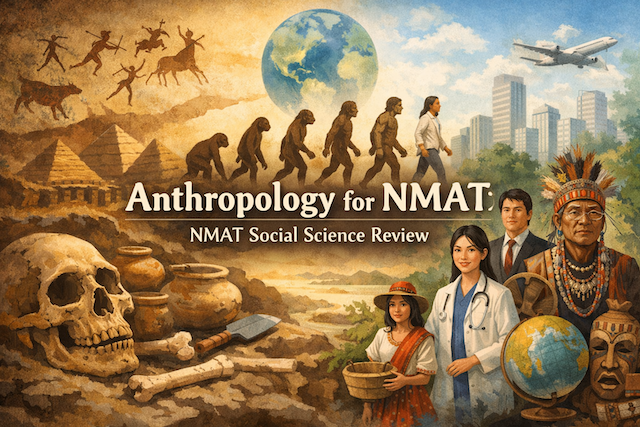
Anthropology for NMAT: NMAT Social Science Review
Contents
- Anthropology for NMAT: NMAT Social Science Review
- Introduction to Anthropology
- Scope and Branches of Anthropology
- Culture: Meaning and Characteristics
- Society and Social Structure
- Kinship and Family Systems
- Marriage and Descent
- Economic Systems in Anthropology
- Religion and Belief Systems
- Language and Communication
- Human Evolution and Adaptation
- Cultural Change and Social Processes
- Ethnocentrism and Cultural Relativism
- Anthropology and Contemporary Society
- Importance of Anthropology for NMAT Preparation
- Conclusion
- FAQs (Frequently Asked Questions)
- What topics in anthropology are most likely to appear in the NMAT Social Science section?
- How is anthropology different from sociology and psychology, and why does NMAT separate them?
- What does “culture is learned and shared” mean in practical terms?
- What is the difference between ethnocentrism and cultural relativism?
- How should I approach NMAT questions about kinship, family, and marriage?
- Do I need to memorize anthropologists’ names and theories for NMAT?
- What are diffusion, acculturation, and assimilation, and how are they tested?
- How can I improve my anthropology score quickly if I’m short on time?
Anthropology for NMAT: NMAT Social Science Review
Introduction to Anthropology
Anthropology is the scientific study of humans, their origins, development, behavior, beliefs, and social structures. In the NMAT Social Science section, anthropology helps assess a student’s understanding of human diversity, culture, evolution, and social organization. Unlike psychology, which focuses on individual behavior, anthropology takes a broader view by examining humans as social and cultural beings across time and space. NMAT questions often test conceptual clarity rather than memorization, making it essential to understand key ideas and apply them to real-life situations.
Scope and Branches of Anthropology
Anthropology is traditionally divided into four major branches. Each branch contributes to a holistic understanding of humanity and may appear in NMAT questions directly or indirectly.
Cultural Anthropology focuses on the study of living societies and cultures. It examines customs, traditions, beliefs, values, language, kinship systems, and social institutions. Questions may ask about cultural relativism, social norms, or patterns of social behavior.
Physical (Biological) Anthropology studies human evolution and biological diversity. It includes the study of fossils, primates, genetics, and adaptation. NMAT questions may involve evolutionary concepts, human variation, or adaptation to environments.
Archaeological Anthropology investigates past human societies through material remains such as tools, dwellings, and art. Understanding how archaeologists infer social structures from artifacts is important.
Linguistic Anthropology examines language as a cultural tool. It explores how language shapes communication, identity, and social relationships.
Culture: Meaning and Characteristics
Culture is a core concept in anthropology and frequently tested in NMAT. Culture refers to the shared patterns of behavior, beliefs, values, customs, symbols, and knowledge transmitted from one generation to another.
Key characteristics of culture include:
- Culture is learned, not inherited biologically.
- Culture is shared among members of a society.
- Culture is dynamic and changes over time.
- Culture is symbolic, using language and symbols to convey meaning.
- Culture shapes perception and behavior.
NMAT questions may ask candidates to distinguish between biological traits and cultural traits or to identify examples of cultural practices.
Society and Social Structure
A society is a group of individuals who share a common culture and interact within a defined territory. Social structure refers to the organized pattern of relationships and institutions that shape social life.
Key elements of social structure include:
- Family and kinship systems
- Economic organization
- Political institutions
- Religious systems
- Education and socialization
NMAT may test understanding of how these institutions function and how they influence individual behavior and group dynamics.
Kinship and Family Systems
Kinship refers to socially recognized relationships based on blood (consanguinity), marriage (affinity), or adoption. Family is the basic unit of kinship organization.
Types of family systems commonly discussed in anthropology include:
- Nuclear family
- Joint or extended family
- Patrilineal and matrilineal descent
- Patrilocal and matrilocal residence
NMAT questions may involve identifying kinship patterns or understanding how family systems influence inheritance, authority, and social roles.
Marriage and Descent
Marriage is a socially approved union that regulates sexual relations and legitimizes offspring. Anthropologists study marriage as a cultural institution rather than a purely personal relationship.
Common forms of marriage include:
- Monogamy
- Polygyny
- Polyandry
Descent systems determine how individuals trace lineage and inherit property or status. Understanding these systems is important for answering NMAT conceptual questions.
Economic Systems in Anthropology
Anthropology examines how societies produce, distribute, and consume resources. Different economic systems reflect environmental conditions and cultural values.
Major types of economic systems include:
- Hunting and gathering
- Pastoralism
- Horticulture
- Agriculture
- Industrial and post-industrial economies
NMAT questions may focus on how economic activities shape social relationships and cultural practices.
Religion and Belief Systems
Religion is a universal cultural phenomenon that involves beliefs, rituals, and moral codes related to the sacred or supernatural. Anthropology studies religion as a social institution rather than evaluating its truth.
Key concepts include:
- Animism
- Totemism
- Shamanism
- Rituals and ceremonies
NMAT may include questions on the social functions of religion, such as social cohesion, moral regulation, or identity formation.
Language and Communication
Language is a defining feature of human culture. Linguistic anthropology studies how language influences thought, social interaction, and cultural continuity.
Important concepts include:
- Language as a system of symbols
- Verbal and non-verbal communication
- Sapir-Whorf hypothesis (linguistic relativity)
NMAT questions may test the relationship between language, culture, and cognition.
Human Evolution and Adaptation
Biological anthropology explores the evolutionary origins of humans. Understanding basic evolutionary principles is important for NMAT.
Key concepts include:
- Natural selection
- Adaptation
- Variation
- Survival of the fittest
Questions may involve distinguishing biological evolution from cultural evolution or identifying adaptive traits in different environments.
Cultural Change and Social Processes
Cultures are not static; they change through internal and external influences. Anthropology studies cultural change to understand social transformation.
Important processes include:
- Diffusion
- Acculturation
- Assimilation
- Globalization
NMAT questions may ask candidates to apply these concepts to contemporary social situations.
Ethnocentrism and Cultural Relativism
Ethnocentrism is the tendency to judge other cultures based on one’s own cultural standards. Cultural relativism, in contrast, emphasizes understanding cultures on their own terms.
NMAT frequently tests this contrast through scenario-based questions requiring unbiased cultural interpretation.
Anthropology and Contemporary Society
Anthropology is highly relevant to modern society, including healthcare, business, education, and public policy. It helps in understanding diversity, social inequality, and cross-cultural interaction.
NMAT may include application-based questions that assess how anthropological insights can solve real-world social problems.
Importance of Anthropology for NMAT Preparation
Anthropology strengthens analytical thinking and cultural awareness, both essential for NMAT success. Rather than rote memorization, NMAT emphasizes conceptual understanding, interpretation, and application.
Students should focus on:
- Understanding core concepts clearly
- Comparing cultural practices
- Applying concepts to social scenarios
- Avoiding ethnocentric assumptions
Conclusion
Anthropology provides a comprehensive framework for understanding human diversity, culture, and social organization. For NMAT aspirants, mastering anthropological concepts enhances performance in the Social Science section by improving critical thinking and contextual analysis. A strong grasp of culture, society, kinship, religion, and human evolution enables students to approach NMAT questions with confidence and clarity.
FAQs (Frequently Asked Questions)
What topics in anthropology are most likely to appear in the NMAT Social Science section?
NMAT questions usually focus on core, high-yield concepts rather than niche ethnographic details. Expect items on the definition of anthropology, the four-field approach (cultural, biological, archaeological, and linguistic anthropology), and foundational ideas such as culture, society, social structure, and social institutions. Culture-related questions are especially common, including cultural traits, cultural change, diffusion, acculturation, ethnocentrism, and cultural relativism. You may also see basic applications of kinship and family systems (e.g., nuclear vs. extended family, descent patterns), and broader themes like globalization and identity. Biological anthropology can appear through simple evolution and adaptation concepts, but the NMAT typically tests understanding and interpretation rather than technical genetics. Preparing well means mastering the language of anthropology and being able to apply terms to short scenarios.
How is anthropology different from sociology and psychology, and why does NMAT separate them?
Anthropology, sociology, and psychology overlap, but they ask different kinds of questions. Psychology centers on the individual—thinking, emotion, perception, and behavior. Sociology focuses on groups and social systems—institutions, social stratification, roles, and large-scale patterns in societies. Anthropology connects these levels by emphasizing culture and human variation across time and place. It often compares societies, studies meaning and symbols, and explores how beliefs and practices develop within cultural contexts. NMAT separates them because each discipline trains a distinct style of reasoning: psychology leans on behavioral and cognitive explanations, sociology emphasizes structural and institutional patterns, and anthropology highlights cultural interpretation and comparative analysis. When answering, look for what the question is really asking: individual-level causes, social-system patterns, or culturally grounded meaning.
“Learned” means culture is acquired through socialization, observation, instruction, and participation—not passed through genes. Children learn language, manners, values, and expectations by watching and interacting with family, peers, school, media, and community. “Shared” means these learned patterns are common enough within a group to guide behavior and communication. For NMAT, this matters because questions may present a behavior and ask whether it is biological or cultural. Eating with utensils, greeting elders in a particular way, or celebrating festivals are cultural because people learn them. Another practical implication is that culture can vary within a society (subcultures), and it can change over time because learning and sharing happen in dynamic environments.
What is the difference between ethnocentrism and cultural relativism?
Ethnocentrism is judging another culture using your own culture’s standards, often assuming your way is “normal” or “better.” Cultural relativism is the effort to understand practices and beliefs within the context of that culture’s values, history, and environment. In NMAT scenario questions, ethnocentrism often appears as quick labeling of unfamiliar practices as “wrong,” “backward,” or “irrational.” Cultural relativism appears as careful interpretation: asking what purpose the practice serves, how it fits local beliefs, and what social meaning it carries. Cultural relativism does not require agreeing with everything; it emphasizes understanding before evaluation. The best NMAT answers usually reflect non-judgmental, context-aware reasoning.
How should I approach NMAT questions about kinship, family, and marriage?
Start by identifying what the question is classifying: family type, descent system, or residence pattern. A nuclear family typically includes parents and children, while an extended family includes relatives beyond that unit. Descent can be traced through the father’s line (patrilineal) or the mother’s line (matrilineal). Residence rules describe where a couple lives after marriage: patrilocal (near the husband’s family) or matrilocal (near the wife’s family). Marriage forms may include monogamy, polygyny, or polyandry. NMAT items often give a short description and ask for the correct term. Avoid assuming your own cultural norm is universal; treat the description as a system with its own internal logic.
Do I need to memorize anthropologists’ names and theories for NMAT?
In most NMAT-style preparation, names are less important than concepts. Knowing major figures can help, but the exam typically rewards clear definitions and correct application. If a question mentions a specific idea such as “cultural relativism,” “diffusion,” or “linguistic relativity,” you should understand what it means and how it appears in real life. If you choose to study names, do it selectively and only when the name is strongly tied to a core concept. For efficient review, focus on terminology, differences between branches, and interpreting short case scenarios. This approach matches how the NMAT often tests social science: comprehension and reasoning under time pressure.
What are diffusion, acculturation, and assimilation, and how are they tested?
Diffusion is the spread of cultural traits from one group to another, such as food, fashion, technology, or words. Acculturation occurs when groups in contact exchange cultural features, often with changes in daily practices while maintaining some original identity. Assimilation is a deeper process in which a minority group gradually adopts the dominant culture to the point that distinct cultural differences shrink significantly. NMAT may test these through examples: a local community adopting foreign music styles (diffusion), migrants blending old traditions with new norms (acculturation), or a group abandoning its language and customs over generations (assimilation). The key is to identify the degree of change and whether identity remains distinct.
How can I improve my anthropology score quickly if I’m short on time?
Prioritize high-yield definitions and practice applying them. Create a one-page concept list covering: culture, society, social structure, ethnocentrism, cultural relativism, diffusion, acculturation, assimilation, kinship terms, and the four branches of anthropology. Then practice with scenario-based multiple-choice questions, because anthropology is often tested through interpretation. When reviewing mistakes, ask: “Which keyword in the scenario signals the concept?” Also train yourself to avoid moral judgments; NMAT answers usually favor neutral, context-driven explanations. Finally, practice reading quickly but carefully—many questions are about subtle distinctions, and a single phrase can indicate the correct anthropological concept.
NMAT Study Guide: Complete Preparation Guide for Medical School in the Philippines

How to Register for eTravel Philippines (2025 Guide)
Step-by-step guide to completing your eTravel registration before arriving in the Philippines, with images and tips.

Night Market in Cebu – Things You Don’t Know About Cebu Life
Discover the hidden charm of Cebu’s night markets, from street food stalls to local life tips you won’t find in tourist guides.

How to Use ChatGPT for IELTS Preparation: A Complete Guide
Learn how to prepare for IELTS using ChatGPT — including strategies for Writing, Reading, Listening, Speaking, and grammar support.

How to Build a Website Without Coding Using ChatGPT
Discover how to build your own website using AI—no coding skills needed. From structure planning to SEO and design, let ChatGPT guide you.