2026年1月16日
3D ACADEMY offers affordable English study programs in Cebu, Philippines – perfect for beginners, professionals, and exam takers.

3D UNIVERSAL ENGLISH INSTITUTE INC
info.3d-universal.com
8:00-17:00(Mon-Fri)
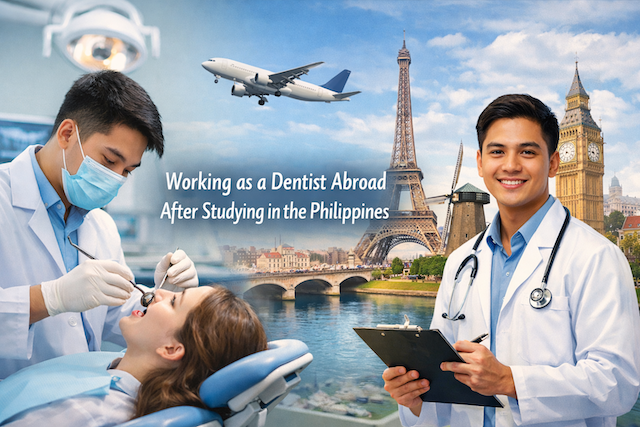
Working as a Dentist Abroad After Studying in the Philippines
Contents
- Working as a Dentist Abroad After Studying in the Philippines
- Why Working Abroad Requires Extra Steps
- Start With a Target Country and Understand Its System
- Credential Readiness: Documents You Should Prepare Early
- English Exams and Communication Skills
- Typical Pathways to Work Abroad as a Foreign-Trained Dentist
- Building a Strong Profile While Still in the Philippines
- What Work Experience Abroad Can Look Like Before Full Dentist Licensure
- Costs, Timelines, and Financial Planning
- Immigration and Visa Considerations
- How to Choose the Best Strategy for You
- Common Mistakes to Avoid
- Action Plan: What to Do Next
- FAQs (Frequently Asked Questions)
- Can I work as a dentist abroad immediately after graduating from a dental school in the Philippines?
- Does a Doctor of Dental Medicine (DMD) degree from the Philippines count in other countries?
- Do I need to be a licensed dentist in the Philippines before applying to work overseas?
- What documents should I prepare before starting the foreign licensure process?
- Will I need an English test even if my dental program was taught in English?
- What is the difference between an exam-based pathway and a bridging program?
- Can I work in a dental clinic abroad while I’m preparing for licensing exams?
- How long does it usually take to become licensed abroad after studying in the Philippines?
- How much should I budget for working abroad as a foreign-trained dentist?
- What are common reasons foreign-trained dentists fail practical exams?
- Are there alternative careers in oral health if I don’t get licensed right away?
- What is the smartest first step if I want to work abroad as a dentist?
Working as a Dentist Abroad After Studying in the Philippines
Studying dentistry in the Philippines can be a strong foundation for an international career. The country’s dental programs are often taught in English, clinical exposure can be extensive, and many graduates build solid hands-on skills. However, working as a dentist abroad is rarely automatic. Dentistry is a tightly regulated profession in most countries, and foreign-trained dentists typically need to complete licensing exams, credential verification, supervised practice, and sometimes additional schooling before they can treat patients independently.
This guide explains what to expect if you studied dentistry in the Philippines and want to work overseas. It focuses on realistic pathways, common requirements, how to prepare early, and what career options exist while you work toward full licensure. Think of it as a roadmap: the exact steps will vary by destination country and even by state or province, but the structure of the journey is surprisingly similar around the world.
Why Working Abroad Requires Extra Steps
Dentistry involves direct patient care, irreversible procedures, anesthesia considerations, infection control, prescribing rules, and strict ethical standards. Because of these risks, most countries require dentists to meet local education standards and pass local assessments. Even if your dental degree is legitimate and you have clinical experience, regulators may still require:
- Credential verification (confirming your school, degree, transcripts, and clinical hours)
- English language proof (sometimes waived if your education was in English, but not always)
- Written exams on biomedical and dental sciences
- Practical or clinical exams (hands-on competency testing)
- Jurisprudence or ethics exams (local laws, professional rules, recordkeeping)
- Background checks, immunization records, and professional references
In many places, “foreign-trained dentist” pathways exist specifically for graduates outside that country’s accredited dental schools. These pathways can be demanding and expensive, but they are designed to be achievable for qualified candidates.
Start With a Target Country and Understand Its System
The most important decision is your destination. The licensing process, exam format, cost, and timeline vary widely. Some countries are more structured with clear bridging programs; others rely heavily on national board exams and practical tests. In addition, immigration rules matter. You may be fully qualified professionally yet unable to work without the correct visa.
When choosing where to pursue licensure, consider:
- Licensing pathway clarity and pass rates
- Total cost (exams, travel, preparation courses, bridging programs, living expenses)
- Time to eligibility (some routes require years)
- Immigration opportunities and work permit options
- Where you have family support, language strength, or professional networks
If you are unsure, shortlist 2–3 destinations and compare them. A common mistake is preparing for one system while applying to another later, which can waste time and money.
Credential Readiness: Documents You Should Prepare Early
Even before you pick a country, you can organize documents that almost every licensing body will ask for. Start collecting these while you are still near your school and can easily request official copies.
- Diploma and proof of graduation
- Official transcripts (sealed and stamped if required)
- Course descriptions/syllabi (sometimes requested for equivalency assessment)
- Clinical requirements record (cases completed, procedures logged, rotations)
- Certificate of internship or clinical training (if applicable)
- PRC license and board rating documents (if you are licensed in the Philippines)
- Certificate of good standing (when available)
- Letters of recommendation from faculty or supervising dentists
- Passport, birth certificate, and name-change documents if applicable
Keep both digital scans and multiple certified copies. Some regulators require documents to be sent directly from your school in sealed envelopes. That process can take weeks or months, especially if you are already abroad.
English Exams and Communication Skills
Even if your program was in English, some destinations still require standardized tests such as IELTS, OET, or TOEFL. Beyond passing scores, communication is crucial for dentistry: explaining risks, obtaining informed consent, managing anxious patients, and documenting accurately. Strong conversational English alone is not enough; you need clinical communication.
Ways to prepare:
- Practice patient explanations for common procedures (fillings, extraction, root canal, crowns)
- Learn how to document SOAP notes and treatment plans in professional English
- Build vocabulary for medical history, medications, contraindications, and emergencies
- Role-play consent conversations and post-op instructions
Good language performance can improve your exam results and your chances of securing assistant or trainee roles while you pursue full licensure.
Typical Pathways to Work Abroad as a Foreign-Trained Dentist
Most countries offer one or more of the following routes. Understanding them helps you choose a strategy that matches your budget and timeline.
- Direct equivalency exams: You pass written and practical exams that prove your knowledge and clinical competence.
- Bridging or advanced standing programs: You enroll in a local dental school program designed for internationally trained dentists, then graduate from an accredited program.
- Supervised practice or limited registration: Some places allow restricted practice under supervision while you complete requirements.
- Alternative oral health roles: Dental assistant, hygienist (requires its own pathway), dental technician, dental receptionist/office manager, or research/academia roles.
Many internationally trained dentists combine pathways: for example, working as a dental assistant while preparing for board exams, then applying for bridging programs if needed.
Building a Strong Profile While Still in the Philippines
Your actions during and right after dental school can make a real difference later. If your goal is to work abroad, treat your student years like preparation for credentialing.
- Take your clinical log seriously: Document procedures clearly and keep proof of requirements completed.
- Seek diverse clinical exposure: Restorative, endodontics, perio, prosthodontics, oral surgery basics, pediatrics, and community dentistry.
- Invest in quality skills: Impression-taking, rubber dam isolation, radiographic positioning, occlusion checks, and infection control.
- Maintain professionalism records: Certificates from seminars, trainings, and volunteer dental missions.
- Get licensed in the Philippines if possible: Some destinations value home-country licensure and work experience.
While not every regulator requires Philippine licensure, being licensed and having verifiable experience can strengthen your credibility when applying for visas, jobs, or supervised practice options.
What Work Experience Abroad Can Look Like Before Full Dentist Licensure
One of the hardest realities is that you might not be able to work as a “dentist” immediately in your target country. But you can still build a dental career while moving toward licensure.
Common entry roles include:
- Dental assistant: Chairside assisting, sterilization, patient preparation, impressions (depending on scope), radiographs (with certification), charting, and inventory.
- Dental receptionist/treatment coordinator: Scheduling, insurance coordination, patient communication, treatment plan discussions (within allowed scope), and record management.
- Dental lab technician assistant: Model work, appliances, and lab workflows (often requires lab-specific training).
- Clinical support roles: Infection control officer, clinic operations, or compliance support in larger practices.
These jobs help you learn the local dental system, terminology, patient expectations, and clinic workflow—skills that can boost your performance in clinical exams and interviews. Just be careful not to perform restricted procedures outside your permitted scope.
Costs, Timelines, and Financial Planning
International licensure can be expensive. Costs usually include application fees, credentialing services, exam fees, review materials, prep courses, travel, and sometimes tuition for bridging programs. Timelines can range from a year (rare) to several years, especially if multiple exams or program admissions are involved.
Practical budgeting tips:
- Create a “licensure budget” with best-case and worst-case scenarios
- Plan for repeat attempts (not pessimism—just realism)
- Choose review resources carefully and avoid buying too many at once
- Work legally in a related role to fund exam preparation when possible
- Track deadlines and processing times to avoid paying fees twice
Financial planning is not only about money; it’s also about avoiding burnout. A sustainable plan increases your chance of finishing the pathway.
Immigration and Visa Considerations
Licensing is only one part of working abroad. You also need the legal right to live and work in the country. Options may include student visas (for bridging programs), skilled worker visas (if eligible), family sponsorship, partner visas, or employer-sponsored pathways for related roles.
Important considerations:
- Some visas restrict the type of work you can do or the hours you can work
- Regulators may require a local address, background checks, or residency status
- Employers may be hesitant to sponsor until you are closer to full licensure
If your plan relies on a bridging program, confirm whether international students can enter that program and what happens after graduation in terms of work authorization.
How to Choose the Best Strategy for You
Because the process varies by country, the “best” pathway depends on your situation. Use this decision logic:
- If you have strong exam skills and savings: A direct exam pathway may be efficient.
- If you prefer structured training and can access tuition funding: A bridging/advanced standing program may fit.
- If you need income quickly: Start with a legal dental support role while preparing.
- If you have limited budget: Consider destinations with clearer and less costly pathways, and avoid frequent international travel requirements.
Also consider your long-term goals. Do you want to own a clinic abroad, specialize, work in public health, or teach? Some destinations require additional years of local practice before specialization training.
Common Mistakes to Avoid
- Assuming your degree automatically transfers: Most places require additional steps.
- Ignoring document requirements: Missing sealed transcripts or clinical logs can delay you for months.
- Preparing without a target country: Exam content and format differ significantly.
- Underestimating practical exams: Hands-on tests require specific technique and time management practice.
- Working outside your legal scope: This can harm future licensing applications.
A careful, compliant approach protects your future career. Regulators value honesty and professionalism, and many applications ask about prior compliance issues.
Action Plan: What to Do Next
If you studied dentistry in the Philippines and want to work abroad, take these steps in order:
- Pick a target country (or shortlist two) and read the regulator’s licensing pathway for foreign-trained dentists.
- Collect and organize documents: diploma, transcripts, syllabi, clinical logs, PRC documents, and references.
- Assess your English requirement and begin targeted clinical communication practice.
- Build a budget and timeline, including exam fees, travel, and living costs.
- Choose a preparation approach for the required exams (self-study, review course, study group).
- Explore legal entry roles abroad (assistant, coordinator) that support your pathway.
- Keep your skills sharp with continuous education, hands-on practice, and updated infection control knowledge.
Working abroad after studying dentistry in the Philippines is absolutely possible, but it requires planning, patience, and a realistic understanding of licensing systems. If you approach it strategically—starting early with documents, selecting a destination carefully, and building experience while preparing—you can turn your Philippine dental education into an international career.
FAQs (Frequently Asked Questions)
Can I work as a dentist abroad immediately after graduating from a dental school in the Philippines?
In most countries, you cannot work independently as a licensed dentist right after graduating in the Philippines. Dentistry is highly regulated, and many destinations require foreign-trained dentists to complete credential verification, pass written board exams, and also pass a hands-on clinical or practical exam. Some countries may allow limited or supervised roles in a dental setting while you work toward full licensure, but the job title “dentist” and the scope of practice are usually protected by law. If your goal is to treat patients as the primary provider, expect additional steps and plan for a transition period.
Does a Doctor of Dental Medicine (DMD) degree from the Philippines count in other countries?
Your Philippine DMD degree is an important academic credential, but whether it is considered equivalent to a local dental degree depends on the destination’s licensing authority. Many countries have a specific pathway for internationally educated dentists that acknowledges the degree but still requires exams or additional education to confirm that your training matches local standards. In some places, the degree may be accepted as proof of completion of dental education, while in others you may need a formal assessment of course content, clinical hours, or competencies before you can even sit for exams.
Do I need to be a licensed dentist in the Philippines before applying to work overseas?
It depends on the country, but being licensed in the Philippines can strengthen your profile even if it is not strictly required. Some regulators or employers value home-country licensure because it suggests you have met a professional standard and can provide proof of good standing. In addition, Philippine licensure may help with job opportunities in dental support roles abroad and can improve your credibility when applying for visas, internships, or supervised practice. However, you should confirm each destination’s rules because some pathways focus more on degree equivalency and local exams than on your home license.
What documents should I prepare before starting the foreign licensure process?
Most licensing bodies require official transcripts, proof of graduation, and identity documents. Many also request course descriptions or syllabi, clinical requirement records, internship certificates, and letters of recommendation. If you are licensed in the Philippines, you may need PRC documents such as your license, board rating, and a certificate of good standing. Keep scanned copies for your records, but remember that many authorities require sealed, stamped, or directly sent documents from your school. Preparing these early can prevent major delays once you move abroad.
Will I need an English test even if my dental program was taught in English?
Some countries still require standardized proof of English proficiency regardless of the language used in your degree program. Others may provide exemptions if your education was completed in English in a recognized institution. Even when an English test is not required, strong clinical communication skills are essential for passing interviews, practical exams, and working safely with patients. Dentistry involves informed consent, medical history discussions, post-operative instructions, and accurate documentation, so improving professional English can directly affect your success abroad.
What is the difference between an exam-based pathway and a bridging program?
An exam-based pathway usually involves passing written and clinical exams that test whether you meet local competency standards. If you pass, you may become eligible for registration or for the final steps toward licensure. A bridging or advanced standing program is a structured educational route for internationally trained dentists, often run by local universities. You complete additional coursework and clinical training, then graduate from an accredited program that makes licensing easier in that country. Exam pathways can be faster if you pass early, while bridging programs can provide guided training but may be competitive and expensive.
Can I work in a dental clinic abroad while I’m preparing for licensing exams?
Often, yes, but usually not as a licensed dentist. Many people start in legally permitted roles such as dental assistant, receptionist, sterilization technician, or treatment coordinator while studying for exams. These jobs can help you learn local systems, dental terminology, patient expectations, and clinic workflows. However, you must follow the destination’s scope-of-practice rules. Performing procedures reserved for licensed dentists can put your future application at risk. Always confirm what tasks are allowed under your visa and local regulations.
How long does it usually take to become licensed abroad after studying in the Philippines?
Timelines vary widely depending on the country, the pathway, exam schedules, credential processing times, and whether you need additional education. For some candidates, it may take a couple of years; for others, it can take longer, especially if bridging programs require admission cycles and multi-year study. A realistic plan should include time for document requests, exam preparation, possible retakes, and immigration steps. The best approach is to map out the exact requirements for your target destination and build a timeline with buffer time.
How much should I budget for working abroad as a foreign-trained dentist?
Costs can include credential verification fees, exam fees, review materials, preparation courses, travel, and living expenses during study periods. If you choose a bridging program, tuition can become the largest expense. It is smart to budget for repeat exam attempts and unexpected administrative fees. Many candidates reduce financial pressure by working in a dental support role legally while preparing. Your budget should also consider visa application costs, English tests (if required), and relocation expenses such as housing deposits.
What are common reasons foreign-trained dentists fail practical exams?
Practical exams often test more than clinical knowledge. Candidates may struggle with time management, unfamiliar equipment setups, strict evaluation rubrics, or anxiety under exam conditions. Technique details matter: isolation, margin integrity, occlusion, proximal contacts, infection control steps, and documentation. Some candidates have strong theory knowledge but limited exposure to the exact exam style. The best preparation includes repeated hands-on practice under timed conditions, feedback from experienced mentors, and careful study of the exam criteria.
Are there alternative careers in oral health if I don’t get licensed right away?
Yes. While working toward full licensure, some people build careers as dental assistants, clinic managers, treatment coordinators, dental lab technicians, or dental sales and product specialists. Others move into public health, research, academic support roles, or healthcare administration. These paths can keep you connected to dentistry, help you earn income, and improve your understanding of the local healthcare environment. If you later complete licensure, this experience can still be valuable and may make you a stronger candidate for higher roles.
What is the smartest first step if I want to work abroad as a dentist?
The smartest first step is choosing a target country and reading the official licensing pathway for internationally trained dentists from that country’s dental regulator. Once you know the exact requirements, start collecting your documents and build a study plan for the required exams. If immigration is a challenge, explore legal entry routes such as study programs, family sponsorship, or employment in permitted dental support roles. A clear target and an organized document file are often the biggest advantages at the beginning of the journey.
Dentistry in the Philippines: Education System, Universities, and Career Path

How to Register for eTravel Philippines (2025 Guide)
Step-by-step guide to completing your eTravel registration before arriving in the Philippines, with images and tips.

Night Market in Cebu – Things You Don’t Know About Cebu Life
Discover the hidden charm of Cebu’s night markets, from street food stalls to local life tips you won’t find in tourist guides.

How to Use ChatGPT for IELTS Preparation: A Complete Guide
Learn how to prepare for IELTS using ChatGPT — including strategies for Writing, Reading, Listening, Speaking, and grammar support.

How to Build a Website Without Coding Using ChatGPT
Discover how to build your own website using AI—no coding skills needed. From structure planning to SEO and design, let ChatGPT guide you.