2026年3月30日
3D ACADEMY offers affordable English study programs in Cebu, Philippines – perfect for beginners, professionals, and exam takers.

3D UNIVERSAL ENGLISH INSTITUTE INC
info.3d-universal.com
8:00-17:00(Mon-Fri)
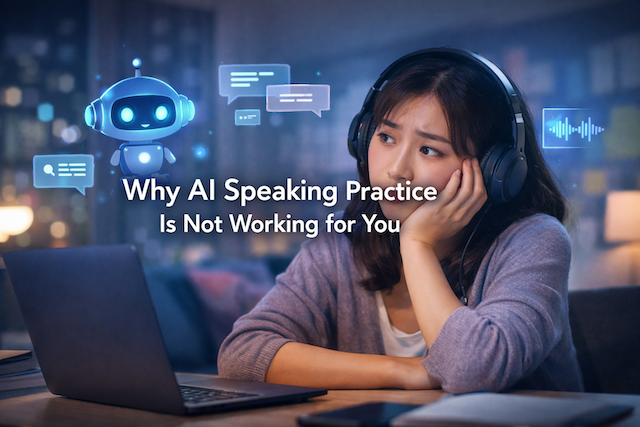
Why AI Speaking Practice Is Not Working for You
Contents
- Why AI Speaking Practice Is Not Working for You
- Introduction
- You Are Practicing Passively, Not Actively
- You Are Not Getting Real Feedback
- You Are Not Training for Real Conversations
- You Are Avoiding Discomfort
- You Are Not Thinking in English
- You Are Not Repeating Enough
- You Are Not Practicing Pronunciation Properly
- You Are Not Tracking Your Progress
- You Expect AI to Do the Work for You
- How to Fix Your AI Speaking Practice
- Conclusion
- FAQs (Frequently Asked Questions)
- Why is AI speaking practice not improving my English?
- Is AI speaking practice enough to become fluent in English?
- How often should I use AI for speaking practice?
- What is the biggest mistake people make when using AI for speaking practice?
- Can AI help with pronunciation, or is it only useful for conversation?
- Why can I speak well with AI but struggle with real people?
- How can I make AI speaking practice more effective?
- Should beginners use AI for speaking practice?
Why AI Speaking Practice Is Not Working for You
Introduction
AI-powered tools have completely transformed the way people learn English. With apps, chatbots, and voice assistants available 24/7, learners now have access to unlimited speaking practice without needing a human partner. On the surface, this seems like the perfect solution—convenient, affordable, and efficient.
However, many learners still struggle to become fluent despite using AI daily. You might be practicing regularly, speaking to AI tools, and even feeling productive—but when it comes to real conversations, you freeze, hesitate, or revert to simple sentences.
So what’s going wrong?
The truth is simple: AI speaking practice is not failing—you are using it incorrectly.
In this article, we will explore the real reasons why AI speaking practice is not working for you, and more importantly, how to fix it.
You Are Practicing Passively, Not Actively
One of the biggest mistakes learners make is treating AI like entertainment rather than training.
If you are simply answering questions casually or chatting without pressure, your brain is not being challenged enough to grow. Real improvement requires effort, discomfort, and focus.
Passive practice looks like this:
- Giving short answers
- Avoiding difficult words
- Letting AI lead the conversation
- Not correcting your mistakes
Active practice, on the other hand, requires:
- Speaking in full sentences
- Forcing yourself to explain ideas
- Trying new vocabulary
- Noticing and correcting errors
If your sessions feel easy, you are probably not improving.
You Are Not Getting Real Feedback
AI tools often prioritize smooth conversation over strict correction. This creates a dangerous illusion—you feel like you are doing well, but your mistakes remain uncorrected.
Without proper feedback:
- You repeat the same grammar errors
- Your pronunciation does not improve
- Your vocabulary stays limited
In real-life conversations, people react naturally—they may misunderstand you, ask for clarification, or correct you. AI often avoids interrupting, which reduces learning opportunities.
To fix this:
- Ask AI to correct every mistake
- Request detailed explanations
- Repeat corrected sentences aloud
Feedback is the foundation of improvement.
You Are Not Training for Real Conversations
Talking to AI is very different from talking to humans.
AI is:
- Patient
- Predictable
- Non-judgmental
- Easy to understand
Real people are:
- Fast
- Emotional
- Unpredictable
- Sometimes unclear
If you only practice with AI, you are training in a controlled environment. When you enter real conversations, your brain cannot adapt quickly enough.
This is why many learners say:
“I can speak with AI, but I cannot speak with real people.”
To solve this:
- Simulate difficult scenarios (interruptions, fast speech)
- Practice listening as much as speaking
- Combine AI practice with real conversations whenever possible
You Are Avoiding Discomfort
Growth happens outside your comfort zone.
Many learners unconsciously avoid:
- Complex sentences
- New vocabulary
- Difficult topics
Instead, they stay in a safe zone where they can speak easily. This creates the illusion of progress while limiting actual development.
Signs you are avoiding discomfort:
- You repeat the same phrases
- You talk about simple topics only
- You rarely make mistakes
But mistakes are necessary.
To improve faster:
- Intentionally choose difficult topics
- Speak longer than you feel comfortable
- Push yourself to express complex ideas
Discomfort is not a problem—it is a signal of progress.
You Are Not Thinking in English
A major barrier to fluency is thinking in your native language first and then translating.
Even with AI, many learners:
- Think in their native language
- Translate into English
- Speak slowly
This process is too slow for real conversations.
AI practice often allows this habit because there is no time pressure.
To break this habit:
- Use simple English thinking patterns
- Describe what you see around you in English
- Practice speaking without translating
Fluency comes when you think directly in English.
You Are Not Repeating Enough
Many learners underestimate the power of repetition.
They:
- Try new topics every day
- Avoid repeating the same sentences
- Move on too quickly
But repetition builds automaticity.
Without repetition:
- Your speaking remains slow
- You forget vocabulary easily
- Your sentences lack confidence
Effective AI practice should include:
- Repeating corrected sentences
- Practicing the same topic multiple times
- Building muscle memory for common phrases
Repetition is not boring—it is essential.
You Are Not Practicing Pronunciation Properly
Speaking is not just about grammar and vocabulary. Pronunciation plays a critical role.
Many learners use AI for text-based conversation only, which ignores:
- Intonation
- Stress patterns
- Natural rhythm
Even when using voice features, learners often:
- Do not listen carefully
- Do not mimic native pronunciation
- Do not record themselves
To improve pronunciation:
- Shadow AI responses (repeat immediately)
- Focus on rhythm, not just individual sounds
- Compare your voice with native models
Clear pronunciation makes a bigger difference than perfect grammar.
You Are Not Tracking Your Progress
Without tracking progress, it is difficult to see improvement or identify weaknesses.
Many learners rely on feeling:
- “I think I’m improving”
- “It feels easier”
But feelings are unreliable.
Instead, you should:
- Record your speaking regularly
- Measure speaking time and complexity
- Track mistakes and improvements
Data-driven learning leads to faster results.
You Expect AI to Do the Work for You
AI is a powerful tool—but it is not magic.
Some learners expect:
- Instant fluency
- Automatic correction
- Effortless improvement
This mindset leads to frustration.
The reality is:
- AI is only a tool
- You must actively engage
- Progress depends on your effort
Think of AI as a gym.
You can have the best equipment, but if you do not train properly, you will not get stronger.
How to Fix Your AI Speaking Practice
Now that you understand the problems, here is a simple framework to make AI practice effective.
Step 1: Set Clear Goals
Instead of “practice English,” define:
- Topic (e.g., travel, business)
- Skill (fluency, pronunciation, vocabulary)
- Time limit
Step 2: Use Structured Sessions
A 30-minute session could look like:
- Warm-up (5 minutes)
- Speaking challenge (15 minutes)
- Feedback and correction (5 minutes)
- Repetition and review (5 minutes)
Step 3: Increase Difficulty Gradually
Start simple, then:
- Add time pressure
- Increase topic complexity
- Use advanced vocabulary
Step 4: Combine AI with Real Practice
AI alone is not enough.
You should also:
- Talk to real people
- Join language exchanges
- Practice in real-life situations
Step 5: Stay Consistent
Consistency beats intensity.
Even 20–30 minutes per day, done properly, can lead to significant improvement over time.
Conclusion
AI speaking practice is one of the most powerful tools available today—but only if used correctly.
If it is not working for you, the problem is not the technology. It is the approach.
To summarize:
- Be active, not passive
- Seek feedback
- Embrace discomfort
- Think in English
- Repeat consistently
- Focus on pronunciation
- Track your progress
Most importantly, remember this:
Fluency is not built by convenience—it is built by challenge.
Use AI not as a shortcut, but as a training partner. When you push yourself properly, AI can accelerate your learning dramatically.
The difference between those who succeed and those who don’t is simple:
They don’t just use AI—they train with it.
FAQs (Frequently Asked Questions)
Why is AI speaking practice not improving my English?
AI speaking practice may not be improving your English because you are using it in a passive way rather than an active one. Many learners talk to AI tools casually, give very short answers, or stay with easy vocabulary and familiar topics. This creates the feeling of practice, but it does not create enough challenge for real language growth. Improvement in speaking usually happens when you push yourself to explain ideas clearly, speak in longer sentences, and notice where you struggle.
Another common reason is that learners do not ask the AI to correct them in detail. If the conversation only flows smoothly, you may continue repeating the same grammar, pronunciation, or word choice mistakes without realizing it. AI can be useful, but only when you use it intentionally. You need to turn it into a training tool, not just a conversation partner.
Is AI speaking practice enough to become fluent in English?
AI speaking practice alone is usually not enough to become fully fluent in English. It can be an excellent part of your study routine because it gives you more chances to speak, repeat, and build confidence. However, real fluency also requires dealing with human unpredictability. Real conversations include interruptions, unclear pronunciation, emotional reactions, slang, and unexpected questions. AI conversations are often more controlled and easier to manage.
That does not mean AI is not valuable. It means AI works best when combined with other forms of practice. For example, you can use AI to build vocabulary, organize your thoughts, and rehearse common speaking situations. Then you can apply those skills in real conversations with teachers, classmates, coworkers, or language partners. AI can help you prepare, but human interaction tests whether your speaking is truly flexible and natural.
How often should I use AI for speaking practice?
For most learners, using AI for speaking practice for about 20 to 30 minutes per day is a strong starting point. Daily consistency matters more than occasional long sessions. If you practice for two hours once a week but do nothing on other days, your progress may be slower than someone who speaks with AI for a shorter time every day. Frequent exposure helps your brain build habits, automatic responses, and comfort with English.
The key is not just how often you practice, but how you structure that practice. A focused daily session with clear goals is far more effective than random chatting. You might spend a few minutes warming up, then work on one topic, ask for corrections, and finally repeat improved answers aloud. This kind of routine gives your speaking practice direction and makes each session more productive.
What is the biggest mistake people make when using AI for speaking practice?
One of the biggest mistakes is staying inside a comfort zone. Many learners only use vocabulary they already know and talk about topics that feel easy. They avoid long explanations, difficult opinions, or unfamiliar expressions because they do not want to make mistakes. Unfortunately, this limits progress. If your English practice always feels easy, it may not be helping you grow very much.
Another major mistake is expecting AI to automatically fix everything. Some learners assume that using AI every day will naturally make them fluent, even if they do not review mistakes or repeat corrected sentences. In reality, AI is a tool. It can support your progress, but it cannot replace effort, reflection, and repetition. Learners improve faster when they actively ask for tougher questions, clearer feedback, and more demanding tasks.
Can AI help with pronunciation, or is it only useful for conversation?
AI can help with pronunciation, but only if you use voice-based features properly. If you only type messages, you are not really training your spoken English. Pronunciation involves stress, rhythm, intonation, and clarity, not just word knowledge. Speaking to AI through voice can be useful because it allows you to hear English, repeat after it, and compare your own speech with model pronunciation.
To make pronunciation practice effective, you should not only listen. You should also imitate. Try shadowing short responses from the AI by repeating them immediately after hearing them. You can also record yourself and compare your version with the original. This helps you notice problems in timing, sentence stress, and sound connections. AI is not perfect, but it can still be a practical pronunciation coach when used with attention and repetition.
Why can I speak well with AI but struggle with real people?
This happens because AI conversations are often more forgiving than real human conversations. AI usually waits patiently, responds clearly, and does not judge you. Human conversations are different. People may speak faster, interrupt you, change topics suddenly, or use expressions you did not expect. This can make you feel nervous and less prepared, even if you seemed confident when practicing with AI.
Another reason is that real conversations involve social pressure. Even learners with decent English often freeze because they are afraid of making mistakes in front of others. AI removes that pressure, which is helpful in one way but limiting in another. To solve this, use AI to prepare for realistic situations. Ask it to simulate interviews, travel problems, class discussions, or fast-paced conversations. Then gradually move into real speaking situations whenever possible.
How can I make AI speaking practice more effective?
You can make AI speaking practice more effective by giving each session a clear goal. Instead of opening the app and speaking randomly, decide what you want to train. Maybe you want to practice speaking for two minutes without stopping, improve your pronunciation of difficult sounds, or answer common interview questions more naturally. A clear target changes the quality of your practice.
You should also ask the AI for specific support. For example, tell it to correct every grammar mistake, point out unnatural phrasing, or ask follow-up questions that force you to speak more deeply. After receiving corrections, do not just read them silently. Say the improved version aloud several times. Effective AI practice includes speaking, feedback, correction, repetition, and review. When these parts are combined, AI becomes much more powerful.
Should beginners use AI for speaking practice?
Yes, beginners can benefit from AI speaking practice, especially because it reduces fear and gives unlimited chances to try. Many beginners are embarrassed to speak English with real people because they feel slow, shy, or unprepared. AI creates a low-pressure environment where they can start building confidence. This can be very helpful in the early stages of learning.
However, beginners need structure. If the conversation is too advanced or too open-ended, they may become confused or discouraged. It is better for beginners to use simple prompts, short speaking tasks, and repeated patterns. For example, they can practice introducing themselves, describing their daily routine, or talking about likes and dislikes. As their confidence grows, they can gradually move to longer and more complex speaking tasks.
How to Improve English Speaking Using AI Apps (Complete Guide 2026)

How to Register for eTravel Philippines (2025 Guide)
Step-by-step guide to completing your eTravel registration before arriving in the Philippines, with images and tips.

Night Market in Cebu – Things You Don’t Know About Cebu Life
Discover the hidden charm of Cebu’s night markets, from street food stalls to local life tips you won’t find in tourist guides.

How to Use ChatGPT for IELTS Preparation: A Complete Guide
Learn how to prepare for IELTS using ChatGPT — including strategies for Writing, Reading, Listening, Speaking, and grammar support.

How to Build a Website Without Coding Using ChatGPT
Discover how to build your own website using AI—no coding skills needed. From structure planning to SEO and design, let ChatGPT guide you.