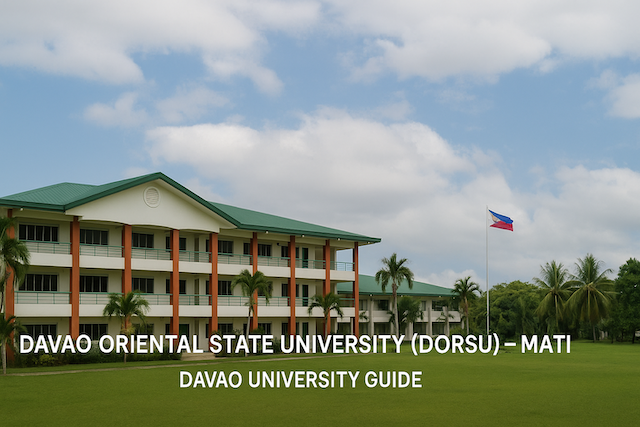
Davao Oriental State University (DOrSU) – Mati: Davao University Guide
Davao Oriental State University (DOrSU) – Mati Campus is one of the most important higher education institutions in the entire Davao Region, serving thousands of students across various academic disciplines. As the main campus of DOrSU, the Mati location is known for its comprehensive degree programs, research initiatives, and role as a key educational center in the province of Davao Oriental. This guide provides an in-depth look at its history, academic offerings, campus life, admission process, and why many students from Mindanao and beyond choose DOrSU Mati for their tertiary education.
Overview of DOrSU – Mati Campus
Davao Oriental State University (DOrSU) is a public university recognized for its strong emphasis on science, research, and community development. The Mati campus, located in the province’s capital city, serves as the main hub for the university’s administration and academic activities.
As a state institution, DOrSU aims to provide accessible, affordable, and quality higher education in a wide range of disciplines including agriculture, environmental sciences, technology, education, and the arts. Its strategic location in Mati City makes it a vital part of the province’s development, producing graduates who contribute to local and national sectors.
History and Background
The institution began as Davao Oriental State College of Science and Technology (DOSCST) before it achieved full university status. Due to continuous growth, enhanced academic programs, and expanded campus facilities, it was eventually converted into Davao Oriental State University (DOrSU) through a Republic Act.
Key milestones include:
-
Expansion of academic programs in sciences, technology, and environmental studies
-
Establishment of specialized research centers focusing on marine biodiversity and natural resources
-
Increased partnerships with LGUs, NGOs, and national agencies for research and community-based programs
-
Continuous campus development to accommodate a growing student population
The Mati campus remains the core academic center and a symbol of progress for the entire DOrSU system.
Academic Programs Offered
DOrSU Mati offers a diverse selection of undergraduate and graduate programs designed to meet national and regional workforce needs. Programs evolve based on labor demand, industry developments, and educational priorities.
Undergraduate Programs
The university typically offers bachelor’s degrees in areas such as:
-
Agriculture and Environmental Sciences
-
BS Agriculture
-
BS Environmental Science
-
BS Forestry
-
BS Fisheries
-
Marine Biology programs
-
Education and Teacher Training
-
Bachelor of Elementary Education
-
Bachelor of Secondary Education
-
Major specializations in Math, Science, English, and others
-
Business, Management, and Public Administration
-
Information Technology and Computing
-
Arts, Humanities, and Social Sciences
-
BA Communication
-
BA Social Sciences
-
Science and Mathematics
-
BS Biology
-
BS Mathematics
-
BS Chemistry
Graduate Studies
Graduate offerings may include:
-
Master of Science in various specializations
-
Master of Arts in Education
-
Other professionally oriented master’s programs depending on faculty availability
Specialized Courses and Certifications
DOrSU Mati may also provide:
Campus Facilities and Resources
The Mati campus is designed to support both academic learning and student life. Over the years, DOrSU has expanded its infrastructure to meet the needs of its increasing enrollment.
Academic Buildings and Laboratories
The campus includes modern lecture halls and various laboratories such as:
-
ICT and computer labs
-
Natural science laboratories
-
Agriculture and fisheries research facilities
-
Engineering and technology workshops
Library and Research Centers
A well-equipped library provides access to physical books, journals, digital databases, and study spaces. Specialized research centers focus on:
Student Services
Students have access to essential support including:
-
Guidance and counseling
-
Student affairs and welfare services
-
Scholarship and financial aid offices
-
Career development and job placement support
Recreational and Sports Facilities
The campus often includes:
Admissions Process
Admission procedures at DOrSU Mati follow standard requirements for state universities, ensuring fairness and accessibility.
General Admission Requirements
Applicants usually need to submit:
-
High school report card (Form 138)
-
PSA Birth Certificate
-
Certificate of Good Moral Character
-
Recent ID photos
-
DOrSU entrance exam results (if required)
Entrance Examination
Some programs may require an entrance test, depending on availability and university guidelines. The exam assesses:
Enrollment Steps
-
Online or on-campus application
-
Submission of required documents
-
Payment of minimal fees (state universities often waive tuition under government programs)
-
Program advising and class registration
-
Issuance of ID and official enrollment confirmation
Tuition, Fees, and Scholarships
Being a state university, DOrSU Mati participates in the Free Higher Education Act (RA 10931), which allows qualified Filipino students to study without paying tuition and miscellaneous fees.
Tuition and Fees
-
Tuition is free for most students under government subsidy
-
Some laboratory-based courses may require additional minimal fees
-
Fees for student organizations and special activities may apply
Scholarship Opportunities
DOrSU offers or accommodates:
Financial aid plays a major role in supporting students from low-income families.
Campus Life and Student Experience
DOrSU Mati offers a dynamic and supportive learning environment. Students enjoy a mix of academic rigor, extracurricular opportunities, and communal culture.
Student Organizations
Organizations vary across categories:
-
Academic and professional groups
-
Cultural and performing arts clubs
-
Environmental and science-based organizations
-
Sports teams
-
Community outreach groups
These organizations help students develop leadership, teamwork, and social awareness.
Events and Activities
Annual events may include:
Living in Mati City
Mati City is known for its:
Students can enjoy a balance between academic life and outdoor activities.
Research and Community Engagement
Research is central to DOrSU’s mission. Faculty and students collaborate on studies involving:
The university is also active in extension services, supporting:
-
Local farmers and fisherfolk
-
Sustainability initiatives
-
Skills training for communities
-
Disaster response and preparedness programs
Why Choose DOrSU Mati?
Davao Oriental State University – Mati stands out due to:
-
Affordable and accessible education as a government-funded university
-
Strong programs in science, agriculture, IT, and education
-
Research excellence particularly in environmental and marine studies
-
Safe and supportive learning environment
-
Opportunities for scholarships and financial support
-
Close connection with the natural environment, ideal for field-based learning
DOrSU is an excellent option for students looking for a high-quality education in Mindanao without the high costs associated with private universities.
FAQs (Frequently Asked Questions)
What programs are offered at Davao Oriental State University (DOrSU) – Mati?
DOrSU – Mati offers a wide range of undergraduate and graduate programs. Popular fields include Agriculture, Environmental Science, Forestry, Fisheries, Marine Biology, Education, Information Technology, Business Administration, Public Administration, Biology, Mathematics, and Communication. The specific list of programs may change over time as new degrees are added, so it is best to check the official DOrSU website or registrar’s office for the most updated program offerings.
Is DOrSU – Mati a public or private university?
Davao Oriental State University – Mati is a public state university in the Philippines. As a state institution, it is funded by the government and is mandated to provide accessible and affordable higher education, particularly to students from Davao Oriental and nearby regions. Being a public university also means that many Filipino students can benefit from government tuition subsidy programs if they meet the requirements.
Is tuition free at DOrSU – Mati under the Free Higher Education Act?
Yes, qualified Filipino students at DOrSU – Mati can study without paying tuition and certain school fees under the Free Higher Education Act (Republic Act 10931). However, there may still be minimal payments for student organizations, ID processing, laboratory materials, and other special fees. International students and those who do not meet the requirements of the law may have different fee structures.
What are the basic admission requirements for new students?
For new college freshmen, common admission requirements include a completed senior high school report card, PSA birth certificate, certificate of good moral character, recent ID photos, and properly accomplished application forms. Some programs may require an entrance examination, interview, or additional documents. Transferees and second coursers will usually need their transcript of records, honorable dismissal, and course descriptions from their previous school.
Does DOrSU – Mati require an entrance examination?
In many cases, DOrSU – Mati administers an entrance examination or qualifying test, especially for high-demand programs. The exam typically evaluates general academic ability, basic English and Mathematics skills, and sometimes program-specific aptitude. Requirements can change depending on university guidelines or national conditions, so applicants should always check the latest announcement from the admissions or guidance office before applying.
Are there scholarships and financial assistance available?
Yes, DOrSU – Mati students may access various scholarship and financial aid programs. These include government scholarships such as CHED and DOST, local government unit (LGU) scholarships, private foundation grants, and university-based academic or merit scholarships. Some scholarships are based on academic performance, while others target low-income families, specific municipalities, or particular courses. Students are encouraged to visit the scholarship office for guidance and application schedules.
What is campus life like at DOrSU – Mati?
Campus life at DOrSU – Mati is generally active and community-oriented. Students can join numerous organizations, including academic clubs, cultural and performing arts groups, environmental organizations, and sports teams. The university regularly hosts activities such as intramurals, foundation celebrations, research conferences, and outreach programs. Because Mati City is relatively laid-back and close to natural attractions, students often enjoy a balance of study, social activities, and outdoor recreation.
What facilities can students use on campus?
Students at DOrSU – Mati have access to classrooms, laboratories, computer and ICT facilities, a main library, and specialized research centers. There may be dedicated laboratories for agriculture, fisheries, marine science, and natural sciences. The campus also typically has sports courts, open fields, and student activity areas. Facilities continue to improve over time as the university invests in infrastructure to support its growing academic community.
Is DOrSU – Mati a good choice for science and environmental courses?
Yes, DOrSU – Mati is particularly strong in science and environment-related fields. Historically, it focused on science and technology as a state college, and it continues to be active in research on agriculture, marine resources, and biodiversity. Students interested in environmental science, forestry, fisheries, or marine biology can benefit from the university’s proximity to coasts, forests, and rural communities, which provide many opportunities for practical fieldwork and research.
What is it like to live and study in Mati City?
Mati City is known for its relaxed atmosphere, friendly locals, and natural attractions such as Dahican Beach. Compared to major metropolitan areas, the cost of living is generally more affordable, especially for food, housing, and transportation. Students can enjoy seaside views, outdoor activities, and a relatively low-stress environment. At the same time, basic services such as markets, banks, clinics, and small malls are available in the city center.
How can I get to DOrSU – Mati from other parts of Mindanao or the Philippines?
Most students travel to Mati City via Davao City, a major urban center in Mindanao. From Davao City, there are regular bus and van services going to Mati, with travel times typically ranging from three to five hours depending on the route and traffic. Students coming from other regions of the Philippines usually fly into Davao International Airport and then ride land transportation to Mati. Once in Mati, local tricycles, jeepneys, or multicabs provide access to the university campus.
Does DOrSU – Mati offer research and community extension opportunities?
Yes, research and community engagement are important parts of DOrSU’s mission. Faculty and students often collaborate on projects related to marine ecosystems, agriculture, environmental conservation, and social development. The university also implements extension programs that support farmers, fisherfolk, local government units, and marginalized communities. Students who participate in these projects gain practical experience and a deeper understanding of local issues while contributing to the province’s development.