2025年11月6日
3D ACADEMY offers affordable English study programs in Cebu, Philippines – perfect for beginners, professionals, and exam takers.

3D UNIVERSAL ENGLISH INSTITUTE INC
info.3d-universal.com
8:00-17:00(Mon-Fri)
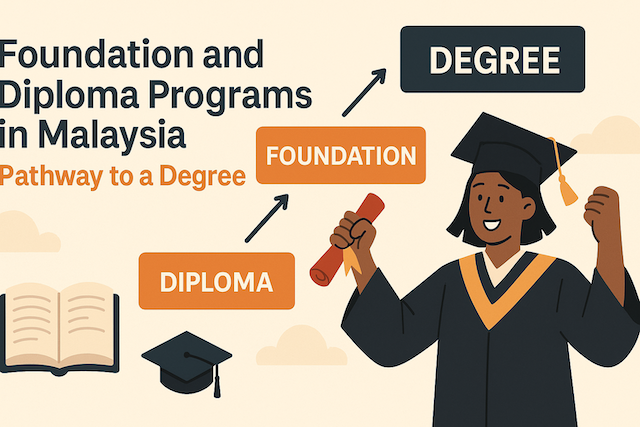
Foundation and Diploma Programs in Malaysia: Pathway to a Degree
Contents
- Foundation and Diploma Programs in Malaysia: Pathway to a Degree
- Understanding Foundation and Diploma Programs
- Key Differences Between Foundation and Diploma
- Popular Foundation Programs in Malaysia
- Popular Diploma Programs in Malaysia
- Entry Requirements
- Tuition Fees and Living Costs
- Advantages of Foundation and Diploma Pathways
- Universities Offering Strong Pathway Programs
- International Recognition and Credit Transfer
- How to Choose Between Foundation and Diploma
- Application Process for International Students
- Conclusion
- What is the difference between a Foundation and a Diploma in Malaysia?
- Who should choose a Foundation program?
- Who should choose a Diploma program?
- How long do Foundation and Diploma programs take?
- What are common entry requirements?
- Can I progress to a degree after completing a Diploma?
- Are Malaysian Foundation and Diploma qualifications recognized internationally?
- What are the typical costs?
- Is instruction in English?
- What subjects can I study at Foundation and Diploma level?
- How do I apply as an international student?
- What factors should I consider when choosing between Foundation and Diploma?
- Will a Foundation guarantee entry to my chosen degree?
- Can I switch universities after Foundation or Diploma?
- Are internships part of these pathways?
- How can I maximize my chance of credit exemptions later?
- What support services do universities provide?
- What is the primary advantage of starting in Malaysia?
Foundation and Diploma Programs in Malaysia: Pathway to a Degree
Malaysia has become one of the most popular destinations in Asia for international students seeking affordable and high-quality higher education. One of the most appealing features of Malaysia’s education system is the pathway programs — particularly foundation and diploma programs — that serve as gateways to bachelor’s degrees.
These preparatory programs help students who have completed their secondary education bridge the gap between high school and university. Whether you’re aiming for a local Malaysian university or an international branch campus, foundation and diploma programs provide flexible routes toward your dream degree.
In this article, we’ll explain everything you need to know about foundation and diploma programs in Malaysia — from the differences between them, entry requirements, popular universities, tuition fees, and the advantages of studying these pathways.
Understanding Foundation and Diploma Programs
What Is a Foundation Program?
A foundation program is a one-year pre-university course designed to prepare students for undergraduate study. It focuses on academic subjects relevant to a student’s intended degree, such as science, business, or engineering.
For example, students who want to study engineering can take the Foundation in Engineering, which includes physics, mathematics, and introductory technical courses. Similarly, those planning to pursue a business degree can take the Foundation in Business, focusing on accounting, economics, and management.
These programs are ideal for students who:
-
Have completed their secondary education (e.g., SPM, O-Level, or equivalent).
-
Want to study a specific field in university.
-
Prefer a smooth transition to a degree program at the same university.
What Is a Diploma Program?
A diploma program is a longer and more practical course, typically lasting two to two and a half years. It combines academic learning with hands-on training and industry exposure. Diploma programs are equivalent to the first year (or sometimes first two years) of a bachelor’s degree.
Diplomas are ideal for students who:
-
Want to gain professional and technical skills.
-
Are not yet ready for direct entry into a degree program.
-
Wish to enter the workforce earlier or continue later to a degree program (with credit transfer).
Diploma graduates can usually enter directly into the second year of a related bachelor’s degree, depending on the university and course alignment.
Key Differences Between Foundation and Diploma
| Feature | Foundation Program | Diploma Program |
|---|---|---|
| Duration | 1 year | 2–2.5 years |
| Focus | Academic and university preparation | Practical and technical training |
| Entry Level | After high school (SPM/O-Level/IGCSE) | After high school (SPM/O-Level/IGCSE) |
| Progression | Leads directly to Year 1 of degree | May lead to Year 2 of degree |
| Suitable for | Students aiming for university study | Students seeking both work skills and degree options |
| Recognition | Usually recognized within the same university | Recognized by most universities and employers |
Both are excellent choices — the right one depends on your career goals and preferred learning style.
Popular Foundation Programs in Malaysia
Many private and public universities in Malaysia offer foundation programs that cater to a range of academic interests. Below are some of the most well-known ones:
1. Foundation in Science
-
Offered by: University of Nottingham Malaysia, Monash University Malaysia, Taylor’s University, Sunway University, UCSI University
-
Duration: 1 year
-
Pathway to: Medicine, Engineering, Pharmacy, Biotechnology, Computer Science
2. Foundation in Business / Arts
-
Offered by: Asia Pacific University (APU), SEGi University, HELP University, INTI International University, Heriot-Watt University Malaysia
-
Duration: 1 year
-
Pathway to: Business Administration, Accounting, Communication, Psychology, Law
3. Foundation in Engineering and Technology
-
Offered by: Curtin University Malaysia, Swinburne University Sarawak, Multimedia University (MMU), UCSI University
-
Duration: 1 year
-
Pathway to: Mechanical, Civil, Electrical, Software Engineering
These foundation programs are typically taught in English, providing international students with language immersion and academic skills necessary for degree success.
Popular Diploma Programs in Malaysia
Diploma programs are offered by many Malaysian universities and colleges that focus on skill-based learning and professional readiness.
1. Diploma in Business Administration
-
Offered by: Sunway College, HELP University, SEGi College, INTI International College, Taylor’s College
-
Career paths: Marketing Executive, Financial Analyst, Business Consultant
2. Diploma in Information Technology / Computer Science
-
Offered by: Asia Pacific University (APU), Multimedia University (MMU), UOW Malaysia KDU, Swinburne University Sarawak
-
Career paths: Web Developer, Network Administrator, Software Engineer
3. Diploma in Hospitality and Tourism Management
-
Offered by: Taylor’s University, Berjaya University College, Sunway University, INTI College, UCSI University
-
Career paths: Hotel Manager, Tour Operator, Event Planner
4. Diploma in Engineering
-
Offered by: Universiti Teknologi Malaysia (UTM), Swinburne Sarawak, Curtin University Malaysia, SEGi University
-
Career paths: Civil Technician, Mechanical Engineer, Project Supervisor
Entry Requirements
Foundation Programs
-
Completion of SPM, O-Level, or IGCSE (minimum 5 credits).
-
English proficiency (IELTS 5.0–5.5 or equivalent).
-
Some science-based programs may require credits in Mathematics and Science.
Diploma Programs
-
Completion of SPM, O-Level, or equivalent (minimum 3 credits).
-
English proficiency (IELTS 5.0 or TOEFL equivalent).
-
Specific requirements vary by course (e.g., Math for IT, Science for Engineering).
Universities may also conduct interviews or placement tests before confirming admission.
Tuition Fees and Living Costs
Studying in Malaysia is relatively affordable compared to countries like the UK or Australia.
| Program Type | Tuition Fee (per year) | Total Duration | Estimated Total Cost |
|---|---|---|---|
| Foundation | RM 15,000–25,000 | 1 year | RM 15,000–25,000 |
| Diploma | RM 20,000–35,000 | 2–2.5 years | RM 40,000–87,500 |
In addition, international students should budget RM 1,500–2,500 per month for living expenses, including accommodation, food, and transportation.
Advantages of Foundation and Diploma Pathways
1. Smooth Transition to University
Foundation students are guaranteed progression to a degree program at the same institution, provided they meet academic requirements. This minimizes stress during university admissions.
2. Cost-Effective Education
Since Malaysian universities offer globally recognized degrees at lower tuition fees, these pathways make higher education accessible and affordable for international students.
3. Flexible Study Routes
Diploma programs provide the flexibility to either continue into a degree program or start working after completion. Students can also transfer to another university, locally or internationally.
4. English-Medium Instruction
All courses are conducted in English, giving students the opportunity to improve their communication skills while preparing for international academic standards.
5. Multicultural Environment
Malaysia is known for its cultural diversity and welcoming environment. Students from over 100 countries study here, creating a global learning atmosphere.
Universities Offering Strong Pathway Programs
Here are some of the top Malaysian institutions that provide reputable foundation and diploma programs:
-
Sunway University – Renowned for its Foundation in Arts and Business programs.
-
Taylor’s University – Offers comprehensive foundation programs linked to degree courses in Hospitality, Business, and Design.
-
Asia Pacific University (APU) – Strong in IT and Engineering pathways.
-
HELP University – Focused on Psychology and Business foundation routes.
-
SEGi University – Offers affordable options with wide diploma-to-degree transfers.
-
Monash University Malaysia – Australian curriculum with guaranteed degree progression.
-
Curtin University Malaysia – Western Australian-based curriculum for engineering and science students.
-
UCSI University – Provides both academic and industry-integrated diplomas.
International Recognition and Credit Transfer
Both foundation and diploma qualifications from Malaysia are widely recognized across Asia, Australia, and the UK. Many students use these programs as stepping stones to study abroad, transferring to partner universities after completing their first year or diploma.
For instance:
-
Foundation in Business at Taylor’s can lead to direct entry to universities in Australia and the UK.
-
Diploma in IT from APU or MMU allows transfer credits to universities in Australia, New Zealand, or the UK.
This global transferability is one of Malaysia’s biggest education advantages.
How to Choose Between Foundation and Diploma
Choosing the right pathway depends on your goals:
| If you… | Choose… |
|---|---|
| Plan to complete a full degree immediately after one year of preparation | Foundation Program |
| Want to gain practical skills before pursuing a degree or entering the workforce | Diploma Program |
| Intend to study a specialized field like Medicine or Law | Foundation Program |
| Prefer hands-on learning in IT, Business, or Hospitality | Diploma Program |
Consider your budget, academic strength, and long-term career goals before deciding.
Application Process for International Students
-
Select your university and program – Research your field and university rankings.
-
Check entry requirements – Review academic and English language prerequisites.
-
Prepare documents – Academic transcripts, passport copy, and English test results.
-
Apply online – Submit your application directly to the university or via an authorized agent.
-
Receive offer letter – Once accepted, you will receive a conditional or unconditional offer.
-
Apply for student visa (EMGS) – Most universities assist in this process.
-
Travel to Malaysia and attend orientation.
Conclusion
Foundation and diploma programs in Malaysia serve as important stepping stones toward achieving a bachelor’s degree. Whether you prefer an academic-focused foundation program or a skill-based diploma, both routes provide affordable, internationally recognized pathways to higher education.
By starting your academic journey in Malaysia, you’ll benefit from a global education system, English-medium instruction, and an inclusive multicultural environment — all while saving significantly on tuition and living costs.
Malaysia’s education pathway system truly opens the door to a world of opportunities.
What is the difference between a Foundation and a Diploma in Malaysia?
A Foundation is a one-year, pre-university program focused on academic preparation for Year 1 of a bachelor’s degree. A Diploma typically lasts two to two-and-a-half years, blends theory with hands-on training, and can grant advanced standing (often into Year 2) of a related degree. Foundation suits students set on proceeding directly to university, while Diploma suits those who want employable skills plus the option to continue to a degree.
Who should choose a Foundation program?
Choose Foundation if you already know your intended major (e.g., Engineering, Business, Computing) and want a fast, structured route into Year 1 at the same university or its articulated partners. It’s also ideal if you prefer academically oriented coursework with fewer work-based components.
Who should choose a Diploma program?
Pick a Diploma if you want practical, job-ready skills while keeping the pathway open to a bachelor’s degree. Diplomas suit learners who benefit from applied labs, projects, or internships in fields like IT, Hospitality, Business, and Engineering tech. They’re also useful if you may work first, then “top up” to a degree later.
How long do Foundation and Diploma programs take?
Foundation is typically 12 months (three semesters or two long trimesters). Diplomas usually take 24–30 months, depending on the institution, study load, and any internship or industrial training requirements.
What are common entry requirements?
Most Foundations require completion of secondary school (e.g., SPM/O-Level/IGCSE) with about five credits, including related subjects for science or engineering tracks. Diplomas commonly require three credits. International applicants should expect proof of English proficiency (e.g., IELTS 5.0–5.5 or equivalent). Exact thresholds vary by university and program.
Can I progress to a degree after completing a Diploma?
Yes. Many Diplomas articulate into the second year of a related bachelor’s degree, subject to meeting GPA and course-match conditions. Credit exemptions depend on curriculum alignment between the Diploma and the target degree; universities will map your transcripts to confirm advanced standing.
Are Malaysian Foundation and Diploma qualifications recognized internationally?
Reputable institutions design their pathways to align with global degree standards. Foundations frequently guarantee progression within the same university (and sometimes partner institutions). Strong Diplomas are widely recognized for credit transfer, especially to universities in Malaysia, Australia, the UK, and parts of Asia, pending course equivalencies.
What are the typical costs?
Foundation tuition often ranges from about RM 15,000–25,000 for the year. Diploma fees commonly range from RM 20,000–35,000 per year. Living costs vary by city, but many students budget around RM 1,500–2,500 per month for accommodation, food, transport, and incidentals. Always verify current fees with the institution.
Is instruction in English?
Yes. Most private universities and international branch campuses teach in English. You may need to meet minimum English entry requirements or take in-house English support classes if your scores are slightly below the threshold.
What subjects can I study at Foundation and Diploma level?
Popular Foundation streams include Science, Business, Engineering, Computing, and Arts. Common Diplomas include Business Administration, Information Technology, Computer Science, Hospitality and Tourism, Creative Media, and Engineering technology fields (e.g., civil, electrical, mechanical). Choose a stream that aligns with your intended bachelor’s major.
How do I apply as an international student?
Typical steps include: shortlist programs; check academic and English requirements; prepare transcripts, passport copy, and test scores; submit the online application; receive a conditional or unconditional offer; complete acceptance and payment; and proceed with visa processing via EMGS with your university’s guidance. Orientation takes place upon arrival.
What factors should I consider when choosing between Foundation and Diploma?
Ask yourself:
- Timeline: Do you want the fastest route to a degree (Foundation) or a longer, skills-oriented path (Diploma)?
- Learning style: Prefer academic theory (Foundation) or applied projects and training (Diploma)?
- Career goals: Need employability sooner (Diploma) or plan to go straight into a full degree (Foundation)?
- Budget and flexibility: Compare total cost and credit transfer policies to your target bachelor’s program.
Will a Foundation guarantee entry to my chosen degree?
Foundations typically offer “assured progression” within the same institution, but it’s conditional on meeting stated grade and subject requirements. Competitive degrees (e.g., Medicine, Pharmacy, Architecture) may have higher thresholds, interviews, or additional tests even for internal Foundation graduates.
Can I switch universities after Foundation or Diploma?
Often yes, but policies differ. Foundations are most portable within the same university or its partners. Diplomas can be more widely transferable, provided course content matches the receiving university’s curriculum. Always request a credit transfer assessment before committing.
Are internships part of these pathways?
Internships are more common in Diplomas, especially in IT, Hospitality, and Engineering tech, where industry training is embedded. Foundations rarely include internships; they focus on academic readiness, study skills, and subject fundamentals.
How can I maximize my chance of credit exemptions later?
Choose a Diploma that closely mirrors the first-year courses of your intended degree. Maintain a strong GPA, keep detailed syllabi and assessments for mapping, and confirm articulation agreements early with your target university to avoid gaps.
What support services do universities provide?
Expect academic advising, English and study-skills workshops, counseling, career services, clubs and societies, and international student offices to assist with visas, housing, and orientation. Access these early to settle quickly and perform well.
What is the primary advantage of starting in Malaysia?
Malaysia offers English-medium instruction, lower tuition and living costs compared with many Western countries, multicultural campuses, and clear progression routes—including to reputable international branch campuses—making it a cost-effective, globally oriented pathway to a bachelor’s degree.

How to Register for eTravel Philippines (2025 Guide)
Step-by-step guide to completing your eTravel registration before arriving in the Philippines, with images and tips.

Night Market in Cebu – Things You Don’t Know About Cebu Life
Discover the hidden charm of Cebu’s night markets, from street food stalls to local life tips you won’t find in tourist guides.

How to Use ChatGPT for IELTS Preparation: A Complete Guide
Learn how to prepare for IELTS using ChatGPT — including strategies for Writing, Reading, Listening, Speaking, and grammar support.

How to Build a Website Without Coding Using ChatGPT
Discover how to build your own website using AI—no coding skills needed. From structure planning to SEO and design, let ChatGPT guide you.