2025年12月23日
3D ACADEMY offers affordable English study programs in Cebu, Philippines – perfect for beginners, professionals, and exam takers.

3D UNIVERSAL ENGLISH INSTITUTE INC
info.3d-universal.com
8:00-17:00(Mon-Fri)
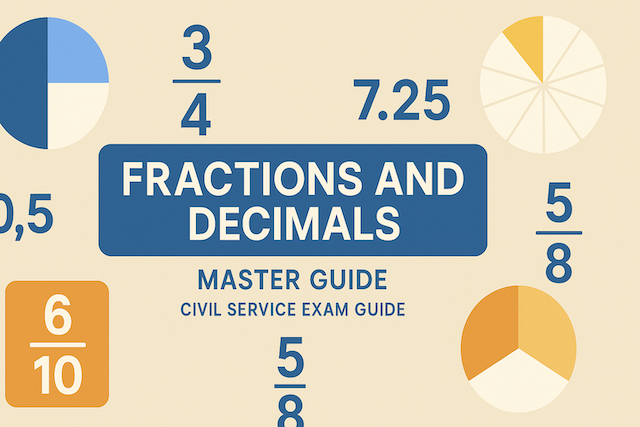
Fractions and Decimals Master Guide: Civil Service Exam Guide
Contents
- Fractions and Decimals Master Guide: Civil Service Exam Guide
- What Are Fractions?
- Types of Fractions
- Proper Fractions
- Improper Fractions
- Mixed Numbers
- Like Fractions
- Unlike Fractions
- Converting Improper Fractions and Mixed Numbers
- Improper Fraction to Mixed Number
- Mixed Number to Improper Fraction
- Equivalent Fractions
- Simplifying Fractions
- Operations Involving Fractions
- Adding and Subtracting Fractions
- Like Fractions
- Unlike Fractions
- Multiplying Fractions
- Dividing Fractions
- Converting Fractions to Decimals
- Converting Decimals to Fractions
- Terminating Decimals
- Repeating Decimals
- What Are Decimals?
- Place Values in Decimals
- Comparing Fractions and Decimals
- Method 1: Convert Fractions to Decimals
- Method 2: Convert Decimals to Fractions
- Ordering Fractions and Decimals
- Operations with Decimals
- Adding and Subtracting Decimals
- Multiplying Decimals
- Dividing Decimals
- Fractions and Decimals in Word Problems
- Example 1: Work and Time
- Example 2: Discounts
- Example 3: Ratio and Proportion
- Common Errors to Avoid
- Practice Questions with Solutions
- Final Tips for the Civil Service Exam
- Problem Sets
- Answer Key
Fractions and Decimals Master Guide: Civil Service Exam Guide
Understanding fractions and decimals is a fundamental part of the Civil Service Exam (CSE). Many numerical ability questions require converting, comparing, or performing operations with fractions and decimals. This master guide provides clear explanations, step-by-step procedures, common errors to avoid, and exam-style examples to help you strengthen your confidence in this topic.
What Are Fractions?
Fractions represent parts of a whole. A fraction has two parts:
- Numerator – the number of parts taken
- Denominator – the total number of equal parts
Example: 3/5 means 3 parts out of 5 equal parts.
Fractions are used to express quantities that are not whole numbers.
Types of Fractions
Proper Fractions
The numerator is smaller than the denominator. Example: 4/7
Improper Fractions
The numerator is greater than or equal to the denominator. Example: 9/4
Mixed Numbers
A combination of a whole number and a proper fraction. Example: 2 1/3
Like Fractions
Fractions with the same denominator. Example: 3/8 and 5/8
Unlike Fractions
Fractions with different denominators. Example: 2/3 and 4/5
Converting Improper Fractions and Mixed Numbers
Improper Fraction to Mixed Number
Divide the numerator by the denominator.
Example: 17/5 = 3 2/5
Mixed Number to Improper Fraction
Multiply the whole number by the denominator and add the numerator.
Example: 4 3/4 = (4 × 4 + 3) / 4 = 19/4
Equivalent Fractions
Equivalent fractions express the same value.
Example: 2/3 = 4/6 = 10/15
To create an equivalent fraction, multiply or divide both numerator and denominator by the same non-zero value.
Simplifying Fractions
To simplify a fraction, divide the numerator and denominator by their greatest common factor (GCF).
Example: 18/24 = (18 ÷ 6) / (24 ÷ 6) = 3/4
Operations Involving Fractions
Adding and Subtracting Fractions
Like Fractions
For like fractions, add or subtract the numerators and keep the same denominator.
Example: 3/10 + 2/10 = 5/10 = 1/2
Unlike Fractions
For unlike fractions, find the Least Common Denominator (LCD).
Example: 2/5 + 1/4
- LCD of 5 and 4 is 20.
- 2/5 = 8/20, 1/4 = 5/20.
- 8/20 + 5/20 = 13/20.
Multiplying Fractions
Multiply the numerators and then the denominators.
Example: 3/7 × 14/5 = (3 × 14) / (7 × 5) = 42/35 = 6/5
You can simplify early if possible by cross-cancelling common factors before multiplying.
Dividing Fractions
To divide by a fraction, multiply by its reciprocal.
Example: 5/6 ÷ 2/3 = 5/6 × 3/2 = 15/12 = 5/4
Converting Fractions to Decimals
To convert a fraction to a decimal, divide the numerator by the denominator.
- 1/2 = 0.5
- 3/4 = 0.75
- 2/3 = 0.666… (repeating)
Converting Decimals to Fractions
Terminating Decimals
Count the decimal places and write the decimal as a fraction with a power of 10 as the denominator, then simplify.
Example: 0.125 = 125/1000 = 1/8
Repeating Decimals
Use an algebraic method for repeating decimals.
Example: let x = 0.333…
- 10x = 3.333…
- 10x − x = 3.333… − 0.333…
- 9x = 3
- x = 3/9 = 1/3
What Are Decimals?
Decimals are another way of expressing fractions whose denominators are powers of 10.
Example: 0.8 = 8/10
Place Values in Decimals
- Tenths (0.1)
- Hundredths (0.01)
- Thousandths (0.001)
Example: 0.527 has 5 tenths, 2 hundredths, and 7 thousandths.
Comparing Fractions and Decimals
Method 1: Convert Fractions to Decimals
Convert the fractions to decimals and compare the values.
Example: Which is bigger, 3/5 or 0.55?
- 3/5 = 0.6
- 0.6 > 0.55, so 3/5 is bigger.
Method 2: Convert Decimals to Fractions
Convert decimals to fractions and then compare, especially when an LCD is easy to find.
Ordering Fractions and Decimals
To order fractions and decimals, you can convert all of them to decimals or all of them to fractions.
Example: Order 0.45, 1/2, and 0.375 from least to greatest.
- 1/2 = 0.5
- So the order is: 0.375, 0.45, 0.5
Operations with Decimals
Adding and Subtracting Decimals
Align the decimal points and then add or subtract as usual.
Example:
12.45 + 3.6 = 16.05
Multiplying Decimals
Ignore the decimal points and multiply as whole numbers, then count the total decimal places from both factors and place the decimal in the product accordingly.
Example: 0.4 × 0.3
- 4 × 3 = 12
- Total of two decimal places, so the answer is 0.12.
Dividing Decimals
Move the divisor’s decimal point to the right until it becomes a whole number, and move the dividend’s decimal point the same number of places. Then divide as with whole numbers.
Example: 3.6 ÷ 0.12
- Move decimal point two places: 3.6 → 360, 0.12 → 12
- 360 ÷ 12 = 30
Fractions and Decimals in Word Problems
Many Civil Service Exam questions require interpreting real-world scenarios with fractions and decimals.
Example 1: Work and Time
A worker completes 3/4 of a task. The decimal form is 0.75.
Example 2: Discounts
A 25% discount can be represented as multiplying by 0.75 (because you pay 75% of the original price).
Example 3: Ratio and Proportion
Using fraction form is often easier for solving ratio and proportion equations, especially when numbers are already in fraction form.
Common Errors to Avoid
- Forgetting to find a common denominator when adding or subtracting unlike fractions
- Misplacing decimal points during multiplication or division
- Not simplifying fractions to lowest terms
- Forgetting to convert denominators to powers of 10 when changing decimals to fractions
- Incorrect cross-multiplication when comparing fractions
Being aware of these mistakes helps reduce errors on exam day.
Practice Questions with Solutions
1. Convert 7/8 to decimal.
7 ÷ 8 = 0.875
2. Add 3/4 + 2/5.
LCD = 20. Convert: 3/4 = 15/20, 2/5 = 8/20. Sum = 23/20 = 1.15
3. Multiply: 0.6 × 0.25
6 × 25 = 150. There are three decimal places in total, so 0.150 = 0.15
4. Compare: 2/3 and 0.67
2/3 ≈ 0.666…, so 0.67 is slightly larger.
5. Divide: 5/6 ÷ 1/3
5/6 × 3/1 = 15/6 = 5/2 = 2.5
6. Simplify: 42/56
GCF is 14, so 42/56 = (42 ÷ 14) / (56 ÷ 14) = 3/4
7. Convert 0.048 to a fraction.
0.048 = 48/1000 = 6/125 after simplification.
8. Subtract: 3.75 − 2.08
3.75 − 2.08 = 1.67
9. Order from least to greatest: 1/4, 0.3, 0.28
1/4 = 0.25, so the order is: 0.25, 0.28, 0.3
10. A tank is 5/6 full. What percent is this?
5/6 ≈ 0.833…, which is approximately 83.33%
Final Tips for the Civil Service Exam
- Always simplify fractions when possible to reduce computation.
- Use approximation when comparing decimals to save time.
- Practice mental math to handle decimal operations quickly.
- Convert everything into the same form (all fractions or all decimals) before comparing values.
- When time is limited, choose the fastest conversion or computation method that you are comfortable with.
Mastering fractions and decimals gives you a strong advantage in the numerical ability section. Regular practice will help build accuracy and speed, which are essential skills for passing the Civil Service Exam.
Problem Sets
Instructions: Answer the following questions on fractions and decimals. Show your solutions on scratch paper if you are using this for practice. These problems are patterned after typical Civil Service Exam numerical ability questions.
Question 1. Write the fraction 3/5 in words and explain its meaning in English.
Question 2. Simplify the following fractions to lowest terms:
- a) 18/24
- b) 42/56
- c) 30/45
Question 3. Convert the following improper fractions to mixed numbers:
- a) 17/5
- b) 29/4
- c) 50/9
Question 4. Convert the following mixed numbers to improper fractions:
- a) 3 2/3
- b) 4 3/4
- c) 7 1/5
Question 5. Add or subtract the following fractions and give your answer in simplest form:
- a) 3/10 + 2/10
- b) 2/5 + 1/4
- c) 7/8 − 3/8
- d) 5/6 − 1/3
Question 6. Multiply the following fractions. Simplify your answers:
- a) 3/7 × 14/5
- b) 2/3 × 9/4
- c) 5/8 × 4/15
Question 7. Divide the following fractions. Write answers in simplest form:
- a) 5/6 ÷ 2/3
- b) 7/9 ÷ 1/3
- c) 4/5 ÷ 6/7
Question 8. Convert the following fractions to decimals. Round to three decimal places if necessary:
- a) 1/2
- b) 3/4
- c) 2/3
- d) 5/8
Question 9. Convert the following decimals to fractions in simplest form:
- a) 0.4
- b) 0.125
- c) 0.75
- d) 0.048
Question 10. Compare the following pairs of numbers using <, >, or =:
- a) 3/5 ___ 0.55
- b) 2/3 ___ 0.67
- c) 1/4 ___ 0.25
- d) 5/6 ___ 0.8
Question 11. Arrange the following numbers in ascending (increasing) order:
- a) 0.45, 1/2, 0.375
- b) 1/4, 0.3, 0.28
Question 12. Perform the following operations with decimals:
- a) 12.45 + 3.6
- b) 15.08 − 6.725
- c) 0.6 × 0.25
- d) 3.6 ÷ 0.12
Question 13. A water tank is 3/4 full. Express this as:
- a) a decimal
- b) a percentage
Question 14. A student scored 18 out of 25 items in a test.
-
- a) Express the score as a fraction in simplest form.
- b) Express the score as a decimal.
<li)c) Express the score as a percentage.
Question 15. A shirt originally costs 800 pesos and is sold at a 25% discount.
- a) What decimal represents the part you have to pay after the discount?
- b) How much is the discount in pesos?
- c) What is the final price of the shirt?
Question 16. A worker completes 5/6 of a job in one day.
- a) Express 5/6 as a decimal (rounded to three decimal places).
- b) Express 5/6 as a percentage (rounded to the nearest tenth of a percent).
Question 17. A recipe requires 2 1/2 cups of flour and 3/4 cup of sugar.
- a) Express 2 1/2 as an improper fraction.
- b) How many cups total are needed if you combine the flour and sugar? Write your answer as a mixed number.
Question 18. In a class, 3/8 of the students are male and the rest are female.
- a) What fraction of the class is female?
- b) Express the fraction of female students as a decimal.
- c) Express the fraction of female students as a percentage.
Question 19. A jogger completes 0.75 of a 12-kilometer route.
- a) Express 0.75 as a fraction in simplest form.
- b) How many kilometers did the jogger complete?
Question 20. A container holds 1.25 liters of juice. Express 1.25 as:
- a) a fraction in simplest form
- b) a mixed number
Question 21. A certain quantity x is equal to 0.333… in decimal form, where 3 repeats infinitely.
- a) Express x as a fraction.
- b) Explain briefly why this fraction is equivalent to the repeating decimal.
Question 22. Without using a calculator, estimate the answer and then compute exactly:
- a) 7/8 + 0.3
- b) 2/3 − 0.15
Question 23. A Civil Service Exam item states: “A tank is 2/5 full. After adding 0.35 of its capacity, it becomes completely full.” Is this statement logically correct? Show your reasoning using fraction or decimal operations.
Question 24. A store marks up the price of an item by 1/4 of its original price. The original price is 640 pesos.
- a) How much is the mark-up?
- b) What is the new selling price?
- c) Express the mark-up (1/4) as a decimal and as a percentage.
Question 25. A fraction has a value of 0.2 when written as a decimal.
- a) Write this fraction in simplest form.
- b) Give another equivalent fraction with a denominator of 25.
Answer Key
Question 1.
3/5 is read as “three fifths.” It means 3 parts out of 5 equal parts of a whole.
Question 2.
a) 18/24 = 3/4
b) 42/56 = 3/4
c) 30/45 = 2/3
Question 3.
a) 17/5 = 3 2/5
b) 29/4 = 7 1/4
c) 50/9 = 5 5/9
Question 4.
a) 3 2/3 = 11/3
b) 4 3/4 = 19/4
c) 7 1/5 = 36/5
Question 5.
a) 3/10 + 2/10 = 5/10 = 1/2
b) 2/5 + 1/4 = 8/20 + 5/20 = 13/20
c) 7/8 − 3/8 = 4/8 = 1/2
d) 5/6 − 1/3 = 5/6 − 2/6 = 3/6 = 1/2
Question 6.
a) 3/7 × 14/5 = (3 × 14) / (7 × 5) = 42/35 = 6/5 = 1 1/5
b) 2/3 × 9/4 = (2 × 9) / (3 × 4) = 18/12 = 3/2 = 1 1/2
c) 5/8 × 4/15 = (5 × 4) / (8 × 15) = 20/120 = 1/6
Question 7.
a) 5/6 ÷ 2/3 = 5/6 × 3/2 = 15/12 = 5/4 = 1 1/4
b) 7/9 ÷ 1/3 = 7/9 × 3/1 = 21/9 = 7/3 = 2 1/3
c) 4/5 ÷ 6/7 = 4/5 × 7/6 = 28/30 = 14/15
Question 8.
a) 1/2 = 0.5
b) 3/4 = 0.75
c) 2/3 ≈ 0.667 (to three decimal places)
d) 5/8 = 0.625
Question 9.
a) 0.4 = 4/10 = 2/5
b) 0.125 = 125/1000 = 1/8
c) 0.75 = 75/100 = 3/4
d) 0.048 = 48/1000 = 6/125
Question 10.
a) 3/5 = 0.6 > 0.55 → 3/5 > 0.55
b) 2/3 ≈ 0.667 < 0.67 → 2/3 < 0.67
c) 1/4 = 0.25 = 0.25 → 1/4 = 0.25
d) 5/6 ≈ 0.833 > 0.8 → 5/6 > 0.8
Question 11.
a) 0.375, 0.45, 1/2
b) 1/4, 0.28, 0.3
Question 12.
a) 12.45 + 3.6 = 16.05
b) 15.08 − 6.725 = 8.355
c) 0.6 × 0.25 = 0.15
d) 3.6 ÷ 0.12 = 30
Question 13.
a) 3/4 as a decimal = 0.75
b) 3/4 as a percentage = 75%
Question 14.
a) Fraction (simplest form): 18/25
b) Decimal: 18 ÷ 25 = 0.72
c) Percentage: 72%
Question 15.
Original price = 800 pesos; discount = 25%.
a) Decimal representing the part you pay = 0.75 (75% of the price).
b) Discount in pesos = 800 × 0.25 = 200 pesos
c) Final price = 800 − 200 = 600 pesos
Question 16.
a) 5/6 as a decimal ≈ 0.833 (to three decimal places)
b) 5/6 as a percentage ≈ 83.3% (to the nearest tenth of a percent)
Question 17.
a) 2 1/2 as an improper fraction = (2 × 2 + 1)/2 = 5/2
b) Total cups = 2 1/2 + 3/4 = 5/2 + 3/4 = 10/4 + 3/4 = 13/4 = 3 1/4 cups
Question 18.
Male = 3/8 of the class.
a) Female fraction = 1 − 3/8 = 5/8
b) Decimal: 5/8 = 0.625
c) Percentage: 0.625 × 100 = 62.5%
Question 19.
Route = 12 km, jogger completes 0.75 of it.
a) 0.75 as a fraction = 75/100 = 3/4
b) Distance completed = 0.75 × 12 = 9 km
Question 20.
a) 1.25 as a fraction = 125/100 = 5/4
b) As a mixed number = 1 1/4
Question 21.
x = 0.333… (3 repeats).
a) x as a fraction = 1/3
b) Explanation (brief): Let x = 0.333…, then 10x = 3.333…. Subtracting x from 10x gives 9x = 3, so x = 3/9 = 1/3. Therefore, 0.333… is equivalent to 1/3.
Question 22.
a) 7/8 + 0.3
7/8 = 0.875, so 0.875 + 0.3 = 1.175.
As a fraction: 7/8 + 3/10 = 35/40 + 12/40 = 47/40 = 1 7/40.
b) 2/3 − 0.15
2/3 ≈ 0.667; 0.667 − 0.15 ≈ 0.517.
Exact as a fraction: 2/3 − 15/100 = 200/300 − 45/300 = 155/300 = 31/60 ≈ 0.517.
Question 23.
Tank is 2/5 full, add 0.35 of its capacity.
2/5 as a decimal = 0.4.
0.4 + 0.35 = 0.75, which is 3/4 of the capacity, not full (1.0).
Therefore, the statement is not logically correct. To become completely full, you would need to add 3/5 (0.6) of the tank’s capacity, not 0.35.
Question 24.
Original price = 640 pesos, mark-up = 1/4 of original price.
a) Mark-up = 640 × 1/4 = 160 pesos
b) New selling price = 640 + 160 = 800 pesos
c) 1/4 as a decimal = 0.25; as a percentage = 25%
Question 25.
Decimal value = 0.2
a) 0.2 as a fraction = 2/10 = 1/5 (simplest form)
b) With denominator 25: 1/5 = 5/25

How to Register for eTravel Philippines (2025 Guide)
Step-by-step guide to completing your eTravel registration before arriving in the Philippines, with images and tips.

Night Market in Cebu – Things You Don’t Know About Cebu Life
Discover the hidden charm of Cebu’s night markets, from street food stalls to local life tips you won’t find in tourist guides.

How to Use ChatGPT for IELTS Preparation: A Complete Guide
Learn how to prepare for IELTS using ChatGPT — including strategies for Writing, Reading, Listening, Speaking, and grammar support.

How to Build a Website Without Coding Using ChatGPT
Discover how to build your own website using AI—no coding skills needed. From structure planning to SEO and design, let ChatGPT guide you.