2025年9月19日

3D UNIVERSAL ENGLISH INSITUTE INC
info.3duniversal.com@gmail.com
8:00-17:00(Mon-Fri)
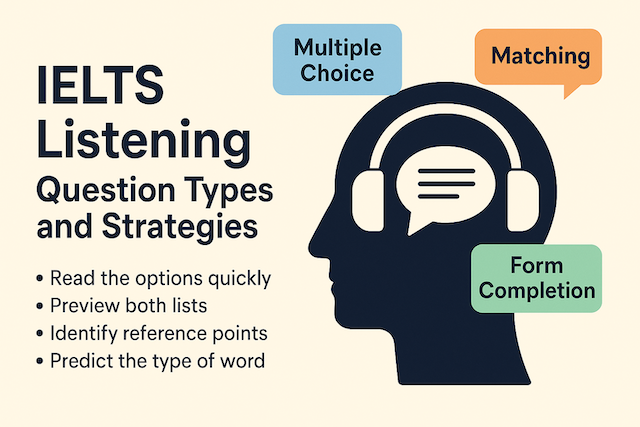
IELTS Listening: Question Types and Strategies
Contents
- IELTS Listening: Question Types and Strategies
- 1. Structure of the IELTS Listening Test
- 2. Common Question Types in IELTS Listening
- 3. Multiple Choice Questions (MCQs)
- 4. Matching
- 5. Plan, Map, or Diagram Labelling
- 6. Form, Note, Table, Flowchart, Summary Completion
- 7. Sentence Completion
- 8. Short Answer Questions
- 9. General Listening Strategies
- 10. Common Mistakes to Avoid
- 11. Final Tips for Success
- Conclusion
- IELTS Listening: Frequently Asked Questions
IELTS Listening: Question Types and Strategies
The IELTS Listening test is often underestimated by candidates, but in reality it requires as much preparation as the other sections of the exam. While it may appear straightforward—listening to recordings and answering questions—many test-takers lose marks due to lack of familiarity with question types, poor time management, or inadequate listening practice. Understanding the structure of the test, the common question types, and the strategies to approach them is essential for achieving a high band score.
In this guide, we will explore in detail the different IELTS Listening question types and provide practical strategies for each. By mastering these, you can significantly improve your accuracy and overall performance.
1. Structure of the IELTS Listening Test
The IELTS Listening test is the same for both the Academic and General Training versions of the exam. It consists of four sections (sometimes called parts) with a total of 40 questions. Each correct answer is worth one mark, and your raw score is converted into a band score ranging from 0 to 9.
-
Section 1: A conversation between two people in an everyday social context (e.g., booking a hotel room).
-
Section 2: A monologue set in a social context (e.g., a tour guide describing a museum).
-
Section 3: A conversation involving up to four people, often set in an academic context (e.g., students discussing a group project).
-
Section 4: A monologue on an academic topic (e.g., a lecture).
The recordings are played only once, and you must answer questions while listening. At the end of the test, you are given 10 minutes to transfer your answers to the answer sheet.
2. Common Question Types in IELTS Listening
IELTS Listening includes a range of question types designed to test different listening skills, such as identifying specific information, understanding main ideas, and following arguments. Below are the most frequent question formats:
-
Multiple Choice Questions (MCQs)
-
Matching
-
Plan, Map, or Diagram Labelling
-
Form, Note, Table, Flowchart, Summary Completion
-
Sentence Completion
-
Short Answer Questions
Let’s examine each in detail with strategies.
3. Multiple Choice Questions (MCQs)
In MCQs, you may be asked to choose one correct answer out of three or four options, or sometimes multiple answers from a list.
Challenges:
-
Options may sound very similar.
-
Distractors (wrong options) are deliberately included to confuse test-takers.
-
Speakers often mention all choices, but only one (or more) is correct.
Strategies:
-
Read the options quickly before listening so you know what to expect.
-
Underline keywords in the question stem and options (dates, names, places, numbers).
-
Be cautious of synonyms—the recording rarely repeats the exact words from the test paper.
-
Listen for signpost language, such as “however,” “but,” or “on the other hand,” which often indicates a change of direction.
4. Matching
In this task, you may need to match a list of items (e.g., names, places, dates) to a set of options.
Challenges:
-
Information may be presented in a different order than in the question.
-
You need to track multiple items simultaneously.
Strategies:
-
Preview both lists to understand the type of information you are listening for.
-
Look for synonyms and paraphrasing.
-
Eliminate impossible options as you listen, to narrow down choices.
-
Pay attention to order words like “first,” “second,” “finally,” which help in sequencing.
5. Plan, Map, or Diagram Labelling
This question type requires you to identify locations or label parts of a diagram, based on descriptions in the recording.
Challenges:
-
Requires spatial awareness and the ability to follow directions.
-
The recording usually gives relative positions (e.g., “next to,” “opposite,” “in front of”).
Strategies:
-
Familiarize yourself with the map/diagram before the audio starts.
-
Identify reference points (north, entrance, main road, etc.).
-
Listen for directional language like “go past,” “turn left,” “just before,” which indicate movement.
-
Trace with your pencil while listening to avoid losing track.
6. Form, Note, Table, Flowchart, Summary Completion
Here, you need to fill in missing words in a form or summary. Answers are usually short words, numbers, or dates.
Challenges:
-
Spelling mistakes lead to lost marks.
-
Synonyms are common: the recording rarely uses the same wording as the test paper.
-
Word limits must be respected (e.g., “NO MORE THAN TWO WORDS AND/OR A NUMBER”).
Strategies:
-
Check the word limit carefully before answering.
-
Predict the type of word (noun, verb, number) that fits the blank.
-
Listen for stress and emphasis—speakers often slow down or repeat important details like phone numbers.
-
Write as you hear, then check spelling during transfer time.
7. Sentence Completion
You need to complete sentences with information from the recording.
Challenges:
-
Answers must fit grammatically.
-
Paraphrasing is common.
-
Distractors may appear before the correct answer.
Strategies:
-
Predict grammar—look at whether a noun, verb, or adjective is required.
-
Anticipate synonyms (e.g., “big” may appear as “large”).
-
Stay calm when you miss one answer—move on quickly to avoid losing the next.
8. Short Answer Questions
You are asked to answer questions with a short response, often related to facts such as numbers, names, or reasons.
Challenges:
-
Very specific information.
-
Requires quick comprehension.
Strategies:
-
Underline question words (Who? What? Where? When? How much?).
-
Anticipate the type of answer—a name, place, or number.
-
Listen for exact wording but be prepared for paraphrases.
-
Write concisely—don’t exceed the word limit.
9. General Listening Strategies
Beyond question-specific tips, mastering IELTS Listening requires good habits and preparation.
-
Develop active listening skills
Don’t just listen for words—listen for meaning, tone, and structure. Practice with podcasts, lectures, and English news broadcasts. -
Practice note-taking
Jot down keywords rather than trying to write full sentences. This helps you follow along without losing focus. -
Improve your spelling and numbers
Since incorrect spelling or misplaced numbers are marked wrong, daily practice is essential. -
Use prediction techniques
Before each recording, use the short preparation time to predict possible answers. -
Stay focused
Losing concentration for even a few seconds can cost multiple answers. Practice long listening sessions to build stamina. -
Transfer answers carefully
When given 10 minutes to transfer answers, double-check spelling, word limits, and grammar.
10. Common Mistakes to Avoid
-
Writing too many words: If the instruction says “no more than two words,” writing three will automatically be marked wrong.
-
Not checking plurals: Writing “student” instead of “students” can cost points.
-
Guessing without logic: Instead, use elimination and prediction.
-
Panicking after missing an answer: Move on quickly; you can’t replay the recording.
11. Final Tips for Success
-
Familiarize yourself with accents: IELTS recordings include British, American, Australian, and Canadian accents.
-
Practice under exam conditions: Simulate the 30-minute test with strict timing and no pauses.
-
Review transcripts: After practice, read transcripts to identify missed words or phrases.
-
Use Cambridge IELTS practice books: These contain authentic past exam papers.
Conclusion
The IELTS Listening test is not just about understanding English—it’s about understanding it under exam pressure, with distractions, paraphrasing, and fast-paced delivery. By knowing the question types and applying targeted strategies, you can avoid traps and maximize your score. Consistent practice, exposure to diverse English accents, and strategic listening will give you the confidence to perform well on test day.
If you approach IELTS Listening with preparation and strategy, you will not only achieve a higher band score but also develop valuable real-world listening skills for academic and professional success.
IELTS Listening: Frequently Asked Questions
This FAQ complements the guide on IELTS Listening question types and strategies. It focuses on practical, action‑oriented answers so you can prepare efficiently and avoid common pitfalls on test day.
General & Scoring
How is the IELTS Listening test structured?
The test has four sections (or parts) with a total of 40 questions. Sections 1–2 cover everyday and social contexts; Sections 3–4 focus on academic settings. You listen once to each recording and answer as you go. After the audio ends, you typically get time to check or transfer your answers to the answer sheet.
How is my Listening band score calculated?
Each correct answer earns one point, for a maximum raw score of 40. IELTS converts this raw score to a band score from 0 to 9 using published conversion tables. While the exact cutoffs can vary slightly by test form, aiming for 35+ correct answers generally puts you near Band 8 or above.
Is Listening the same for Academic and General Training?
Yes. The Listening module is identical for both versions. The main differences between Academic and General Training appear in Reading and Writing. This means resources for Listening are cross‑applicable, and strategies you learn will help regardless of which overall test you take.
What accents appear in the recordings?
Expect a mix of British, American, Australian, and sometimes Canadian or New Zealand accents. You may also hear regional variations. Build accent flexibility by practicing with international news, university lectures, and podcasts so you can handle different vowel sounds, stress patterns, and pace.
What are the most common reasons for losing marks?
Typical causes include missing word-limit rules, spelling errors, mishearing plural forms, copying distractors from the audio, and losing focus after missing one item. Many candidates also fail to anticipate synonyms or paraphrases, so they listen for exact words rather than meaning.
Time Management & Focus
How can I use the pre‑listening time effectively?
Scan the questions quickly, underline keywords, and predict what kind of information will fill each blank (e.g., a date, a place, a verb). Label question groups (e.g., “directions,” “prices,” “reasons”) so your brain is primed to recognize the right information when it appears.
What should I do if I miss an answer?
Do not dwell on it. Make a best guess and move on instantly to avoid a cascade of missed items. Regain focus using the next visible keyword. If time allows after the recording, you can revisit guesses, but protecting your concentration is the top priority during playback.
How do I stay focused for all four sections?
Practice long listening sessions to build stamina. During the test, keep your pencil moving: note keywords, arrows for direction, or brief symbols. Active engagement reduces mind‑wandering. Use brief breathing resets between sections to prevent fatigue and sharpen attention for the next part.
Question Types & Tactics
What is the best approach to Multiple Choice Questions?
Before listening, distill each option to its core idea and mark contrasts. During playback, watch for signpost language such as “however,” “but,” or “on the other hand.” Expect the speakers to mention elements from several options; choose the one that aligns with the final stance or outcome, not the first mention.
How do I handle Matching tasks efficiently?
Preview both lists, identify categories (e.g., “speaker,” “feature,” “recommendation”), and anticipate synonyms. As you hear matches, lightly cross out used options to limit the remaining pool. If the order of information differs from the paper, rely on category logic rather than position.
What tips help with Map/Plan/Diagram Labelling?
Find the orientation quickly (entrance, north arrow, landmarks). Trace the route with your pencil as you listen for directional cues like “opposite,” “next to,” “just past,” or “at the end of the corridor.” If you get momentarily lost, re‑anchor on the next clear landmark rather than guessing wildly.
How can I avoid errors in form/table/summary completion?
Check the word limit first (e.g., “NO MORE THAN TWO WORDS AND/OR A NUMBER”). Predict the word type (noun, verb, adjective) and listen for paraphrases. Write what you hear, then verify spelling and pluralization during checking time. For numbers, listen for repeats and emphasis around key details.
How do I ensure grammatical fit in sentence completion?
Use the stem as a grammar guide. If a plural noun or a past‑tense verb is required, filter your listening accordingly. When two synonyms could fit, choose the one that completes a grammatically smooth sentence. Re‑read the finished sentence to confirm subject‑verb agreement and article usage.
What should I know about Short Answer Questions?
Underline the question word (who, where, how much, why). Anticipate the answer’s format and length. Keep responses concise and within the word limit. If you hear multiple figures or names, note them briefly and select the one that directly answers the question prompt.
Language Skills & Accuracy
How can I reduce spelling mistakes?
Target high‑frequency problem areas: days, months, common academic terms, and nationality or place names. Build a personalized misspelling list and review it daily. During the test, leave a small margin of time to scan for capitalization, hyphens, and plural endings, which are frequent error sources.
Do hyphens, capitalization, and plurals matter?
Yes. Names and proper nouns need correct capitalization. If the audio clearly indicates a hyphenated compound (e.g., “two‑day pass”), follow that form. Plurals must match the recording and the sentence context. Small accuracy details can be the difference between right and wrong.
How do I train for synonyms and paraphrasing?
Build theme‑based vocabulary (e.g., campus, travel, research). When you practice, always compare the question wording to the transcript and highlight paraphrases. Create two‑column lists: “question word” vs. “audio word.” This conditions you to listen for meaning instead of exact lexical matches.
Practice & Materials
What practice routine is most effective?
Rotate between timed full tests and targeted drills. After each session, review with transcripts: mark every missed item, locate the precise audio cue, and write a one‑line “cause of error.” Track patterns (e.g., numbers, maps, distractors) and design short drills to fix the weakest category before your next full test.
Should I read transcripts after listening?
Yes. Transcripts are a powerful diagnostic. Use them to identify the exact phrases you missed, the synonyms you overlooked, and where your attention drifted. Shadow challenging sentences to improve decoding speed and accent tolerance, especially for fast or unfamiliar speakers.
How can I simulate real test conditions?
Use a single, uninterrupted playback with strict timing. Sit at a desk, keep your phone away, and avoid pausing. Practice transferring answers within the allowed time. Recreate small stresses (e.g., light background noise) so you can stay calm and accurate in the actual exam environment.
Test Day Logistics
Any last‑minute tips for the exam day?
Arrive early, warm up with 5–10 minutes of light listening, and review your personal “watch‑outs” list (plurals, numbers, word limits). During the test, write clearly, keep moving if you miss one item, and use the checking time to correct spelling and ensure every answer respects the required format.
What if I am unsure between two answers?
Choose the option that best matches the speaker’s final conclusion or the sentence’s grammar and meaning. Eliminate choices contradicted by the audio or that duplicate information already assigned to other items. Make a decisive pick; leaving blanks is almost always worse than an informed guess.
How soon can I realistically improve my band score?
With focused practice—especially transcript review, accent exposure, and targeted drills—many learners see a noticeable boost within two to four weeks. The key is feedback quality: diagnose why you missed each item, then practice that exact weakness until it no longer costs you marks.
If you apply these strategies consistently—predicting answers, tracking paraphrases, and protecting your focus throughout the recording—you will convert more questions, reduce avoidable errors, and move closer to your target Listening band score.

How to Register for eTravel Philippines (2025 Guide)
Step-by-step guide to completing your eTravel registration before arriving in the Philippines, with images and tips.

Night Market in Cebu – Things You Don’t Know About Cebu Life
Discover the hidden charm of Cebu’s night markets, from street food stalls to local life tips you won’t find in tourist guides.

How to Use ChatGPT for IELTS Preparation: A Complete Guide
Learn how to prepare for IELTS using ChatGPT — including strategies for Writing, Reading, Listening, Speaking, and grammar support.

How to Build a Website Without Coding Using ChatGPT
Discover how to build your own website using AI—no coding skills needed. From structure planning to SEO and design, let ChatGPT guide you.