2025年9月19日
3D ACADEMY offers affordable English study programs in Cebu, Philippines – perfect for beginners, professionals, and exam takers.

3D UNIVERSAL ENGLISH INSTITUTE INC
info.3d-universal.com
8:00-17:00(Mon-Fri)
IELTS Writing Task 1 General Training: Informal and Semi-formal Letters
Contents
- IELTS Writing Task 1 General Training: Informal and Semi-formal Letters
- Introduction
- Understanding the Letter Types
- Tone and Language Features
- Structure of the Letter
- Common IELTS Topics
- Vocabulary Examples
- Sample Informal Letter (Band 8–9)
- Sample Semi-formal Letter (Band 8–9)
- Tips for Success
- Common Mistakes to Avoid
- Conclusion
- FAQ:IELTS Writing Task 1 General Training: Informal and Semi-formal Letters
- What is the difference between informal and semi-formal letters in IELTS GT Task 1?
- How do I identify the correct tone from the prompt?
- What greeting and closing should I use?
- How should I structure my letter for maximum score?
- How many words should I write, and what happens if I write too many?
- What language features fit each tone?
- How do I ensure I fully answer the bullet points?
- What are strong opening lines for each tone?
- Which closings work best, and do I need a call to action?
- What common mistakes lower scores in informal and semi-formal letters?
- How can I show a wide range of vocabulary naturally?
- What grammar points are examiners looking for in these letter types?
- Can I use questions and exclamations?
- What does a high-scoring informal sentence look like?
- What does a high-scoring semi-formal sentence look like?
- How do I plan quickly before writing?
- What cohesive devices work well without sounding mechanical?
- How can I adapt an answer if I misjudged the tone?
- Do I need to include addresses or dates?
- How can I practice effectively for both tones?
- What quick checklist should I run before I finish?
IELTS Writing Task 1 General Training: Informal and Semi-formal Letters
Introduction
IELTS Writing Task 1 for the General Training module asks candidates to write a letter based on a given situation. Unlike the Academic module, where you must analyze graphs or processes, the General Training version emphasizes practical writing skills that are relevant to everyday and workplace contexts. Letters may be formal, semi-formal, or informal, depending on the recipient and purpose.
This article focuses on informal and semi-formal letters, which are very common in the exam. Understanding the difference between these two types is essential, because the tone, vocabulary, and structure you use can directly influence your score.
Understanding the Letter Types
Informal Letters
Informal letters are written to people you know well, such as friends, family members, or close acquaintances. The language is casual and personal, and you can express emotions, opinions, and even use idiomatic expressions.
Common scenarios in IELTS prompts include:
-
Inviting a friend to visit or attend an event.
-
Thanking someone for help or a gift.
-
Apologizing for missing an event.
-
Sharing personal news, like moving house or getting a new job.
Tone: relaxed, conversational, friendly.
Semi-formal Letters
Semi-formal letters are addressed to people you know, but with whom you maintain a polite and respectful distance. These could be neighbors, colleagues, landlords, teachers, or members of a club. The tone should not be overly casual, but it should not be as rigid as in formal letters either.
Common scenarios in IELTS prompts include:
-
Explaining a situation to a landlord or neighbor.
-
Requesting information from a teacher or colleague.
-
Inviting neighbors or colleagues to an event.
-
Complaining politely about a service or problem.
Tone: polite, respectful, clear, moderately formal.
Tone and Language Features
A major difference between informal and semi-formal letters is tone. You must choose words, sentence structures, and greetings that match the relationship with the recipient.
Informal Letters:
-
Use contractions: I’m, can’t, don’t.
-
Use idioms and phrasal verbs: “drop by,” “hang out,” “by the way.”
-
Express feelings openly: “I was thrilled to hear your news!”
Semi-formal Letters:
-
Use more neutral expressions: “I am writing to ask about…”
-
Polite modal verbs: “I would appreciate it if you could…”
-
Avoid slang or excessive familiarity.
Example comparison:
-
Informal: “Hey, I just wanted to let you know I’ll be in town next week. Can we meet up?”
-
Semi-formal: “I wanted to inform you that I will be in your area next week, and I was wondering if we could arrange a convenient time to meet.”
Structure of the Letter
IELTS Task 1 letters should be around 150 words, but you can go slightly above (160–180) for clarity. Regardless of type, they should follow a clear structure:
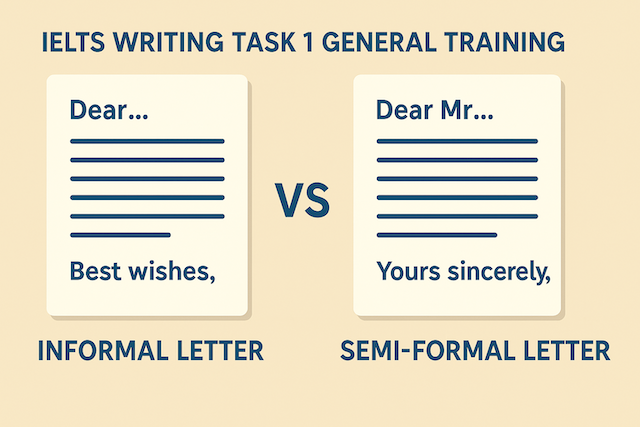
Greeting
-
Informal: Dear John, Hi Sarah, Hello Mike.
-
Semi-formal: Dear Mr. Smith, Dear Ms. Lee, Dear Professor Adams.
Opening
-
Informal: How are you? It’s been such a long time since we last spoke.
-
Semi-formal: I hope this message finds you well. I am writing in connection with…
Body
Address the three bullet points given in the IELTS prompt. Make sure each point has its own explanation, example, or detail.
Closing
-
Informal: Take care, Cheers, Best wishes, Lots of love.
-
Semi-formal: Best regards, Yours sincerely, With kind regards.
Common IELTS Topics
Informal letter topics:
-
Invitations: “Invite your friend to stay at your house during their trip.”
-
Thank-you letters: “Thank a friend for their hospitality.”
-
Sharing news: “Tell your friend about your new job.”
-
Apologies: “Apologize for missing your friend’s wedding.”
Semi-formal letter topics:
-
Requests: “Ask your landlord to repair the heating system.”
-
Invitations: “Invite your neighbor to a small gathering.”
-
Complaints: “Complain to your landlord about noisy neighbors.”
-
Explanations: “Explain to your teacher why you missed a class.”
Vocabulary Examples
Informal Phrases:
-
“By the way, …”
-
“Can’t wait to see you.”
-
“I was really happy to hear…”
-
“Drop me a line when you’re free.”
Semi-formal Phrases:
-
“I am writing to request…”
-
“I would appreciate it if you could…”
-
“Please let me know at your earliest convenience.”
-
“I look forward to your reply.”
Sample Informal Letter (Band 8–9)
Prompt: You are planning to invite your friend to stay at your house during their vacation. Write a letter including:
-
Why you are inviting them.
-
What they can do in your city.
-
Other information they may need.
Answer:
Dear Alex,
How are you doing? It feels like ages since we last met! I’m writing because I’d love for you to come and stay at my place during your vacation next month.
There are so many things to do here that I’m sure you’ll enjoy. We can go hiking in the nearby hills, explore the local markets, and even spend a few days at the beach, which is just a short drive away.
You don’t need to worry about accommodation since you can stay in my spare room. Just bring some light clothes, as the weather will be quite warm. I’ll pick you up from the airport, so travel will be easy.
I can’t wait to catch up and spend some quality time together.
Take care,
Best wishes,
Sam
Sample Semi-formal Letter (Band 8–9)
Prompt: You are planning a party at your house. Write a letter to your neighbor to inform them. Include:
-
Why you are having the party.
-
What arrangements you have made.
-
How it might affect them.
Answer:
Dear Mr. Johnson,
I hope this letter finds you well. I am writing to let you know that I am planning to host a small gathering at my home this Saturday evening. The purpose of the party is to celebrate my wife’s birthday with a few close friends and relatives.
We expect around 15 guests, and the event will begin at 7 p.m. and finish before midnight. I have arranged catering and soft background music, so the noise level should remain moderate. Parking will be limited, but I have advised my guests to use the nearby public parking area.
Please let me know if the arrangements might cause you any inconvenience. If so, I will do my best to minimize any disturbance.
Thank you very much for your understanding.
Best regards,
Michael Green
Tips for Success
-
Match the tone: Think carefully about who you are writing to.
-
Cover all bullet points: Missing one will lower your Task Achievement score.
-
Stay consistent: Don’t mix formal and informal expressions in the same letter.
-
Word count: Aim for 150–180 words. Going far below or above this may hurt your score.
-
Plan quickly: Spend 2–3 minutes outlining ideas before writing.
Common Mistakes to Avoid
-
Using casual language in a semi-formal letter.
-
Forgetting to address one of the bullet points.
-
Overusing contractions in semi-formal writing.
-
Writing too short (less than 150 words).
-
Copying phrases without adapting them to the context.
Conclusion
In IELTS Writing Task 1 (General Training), informal and semi-formal letters test your ability to adjust your writing tone and style depending on the recipient. Informal letters allow for a personal and relaxed style, while semi-formal letters demand a respectful yet friendly tone. Mastering these two types is vital for success, since most exam prompts fall into these categories.
By practicing a wide range of scenarios, expanding your vocabulary, and always paying attention to the recipient, you can score well in Task 1 and build confidence for the entire Writing test.
FAQ:IELTS Writing Task 1 General Training: Informal and Semi-formal Letters
What is the difference between informal and semi-formal letters in IELTS GT Task 1?
Informal letters are written to people you know well (friends or family). The tone is personal, relaxed, and conversational. Semi-formal letters are for acquaintances with a respectful distance (neighbors, colleagues, teachers, landlords). The tone is polite and courteous but not as rigid as formal business writing. In practice, this means more contractions and personal warmth in informal letters, and clearer structure with neutral vocabulary in semi-formal letters.
How do I identify the correct tone from the prompt?
Look for the recipient and context. If the recipient is a friend, cousin, or classmate you know well, choose informal. If the recipient is a neighbor, teacher, club coordinator, landlord, or colleague, choose semi-formal. Also pay attention to verbs in the task: complain, request, arrange, inform often lean semi-formal; invite, thank, apologize to a friend often lean informal.
What greeting and closing should I use?
Informal: Start with “Dear/Hi/Hello + first name” (e.g., “Hi Alex,”). Close with “Best wishes,” “Cheers,” “Take care,” or “Love” (if appropriate), followed by your first name.
Semi-formal: Start with “Dear + title + last name” (e.g., “Dear Mr Brown,” or “Dear Ms Lee,”). If only the first name is given but the situation is semi-formal, “Dear + first name” is acceptable. Close with “Best regards,” “Kind regards,” or “Yours sincerely,” followed by your full name or first name, depending on context.
How should I structure my letter for maximum score?
Use a clear 4-part structure:
- Greeting & Purpose: Open with a friendly or polite sentence and state why you are writing.
- Body Paragraph 1: Address the first bullet point with detail and examples.
- Body Paragraph 2: Cover the second bullet point and any necessary explanations.
- Body Paragraph 3 + Closing: Cover the final bullet point, add a call to action (request, suggestion, thanks), and close appropriately.
Logical sequencing and paragraphing help your Coherence & Cohesion score.
How many words should I write, and what happens if I write too many?
The minimum is 150 words. A safe target is 160–190 words. Writing significantly more can increase the chance of mistakes and off-topic content, which may lower your score. Quality and task coverage matter more than length.
What language features fit each tone?
Informal: contractions (I’m, can’t), idioms and phrasal verbs used naturally (drop by, pick up, sort out), personal feelings, and first-person anecdotes. Keep sentences varied and natural.
Semi-formal: neutral vocabulary, polite modals (would, could, might), indirect requests (“I would appreciate it if…”), and a respectful, solution-oriented tone. Avoid slang and emojis.
How do I ensure I fully answer the bullet points?
Underline the three bullets in the prompt and convert each into a direct sentence starter before writing (e.g., “First, …”; “Regarding …”; “Finally, …”). Provide a specific detail or example for each point to show you have addressed it thoroughly. If a bullet asks you to explain or describe, add a reason and a plausible outcome, not just a statement.
What are strong opening lines for each tone?
Informal: “It’s been ages—how have you been?” / “I was so happy to hear your news and wanted to write right away.”
Semi-formal: “I am writing to enquire about…” / “I hope this message finds you well. I am contacting you regarding…”
Which closings work best, and do I need a call to action?
A brief, purposeful ending helps Task Achievement. Add a clear next step:
- Informal: “Let me know your travel dates so I can plan the pick-up.” / “Text me when you’re free.”
- Semi-formal: “Please let me know by Friday if these arrangements suit you.” / “I would appreciate your confirmation at your earliest convenience.”
Then use a suitable sign-off as noted above.
What common mistakes lower scores in informal and semi-formal letters?
- Mismatched tone: Using slang in a semi-formal letter or being overly stiff with a friend.
- Missing bullets: Ignoring or underdeveloping one of the task points.
- Poor organization: Writing one long paragraph or jumping between ideas.
- Wordiness: Filling the letter with irrelevant details.
- Vocabulary errors: Misusing idioms or overly formal words in an informal context.
How can I show a wide range of vocabulary naturally?
Use topic-specific words relevant to the situation (repairs, deposit, venue, dietary requirements, timetable). Mix single- and multi-word verbs: arrange, confirm, clarify, follow up (semi-formal); sort out, put off, catch up, drop by (informal). Paraphrase the prompt rather than repeating it; for example, turn “ask for information about a course” into “I’m writing to find out more about the evening classes you’re running next term.”
What grammar points are examiners looking for in these letter types?
Control over sentence variety (simple, compound, complex), appropriate modality (would/could for polite requests), and accurate tense use (present for general facts, past for previous events, future for plans). In informal letters, occasional fragments can work for style, but avoid persistent errors. In semi-formal letters, maintain full, clear sentences and consistent subject-verb agreement.
Can I use questions and exclamations?
Yes, but match the tone. In informal letters, an occasional rhetorical question or mild exclamation can add warmth (“Can you believe it?” “That would be amazing!”). In semi-formal letters, keep punctuation restrained; questions should be purposeful (“Could you please confirm the start date?”). Avoid multiple exclamation marks in any tone.
What does a high-scoring informal sentence look like?
“By the way, if you’re still thinking about visiting in July, I’ve found a couple of great hiking trails we could try—nothing too intense, but the views are brilliant.”
It’s personal, specific, and uses natural connectors and detail.
What does a high-scoring semi-formal sentence look like?
“I would appreciate it if you could confirm whether maintenance can be scheduled early next week, as the boiler has been unreliable in the mornings.”
It’s clear, polite, specific about time, and explains the reason.
How do I plan quickly before writing?
Spend 2 minutes on a micro-plan: note the recipient and tone; jot three bullet-point answers (one key detail each); decide greeting and closing; choose one connector per paragraph (“First,” “Regarding,” “Finally,” “In the meantime,” “As a result”). This prevents drifting off-topic and keeps the word count tight.
What cohesive devices work well without sounding mechanical?
Use a light mix: “Regarding…,” “As for…,” “In addition…,” “That said…,” “Because of this…,” “In the meantime…,” “If that suits you…,” “By the way…” (informal). Avoid repeating the same linker; vary them naturally and ensure each adds meaning rather than padding.
How can I adapt an answer if I misjudged the tone?
If you realize mid-writing that the letter should be semi-formal, quickly adjust: remove slang, expand contractions (I am, we will), add polite modal verbs, and include a courteous closing sentence. If moving the other way (semi-formal to informal), shorten sentences slightly, add a friendly opener, and use one or two natural phrasal verbs. Consistency by the end of the letter is more important than a perfect start.
Do I need to include addresses or dates?
No. In IELTS GT Task 1, write only the body of the letter starting with the greeting; addresses are unnecessary. Use paragraphs, not headings, and keep the presentation clean and readable.
How can I practice effectively for both tones?
Create a prompt bank with mixed recipients and purposes. For each prompt, write two versions: one informal, one semi-formal. Time yourself for 20 minutes per letter. After writing, check: Did I cover all bullets? Is the tone consistent? Are my greeting and closing appropriate? Did I include at least one specific detail per bullet? This targeted practice builds reliable habits.
What quick checklist should I run before I finish?
- Recipient and tone match.
- All three bullets addressed with specific details.
- Clear paragraphs and logical progression.
- Appropriate greeting and closing with a call to action if needed.
- 160–190 words, few errors, and natural vocabulary.
If each box is ticked, your letter is likely to meet Task Achievement and enhance your Lexical Resource, Coherence & Cohesion, and Grammatical Range & Accuracy scores.

How to Register for eTravel Philippines (2025 Guide)
Step-by-step guide to completing your eTravel registration before arriving in the Philippines, with images and tips.

Night Market in Cebu – Things You Don’t Know About Cebu Life
Discover the hidden charm of Cebu’s night markets, from street food stalls to local life tips you won’t find in tourist guides.

How to Use ChatGPT for IELTS Preparation: A Complete Guide
Learn how to prepare for IELTS using ChatGPT — including strategies for Writing, Reading, Listening, Speaking, and grammar support.

How to Build a Website Without Coding Using ChatGPT
Discover how to build your own website using AI—no coding skills needed. From structure planning to SEO and design, let ChatGPT guide you.