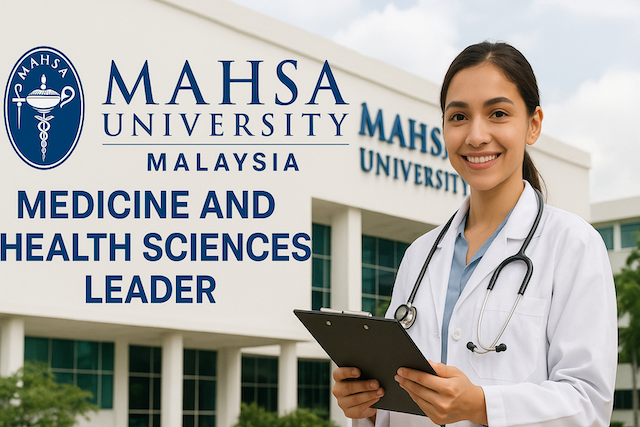
MAHSA University Malaysia: Medicine and Health Sciences Leader
Introduction
MAHSA University (Malaysian Allied Health Sciences Academy) is one of Malaysia’s premier private institutions specializing in medicine, health sciences, and related disciplines. Founded in 2005 by Professor Tan Sri Dr. Hj. Mohamed Haniffa, MAHSA has evolved from a health-focused college into a comprehensive multidisciplinary university, maintaining its strong roots in medical and healthcare education. The university’s core mission is to produce competent, compassionate, and ethical professionals who are ready to contribute to both local and global healthcare systems.
With a state-of-the-art campus in Bandar Saujana Putra, Selangor, MAHSA University offers a learning environment that integrates innovation, technology, and global perspectives. Over the years, MAHSA has gained recognition for its commitment to practical learning, partnerships with healthcare institutions, and programs that align with international standards.
History and Vision
MAHSA University began as a specialized institution focusing on nursing and allied health sciences. Recognizing the growing demand for healthcare professionals in Southeast Asia, the university expanded its offerings to include medicine, dentistry, pharmacy, biomedical sciences, and later on, business, engineering, and hospitality programs.
The university’s vision—“To be the centre of excellence in higher education in the region”—is grounded in values of professionalism, integrity, and service. MAHSA aims to nurture graduates who not only possess clinical and scientific expertise but also empathy and social responsibility. Its founder’s motto, “Be More,” reflects the university’s encouragement for students to exceed expectations academically and personally.
Campus and Facilities
The main campus of MAHSA University at Bandar Saujana Putra is an impressive 48-acre modern complex designed to facilitate a holistic student experience. The campus features cutting-edge learning and teaching facilities, including:
-
Clinical and Simulation Labs: Equipped with real-life hospital setups, allowing students to practice patient care, diagnosis, and emergency response.
-
Dental and Pharmacy Training Facilities: Designed for hands-on learning with real cases under professional supervision.
-
Anatomy and Physiology Labs: For medical students to gain in-depth knowledge of human biology.
-
Library and Digital Learning Resources: A modern library housing thousands of reference materials, journals, and digital subscriptions.
-
Student Residences: Safe and comfortable on-campus accommodation options with 24-hour security.
-
Sports and Recreation: Facilities for football, basketball, swimming, and gym training to promote a balanced lifestyle.
The campus also incorporates eco-friendly design and smart technologies to provide a sustainable, efficient environment conducive to learning.
Academic Faculties and Programs
MAHSA University offers a wide range of academic programs from foundation to postgraduate levels. Its strongest areas remain in Medicine, Dentistry, Nursing, and Health Sciences, but the institution has diversified into several other fields.
Faculty of Medicine, Bioscience and Nursing
This faculty is the backbone of MAHSA University. Programs include:
-
Bachelor of Medicine and Bachelor of Surgery (MBBS) – recognized by the Malaysian Medical Council (MMC).
-
Bachelor of Nursing (Hons) – combining theory, lab practice, and clinical placements.
-
Diploma in Medical Laboratory Technology – training future laboratory technicians in diagnostics and analysis.
-
Bachelor of Biomedical Sciences (Hons) – focusing on research, biotechnology, and diagnostics.
Faculty of Dentistry
MAHSA’s dental school features a modern dental hospital that provides affordable care to the community while offering students hands-on clinical experience.
Faculty of Pharmacy
Offering degrees and diplomas that emphasize pharmaceutical sciences, industrial practice, and community pharmacy experience.
Faculty of Health and Sport Sciences
Programs under this faculty cover physiotherapy, medical imaging, and sports science, preparing graduates for professional roles in rehabilitation, imaging, and sports health sectors.
Faculty of Business, Accounting, and Hospitality Management
Though health sciences remain the core, MAHSA has broadened its academic base with programs such as:
-
Bachelor of Business Administration
-
Bachelor of Accounting and Finance
-
Diploma in Hotel Management
Faculty of Engineering and IT
Responding to Malaysia’s industrial growth, MAHSA now offers programs in civil, electrical, and mechanical engineering, as well as computer science.
International Recognition and Partnerships
MAHSA University is recognized by multiple national and international accrediting bodies, including:
-
Malaysian Qualifications Agency (MQA)
-
Malaysian Medical Council (MMC)
-
Ministry of Higher Education (MOHE)
In addition, MAHSA has formed partnerships with global universities and industry organizations, providing students opportunities for exchange, research collaboration, and global exposure. Partner institutions include universities from the UK, Australia, and India.
MAHSA’s graduates are widely accepted for further studies or employment in countries such as the UK, Singapore, and the Middle East, reflecting the university’s international credibility.
Learning Philosophy and Student Experience
MAHSA promotes a “blended learning” approach that combines classroom instruction, digital resources, and real-world practice. The curriculum is outcome-based and emphasizes patient-centered care, research, and innovation.
Students are encouraged to engage in interdisciplinary learning, particularly in healthcare, where collaboration between doctors, nurses, pharmacists, and technologists is essential.
Beyond academics, MAHSA fosters student engagement through clubs, societies, sports, and volunteer work. Health awareness campaigns, medical outreach programs, and community service initiatives help students apply their knowledge while developing empathy and leadership.
Scholarships and Financial Aid
To make education accessible, MAHSA University provides a range of scholarships and bursaries, including:
-
Founder’s Scholarship for high achievers.
-
Sports Scholarship for talented athletes.
-
Alumni Bursary for continuing MAHSA students.
-
International Student Discount programs for overseas applicants.
These financial supports demonstrate MAHSA’s dedication to inclusivity and education equity.
Research and Innovation
Research plays an increasingly important role at MAHSA University. The institution invests in biomedical, public health, and pharmaceutical research projects that contribute to Malaysia’s healthcare innovation ecosystem.
Key areas of research include:
-
Tropical medicine and infectious diseases.
-
Community health and preventive care.
-
Biomedical technology development.
-
Digital health and telemedicine.
Students and faculty regularly present papers at international conferences and collaborate with health agencies to address real-world medical challenges.
Global Community and Diversity
MAHSA University hosts students from over 75 countries, creating a vibrant multicultural environment. The international office provides assistance with visa applications, accommodation, and orientation to help foreign students adapt smoothly to Malaysian life.
The multicultural atmosphere enhances learning, encouraging global networking and intercultural communication—key skills for future healthcare professionals.
Career Opportunities and Employability
Graduates of MAHSA are highly employable in Malaysia and abroad. The university’s partnerships with hospitals, clinics, pharmaceutical companies, and research institutions ensure students gain relevant experience before graduation.
Many graduates work in government hospitals, private healthcare centers, and research labs, while others pursue postgraduate studies in medicine, dentistry, and biomedical sciences.
The university’s Career Services Unit organizes job fairs, internship placements, and career development workshops to bridge the gap between academic study and professional success.
Living at MAHSA
Located just 30 minutes from Kuala Lumpur city center, the Bandar Saujana Putra campus offers a self-contained community with cafes, convenience stores, sports facilities, and student residences. Students enjoy a safe and inclusive environment, supported by 24/7 security and health services.
MAHSA’s “student city” concept promotes convenience and connectivity, with shuttle services to nearby train stations and shopping malls.
Accreditation and Rankings
While MAHSA University is relatively young, it has steadily built a strong reputation among Malaysian private universities, particularly in healthcare education. It is recognized as a Tier 5 (Excellent) institution in several program assessments conducted by the MQA and has received commendations for quality assurance and academic delivery.
Conclusion
MAHSA University Malaysia stands as a leader in medicine and health sciences education, committed to nurturing the next generation of healthcare professionals. With its advanced facilities, global partnerships, and student-centered philosophy, the university continues to expand its impact across disciplines.
For international students seeking quality education in Southeast Asia, MAHSA University offers an ideal combination of academic excellence, practical experience, and cultural diversity—all within the dynamic and welcoming environment of Malaysia.
FAQs
What programs does MAHSA University offer for medicine and health sciences?
MAHSA offers a comprehensive suite of health-related programs from foundation to postgraduate levels. Flagship options include the MBBS (Bachelor of Medicine, Bachelor of Surgery), Dentistry, Pharmacy, Nursing, Biomedical Sciences, Physiotherapy, Medical Imaging, and Medical Laboratory Technology. In addition, the university provides preparatory pathways such as Foundation in Science and Diploma routes for students who plan to progress into degree programs. For professionals, MAHSA also runs selected master’s degrees and research routes in allied health and public health areas.
Is the MBBS program recognized in Malaysia and abroad?
The MBBS program is designed to meet national regulatory requirements and is recognized by Malaysian authorities. Graduates who complete housemanship and licensing steps may practice in Malaysia and can pursue opportunities abroad subject to each country’s regulatory approvals and exams. It’s always advisable to check the latest requirements of the medical council or licensing body in the destination country where you intend to work.
What are the entry requirements for health sciences degrees?
Entry criteria vary by program. Generally, medicine and dentistry are competitive and expect strong grades in Biology, Chemistry, and either Physics or Mathematics at the pre-university level (e.g., A Levels, IB, STPM, Foundation in Science). Other health programs such as Nursing, Physiotherapy, Biomedical Science, and Medical Imaging also require science subjects, minimum GPA thresholds, and in some cases interviews or health clearances. International applicants should submit equivalent qualifications with certified translations where necessary.
How does MAHSA support practical and clinical training?
MAHSA emphasizes hands-on learning through simulation labs, skill centers, and supervised clinical postings. Facilities replicate hospital and clinic environments, including simulation wards, dental chairs, diagnostic equipment, and pharmacy practice labs. Clinical placements are arranged with partner hospitals, community clinics, and private healthcare providers to ensure students gain real patient exposure, interprofessional teamwork experience, and familiarity with current healthcare technologies and protocols.
What is the learning approach—traditional or blended?
Teaching is blended and outcomes-based. Students learn through lectures, case-based discussions, lab practicums, simulation scenarios, bedside teaching, and digital platforms. Assessments combine written exams, OSCEs (Objective Structured Clinical Examinations), practicals, projects, and portfolio tasks. The approach aims to develop clinical reasoning, communication, ethics, and reflective practice alongside scientific knowledge.
Are there scholarships or financial aid options?
Yes. MAHSA offers merit scholarships for high achievers, need-based assistance, alumni bursaries, and selected awards for sports and leadership. Some programs may feature early-bird discounts or partner grants. International students can apply for specific fee waivers depending on academic results and intake periods. Applicants should prepare transcripts, recommendation letters, and a personal statement to strengthen scholarship applications.
What is campus life like at the Bandar Saujana Putra campus?
The purpose-built campus is a self-contained environment with residences, eateries, convenience stores, sports amenities, and study spaces. Students benefit from 24/7 security, on-campus medical support, Wi-Fi-enabled learning areas, and shuttle links to transport hubs and nearby malls. Clubs and societies cover medical outreach, cultural events, sports, entrepreneurship, and research, helping students build networks and soft skills.
MAHSA hosts students from many countries across Asia, the Middle East, Africa, and beyond. This diversity enriches classroom discussions and clinical simulations, where cultural competence is vital. The International Office supports visa processes, airport pickup options during intake periods, accommodation placement, and orientation programs to help new students settle in smoothly.
What are the career prospects for graduates?
Graduates pursue roles in hospitals, primary care clinics, dental practices, community pharmacies, rehabilitation centers, diagnostic laboratories, research institutes, NGOs, and health-tech startups. Many continue with postgraduate training or specialization (e.g., medical residency, clinical master’s, or doctoral research). Employability is strengthened by clinical placements, soft-skill workshops, CV clinics, mock interviews, and employer networking events hosted by MAHSA’s career services.
Does MAHSA engage in research and innovation?
Yes. Faculty and students contribute to research in areas such as tropical diseases, community health, pharmacology, biomedical technology, and digital health. Students may join supervised projects, present at symposiums, and publish under mentorship. Research exposure develops critical appraisal skills and can open pathways to academic careers or R&D roles in the healthcare industry.
How can international students apply, and what documents are needed?
Applications are typically submitted online. Required documents include academic transcripts and certificates, passport copy, English proficiency results (e.g., IELTS/TOEFL, or equivalent), a personal statement, and recommendation letters where applicable. Some programs require interviews, health declarations, or immunization records. Applicants should apply well ahead of intake deadlines to allow time for offer processing, visa approvals, and travel arrangements.
What English proficiency is required?
Minimum English requirements depend on the program’s regulatory standards. Medicine, Dentistry, and Nursing may require higher scores due to clinical communications and patient safety considerations. Foundation or Diploma routes may have slightly different thresholds. If you fall short, MAHSA may offer English support or pathway options—check the latest program pages for exact score bands.
Are there on-campus accommodation options?
Yes. On-campus residences provide single and shared rooms, study areas, laundry facilities, and security. Living on campus enhances access to early-morning labs or late study sessions and fosters community life. Places are limited during peak intakes, so students should apply for housing soon after receiving their offer.
How many intakes are there each year, and when should I arrive?
Intakes vary by program, with major entries commonly scheduled in the first and second halves of the year. International students should target arrival at least one to two weeks before orientation to complete medical screenings, visa endorsements, and course registration. Orientation covers academic expectations, safety briefings, digital learning tools, and campus services.
What support exists for student wellbeing and safety?
Student wellbeing is supported through counseling services, health clinics, peer networks, and academic advising. The campus maintains 24/7 security and clear safety protocols for labs and clinical practice. Workshops on stress management, clinical etiquette, and professional conduct prepare students for the demands of healthcare education and practice.
How do I learn more or get personalized advice?
Prospective students can contact MAHSA’s admissions team, attend virtual or on-campus open days, or speak with program advisors for tailored guidance on entry routes, credit transfers, and career planning. Having your transcripts, English test scores, and intended intake ready speeds up personalized recommendations.
Malaysia University Guide 2025: Best Universities, Programs, and Scholarships for International Students