2025年12月23日
3D ACADEMY offers affordable English study programs in Cebu, Philippines – perfect for beginners, professionals, and exam takers.

3D UNIVERSAL ENGLISH INSTITUTE INC
info.3d-universal.com
8:00-17:00(Mon-Fri)
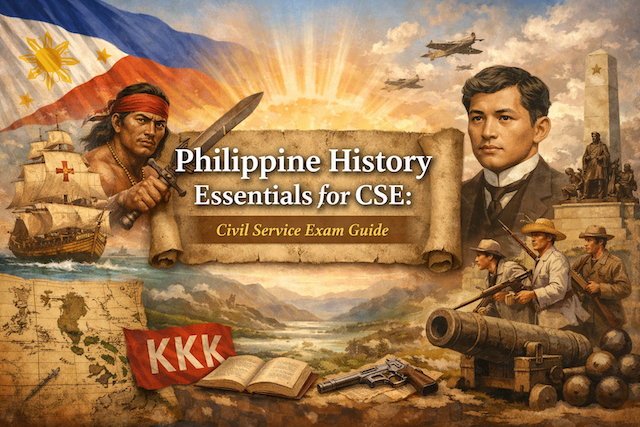
Philippine History Essentials for CSE: Civil Service Exam Guide
Contents
- Philippine History Essentials for CSE: Civil Service Exam Guide
- Pre-Colonial Philippines
- Spanish Colonial Period (1521–1898)
- Rise of Filipino Nationalism
- Philippine Revolution and the First Republic
- American Colonial Period (1898–1946)
- Commonwealth Period (1935–1946)
- Japanese Occupation (1942–1945)
- Post-War Independence and the Third Republic
- Martial Law and the Marcos Era
- People Power and the Contemporary Philippines
- Common Patterns in CSE Philippine History Questions
- Effective Study Tips for Philippine History in CSE
- Final Thoughts
- Problems Set: Philippine History (Civil Service Exam Style)
- Answer Key: Philippine History (CSE)
Philippine History Essentials for CSE: Civil Service Exam Guide
The Philippine Civil Service Examination (CSE) includes Philippine History as a core component under General Information. Many examinees underestimate this subject, yet it frequently appears in both Professional and Subprofessional levels. Questions are usually factual, chronological, and concept-based, testing your understanding of major historical periods, key figures, laws, and national movements.
This guide provides a clear, exam-focused overview of Philippine history, highlighting essential topics and patterns that often appear in the CSE. The goal is not to memorize everything, but to understand timelines, causes, and significance, which helps eliminate wrong answers during the exam.
Pre-Colonial Philippines
Before Spanish colonization, the Philippines was composed of independent communities called barangays, led by a datu. These communities had their own systems of governance, trade, culture, and belief systems.
The social structure generally consisted of:
-
Datu – the chief or leader
-
Maharlika – the warrior nobility
-
Timawa – free commoners
-
Alipin – dependents or servants (not equivalent to Western slavery)
Early Filipinos engaged in barter trade with neighboring Asian countries such as China, Japan, and Southeast Asian kingdoms. Artifacts like porcelain, gold ornaments, and tools provide evidence of advanced craftsmanship.
Writing systems such as Baybayin were already in use. Religious beliefs were largely animistic, with spirits called anito and religious leaders known as babaylan.
CSE Tip: Questions often focus on social classes, leadership structures, and early cultural practices.
Spanish Colonial Period (1521–1898)
The Spanish era began with Ferdinand Magellan’s arrival in 1521, though permanent colonization started in 1565 under Miguel López de Legazpi.
Political and Administrative System
Spain ruled the Philippines through a centralized colonial government headed by the Governor-General, who exercised executive, legislative, judicial, and military powers. The Philippines was governed as part of the Viceroyalty of New Spain (Mexico) until 1821.
Role of the Catholic Church
The Catholic Church played a dominant role in governance, education, and daily life. Friars held significant influence, often surpassing civil authorities in local towns.
Economic Policies
Spain implemented systems such as:
-
Encomienda system – land grants given to Spaniards
-
Tributo – annual tax paid by natives
-
Polo y servicios – forced labor for Filipino males
Education and Culture
Formal education was introduced, culminating in the Education Decree of 1863, which established free public education. However, access was limited, and instruction favored Spanish interests.
CSE Tip: Expect questions about colonial systems like tributo, polo y servicios, and the role of friars.
Rise of Filipino Nationalism
By the late 19th century, exposure to liberal ideas sparked Filipino nationalism. Educated Filipinos known as Ilustrados led reform movements.
Propaganda Movement
The Propaganda Movement aimed for peaceful reforms, not independence. Key figures included:
-
José Rizal
-
Marcelo H. del Pilar
-
Graciano López Jaena
Their works were published in La Solidaridad, advocating equality and representation.
Execution of Gomburza
The execution of Gomez, Burgos, and Zamora (Gomburza) in 1872 deeply influenced nationalist sentiment and inspired future revolutionaries.
CSE Tip: Know the goals of the Propaganda Movement and distinguish it from revolutionary movements.
Philippine Revolution and the First Republic
When peaceful reforms failed, revolution followed.
Katipunan
Founded by Andres Bonifacio in 1892, the Katipunan sought complete independence from Spain through armed struggle.
Declaration of Independence
On June 12, 1898, Emilio Aguinaldo proclaimed Philippine independence in Kawit, Cavite.
Malolos Constitution
The Malolos Constitution (1899) established the First Philippine Republic, making it Asia’s first democratic republic.
CSE Tip: Dates, leaders, and documents like the Malolos Constitution frequently appear in exams.
American Colonial Period (1898–1946)
Following the Treaty of Paris (1898), Spain ceded the Philippines to the United States, leading to the Philippine-American War (1899–1902).
American Policies
The Americans introduced:
-
Public education system with English as medium
-
Democratic institutions
-
Civil service system
Philippine Autonomy Acts
Key laws included:
-
Philippine Organic Act of 1902
-
Jones Law of 1916, promising eventual independence
-
Tydings-McDuffie Act (1934), establishing the Commonwealth
CSE Tip: Understand the significance of these acts and their role in self-governance.
Commonwealth Period (1935–1946)
The Commonwealth of the Philippines served as a transition government toward independence.
-
Manuel L. Quezon was the first President
-
Focus areas included national defense, social justice, and economic development
The period was interrupted by World War II.
CSE Tip: Quezon is often asked in relation to Commonwealth policies and leadership.
Japanese Occupation (1942–1945)
Japan occupied the Philippines during World War II.
Key features:
-
Harsh military rule
-
Establishment of the Second Philippine Republic under Jose P. Laurel
-
Growth of guerrilla resistance movements
The Philippines was liberated in 1945 with the return of American forces.
CSE Tip: Know the puppet government and the role of guerrillas.
Post-War Independence and the Third Republic
The Philippines gained full independence on July 4, 1946.
Challenges included:
-
War rehabilitation
-
Economic dependency
-
Hukbalahap rebellion
Presidents during this era included Manuel Roxas, Elpidio Quirino, and Ramon Magsaysay.
CSE Tip: Magsaysay is frequently associated with anti-corruption and pro-people governance.
Martial Law and the Marcos Era
President Ferdinand Marcos declared Martial Law on September 21, 1972.
Key features:
-
Suspension of civil liberties
-
Centralization of power
-
Widespread human rights abuses
-
Economic decline despite infrastructure projects
The period ended with the People Power Revolution (1986).
CSE Tip: Martial Law-related questions often focus on dates, reasons, and consequences.
People Power and the Contemporary Philippines
The EDSA People Power Revolution led to the ouster of Marcos and the installation of Corazon Aquino as President.
1987 Constitution
The 1987 Constitution restored democratic institutions and strengthened civil liberties.
Subsequent administrations focused on democratic consolidation, economic reforms, and globalization.
CSE Tip: Link People Power to the restoration of democracy and the 1987 Constitution.
Common Patterns in CSE Philippine History Questions
-
Chronological order of events
-
Identification of key laws and documents
-
Matching leaders with accomplishments
-
Causes and effects of major movements
-
Comparison of colonial policies
Most questions are direct and factual, but understanding context helps avoid traps.
Effective Study Tips for Philippine History in CSE
-
Create a timeline from pre-colonial to modern era
-
Memorize key dates with events, not in isolation
-
Associate leaders with their major contributions
-
Practice elimination techniques in multiple-choice questions
-
Focus on why events happened, not just what happened
Final Thoughts
Philippine History in the CSE is not about deep historical debate but clear mastery of essential facts and sequences. With structured review and attention to recurring themes, this subject can become a high-scoring area rather than a weakness.
By understanding the flow of Philippine history—from barangays to modern democracy—you gain not only exam confidence but a stronger grasp of the nation’s identity and governance.
Problems Set: Philippine History (Civil Service Exam Style)
Question 1
What was the basic political unit in pre-colonial Philippine society?
A. Sultanate
B. Barangay
C. Province
D. Kingdom
Question 2
Who was the leader of a pre-colonial barangay?
A. Rajah
B. Gobernadorcillo
C. Datu
D. Sultan
Question 3
Which group served as spiritual leaders in pre-colonial Filipino communities?
A. Maharlika
B. Babaylan
C. Ilustrado
D. Timawa
Question 4
What system required Filipino males to render forced labor during the Spanish period?
A. Encomienda
B. Tributo
C. Polo y servicios
D. Cedula
Question 5
Who was the first Spanish governor-general of the Philippines?
A. Ferdinand Magellan
B. Miguel López de Legazpi
C. Andrés de Urdaneta
D. Diego Silang
Question 6
Which event greatly intensified Filipino nationalism in the 19th century?
A. Opening of the Suez Canal
B. Execution of Gomburza
C. Discovery of the Philippines by Magellan
D. Establishment of La Solidaridad
Question 7
What was the primary goal of the Propaganda Movement?
A. Immediate independence through revolution
B. Separation from Spain
C. Peaceful reforms and equal rights
D. Establishment of a monarchy
Question 8
Who founded the Katipunan?
A. Emilio Aguinaldo
B. Apolinario Mabini
C. Andres Bonifacio
D. Jose Rizal
Question 9
On what date was Philippine independence declared from Spain?
A. August 26, 1896
B. June 12, 1898
C. July 4, 1946
D. January 23, 1899
Question 10
What constitution established the First Philippine Republic?
A. 1935 Constitution
B. 1973 Constitution
C. Malolos Constitution
D. 1987 Constitution
Question 11
Which treaty ended the Spanish-American War?
A. Treaty of Paris
B. Treaty of Tordesillas
C. Treaty of Manila
D. Treaty of Madrid
Question 12
Which law promised eventual independence to the Philippines during the American period?
A. Bell Trade Act
B. Philippine Organic Act
C. Jones Law
D. Hare-Hawes-Cutting Act
Question 13
Who was the first President of the Philippine Commonwealth?
A. Sergio Osmeña
B. Manuel Roxas
C. Manuel L. Quezon
D. Elpidio Quirino
Question 14
Who served as President during the Japanese-sponsored Second Philippine Republic?
A. Manuel L. Quezon
B. Emilio Aguinaldo
C. Jose P. Laurel
D. Ramon Magsaysay
Question 15
When did the Philippines gain full independence from the United States?
A. June 12, 1898
B. July 4, 1946
C. February 25, 1986
D. January 23, 1899
Question 16
Which Philippine president declared Martial Law in 1972?
A. Diosdado Macapagal
B. Ferdinand Marcos
C. Corazon Aquino
D. Ramon Magsaysay
Question 17
What major event ended the Marcos regime?
A. Snap Elections
B. EDSA People Power Revolution
C. Declaration of Martial Law
D. Ratification of the 1973 Constitution
Question 18
What constitution restored democratic institutions after Martial Law?
A. 1935 Constitution
B. 1973 Constitution
C. Freedom Constitution
D. 1987 Constitution
Question 19
Which president is best remembered for a pro-people and anti-corruption campaign?
A. Manuel Roxas
B. Elpidio Quirino
C. Ramon Magsaysay
D. Carlos P. Garcia
Question 20
Which of the following is a correct chronological order?
A. Spanish Period → American Period → Japanese Occupation
B. Japanese Occupation → Spanish Period → American Period
C. American Period → Spanish Period → Japanese Occupation
D. Commonwealth → Spanish Period → American Period
Answer Key: Philippine History (CSE)
-
B – Barangay
-
C – Datu
-
B – Babaylan
-
C – Polo y servicios
-
B – Miguel López de Legazpi
-
B – Execution of Gomburza
-
C – Peaceful reforms and equal rights
-
C – Andres Bonifacio
-
B – June 12, 1898
-
C – Malolos Constitution
-
A – Treaty of Paris
-
C – Jones Law
-
C – Manuel L. Quezon
-
C – Jose P. Laurel
-
B – July 4, 1946
-
B – Ferdinand Marcos
-
B – EDSA People Power Revolution
-
D – 1987 Constitution
-
C – Ramon Magsaysay
-
A – Spanish Period → American Period → Japanese Occupation
Civil Service Exam Philippines: Complete Preparation and Passing Guide

How to Register for eTravel Philippines (2025 Guide)
Step-by-step guide to completing your eTravel registration before arriving in the Philippines, with images and tips.

Night Market in Cebu – Things You Don’t Know About Cebu Life
Discover the hidden charm of Cebu’s night markets, from street food stalls to local life tips you won’t find in tourist guides.

How to Use ChatGPT for IELTS Preparation: A Complete Guide
Learn how to prepare for IELTS using ChatGPT — including strategies for Writing, Reading, Listening, Speaking, and grammar support.

How to Build a Website Without Coding Using ChatGPT
Discover how to build your own website using AI—no coding skills needed. From structure planning to SEO and design, let ChatGPT guide you.