2026年4月3日
3D ACADEMY offers affordable English study programs in Cebu, Philippines – perfect for beginners, professionals, and exam takers.

3D UNIVERSAL ENGLISH INSTITUTE INC
info.3d-universal.com
8:00-17:00(Mon-Fri)
Public vs Private Universities in the Philippines: Pros and Cons
Contents
- Public vs Private Universities in the Philippines: Pros and Cons
- Overview of Public and Private Universities in the Philippines
- Tuition and Financial Considerations
- Quality of Education and Curriculum
- Admission and Enrollment Process
- Facilities and Campus Environment
- Academic Pressure and Student Life
- Employment and Alumni Network
- Social Environment and Diversity
- Pros and Cons Summary
- Which Type of University Should You Choose?
- Final Thoughts
- FAQs
- What are the key differences between public and private universities in the Philippines?
- Is tuition free at public universities?
- How much do private universities usually cost?
- Which has better quality—public or private?
- How competitive are admissions?
- Do private universities really have better facilities?
- Which sector is better for employability?
- How do research opportunities compare?
- What about class sizes and teaching styles?
- Are there cultural or campus-life differences?
- How can I decide which is right for me?
- Any tips for getting scholarships and financial aid?
- Will transferring between public and private schools be difficult?
- What red flags should I watch for?
- Bottom line: public vs private—how do I choose?
Public vs Private Universities in the Philippines: Pros and Cons
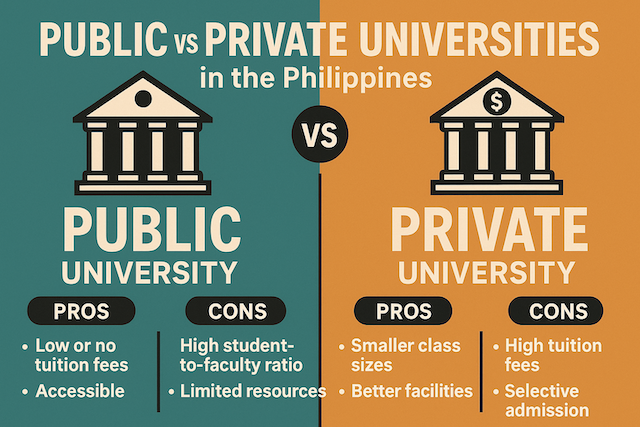
Choosing between a public or private university in the Philippines is one of the most important decisions for any student or parent. Both types of institutions offer quality education, but they differ significantly in terms of tuition fees, facilities, admission process, and learning environment. Understanding their advantages and disadvantages will help you decide which is the best fit for your goals, budget, and preferred academic experience.
Overview of Public and Private Universities in the Philippines
The Philippines has a diverse higher education system consisting of state universities and colleges (SUCs), local universities and colleges (LUCs), and private higher education institutions (HEIs).
-
Public Universities are government-funded institutions. Examples include the University of the Philippines (UP), Polytechnic University of the Philippines (PUP), and Mindanao State University (MSU).
-
Private Universities, on the other hand, are managed by private organizations or religious groups. Examples include Ateneo de Manila University, De La Salle University, University of Santo Tomas, and Mapúa University.
While both sectors aim to provide high-quality education, their funding sources, governance, and target student population often lead to distinct educational experiences.
Tuition and Financial Considerations
Public Universities: Affordable or Free Education
Public universities in the Philippines are known for their low tuition fees. In fact, under the Republic Act 10931 or the Universal Access to Quality Tertiary Education Act, students enrolled in state universities and colleges (SUCs) enjoy free tuition and miscellaneous fees.
This makes public universities a popular choice for financially conscious students. Scholarships and stipends are also available for those who excel academically or come from disadvantaged backgrounds.
However, because of this affordability, competition for admission is extremely high, and the number of slots is often limited.
Private Universities: Higher Cost, More Amenities
Private universities charge significantly higher tuition fees, often ranging from ₱60,000 to ₱200,000 per semester, depending on the program and institution. However, the higher cost typically comes with better facilities, modern classrooms, air-conditioned environments, and smaller class sizes.
Private institutions also tend to offer flexible payment plans and various scholarship programs for academic achievers, athletes, or financially challenged students.
Quality of Education and Curriculum
Public Universities: Academically Rigid and Competitive
Top public universities like the University of the Philippines (UP) are internationally recognized for academic excellence. They maintain rigorous admission exams and research-based programs, producing many of the country’s top professionals and leaders.
Public universities emphasize critical thinking, nationalism, and public service, often reflecting their mandate to serve the Filipino people. However, because of limited funding, laboratories and equipment in some public schools may be outdated compared to those in private universities.
Private Universities: Industry-Oriented and Modern
Private universities are known for their modern facilities, industry linkages, and innovative teaching methods. They often collaborate with international partners and private companies, giving students internship and employment opportunities even before graduation.
The curriculum in private schools may be more flexible, with a focus on global competitiveness and career readiness. Students are also more exposed to technology and digital learning platforms, which prepare them for modern work environments.
Admission and Enrollment Process
Public Universities: Highly Competitive Entrance Exams
Getting into a top public university in the Philippines can be extremely difficult. For instance, the UP College Admission Test (UPCAT) and PUP College Entrance Test (PUPCET) are known for their high standards and limited quotas.
Because education is heavily subsidized, only the best-performing students usually gain admission. Those who do not pass often look for alternatives in private institutions.
Private Universities: Easier but More Expensive Entry
Private universities generally have less competitive admission processes. Many only require entrance tests, interviews, and document screening. This makes them more accessible to students who did not pass public university exams.
However, students and parents must be prepared for higher tuition costs and additional expenses such as lab fees, uniforms, and materials.
Facilities and Campus Environment
Public Universities: Large Campuses, Simple Facilities
Public universities usually have spacious campuses, often with open spaces and multiple buildings. However, because of budget constraints, classrooms and equipment may be basic or outdated.
That said, the atmosphere in public schools often promotes social awareness and activism. Students participate in community service, rallies, and discussions on national issues, creating a sense of engagement and leadership.
Private Universities: Modern Infrastructure and Comfort
Private universities typically have modern infrastructure, air-conditioned classrooms, Wi-Fi-equipped study areas, and state-of-the-art laboratories. Many are located in urban areas like Makati, Quezon City, and Manila, offering convenience and access to city life.
The campus culture is generally more structured and discipline-oriented, emphasizing academic performance and extracurricular involvement.
Academic Pressure and Student Life
Public Universities: Challenging and Politically Active
Students in public universities often face heavy workloads and high academic expectations. Many institutions promote independence, social involvement, and critical thinking.
Campus life can be vibrant and politically charged, especially in universities like UP and PUP, where students are known for their activism. This environment builds resilience, leadership, and a strong sense of identity.
Private Universities: Balanced and Career-Focused
Private universities tend to have a more balanced approach between academics and extracurriculars. They offer numerous clubs, sports, and student organizations, promoting leadership and social interaction.
Because of smaller class sizes, teacher-student interaction is more personal, and academic support is readily available. This can be ideal for students who thrive in a more structured and supportive environment.
Employment and Alumni Network
Public Universities: Strong Reputation and Alumni Influence
Graduates of public universities, especially from UP, PUP, and MSU, enjoy high employability due to their academic reputation and strong alumni networks. Employers often recognize their work ethic and problem-solving abilities, traits developed through rigorous training.
However, in some cases, graduates from less-known state universities may face challenges in matching the industry connections of private school graduates.
Private Universities: Industry Connections and International Recognition
Private universities like Ateneo, De La Salle, and UST have powerful alumni networks and corporate linkages. They often host job fairs and internship programs with top companies, both locally and abroad.
Graduates from these institutions benefit from the school’s brand recognition and are often recruited for high-paying corporate positions.
Social Environment and Diversity
Public Universities: Socioeconomic Diversity
Public universities bring together students from diverse backgrounds—urban and rural, rich and poor. This diversity fosters cultural awareness, empathy, and inclusivity.
Students also engage in discussions on national issues, social justice, and community development, shaping them into socially conscious individuals.
Private Universities: Socioeconomic Homogeneity
Private schools tend to attract middle- to upper-class students due to higher tuition costs. The environment may feel more privileged, but it offers global exposure and a professional atmosphere.
International students are also more common in private universities, creating a multicultural yet elite setting.
Pros and Cons Summary
| Category | Public Universities | Private Universities |
|---|---|---|
| Tuition Fees | Free or very low | High (₱60,000–₱200,000/sem) |
| Admission | Competitive exams | Easier, more flexible |
| Facilities | Basic, limited budget | Modern, well-equipped |
| Curriculum | Research- and service-oriented | Career- and industry-oriented |
| Campus Culture | Activism, independence | Discipline, structure |
| Alumni Network | Strong, especially in UP/PUP | Elite and corporate |
| Diversity | Mixed socioeconomic background | Predominantly middle/upper class |
| Job Opportunities | Strong reputation in government/public sector | Strong private/corporate links |
Which Type of University Should You Choose?
Your decision should depend on your goals, financial situation, and learning style:
-
Choose a public university if you:
-
Are academically competitive and want to minimize expenses
-
Value social involvement, community service, and public leadership
-
Are comfortable with large classes and modest facilities
-
-
Choose a private university if you:
-
Prefer modern learning environments and personalized attention
-
Can afford higher tuition or qualify for scholarships
-
Want strong industry connections and international recognition
-
Both types can provide a strong foundation for your future—what matters most is your effort, mindset, and passion for learning.
Final Thoughts
The debate between public vs private universities in the Philippines is not about which is better, but which is better for you. Public schools excel in accessibility and social mission, while private schools lead in facilities and global exposure.
Ultimately, the right choice is the one that aligns with your personal aspirations, values, and resources. Whether you study in a state-funded campus or a private institution, success will depend on how you make the most of your education.
FAQs
What are the key differences between public and private universities in the Philippines?
Public universities (SUCs and LUCs) are government-funded and generally charge little to no tuition for eligible Filipino undergraduates. They often emphasize public service, research, and broad access. Private universities are run by private organizations (secular or religious) and rely on tuition and endowments. They typically offer modern facilities, smaller class sizes, and extensive industry linkages, but at higher cost.
Is tuition free at public universities?
Many state universities and colleges provide free tuition and certain mandatory fees to qualified Filipino undergraduates under national policy. However, not all programs, students, or circumstances are covered (e.g., second degree, some non-baccalaureate programs, or students who exceed residency limits). Always verify the latest rules with the specific SUC or LUC and check for any remaining out-of-pocket costs like dorms, materials, or student organization dues.
How much do private universities usually cost?
Tuition and fees vary widely, but private universities commonly range from moderate to high relative to public institutions. Costs depend on program (e.g., engineering and health sciences tend to be pricier), campus location, and add-ons such as laboratory, internship, or thesis fees. Many private universities offer need-based aid, merit scholarships, athletic grants, and installment plans that can significantly reduce the net price.
Which has better quality—public or private?
Quality depends on the specific institution and program, not solely on whether it is public or private. Some public universities are nationally top-ranked and research-oriented; some private universities excel in industry partnerships, internationalization, and student support. Look at program-level outcomes such as licensure exam performance, accreditation status, faculty qualifications, research output, internship pipelines, and graduate employment.
How competitive are admissions?
Top public universities often use competitive entrance exams and quotas due to high demand and limited slots. Private universities vary—some are highly selective, while others prioritize holistic screening, interviews, or program-specific requirements. Competitive programs (medicine, nursing, engineering, law, architecture) usually have stricter criteria regardless of sector.
Do private universities really have better facilities?
Private institutions often invest heavily in infrastructure: air-conditioned classrooms, specialized labs, makerspaces, and digital learning platforms. That said, many flagship public universities have strong laboratories and research centers, particularly in STEM and agriculture. Evaluate the specific facilities you will actually use in your program and ask to see current equipment, software, studios, and clinical partnerships.
Which sector is better for employability?
Both can lead to strong employment outcomes. Private universities may offer robust corporate linkages, career centers, job fairs, and international partnerships. Public universities often have reputational strength, large alumni networks, and rigorous training valued by employers. The decisive factors are usually program relevance, internship experience, soft skills, and your portfolio—more than the sector label alone.
How do research opportunities compare?
Flagship public universities typically host significant research programs, government-funded centers, and graduate studies. Many private universities also run active research institutes and collaborate with industry on applied projects. If research matters to you, compare adviser availability, funded projects, publication expectations, and undergraduate research slots within your discipline.
What about class sizes and teaching styles?
Private universities often feature smaller cohorts and closer faculty interaction, which can support mentoring and timely feedback. Public universities may have larger foundational classes but can still offer intimate upper-division seminars and thesis advising. Teaching style is highly instructor- and program-dependent; visit classes if possible and ask students about workload, assessment, and accessibility of professors.
Are there cultural or campus-life differences?
Public campuses frequently cultivate civic engagement, student activism, and community immersion. Private campuses may emphasize organization-driven leadership, structured student services, and professional networking. Both offer diverse clubs, varsity teams, volunteer work, and entrepreneurial groups. Choose the environment that aligns with your values, learning preferences, and well-being.
How can I decide which is right for me?
Create a comparison matrix for your shortlisted schools. Include total cost of attendance, scholarships, program accreditation, licensure outcomes, facilities used by your major, internship pipelines, faculty profiles, class sizes, campus safety, commute or housing, and alumni networks in your target industry. Rank what matters most—cost, prestige, mentorship, research, or career placement—and weigh each school accordingly.
Any tips for getting scholarships and financial aid?
Apply early and broadly. Combine institutional aid (merit/need), government grants, local government unit scholarships, NGO foundations, and private donors. Maintain a strong academic record, craft a compelling personal statement, and prepare documentation (income proofs, recommendation letters, portfolio). Ask about renewal criteria (GPA, load), service obligations, and whether aid stacks with other awards or affects installment plans.
Will transferring between public and private schools be difficult?
Transfers are possible but depend on curriculum alignment, grade thresholds, and available slots. Expect credit evaluation, possible bridging courses, and differences in academic calendars or general education frameworks. Confirm residency rules for graduating honors or thesis requirements that might reset upon transfer.
What red flags should I watch for?
Be cautious of programs without recognized accreditation, poor or opaque licensure/board exam results, outdated lab equipment for lab-heavy majors, minimal internship tie-ups, and unclear total program costs. Speak with current students and recent alumni, verify published outcomes, and read the fine print on fees, refund policies, and overload charges.
Bottom line: public vs private—how do I choose?
If minimizing cost while accessing rigorous academics is your priority, a strong public university may be ideal. If you value smaller classes, modern facilities, and structured industry pathways—and have a realistic financing plan—a reputable private university can be a great fit. In both cases, your engagement, internships, projects, and networks will ultimately drive results.
Philippines University Guide: Top Universities, Admissions, Scholarships, and Student Life

How to Register for eTravel Philippines (2025 Guide)
Step-by-step guide to completing your eTravel registration before arriving in the Philippines, with images and tips.

Night Market in Cebu – Things You Don’t Know About Cebu Life
Discover the hidden charm of Cebu’s night markets, from street food stalls to local life tips you won’t find in tourist guides.

How to Use ChatGPT for IELTS Preparation: A Complete Guide
Learn how to prepare for IELTS using ChatGPT — including strategies for Writing, Reading, Listening, Speaking, and grammar support.

How to Build a Website Without Coding Using ChatGPT
Discover how to build your own website using AI—no coding skills needed. From structure planning to SEO and design, let ChatGPT guide you.