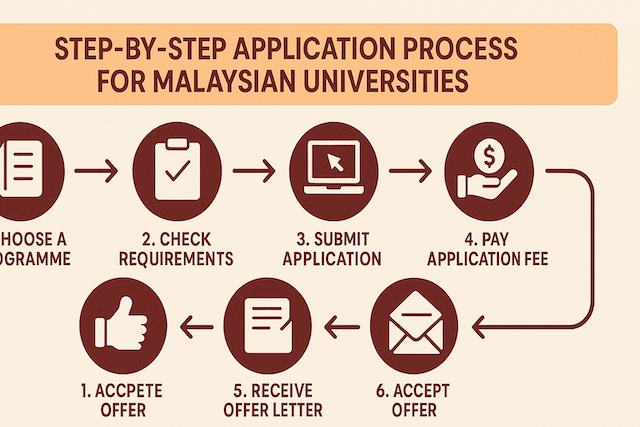
Step-by-Step Application Process for Malaysian Universities
Applying to a university in Malaysia as an international student is an exciting journey that requires careful planning and attention to detail. Malaysia offers a wide range of universities—both local and foreign branch campuses—that provide internationally recognized degrees at affordable tuition rates. This guide walks you through the step-by-step application process for Malaysian universities, ensuring you understand each phase clearly, from researching programs to securing your student visa.
Why Study in Malaysia?
Before starting the application process, it’s worth knowing why Malaysia has become a preferred destination for international students.
-
Affordable Tuition and Living Costs – Compared to Western countries, Malaysia offers quality education at a fraction of the cost.
-
Globally Recognized Degrees – Many Malaysian universities are internationally accredited or affiliated with top universities in the UK, Australia, and other countries.
-
Multicultural Environment – Students from over 100 countries study in Malaysia, creating a diverse and welcoming atmosphere.
-
English as the Medium of Instruction – Most programs are taught in English, reducing language barriers for international students.
-
Strategic Location – Located in Southeast Asia, Malaysia provides easy access to neighboring countries for travel and networking.
Step 1: Research Your University and Program
The first step is to identify the right university and program based on your career goals, academic background, and budget.
How to Choose a University
-
Check Accreditation: Ensure the university and its programs are recognized by the Malaysian Qualifications Agency (MQA).
-
Explore Ranking and Reputation: Look at QS World University Rankings or Times Higher Education to assess quality.
-
Compare Program Offerings: Some universities specialize in certain fields, such as engineering, business, or medicine.
-
Consider Location: Kuala Lumpur, Selangor, and Penang are urban hubs with more amenities, while states like Sarawak and Johor offer quieter environments.
Examples of Top Universities
-
University of Malaya (UM)
-
Universiti Kebangsaan Malaysia (UKM)
-
Monash University Malaysia
-
Taylor’s University
-
Sunway University
-
UCSI University
You can visit each university’s website for details on courses, tuition fees, and admission requirements.
Step 2: Check Admission Requirements
Each university sets its own entry requirements, which typically include academic qualifications, English proficiency, and supporting documents.
Academic Requirements
-
Undergraduate Programs: Completion of high school (equivalent to A-Levels, STPM, IB Diploma, or Foundation program).
-
Postgraduate Programs: Bachelor’s degree with good academic standing.
English Language Requirements
Since courses are in English, you’ll need to provide proof of proficiency. Common tests include:
-
IELTS (minimum overall band: 5.5–6.5 depending on the program)
-
TOEFL (minimum score: 550 for paper-based or 80 for internet-based)
-
MUET (Malaysian University English Test) – accepted by local universities.
Some universities may waive this requirement if you studied in an English-medium institution.
Additional Requirements
-
Passport copy (valid for at least 12 months)
-
Personal statement or motivation letter
-
Recommendation letters (for postgraduate applicants)
-
Portfolio (for design, architecture, or art programs)
Step 3: Prepare Required Documents
Before applying, gather all the documents you need. Typically, you’ll need the following:
-
Completed Application Form (usually done online)
-
Academic Transcripts and Certificates – certified copies
-
English Proficiency Test Results
-
Copy of Passport – including all pages with personal details
-
Passport-sized Photos – recent and in color
-
Medical Report – may be required for visa purposes
-
Application Fee Payment Receipt – varies by university
Ensure all documents are in English or officially translated before submission.
Step 4: Submit the Application
Most Malaysian universities accept online applications through their websites.
Application Process
-
Create an Online Account: Register on the university’s official admission portal.
-
Fill Out the Application Form: Provide personal, educational, and program information.
-
Upload Documents: Attach scanned copies of all required materials.
-
Pay the Application Fee: Usually ranges from RM 100 to RM 500.
-
Submit and Wait for Confirmation: You will receive an email confirming your application.
Application Timeline
-
February/March Intake: Apply between October and January.
-
July/August Intake: Apply between March and June.
-
September/October Intake: Some universities have additional intakes during this period.
Apply early to allow enough time for visa processing and travel arrangements.
Step 5: Wait for the Offer Letter
Once the university reviews your application, it may take 2–6 weeks to receive a response.
There are typically two types of offer letters:
-
Conditional Offer Letter: Issued if you still need to meet certain requirements, such as submitting final exam results or English test scores.
-
Unconditional Offer Letter: Granted when all requirements are met.
After receiving your offer letter, you’ll be asked to accept the offer and pay the tuition deposit to confirm your place.
Step 6: Apply for the Student Visa (VAL – Visa Approval Letter)
To study in Malaysia, international students must obtain a Visa Approval Letter (VAL) issued by the Education Malaysia Global Services (EMGS).
Documents Required for Student Visa Application
-
Copy of Offer Letter from the university
-
Passport copy (all pages)
-
Passport-sized photo
-
Pre-arrival medical examination report (if applicable)
-
Academic transcripts and certificates
-
Visa processing fee payment receipt
Visa Application Process
-
The university submits your application to EMGS.
-
EMGS reviews and processes the visa (usually takes 4–6 weeks).
-
You receive a Visa Approval Letter (VAL) via email.
-
With the VAL, you can apply for an entry visa at the Malaysian embassy or consulate in your home country.
After arrival, you’ll need to undergo a medical screening and have your student pass sticker affixed to your passport.
Step 7: Arrange Accommodation
Most universities in Malaysia offer on-campus or nearby accommodation.
Options Include
-
University Residence Halls: Convenient and affordable, ideal for new students.
-
Private Apartments or Condos: Suitable for students seeking more independence.
-
Homestays: Allow cultural immersion with local families.
Check with your university’s student affairs office for recommendations. Monthly accommodation costs typically range from RM 400 to RM 1,500, depending on location and type.
Step 8: Plan Your Arrival in Malaysia
Before flying to Malaysia, make sure all your arrangements are complete:
-
Book your flight after receiving the VAL and entry visa.
-
Prepare important documents in your hand-carry folder (passport, offer letter, VAL, visa, and medical report).
-
Notify your university’s international office of your arrival date.
-
Upon arrival, attend the orientation session to familiarize yourself with campus facilities and Malaysian culture.
Step 9: Register and Begin Classes
Once in Malaysia, follow the final administrative steps:
-
Complete Student Pass Endorsement – usually done within the first week.
-
Attend Orientation Week – meet other international students and learn about your new environment.
-
Register for Classes – through the student portal or with help from academic advisors.
-
Open a Bank Account – for daily expenses and tuition payments.
-
Apply for a Student ID Card – required for library access and exams.
Congratulations — you’re now officially a university student in Malaysia!
Step 10: Maintain Your Student Visa and Status
To stay in Malaysia legally throughout your studies, you must follow immigration and university regulations.
Important Reminders
-
Attend Classes Regularly: Poor attendance can affect visa renewals.
-
Keep Passport Valid: Renew at least 6 months before expiry.
-
Renew Student Pass Annually: Your university usually assists with this process.
-
Update EMGS if You Change Programs or Institutions.
Failure to comply may result in visa cancellation or penalties.
Step 11: After Graduation
After completing your studies, you have several options:
-
Apply for an Employment Pass to work in Malaysia.
-
Pursue Postgraduate Studies at the same or another Malaysian university.
-
Return Home or Move Abroad with an internationally recognized Malaysian degree.
Malaysia’s education system prepares you with practical skills and multicultural experience—assets that are highly valued worldwide.
Final Thoughts
Applying to a Malaysian university as an international student is straightforward if you follow each step carefully. From choosing the right program and submitting your application to obtaining your visa and arriving in Malaysia, planning ahead will ensure a smooth transition.
Malaysia’s blend of quality education, affordability, and cultural diversity makes it an exceptional choice for global students seeking academic and personal growth.
What are the main intakes for Malaysian universities, and when should I apply?
Most universities offer two major intakes: February/March and July/August. Some institutions also have September/October or rolling intakes for selected programs. Aim to apply 3–6 months before your preferred start date to allow time for evaluation, Visa Approval Letter (VAL) processing through EMGS, medical screening, housing, and travel arrangements.
Do I need IELTS or TOEFL to study in Malaysia?
Yes, if your prior education was not in English. Typical minimums are IELTS 5.5–6.5 or TOEFL iBT 60–80, depending on the program. Many local universities also accept MUET. Exemptions or waivers may apply if you completed studies in an English-medium institution; always verify program-specific policies.
What academic qualifications are required for undergraduate admission?
Requirements vary by institution but commonly include completion of A-Levels, IB Diploma, STPM, UEC, SAT/ACT, or a recognized Foundation/Matriculation program. Select programs—engineering, health sciences, architecture—may require subject prerequisites and minimum grades. Universities will assess certified transcripts and equivalencies against the Malaysian Qualifications Framework (MQF).
How does the online application process work?
You create an account on the university portal, select your program, complete personal and academic sections, upload certified documents, and pay a nonrefundable application fee (often RM100–RM500). After submission, you’ll receive an acknowledgement email. Processing typically takes 2–6 weeks, followed by a conditional or unconditional offer if successful.
What documents should I prepare before applying?
Prepare scanned copies of your passport (all biodata pages), passport-sized photos, academic transcripts and certificates, English test scores, personal statement, CV (for postgraduate applicants), recommendation letters, and any program-specific items such as a portfolio. Provide official translations for non-English documents and ensure notarization/certification where required.
What is EMGS and what is a Visa Approval Letter (VAL)?
Education Malaysia Global Services (EMGS) manages international student visas. After you accept your offer and pay the required fees, your university submits your visa application to EMGS. Upon approval, you receive a VAL, which you use to obtain an entry visa from a Malaysian embassy/consulate. You’ll complete medical screening and student pass endorsement after arrival.
How long does the student visa process take?
From university submission to VAL issuance, expect roughly 4–6 weeks, although timelines can vary by season and completeness of your file. Add time for embassy processing of your entry visa, flight booking, and post-arrival medical screening and student pass sticker. Apply early to avoid deferrals to the next intake.
What is the difference between a conditional and an unconditional offer?
A conditional offer is granted when you meet most criteria but must still submit final grades, English scores, or documents. Once conditions are satisfied by the stated deadline, the university issues an unconditional offer. You usually must pay a tuition deposit to confirm your seat and trigger the visa process.
Can I work while studying in Malaysia?
International students may work part-time in certain roles and during specific breaks, subject to immigration regulations and university policies. Work is usually limited to designated sectors (e.g., restaurants, mini-marts) and capped weekly during semesters. Always consult your international office to ensure compliance with your student pass conditions.
How much should I budget for living expenses?
Living costs vary by city and lifestyle. A reasonable monthly range is RM1,800–RM3,500, covering shared accommodation (RM400–RM1,500), food, local transport, utilities, mobile data, and personal expenses. Branch campuses in suburban areas may be cheaper than central Kuala Lumpur, while private apartments cost more than university residence halls.
What accommodation options are available for new students?
Choices include on-campus residence halls, off-campus student hostels, shared apartments/condos, and homestays. University-managed housing simplifies move-in and orientation, while private rentals offer flexibility and amenities. Review lease terms, deposits, utility arrangements, commute times, and safety. Book early—popular residences fill quickly near intake dates.
How do I choose the right program and university?
Align your selection with career goals and academic strengths. Check accreditation via MQA, review curriculum structure and specializations, examine graduate outcomes and internships, compare tuition and scholarships, and weigh campus location and student support services. Shortlist two to four suitable programs to maintain options if your first choice fills up.
Are scholarships available for international students?
Yes. Many universities offer merit-based or need-based awards, often tied to academic excellence, test scores, or extracurricular achievements. Some external bodies and home-country sponsors also fund study in Malaysia. Deadlines can precede program applications, so prepare early with transcripts, references, and a strong personal statement.
What happens after I arrive in Malaysia?
Attend airport pickup if offered, check into housing, and complete the post-arrival medical screening and student pass endorsement. Participate in orientation to learn registration steps, course selection, library access, IT services, and campus safety. Activate your student email, obtain your ID card, and set up a local bank account and SIM card.
How do I register for courses and avoid timetable conflicts?
Use the student portal during the enrollment window to select modules with guidance from program advisors. Confirm prerequisites, credit loads, and class capacities. Lock in tutorials and labs early, then review your timetable for clashes. Keep screenshots or confirmations and verify add/drop deadlines in case adjustments are needed.
What are common reasons for application delays or rejections?
Typical issues include incomplete documents, uncertified transcripts, expired passports, insufficient English scores, missed deadlines, and not meeting academic prerequisites. For visa files, unclear scans, inconsistent biodata, and unpaid fees can stall processing. Double-check instructions, maintain valid travel documents, and respond promptly to university or EMGS queries.
Do I need health insurance as a student?
Yes. International students are generally required to maintain EMGS-approved medical insurance throughout their studies. Insurance is often bundled with your visa application or arranged via the university. Review coverage for outpatient, inpatient, emergency, and personal accident benefits, and keep your policy card accessible.
Can I change programs or transfer universities after enrolling?
Transfers are possible but must comply with both university rules and EMGS/immigration requirements. You’ll typically need academic approval, proof of good standing, and a revised visa process. Changing programs may affect timelines, credit transfer, and tuition. Consult your international office before making decisions to ensure continuity of your student pass.
How do I maintain my student status and renew my pass?
Maintain satisfactory attendance and academic progress, keep your passport valid (at least six months before expiration), renew your student pass annually, and update records if you change address or contact details. The international office usually coordinates renewals—submit documents early to avoid overstays or penalties.
What are my options after graduation?
Graduates may pursue employment in Malaysia via an Employment Pass, continue with postgraduate studies, or leverage their Malaysian degree internationally. Build a strong profile through internships, industry projects, and research. Attend career fairs, network with alumni, and consult the university’s employability services for CV, interview, and visa guidance.