
Contents
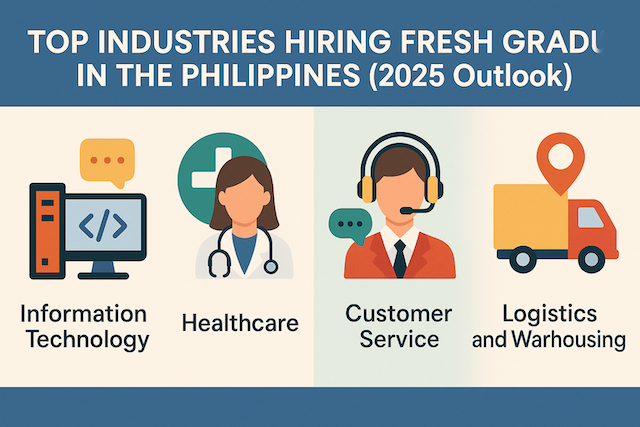
- Top Industries Hiring Fresh Graduates in the Philippines (2025 Outlook)
- Introduction
- 1. Information Technology (IT) and Software Development
- 2. Business Process Outsourcing (BPO) and Shared Services
- 3. Healthcare and Medical Services
- 4. Finance, Banking, and Fintech
- 5. E-commerce and Digital Marketing
- 6. Engineering and Construction
- 7. Tourism, Hospitality, and Aviation
- 8. Education and EdTech
- 9. Renewable Energy and Sustainability
- 10. Media, Communication, and Creative Industries
- Conclusion
- FAQs
- What are the top industries hiring fresh graduates in the Philippines in 2025?
- Which degrees or backgrounds are most in demand?
- I have no work experience. How can I be competitive?
- What entry-level roles are common for fresh grads?
- How is AI changing entry-level work?
- What skills matter most besides technical knowledge?
- Which locations have the most opportunities?
- What certifications help a fresh grad get hired quickly?
- Where should I look for openings and internships?
- How do I tailor my resume for applicant tracking systems (ATS)?
- What salary and benefits should fresh grads expect?
- Is the BPO sector still a good starting point?
- Can non-STEM grads move into tech or data roles?
- How can I stand out in interviews?
- What’s a smart 90-day plan for my first job?
Top Industries Hiring Fresh Graduates in the Philippines (2025 Outlook)
Introduction
Graduating from college is both an exciting and challenging milestone. For many students in the Philippines, the next big step is finding the right job that matches their skills, interests, and goals. The country’s job market has evolved rapidly in recent years, especially after the pandemic recovery, the rise of digital transformation, and the entry of new global investors.
In 2025, fresh graduates in the Philippines will find more opportunities across multiple industries — not just in traditional sectors like banking or education, but also in emerging fields such as technology, renewable energy, and e-commerce. This article provides a detailed overview of the top industries hiring fresh graduates in the Philippines in 2025, the most in-demand roles, and practical tips for landing your first job.
1. Information Technology (IT) and Software Development
The IT industry continues to dominate the Philippine job market. With the country becoming a hub for software outsourcing, app development, and digital transformation, IT companies are constantly seeking skilled young professionals.
In-demand positions:
-
Software Developers (Java, Python, PHP)
-
Data Analysts and Scientists
-
Cybersecurity Specialists
-
IT Support Engineers
-
Web and Mobile App Developers
Why it’s growing:
The digitalization of businesses, coupled with the expansion of cloud-based solutions, has created sustained demand for IT professionals. Local and international firms are opening offices in Metro Manila, Cebu, and Davao, offering competitive salaries and hybrid work setups.
What fresh graduates can do:
Graduates of Computer Science, Information Technology, or Engineering are highly preferred. However, even non-IT graduates can join the industry through coding bootcamps and online certifications from platforms like Coursera, Udemy, and TESDA.
2. Business Process Outsourcing (BPO) and Shared Services
The BPO industry remains one of the biggest employers in the Philippines, with over 1.5 million workers nationwide. In 2025, the sector is shifting towards higher-value roles beyond customer service — such as finance, healthcare, and IT-enabled services.
In-demand positions:
-
Customer Service Representatives (CSR)
-
Technical Support Specialists
-
Financial Analysts
-
HR and Payroll Specialists
-
Medical Billing Specialists
Why it’s growing:
Companies from the U.S., Europe, and Japan continue to outsource operations to the Philippines due to the workforce’s English proficiency and adaptability. AI tools are changing some processes, but human-driven communication remains essential — especially for complex and personalized services.
What fresh graduates can do:
Strong communication skills and basic technical knowledge are key. Many BPO companies provide extensive training programs, making this a great starting point for new graduates to gain professional experience.
3. Healthcare and Medical Services
The healthcare sector continues to expand due to population growth, an aging demographic, and the country’s push toward better public health systems. Moreover, many international employers recruit Filipino healthcare professionals.
In-demand positions:
-
Nurses and Nursing Assistants
-
Medical Technologists
-
Pharmacists
-
Healthcare Administrators
-
Physical Therapists
Why it’s growing:
Post-pandemic, hospitals, clinics, and telemedicine startups have increased hiring. The global demand for Filipino nurses and caregivers also remains high, creating both local and overseas opportunities.
What fresh graduates can do:
Graduates with degrees in Nursing, Medical Technology, or Pharmacy can apply for local hospital positions or begin licensing processes for international work. Soft skills like empathy, communication, and teamwork are vital.
4. Finance, Banking, and Fintech
The finance industry remains one of the most stable and rewarding sectors for graduates. In 2025, digital banking and fintech innovations are transforming traditional finance roles into tech-driven positions.
In-demand positions:
-
Financial Analysts
-
Accountants
-
Bank Tellers
-
Credit Analysts
-
Compliance Officers
-
Risk Management Analysts
Why it’s growing:
The rise of digital banks like Maya, GCash, and Tonik Bank has expanded the financial landscape. Startups and traditional banks alike are competing for young talent who understand both finance and digital platforms.
What fresh graduates can do:
Graduates in Finance, Accountancy, Economics, and Business Administration are ideal candidates. Obtaining certifications such as CPA, CFA, or Fintech Fundamentals can improve job prospects.
5. E-commerce and Digital Marketing
The e-commerce boom in the Philippines shows no signs of slowing down. With platforms like Lazada, Shopee, and TikTok Shop dominating online retail, the demand for professionals in logistics, marketing, and content creation continues to grow.
In-demand positions:
-
Digital Marketing Specialists
-
SEO and Content Writers
-
Social Media Managers
-
E-commerce Operations Associates
-
Graphic Designers
Why it’s growing:
Online shopping has become a daily habit for Filipino consumers, and even small businesses are going digital. Companies are investing heavily in online advertising, influencer campaigns, and website optimization.
What fresh graduates can do:
Graduates in Marketing, Communications, or Multimedia Arts can find plenty of opportunities. Freelance and remote jobs are also common in this field, allowing flexibility and quick career growth.
6. Engineering and Construction
The Philippine government’s “Build Better More” infrastructure program has driven growth in the engineering and construction sectors. Roads, bridges, airports, and residential developments are being built across the country, providing many career paths for engineers.
In-demand positions:
-
Civil Engineers
-
Electrical Engineers
-
Mechanical Engineers
-
Quantity Surveyors
-
Project Supervisors
Why it’s growing:
Massive infrastructure projects and private real estate investments are ongoing in Metro Manila, Cebu, Davao, and Clark. Companies are eager to hire fresh engineering graduates who can be trained on-site.
What fresh graduates can do:
Graduates with PRC licenses or those working toward certification can apply to engineering firms, contractors, or government agencies. Computer-aided design (CAD) and project management skills are valuable assets.
7. Tourism, Hospitality, and Aviation
After the pandemic, the tourism industry has bounced back stronger than expected. The Philippines welcomed millions of tourists in 2024 and expects even more in 2025, driving demand for hospitality professionals.
In-demand positions:
-
Hotel Front Desk Officers
-
Tour Guides and Coordinators
-
Flight Attendants
-
Chefs and Kitchen Staff
-
Travel Consultants
Why it’s growing:
Cebu, Palawan, and Boracay are seeing a surge in international arrivals. Airlines are expanding routes, and hotels are opening new branches — creating jobs for customer-oriented graduates.
What fresh graduates can do:
Hospitality Management and Tourism graduates are most in demand, but even Communication or Business majors can enter through management trainee programs. A friendly personality and foreign language skills can give you an edge.
8. Education and EdTech
As the education sector modernizes, opportunities have opened up not only in traditional teaching but also in online education technology (EdTech) companies. These firms provide digital learning solutions, language tutoring, and AI-based tools.
In-demand positions:
-
Teachers and Instructors
-
Curriculum Developers
-
Online Tutors
-
Educational Content Creators
-
Learning Platform Support Staff
Why it’s growing:
Online education platforms for both local and international students (like 51Talk and RareJob) continue to hire Filipino educators. There’s also growth in corporate training and digital course development.
What fresh graduates can do:
Education, Psychology, and Communication graduates can pursue teaching or content creation roles. Obtaining TESOL or TEFL certification can help if you want to teach English online.
9. Renewable Energy and Sustainability
Sustainability is now a priority for many companies, with the Philippines investing heavily in renewable energy and green technology. This creates opportunities for science and engineering graduates who want to make a positive impact.
In-demand positions:
-
Environmental Engineers
-
Solar Energy Technicians
-
Sustainability Analysts
-
Project Coordinators for Green Initiatives
Why it’s growing:
Government incentives for clean energy projects and the rising demand for corporate ESG (Environmental, Social, Governance) compliance are driving employment in this field.
What fresh graduates can do:
Graduates in Environmental Science, Mechanical or Electrical Engineering can enter this field. Joining sustainability-related volunteer projects or internships can also enhance your resume.
10. Media, Communication, and Creative Industries
The creative sector — including film, digital content, animation, and gaming — is expanding due to the Philippines’ strong English proficiency and artistic talent.
In-demand positions:
-
Video Editors and Animators
-
Copywriters
-
Content Creators
-
Public Relations Officers
-
Multimedia Designers
Why it’s growing:
Social media platforms have created a global demand for Filipino creatives, with local production companies and international clients outsourcing creative work to the Philippines.
What fresh graduates can do:
Graduates in Communication, Fine Arts, or Journalism can start freelancing, work for media agencies, or join startups. Building a personal portfolio or online presence is crucial in this industry.
Conclusion
The Philippine job market in 2025 offers a diverse range of opportunities for fresh graduates, from technology and finance to healthcare and education. The key to success is adaptability — the ability to learn new skills quickly and embrace continuous growth.
Whether you’re aiming for a corporate career, government service, or a creative profession, the opportunities are wide open. Start by identifying your strengths, improving your technical and soft skills, and applying to industries that align with your long-term goals.
Your first job doesn’t have to be perfect — it just has to be a step forward toward building a sustainable and fulfilling career.
FAQs
What are the top industries hiring fresh graduates in the Philippines in 2025?
Leading sectors include Information Technology (software, data, cybersecurity), Business Process Outsourcing and shared services, healthcare, banking and fintech, e-commerce and digital marketing, engineering and construction, tourism and hospitality, education and EdTech, renewable energy and sustainability, and media, communications, and creative work. These industries combine steady demand with clear entry-level tracks and training pipelines for new grads.
Which degrees or backgrounds are most in demand?
Computer Science, IT, and Engineering remain hot for tech and infrastructure roles. Accountancy, Economics, and Business Administration feed finance and shared services. Nursing, Pharmacy, and allied health courses lead healthcare hiring. Communications, Marketing, and Multimedia fit e-commerce and creative fields. Education and Psychology align with EdTech and training roles. Non-aligned degrees can still pivot via certifications and bootcamps.
I have no work experience. How can I be competitive?
Show proof of skill, not just potential. Build a portfolio (GitHub apps, data notebooks, design reels, writing samples), complete internships or OJT, take micro-credentials, and contribute to student orgs or volunteer projects with measurable outcomes. Quantify impact (e.g., “reduced response time by 20%”). Tailor each resume to the job’s keywords and demonstrate learning agility.
What entry-level roles are common for fresh grads?
Typical roles include software developer, QA tester, IT support, data analyst; CSR or technical support associate, payroll analyst, or accounts associate in BPO; staff nurse, med tech, or healthcare admin; bank teller, risk/compliance analyst, junior accountant; digital marketing associate, content writer, social media coordinator; civil or electrical engineer trainee; hotel front office or management trainee; and online tutor or curriculum assistant.
How is AI changing entry-level work?
AI automates routine tasks (drafting, summarization, simple classification), raising the bar for human roles. Employers now value prompt design, data literacy, and workflow orchestration with AI tools. Fresh grads who combine domain skills with AI proficiency (e.g., using notebooks, low-code automations, and model-assisted analysis) can produce more value, faster, and stand out in interviews.
What skills matter most besides technical knowledge?
Employers consistently list communication (clear writing and speaking), problem solving, stakeholder management, time management, and teamwork. Add business acumen (understanding revenue/cost drivers) and customer empathy. For client-facing roles, resilience and de-escalation skills are prized. Demonstrate these with specific stories using the STAR method: Situation, Task, Action, Result.
Which locations have the most opportunities?
Metro Manila remains the largest hub, followed by Cebu and Davao for tech, BPO, finance, and hospitality. Clark/Subic and Iloilo are growing for logistics and shared services. Remote and hybrid work broaden options nationwide, especially for IT, design, marketing, and support roles that can be performed off-site with reliable connectivity.
What certifications help a fresh grad get hired quickly?
For IT/data: CompTIA A+/Network+, AWS Cloud Practitioner, Google Data Analytics, Microsoft Azure Fundamentals, and basic cybersecurity certs. For finance: CPA (where applicable), bookkeeping certs, and Excel/Power BI. For marketing: Google Ads, Analytics, Meta certifications, and SEO fundamentals. For education: TESOL/TEFL for online English teaching. Choose certs aligned with job postings you’re targeting.
Where should I look for openings and internships?
Use mainstream job boards, company career pages, and LinkedIn. Join university career centers, alumni groups, and industry associations. Attend job fairs and virtual hiring events. For internships, watch company Facebook/LinkedIn pages and faculty networks; many firms recruit directly from campus groups and capstone classes.
How do I tailor my resume for applicant tracking systems (ATS)?
Mirror keywords from the job description in your skills, experience bullets, and projects. Use a clean layout with standard headings, avoid images or tables, and prefer PDF or simple DOCX. Quantify achievements, list relevant tools (e.g., Python, SQL, Figma, Excel), and move your strongest, role-matched items to the top third of the page.
What salary and benefits should fresh grads expect?
Compensation varies by city and industry. Tech, finance, and shared services generally pay higher starting rates and often include allowances, HMO coverage, and performance bonuses. Hospitality, education, and creative roles may start lower but offer rapid responsibility growth, tips or commissions, project royalties, or flexible schedules. Evaluate total rewards, not just base pay.
Is the BPO sector still a good starting point?
Yes. Beyond voice support, many centers now run finance, HR, healthcare, and IT operations. They offer structured training, clear promotion ladders, and exposure to global standards. Use this path to build communication finesse, process rigor, and domain familiarity, then transition to specialized roles internally or in adjacent industries.
Can non-STEM grads move into tech or data roles?
Absolutely. Start with a focus (front-end web, QA, data analytics), complete a reputable bootcamp or MOOC sequence, and build portfolio projects using real datasets or briefs. Contribute to open source or freelance micro-gigs. Pair technical skills with your original domain (e.g., marketing analytics, fintech ops) to create a compelling hybrid profile.
How can I stand out in interviews?
Research the company’s products and metrics, prepare concise STAR stories, and bring a portfolio or code/design samples. Show how you learn: discuss a recent course, a challenging bug you fixed, or an experiment you ran. Ask thoughtful questions about success metrics, onboarding, mentorship, and the tech or process stack you will use.
What’s a smart 90-day plan for my first job?
Days 1–30: master tools, documentation, and key processes; clarify expectations and success metrics. Days 31–60: deliver a small but visible win (dashboards, SOP cleanup, A/B test). Days 61–90: automate a repetitive task, document learnings, and present impact to your team. This cadence builds trust and momentum quickly.
Philippines University Guide: Top Universities, Admissions, Scholarships, and Student Life



