
Contents
- Daily Habits to Improve English Fluency
- 1. Start Your Day in English
- 2. Listen to English Daily
- 3. Speak Every Day — Even Alone
- 4. Read for 15–30 Minutes a Day
- 5. Keep a Daily Journal in English
- 6. Think in English
- 7. Learn 5–10 New Words Daily — in Context
- 8. Use English in Real Situations
- 9. Review and Reflect Daily
- 10. Surround Yourself with English
- 11. Be Patient and Consistent
- Final Thoughts
- FAQs
- What daily habits help me improve English fluency the fastest?
- How long should I practice each day to see results?
- What is the best way to learn vocabulary so it actually sticks?
- How do I practice speaking if I don’t have a partner?
- What is shadowing and how do I do it effectively?
- How can I train myself to think in English instead of translating?
- What should I read daily to improve fluency?
- How do I balance accuracy (grammar) with fluency (speed) every day?
- What’s a simple daily routine I can follow?
- How can I make listening practice more active and effective?
- How many new words should I learn per day?
- How do I track progress so I stay motivated?
- What if I feel stuck or plateaued?
- How important is pronunciation, and how can I improve it daily?
- Can apps and social media really help with fluency?
- How do I keep my routine sustainable long term?
Daily Habits to Improve English Fluency
Becoming fluent in English is not about memorizing grammar rules or spending hours on vocabulary lists. True fluency develops from consistent, daily practice and exposure. By building simple yet powerful habits into your daily routine, you can steadily move from hesitant speaking to confident communication. Here are some practical daily habits that can help you improve your English fluency.
1. Start Your Day in English
One of the most effective ways to immerse yourself in English is to start your day with it. The first 30 minutes after you wake up are ideal for setting your brain’s language mode. You can:
-
Read a short article or news summary in English.
-
Watch a short motivational video or TED Talk.
-
Write a short morning journal entry in English.
This simple routine helps your brain think in English right from the beginning of the day. Over time, your vocabulary and comprehension will naturally improve.
2. Listen to English Daily
Listening is the foundation of fluency. The more you hear natural English, the better you’ll understand pronunciation, rhythm, and intonation.
Try to incorporate English listening into your everyday life:
-
Podcasts and Audiobooks: Choose topics that genuinely interest you. Even 10–15 minutes per day can make a difference.
-
YouTube Channels: Watch English content creators or vloggers. Observe how they use phrases and expressions naturally.
-
Music and Lyrics: Listen to English songs and read the lyrics. Try to sing along to improve your pronunciation and rhythm.
Listening passively (while doing chores or commuting) and actively (with focus) both contribute to better fluency.
3. Speak Every Day — Even Alone
Many learners wait for the perfect moment to speak — a class, a native speaker, or an English test. But real fluency grows when you speak every day, regardless of who’s listening.
Here’s how you can practice:
-
Talk to Yourself: Describe what you’re doing (“I’m making coffee,” “I’m checking my email”).
-
Shadowing Practice: Imitate what you hear in podcasts or videos, repeating the speaker’s words with the same tone and speed.
-
Voice Recording: Record yourself speaking about a topic, then listen to it to find pronunciation or grammar mistakes.
Speaking daily helps reduce hesitation, builds muscle memory, and increases your confidence.
4. Read for 15–30 Minutes a Day
Reading expands your vocabulary, exposes you to different sentence structures, and improves your grammar subconsciously. You don’t need to read long novels; consistency matters more than length.
Good reading materials include:
-
English blogs or news websites like BBC, Medium, or The Guardian.
-
Short stories or graded readers for English learners.
-
English posts on social media platforms like Reddit or Quora.
When you encounter new words, don’t rush to check the dictionary immediately. Try to guess the meaning from context first — this builds your natural understanding of English.
5. Keep a Daily Journal in English
Writing is one of the most powerful habits for fluency. It forces you to organize your thoughts in English and helps you notice gaps in your vocabulary and grammar.
You can write about:
-
Your daily activities or plans.
-
Something new you learned today.
-
Your opinions about a movie, a book, or the news.
Writing 5–10 sentences daily is enough to make progress. Over time, your writing will become more natural and less dependent on translation.
6. Think in English
This is a game-changer. If you always translate from your native language to English, fluency will feel slow and unnatural. Start training your brain to think directly in English.
You can do this by:
-
Naming objects around you in English.
-
Asking yourself questions in English (“What should I eat for lunch?” “Where did I put my keys?”).
-
Planning your day in English internally.
The goal is to make English your automatic thought language, not just your study subject.
7. Learn 5–10 New Words Daily — in Context
Vocabulary lists are useful, but memorizing words alone doesn’t guarantee fluency. Instead, learn new words in context — with phrases, sentences, or examples.
For example:
-
Instead of learning “improve”, learn “improve your skills,” “improve rapidly,” “improve over time.”
-
Instead of “confidence”, learn “build confidence,” “lose confidence,” “speak with confidence.”
Review new words at the end of the day and try to use them in your writing or speech. This active use makes them stick.
8. Use English in Real Situations
Fluency grows faster when you use English in meaningful situations. Even if you don’t live in an English-speaking country, you can create real-life opportunities:
-
Online Communities: Join Facebook groups, Reddit discussions, or Discord servers in English.
-
Language Exchange Apps: Use platforms like HelloTalk or Tandem to talk with native speakers.
-
English Games and Apps: Change your phone and social media settings to English.
Real communication gives you confidence and shows you how English is used naturally — far beyond textbooks.
9. Review and Reflect Daily
Reflection helps you turn learning into lasting knowledge. Before going to bed, take five minutes to review what you learned that day. Ask yourself:
-
What new words or phrases did I learn today?
-
Did I use English naturally in any situation?
-
What will I do better tomorrow?
Keeping a small reflection notebook (or using a note app) will help track your progress and motivate you to continue.
10. Surround Yourself with English
Create an “English environment” around you, even if you live in a non-English-speaking country. Your environment shapes your habits.
Try to:
-
Label objects in your home in English.
-
Follow English-speaking influencers or YouTube channels.
-
Watch movies and TV shows in English with English subtitles.
-
Listen to English podcasts during exercise or cooking.
When English becomes part of your daily environment, learning stops feeling like a chore — it becomes part of who you are.
11. Be Patient and Consistent
Fluency doesn’t happen overnight. You might not notice progress every day, but your effort accumulates. Consistency is far more important than intensity.
Even 30 minutes daily can transform your English skills if you do it for months.
Set realistic goals:
-
Daily goal: Speak or write in English for 10–15 minutes.
-
Weekly goal: Learn 50 new words and review them.
-
Monthly goal: Hold a 5-minute conversation without hesitation.
Celebrate small wins — they’re proof that you’re improving.
Final Thoughts
Daily habits are the secret weapon of fluent English speakers. You don’t need expensive classes or long study hours; what you need is regular exposure, active use, and consistent practice.
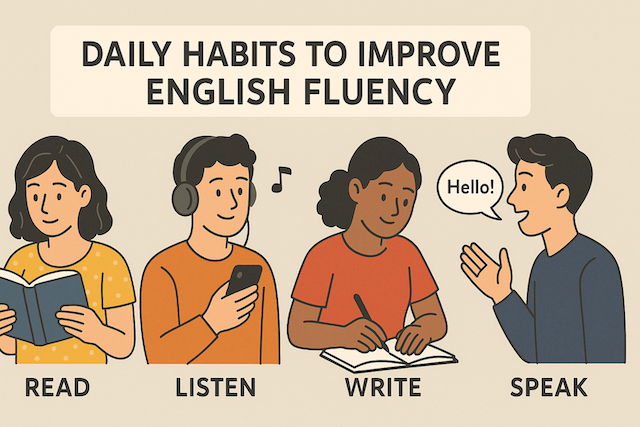
By reading, listening, speaking, writing, and thinking in English every day, your fluency will grow naturally — just as it did with your first language.
Fluency is not a destination. It’s a continuous journey of progress, confidence, and connection. Start small today, stay consistent, and your English will improve faster than you ever imagined.
FAQs
What daily habits help me improve English fluency the fastest?
Fluency grows from consistent, bite-sized exposure across four skills: listening, speaking, reading, and writing. Start your morning with English input (a short article, podcast, or video), speak out loud daily (shadowing or self-talk), read 15–30 minutes in topics you enjoy, and keep a short reflection journal at night. Build vocabulary in context (5–10 items/day) and recycle it in speech and writing. Keep your phone and apps in English to create ambient immersion that compounds over time.
How long should I practice each day to see results?
Quality beats quantity, but a realistic baseline is 30–60 minutes daily, split into micro-sessions. For example: 10 minutes listening + 10 minutes speaking (shadowing) + 10 minutes reading + 5 minutes journaling + 5 minutes vocabulary review. If you’re busy, protect a non-negotiable 20 minutes. The key is streaks—daily repetition wires automaticity. A consistent month of short, focused practice usually produces noticeable gains in flow, recall, and confidence.
What is the best way to learn vocabulary so it actually sticks?
Learn words in context, not isolation. Pair each new word with a collocation and a sentence that matters to you. For example, move from “confidence” to “speak with confidence.” Use spaced repetition flashcards, but also recycle words in a quick voice note or journal entry the same day you learn them. Track “active vocabulary” by listing words you used this week, not just words you studied. Retention follows meaningful use.
How do I practice speaking if I don’t have a partner?
Use three solo-friendly methods: (1) Self-talk—narrate tasks or plan your day aloud. (2) Shadowing—repeat a native clip line-by-line, matching rhythm and intonation. (3) Record & review—speak for one minute on a prompt, then re-record improving clarity, linking, and word choice. Combine with targeted feedback by comparing to transcripts or using pronunciation checkers. Solo speaking trains fluency, muscle memory, and confidence without scheduling.
What is shadowing and how do I do it effectively?
Shadowing is imitating a speaker in real time to internalize rhythm, stress, and connected speech. Choose a 30–90 second clip with subtitles, listen once for gist, then repeat sentence by sentence: first slowly (clear sounds), then at natural speed (flow), then without text (memory). Focus on stress patterns, reductions (gonna, wanna), and linking (gonna-need-it). Finish by recording yourself and comparing to the original to pinpoint one or two improvements.
How can I train myself to think in English instead of translating?
Start micro: label nearby objects in English, plan a task using simple phrases, or ask yourself small questions (“What’s next?”). Use monolingual learner’s dictionaries to avoid native-language crutches. Practice “English-only windows” (5–10 minutes with no translation). When you don’t know a word, paraphrase quickly rather than pausing to translate. Over time, these constraints force retrieval in English, accelerating automaticity and reducing hesitation.
What should I read daily to improve fluency?
Read material you want to return to: short news explainers, graded readers, blogs, or social posts with natural language. Aim for a 95–98% comprehension level—challenging but comfortable. Use an “eyes-on-meaning” approach: guess from context first, then check a learner’s dictionary. Capture at most 5–10 items per session and add a quick personal sentence for each. Reading builds grammar intuitively and seeds your active vocabulary for speaking.
How do I balance accuracy (grammar) with fluency (speed) every day?
Alternate modes: during input and free speaking, prioritize fluency—keep going even with imperfect grammar. During focused drills, slow down to repair one pattern (e.g., past tense or articles). A simple cycle works well: 1–2 minutes free talk → 30 seconds micro-fix on a recurring error → repeat. Accuracy improves fastest when it rides on plenty of fluent production rather than replacing it.
What’s a simple daily routine I can follow?
Try this 30–40 minute template:
- Morning (10 min): Short podcast + shadow 4–6 lines.
- Afternoon (10–15 min): Read an article; save 5 collocations.
- Evening (5–10 min): 1-minute speaking prompt → re-record.
- Night (5 min): Journal 5 lines using today’s collocations.
Lock this in for two weeks, then iterate: keep what you enjoy, replace what you skip, and add difficulty gradually.
How can I make listening practice more active and effective?
Use layered listening: (1) Gist pass without pausing; (2) Detail pass with pauses to note 3–5 key phrases; (3) Pronunciation pass for shadowing and noticing reductions; (4) Retell the clip in your own words. Choose varied accents and speeds, but stay within a zone where you can capture at least 70–80% meaning. Active listening turns input into output-ready language.
How many new words should I learn per day?
Five to ten high-utility items is ideal for long-term retention. Make each item a bundle: headword + collocation + personal sentence (e.g., “make steady progress… ‘I’m making steady progress with daily shadowing.’”). Review yesterday’s bundle before adding new ones, and “spend” the words in a voice note or chat message. Tracking usage—not just exposure—is what converts vocabulary into fluency.
How do I track progress so I stay motivated?
Measure behaviors you control: minutes practiced, days in a row, words used, not just words studied. Keep a weekly “wins” list (e.g., “ordered coffee smoothly,” “understood a fast video”). Every two weeks, record a 60-second monologue on the same prompt and compare: fewer pauses, clearer stress, richer vocabulary. Visible micro-improvements build momentum and make consistency emotionally rewarding.
What if I feel stuck or plateaued?
Plateaus are signals to change the stimulus, not to stop. Increase intensity (faster audio), change modality (from reading to listening), or switch topics you care about. Introduce a constraint (no filler words, or start every sentence with a connector). Add accountability: a weekly tutor or speaking buddy. Often, a small tweak—new accent source, tighter goal, or timed tasks—restarts adaptation and progress.
How important is pronunciation, and how can I improve it daily?
Pronunciation is crucial for intelligibility and confidence. Focus on three levers: (1) Stress & rhythm—mark stressed syllables and practice chunking. (2) Linking & reductions—notice how words connect in fast speech. (3) Problem sounds—target 1–2 sounds that cause confusion. Do 3–5 minutes of shadowing and minimal pairs daily. Record yourself; aim for clearer patterns, not a perfect accent.
Can apps and social media really help with fluency?
Yes—if used intentionally. Turn passive scrolling into micro-lessons: follow creators who speak clearly, switch your device to English, comment briefly on posts, and save useful phrases to a note. Pair apps (spaced repetition, pronunciation checkers, chat platforms) with real output tasks: weekly voice messages, short posts, or live language exchanges. Technology multiplies exposure; your consistent use turns that exposure into fluency.
How do I keep my routine sustainable long term?
Design for friction-free repetition: keep materials one tap away, practice at the same time daily, and anchor habits to existing cues (morning coffee → 8 lines of shadowing). Choose enjoyable content, celebrate small wins, and allow “minimum viable sessions” on busy days. Sustainability comes from routines that fit your life, not from occasional marathons. Momentum, not perfection, is what produces fluent speech.



