2025年12月29日
3D ACADEMY offers affordable English study programs in Cebu, Philippines – perfect for beginners, professionals, and exam takers.

3D UNIVERSAL ENGLISH INSTITUTE INC
info.3d-universal.com
8:00-17:00(Mon-Fri)
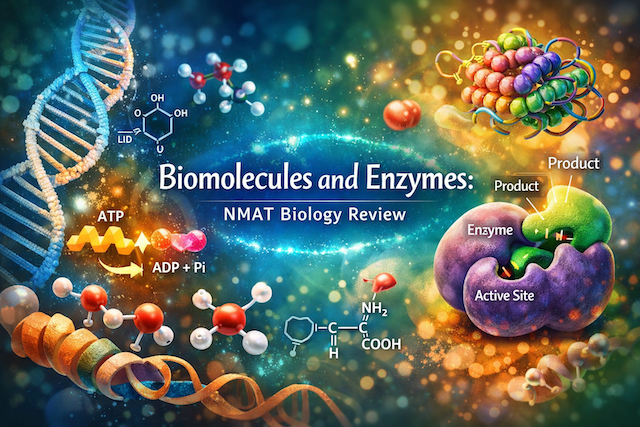
Biomolecules and Enzymes: NMAT Biology Review
Contents
- Biomolecules and Enzymes: NMAT Biology Review
- Introduction to Biomolecules
- Carbohydrates: Structure and Function
- Lipids: Energy Storage and Membrane Structure
- Proteins: Structure Determines Function
- Nucleic Acids: Genetic Information Storage
- Enzymes: Biological Catalysts
- Mechanism of Enzyme Action
- Factors Affecting Enzyme Activity
- Enzyme Kinetics and Michaelis-Menten Concept
- Cofactors and Coenzymes
- Isoenzymes and Zymogens
- Clinical and Practical Importance of Enzymes
- Integration of Biomolecules and Metabolism
- NMAT Exam Tips for Biomolecules and Enzymes
- Conclusion
- Problems Sets
- Biomolecules and Enzymes: NMAT Biology Review
- Section A: Biomolecules – Basic Concepts
- Section B: Proteins and Structure
- Section C: Enzymes and Catalysis
- Section D: Enzyme Inhibition and Kinetics
- Section E: Integrated NMAT-Style Questions
- Answer Keys
- Biomolecules and Enzymes: NMAT Biology Review
Biomolecules and Enzymes: NMAT Biology Review
Understanding biomolecules and enzymes is a core requirement for the NMAT Biology section. Questions from this topic frequently test both conceptual clarity and application-based understanding, such as identifying biomolecule functions, interpreting enzyme kinetics, and predicting the effects of environmental changes on enzyme activity. This review provides a comprehensive, NMAT-focused explanation of biomolecules and enzymes, covering structure, function, and exam-relevant concepts.
Introduction to Biomolecules
Biomolecules are organic molecules essential for life. They are primarily composed of carbon, hydrogen, oxygen, nitrogen, phosphorus, and sulfur. In living organisms, biomolecules are responsible for energy storage, structural support, metabolic reactions, and genetic information storage.
The four major classes of biomolecules are:
-
Carbohydrates
-
Lipids
-
Proteins
-
Nucleic acids
Each class has distinct structures and biological roles that frequently appear in NMAT questions.
Carbohydrates: Structure and Function
Carbohydrates are the primary source of immediate energy in living organisms. They consist of carbon, hydrogen, and oxygen, usually in a 1:2:1 ratio.
Classification of Carbohydrates
Carbohydrates are classified based on the number of sugar units they contain:
Monosaccharides
These are the simplest carbohydrates and cannot be hydrolyzed further. Examples include glucose, fructose, and galactose. Glucose is especially important as it is the primary energy source for cells.
Disaccharides
Formed by the condensation of two monosaccharides linked by a glycosidic bond. Examples include sucrose (glucose + fructose), lactose (glucose + galactose), and maltose (glucose + glucose).
Polysaccharides
These are complex carbohydrates made of many monosaccharide units. Important examples include:
-
Starch (plant energy storage)
-
Glycogen (animal energy storage)
-
Cellulose (structural component of plant cell walls)
-
Chitin (structural component in fungi and arthropods)
Biological Roles of Carbohydrates
-
Primary energy source
-
Energy storage
-
Structural support
-
Cell recognition and signaling (glycoproteins and glycolipids)
NMAT often tests differences between starch, glycogen, and cellulose based on structure and digestibility.
Lipids: Energy Storage and Membrane Structure
Lipids are hydrophobic biomolecules composed mainly of carbon and hydrogen. They are insoluble in water but soluble in organic solvents.
Types of Lipids
Triglycerides
Made of glycerol and three fatty acids. They serve as long-term energy storage molecules.
Phospholipids
Key components of cell membranes. They have a hydrophilic head and hydrophobic tails, forming a bilayer in aqueous environments.
Steroids
Lipids with four fused carbon rings. Examples include cholesterol, estrogen, and testosterone. Cholesterol is essential for membrane fluidity and hormone synthesis.
Waxes
Provide waterproofing in plants and animals.
Functions of Lipids
-
Long-term energy storage
-
Insulation and protection
-
Structural components of cell membranes
-
Hormone production
For NMAT, remember the difference between saturated and unsaturated fatty acids and their effects on membrane fluidity.
Proteins: Structure Determines Function
Proteins are polymers of amino acids linked by peptide bonds. They are the most diverse biomolecules, performing numerous biological functions.
Levels of Protein Structure
Primary Structure
The linear sequence of amino acids.
Secondary Structure
Local folding patterns such as alpha-helices and beta-pleated sheets, stabilized by hydrogen bonds.
Tertiary Structure
The overall three-dimensional shape of a single polypeptide chain.
Quaternary Structure
Formed when two or more polypeptide chains associate (e.g., hemoglobin).
Functions of Proteins
-
Enzymatic catalysis
-
Structural support (collagen, keratin)
-
Transport (hemoglobin)
-
Defense (antibodies)
-
Signaling (hormones and receptors)
-
Movement (actin and myosin)
Protein denaturation, caused by changes in pH or temperature, is a common NMAT concept.
Nucleic Acids: Genetic Information Storage
Nucleic acids store and transmit genetic information. They are composed of nucleotides, each consisting of a sugar, phosphate group, and nitrogenous base.
Types of Nucleic Acids
DNA (Deoxyribonucleic Acid)
Stores genetic information. It is double-stranded and follows complementary base pairing (A-T, G-C).
RNA (Ribonucleic Acid)
Involved in protein synthesis. Types include:
-
mRNA (messenger RNA)
-
tRNA (transfer RNA)
-
rRNA (ribosomal RNA)
NMAT often tests base pairing rules, differences between DNA and RNA, and the role of RNA in protein synthesis.
Enzymes: Biological Catalysts
Enzymes are proteins that speed up biochemical reactions without being consumed. They are highly specific and efficient.
Characteristics of Enzymes
-
Protein in nature (except ribozymes)
-
Highly specific to substrates
-
Reusable
-
Sensitive to temperature and pH
-
Lower activation energy
Enzymes do not change the overall free energy of reactions; they only accelerate reaction rates.
Mechanism of Enzyme Action
Enzymes interact with substrates at a specific region called the active site.
Models of Enzyme Action
Lock-and-Key Model
Assumes a rigid active site that perfectly fits the substrate.
Induced-Fit Model
Suggests that the enzyme undergoes a conformational change upon substrate binding, improving interaction.
The induced-fit model is more widely accepted and frequently tested in NMAT.
Factors Affecting Enzyme Activity
Temperature
Enzyme activity increases with temperature up to an optimum point. Beyond this, enzymes denature and lose function.
pH
Each enzyme has an optimal pH. For example:
-
Pepsin works best in acidic conditions
-
Trypsin functions optimally in alkaline conditions
Substrate Concentration
As substrate concentration increases, enzyme activity increases until all active sites are saturated, reaching maximum velocity (Vmax).
Enzyme Concentration
Higher enzyme concentration increases the rate of reaction if substrate is not limiting.
Inhibitors
Competitive Inhibitors
Compete with the substrate for the active site. Increasing substrate concentration can overcome inhibition.
Non-competitive Inhibitors
Bind to a site other than the active site, altering enzyme shape. Increasing substrate concentration does not reverse inhibition.
Inhibitor-related questions are common in NMAT.
Enzyme Kinetics and Michaelis-Menten Concept
Enzyme kinetics studies the rate of enzyme-catalyzed reactions.
Key Terms
Vmax
Maximum reaction rate when the enzyme is saturated.
Km (Michaelis constant)
Substrate concentration at which reaction rate is half of Vmax. A low Km indicates high affinity between enzyme and substrate.
Understanding the relationship between Km, Vmax, and inhibitors is crucial for NMAT problem-solving questions.
Cofactors and Coenzymes
Some enzymes require additional components to function properly.
Cofactors
Inorganic ions such as Mg²⁺, Zn²⁺, and Fe²⁺ that assist enzyme activity.
Coenzymes
Organic molecules, often derived from vitamins (e.g., NAD⁺, FAD, Coenzyme A).
NMAT may test vitamin deficiency effects through coenzyme malfunction.
Isoenzymes and Zymogens
Isoenzymes
Different forms of an enzyme that catalyze the same reaction but differ in structure and tissue distribution.
Zymogens (Proenzymes)
Inactive enzyme precursors that require activation (e.g., pepsinogen to pepsin).
These concepts are commonly tested in clinical and applied biology questions.
Clinical and Practical Importance of Enzymes
Enzymes have diagnostic and therapeutic applications:
-
Blood enzyme levels indicate tissue damage (e.g., ALT, AST)
-
Enzymes are used in industrial processes and biotechnology
-
Digestive enzymes aid nutrient absorption
NMAT may include applied questions linking enzymes to medical scenarios.
Integration of Biomolecules and Metabolism
Biomolecules are interconnected through metabolic pathways:
-
Carbohydrates and lipids provide energy
-
Proteins act as enzymes controlling metabolism
-
Nucleic acids regulate protein synthesis
Understanding these interactions helps in answering integrated NMAT questions.
NMAT Exam Tips for Biomolecules and Enzymes
-
Focus on structure-function relationships
-
Memorize key examples and definitions
-
Practice enzyme kinetics graphs
-
Understand effects of inhibitors and environmental factors
-
Relate biomolecules to physiological roles
Conclusion
Biomolecules and enzymes form the biochemical foundation of life and are a high-yield topic in NMAT Biology. A strong grasp of carbohydrate, lipid, protein, and nucleic acid structures, along with enzyme mechanisms and kinetics, will significantly improve performance in the exam. Conceptual clarity combined with consistent practice is the key to mastering this section.
Problems Sets
Biomolecules and Enzymes: NMAT Biology Review
Section A: Biomolecules – Basic Concepts
Q1. Which of the following carbohydrates is primarily structural in function?
A. Starch
B. Glycogen
C. Cellulose
D. Amylose
Q2. Sucrose is composed of which two monosaccharides?
A. Glucose and glucose
B. Glucose and fructose
C. Glucose and galactose
D. Fructose and fructose
Q3. Which lipid is mainly responsible for regulating cell membrane fluidity?
A. Triglycerides
B. Cholesterol
C. Waxes
D. Glycolipids
Q4. Unsaturated fatty acids differ from saturated fatty acids because they:
A. Have fewer carbon atoms
B. Contain double bonds
C. Are solid at room temperature
D. Are insoluble in organic solvents
Q5. Which biomolecule stores genetic information?
A. Protein
B. Lipid
C. Carbohydrate
D. Nucleic acid
Section B: Proteins and Structure
Q6. The primary structure of a protein refers to its:
A. Alpha-helix formation
B. Three-dimensional shape
C. Amino acid sequence
D. Quaternary association
Q7. Which level of protein structure is mainly stabilized by hydrogen bonds?
A. Primary
B. Secondary
C. Tertiary
D. Quaternary
Q8. Protein denaturation most directly affects:
A. Peptide bonds
B. Amino acid composition
C. Secondary and tertiary structure
D. Molecular weight
Q9. Which protein plays a direct role in immunity?
A. Hemoglobin
B. Insulin
C. Antibody
D. Actin
Q10. Which condition is most likely to cause enzyme denaturation?
A. Optimal pH
B. Low substrate concentration
C. Extreme temperature
D. Presence of cofactors
Section C: Enzymes and Catalysis
Q11. Enzymes speed up chemical reactions by:
A. Increasing free energy change
B. Increasing product concentration
C. Lowering activation energy
D. Raising equilibrium constant
Q12. The region of an enzyme that binds the substrate is called the:
A. Allosteric site
B. Active site
C. Cofactor site
D. Regulatory site
Q13. Which model of enzyme action involves a flexible active site?
A. Lock-and-key model
B. Induced-fit model
C. Template model
D. Collision model
Q14. Which factor does NOT typically affect enzyme activity?
A. Temperature
B. pH
C. Substrate concentration
D. Light intensity
Q15. An enzyme working at Vmax means that:
A. Substrate is limiting
B. Enzyme is inactive
C. All active sites are occupied
D. Reaction has stopped
Section D: Enzyme Inhibition and Kinetics
Q16. Competitive inhibitors reduce enzyme activity by:
A. Binding permanently to enzymes
B. Binding to allosteric sites
C. Competing with substrate for the active site
D. Destroying the enzyme
Q17. Which statement about non-competitive inhibition is TRUE?
A. Km increases
B. Vmax increases
C. Inhibition can be overcome by substrate
D. Enzyme structure is altered
Q18. A low Km value indicates:
A. Low substrate affinity
B. High substrate affinity
C. Low enzyme concentration
D. Slow reaction rate
Q19. Which molecule is an example of a coenzyme?
A. Mg²⁺
B. Fe²⁺
C. NAD⁺
D. Cl⁻
Q20. Pepsin functions optimally in which environment?
A. Neutral
B. Alkaline
C. Slightly alkaline
D. Acidic
Section E: Integrated NMAT-Style Questions
Q21. Which pairing is INCORRECT?
A. Glycogen – animal energy storage
B. Cellulose – plant cell wall
C. Triglyceride – membrane structure
D. DNA – genetic information
Q22. Enzyme denaturation primarily affects which property?
A. Molecular mass
B. Amino acid sequence
C. Shape of active site
D. Number of peptide bonds
Q23. Zymogens are important because they:
A. Increase reaction rate
B. Prevent self-digestion
C. Act as competitive inhibitors
D. Bind cofactors
Q24. Which biomolecule directly regulates metabolic pathways?
A. Lipids
B. Carbohydrates
C. Proteins
D. Nucleic acids
Q25. Increasing substrate concentration will NOT increase reaction rate when:
A. Temperature is optimal
B. pH is optimal
C. Enzyme is saturated
D. Enzyme concentration increases
Answer Keys
Biomolecules and Enzymes: NMAT Biology Review
Q1. C
→ Cellulose is a structural polysaccharide in plant cell walls.
Q2. B
→ Sucrose is composed of glucose and fructose.
Q3. B
→ Cholesterol regulates membrane fluidity.
Q4. B
→ Unsaturated fatty acids contain one or more double bonds.
Q5. D
→ DNA and RNA store genetic information.
Q6. C
→ Primary structure is the amino acid sequence.
Q7. B
→ Hydrogen bonds stabilize secondary structure.
Q8. C
→ Denaturation disrupts folding, not peptide bonds.
Q9. C
→ Antibodies function in immune defense.
Q10. C
→ Extreme temperature causes denaturation.
Q11. C
→ Enzymes lower activation energy.
Q12. B
→ Substrate binds at the active site.
Q13. B
→ Induced-fit model explains enzyme flexibility.
Q14. D
→ Light generally does not affect enzyme activity.
Q15. C
→ Vmax occurs when enzymes are saturated.
Q16. C
→ Competitive inhibitors compete for the active site.
Q17. D
→ Non-competitive inhibitors alter enzyme structure.
Q18. B
→ Low Km indicates high substrate affinity.
Q19. C
→ NAD⁺ is an organic coenzyme.
Q20. D
→ Pepsin works best in acidic conditions.
Q21. C
→ Triglycerides are for energy storage, not membranes.
Q22. C
→ Active site shape is affected by denaturation.
Q23. B
→ Zymogens prevent tissue damage.
Q24. C
→ Enzymes (proteins) regulate metabolism.
Q25. C
→ At saturation (Vmax), rate no longer increases.
NMAT Study Guide: Complete Preparation Guide for Medical School in the Philippines

How to Register for eTravel Philippines (2025 Guide)
Step-by-step guide to completing your eTravel registration before arriving in the Philippines, with images and tips.

Night Market in Cebu – Things You Don’t Know About Cebu Life
Discover the hidden charm of Cebu’s night markets, from street food stalls to local life tips you won’t find in tourist guides.

How to Use ChatGPT for IELTS Preparation: A Complete Guide
Learn how to prepare for IELTS using ChatGPT — including strategies for Writing, Reading, Listening, Speaking, and grammar support.

How to Build a Website Without Coding Using ChatGPT
Discover how to build your own website using AI—no coding skills needed. From structure planning to SEO and design, let ChatGPT guide you.