2025年12月29日
3D ACADEMY offers affordable English study programs in Cebu, Philippines – perfect for beginners, professionals, and exam takers.

3D UNIVERSAL ENGLISH INSTITUTE INC
info.3d-universal.com
8:00-17:00(Mon-Fri)
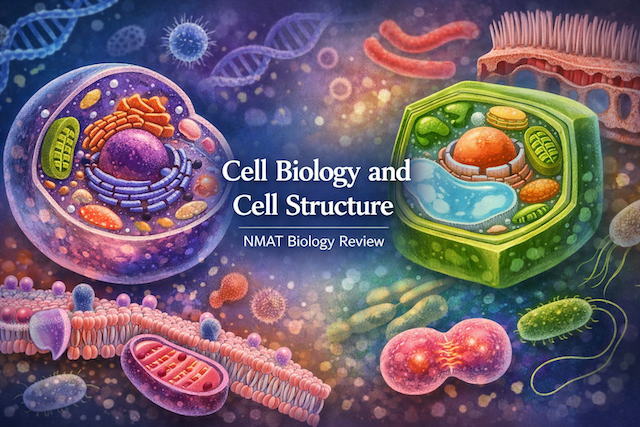
Cell Biology and Cell Structure: NMAT Biology Review
Contents
- Cell Biology and Cell Structure: NMAT Biology Review
- Introduction to Cell Biology
- Cell Theory and the Discovery of Cells
- Types of Cells: Prokaryotic and Eukaryotic Cells
- The Plasma Membrane: Structure and Function
- Cytoplasm and Cytoskeleton
- The Nucleus: Control Center of the Cell
- Ribosomes and Protein Synthesis
- Endoplasmic Reticulum: Rough and Smooth
- Golgi Apparatus: Protein Modification and Sorting
- Mitochondria: Powerhouse of the Cell
- Lysosomes and Peroxisomes
- Chloroplasts and Plant Cell Structures
- Cell Division and the Cell Cycle
- Importance of Cell Biology in NMAT
- Conclusion
- Cell Biology and Cell Structure
- NMAT Biology Review – Problem Sets with Answer Keys
- Problem Set 1: Basic Cell Concepts and Cell Theory
- Problem Set 2: Prokaryotic vs Eukaryotic Cells
- Problem Set 3: Plasma Membrane and Transport
- Problem Set 4: Cytoplasm, Cytoskeleton, and Organelles
- Problem Set 5: Endoplasmic Reticulum and Golgi Apparatus
- Problem Set 6: Mitochondria, Lysosomes, and Peroxisomes
- Answer Keys with Brief Explanations
Cell Biology and Cell Structure: NMAT Biology Review
Introduction to Cell Biology
Cell biology is a fundamental branch of biology that focuses on the study of cells—the basic structural, functional, and biological units of life. For the NMAT (National Medical Admission Test), a strong understanding of cell biology is essential because it forms the foundation for many advanced topics in medicine, including physiology, pathology, microbiology, and genetics. Questions related to cell structure, organelle function, membrane dynamics, and cellular processes frequently appear in the NMAT Biology section.
Cells vary widely in size, shape, and function, but all cells share certain characteristics that allow them to maintain life. By understanding how cells are organized and how their components work together, NMAT examinees can better grasp how tissues, organs, and entire organisms function.
This review provides a comprehensive explanation of cell biology and cell structure, with a focus on concepts commonly tested in the NMAT.
Cell Theory and the Discovery of Cells
The foundation of cell biology is built on the cell theory, which was developed in the 19th century through the work of scientists such as Matthias Schleiden, Theodor Schwann, and Rudolf Virchow. The modern cell theory consists of three main principles:
-
All living organisms are composed of one or more cells.
-
The cell is the basic unit of structure and function in living organisms.
-
All cells arise from pre-existing cells.
The discovery of cells began in 1665 when Robert Hooke observed cork under a microscope and described the small compartments as “cells.” Later, Antonie van Leeuwenhoek observed living cells, including bacteria and protozoa. These discoveries laid the groundwork for understanding life at the microscopic level.
For NMAT purposes, it is important to understand both the historical development of cell theory and its implications for modern biology and medicine.
Types of Cells: Prokaryotic and Eukaryotic Cells
Cells are broadly classified into two main types: prokaryotic cells and eukaryotic cells.
Prokaryotic Cells
Prokaryotic cells are simpler and smaller than eukaryotic cells. They lack a true nucleus and membrane-bound organelles. Bacteria and archaea are examples of prokaryotic organisms.
Key characteristics of prokaryotic cells include:
-
No nuclear membrane; genetic material is located in a nucleoid region
-
Absence of membrane-bound organelles such as mitochondria and endoplasmic reticulum
-
Presence of a cell wall (in most species)
-
Ribosomes are smaller (70S) compared to eukaryotic ribosomes
Prokaryotic cells are especially important in medical studies due to their role in infections and antibiotic targeting.
Eukaryotic Cells
Eukaryotic cells are more complex and are found in animals, plants, fungi, and protists. These cells contain a true nucleus enclosed by a nuclear membrane and various membrane-bound organelles.
Key features of eukaryotic cells include:
-
A nucleus that houses genetic material
-
Presence of membrane-bound organelles
-
Larger size and greater structural complexity
-
Ribosomes are larger (80S)
NMAT questions often compare and contrast prokaryotic and eukaryotic cells, making this distinction crucial.
The Plasma Membrane: Structure and Function
The plasma membrane, also known as the cell membrane, is a selectively permeable barrier that surrounds the cell. It plays a critical role in maintaining cellular integrity and regulating the movement of substances into and out of the cell.
Fluid Mosaic Model
The structure of the plasma membrane is best explained by the fluid mosaic model. According to this model:
-
The membrane is composed of a phospholipid bilayer
-
Hydrophilic (water-loving) heads face outward
-
Hydrophobic (water-repelling) tails face inward
-
Proteins are embedded within or attached to the bilayer
The “fluid” nature refers to the lateral movement of lipids and proteins, while the “mosaic” refers to the patchwork arrangement of proteins.
Functions of the Plasma Membrane
The plasma membrane serves several important functions:
-
Regulates transport of ions and molecules
-
Facilitates cell signaling through receptors
-
Maintains cell shape and structural support
-
Enables cell recognition and adhesion
Transport mechanisms such as diffusion, facilitated diffusion, active transport, endocytosis, and exocytosis are frequently tested topics in NMAT Biology.
Cytoplasm and Cytoskeleton
The cytoplasm is the region of the cell between the plasma membrane and the nucleus. It consists of cytosol, organelles, and cytoskeletal elements.
Cytosol
Cytosol is a semi-fluid matrix rich in enzymes, metabolites, and ions. Many metabolic pathways, such as glycolysis, occur in the cytosol.
Cytoskeleton
The cytoskeleton is a network of protein filaments that provides structural support and facilitates cellular movement and transport. It consists of three main components:
-
Microfilaments (actin filaments)
-
Intermediate filaments
-
Microtubules
These structures are involved in maintaining cell shape, intracellular transport, cell division, and motility.
The Nucleus: Control Center of the Cell
The nucleus is a membrane-bound organelle that contains the cell’s genetic material in the form of DNA. It is often referred to as the control center of the cell.
Structure of the Nucleus
The nucleus consists of:
-
Nuclear envelope: a double membrane with nuclear pores
-
Nucleoplasm: the internal fluid
-
Chromatin: DNA-protein complex
-
Nucleolus: site of ribosomal RNA synthesis
Nuclear pores regulate the exchange of materials between the nucleus and cytoplasm, including RNA and proteins.
Functions of the Nucleus
The nucleus plays a vital role in:
-
DNA replication
-
Transcription of RNA
-
Regulation of gene expression
-
Cell cycle control
Understanding nuclear structure and function is essential for topics such as genetics and cell division in the NMAT.
Ribosomes and Protein Synthesis
Ribosomes are non-membrane-bound organelles responsible for protein synthesis. They can be found freely in the cytoplasm or attached to the rough endoplasmic reticulum.
Ribosomes consist of two subunits made of ribosomal RNA (rRNA) and proteins. They translate messenger RNA (mRNA) into polypeptide chains during translation.
NMAT questions often test the difference between free ribosomes and bound ribosomes:
-
Free ribosomes synthesize proteins for use within the cell
-
Bound ribosomes synthesize proteins for secretion or membrane insertion
Endoplasmic Reticulum: Rough and Smooth
The endoplasmic reticulum (ER) is an extensive network of membranous tubules and sacs involved in protein and lipid synthesis.
Rough Endoplasmic Reticulum (RER)
The rough ER is studded with ribosomes and is involved in:
-
Synthesis of secretory and membrane proteins
-
Initial protein folding and modification
Proteins synthesized in the RER are transported to the Golgi apparatus for further processing.
Smooth Endoplasmic Reticulum (SER)
The smooth ER lacks ribosomes and has different functions, including:
-
Lipid and steroid synthesis
-
Detoxification of drugs and poisons
-
Calcium ion storage (especially in muscle cells)
Distinguishing between the functions of RER and SER is a common NMAT topic.
Golgi Apparatus: Protein Modification and Sorting
The Golgi apparatus is a stack of flattened membranous sacs responsible for modifying, sorting, and packaging proteins and lipids.
Proteins from the ER enter the Golgi at the cis face and exit at the trans face. During their passage, proteins undergo modifications such as glycosylation.
The Golgi apparatus ensures that proteins are delivered to the correct destination, including lysosomes, plasma membrane, or extracellular space.
Mitochondria: Powerhouse of the Cell
Mitochondria are double-membrane organelles responsible for producing ATP through cellular respiration.
Structure of Mitochondria
Mitochondria consist of:
-
Outer membrane
-
Inner membrane with folds called cristae
-
Intermembrane space
-
Matrix containing enzymes, mitochondrial DNA, and ribosomes
Functions of Mitochondria
Key functions include:
-
ATP production via oxidative phosphorylation
-
Regulation of apoptosis (programmed cell death)
-
Heat production in certain cells
Mitochondria have their own DNA, supporting the endosymbiotic theory, which suggests that mitochondria evolved from ancient prokaryotic organisms.
Lysosomes and Peroxisomes
Lysosomes
Lysosomes are membrane-bound organelles containing digestive enzymes. They are involved in:
-
Breakdown of macromolecules
-
Recycling of cellular components (autophagy)
-
Defense against pathogens
Defects in lysosomal enzymes can lead to storage diseases, a topic sometimes referenced in medical entrance exams.
Peroxisomes
Peroxisomes contain enzymes involved in oxidative reactions. Their functions include:
-
Breakdown of fatty acids
-
Detoxification of harmful substances
-
Metabolism of hydrogen peroxide
Chloroplasts and Plant Cell Structures
In plant cells, chloroplasts are the sites of photosynthesis. They contain chlorophyll, which captures light energy.
Chloroplasts have a double membrane and internal structures called thylakoids, which are arranged into stacks known as grana. The surrounding fluid is called the stroma.
Other plant-specific structures include:
-
Cell wall (made of cellulose)
-
Large central vacuole
-
Plasmodesmata for cell-to-cell communication
Comparing plant and animal cells is a frequent NMAT exam theme.
Cell Division and the Cell Cycle
Cells divide to grow, repair tissues, and reproduce. The cell cycle consists of interphase and the mitotic phase.
Interphase includes:
-
G1 phase (cell growth)
-
S phase (DNA synthesis)
-
G2 phase (preparation for division)
The mitotic phase includes mitosis and cytokinesis. Mitosis is divided into prophase, metaphase, anaphase, and telophase.
Understanding cell division is essential for topics such as cancer biology and genetics.
Importance of Cell Biology in NMAT
Cell biology forms the backbone of many NMAT Biology questions. A strong grasp of cell structure and function helps in understanding higher-level concepts such as physiology, pathology, immunology, and pharmacology.
NMAT questions often test:
-
Structure-function relationships
-
Comparative cell biology
-
Application of concepts rather than memorization
Mastering cell biology not only improves NMAT performance but also prepares students for the rigorous medical curriculum ahead.
Conclusion
Cell biology and cell structure are core topics in the NMAT Biology syllabus. From the plasma membrane to the nucleus and mitochondria, each cellular component plays a vital role in maintaining life. By understanding how cells are organized and how their organelles function together, NMAT examinees can build a solid foundation for medical studies.
Consistent review, concept-based learning, and practice with application-type questions will ensure success in this essential area of NMAT Biology.
Cell Biology and Cell Structure
NMAT Biology Review – Problem Sets with Answer Keys
Problem Set 1: Basic Cell Concepts and Cell Theory
Q1. Which statement is NOT part of the modern cell theory?
A. All living organisms are composed of cells
B. Cells arise only from pre-existing cells
C. All cells contain a nucleus
D. The cell is the basic unit of life
Q2. Who first observed and named “cells” after examining cork tissue?
A. Antonie van Leeuwenhoek
B. Robert Hooke
C. Louis Pasteur
D. Matthias Schleiden
Q3. Which principle best explains why cell division is essential for growth and repair?
A. Cells carry genetic material
B. Cells arise from pre-existing cells
C. Cells require energy
D. Cells contain enzymes
Q4. Which discovery most strongly supported the rejection of spontaneous generation?
A. Discovery of ribosomes
B. Electron microscopy
C. Pasteur’s swan-neck flask experiment
D. Identification of DNA
Q5. Which organism violates the classical definition of a cell?
A. Bacteria
B. Amoeba
C. Virus
D. Yeast
Problem Set 2: Prokaryotic vs Eukaryotic Cells
Q6. Which structure is found in prokaryotic cells but not in eukaryotic cells?
A. Nucleoid region
B. Ribosomes
C. Plasma membrane
D. Cytoplasm
Q7. Which feature is characteristic of eukaryotic cells?
A. Circular DNA
B. Absence of organelles
C. Membrane-bound nucleus
D. 70S ribosomes
Q8. A major difference between bacterial and human cells is that bacteria lack:
A. DNA
B. Cell membrane
C. Ribosomes
D. Mitochondria
Q9. Antibiotics often target bacterial ribosomes because:
A. Human ribosomes are inactive
B. Bacterial ribosomes differ structurally
C. Ribosomes exist only in bacteria
D. Human cells lack protein synthesis
Q10. Which statement correctly compares prokaryotic and eukaryotic cells?
A. Both contain mitochondria
B. Only eukaryotes contain DNA
C. Prokaryotes lack membrane-bound organelles
D. Prokaryotes are always multicellular
Problem Set 3: Plasma Membrane and Transport
Q11. The fluid mosaic model describes the plasma membrane as:
A. A rigid lipid sheet
B. A static protein barrier
C. A dynamic phospholipid bilayer with embedded proteins
D. A carbohydrate-based structure
Q12. Which membrane component primarily determines membrane fluidity?
A. Cholesterol
B. Proteins
C. Carbohydrates
D. Nucleic acids
Q13. Passive transport differs from active transport because passive transport:
A. Requires ATP
B. Moves substances against the gradient
C. Moves substances down their concentration gradient
D. Occurs only through protein pumps
Q14. Which process allows bulk transport of materials out of the cell?
A. Endocytosis
B. Osmosis
C. Diffusion
D. Exocytosis
Q15. Which molecule can pass directly through the phospholipid bilayer without a transport protein?
A. Glucose
B. Sodium ion
C. Oxygen
D. Amino acid
Problem Set 4: Cytoplasm, Cytoskeleton, and Organelles
Q16. Which cytoskeletal component is primarily responsible for cell movement?
A. Intermediate filaments
B. Microfilaments
C. Microtubules
D. Ribosomes
Q17. Glycolysis occurs mainly in the:
A. Mitochondria
B. Nucleus
C. Cytosol
D. Golgi apparatus
Q18. The nucleus is surrounded by:
A. A single membrane
B. A double membrane with pores
C. A protein shell
D. A lipid monolayer
Q19. The nucleolus is directly involved in:
A. DNA replication
B. Protein folding
C. Ribosome production
D. Lipid synthesis
Q20. Which structure controls the passage of RNA from nucleus to cytoplasm?
A. Nuclear envelope
B. Chromatin
C. Nuclear pores
D. Nucleolus
Problem Set 5: Endoplasmic Reticulum and Golgi Apparatus
Q21. Ribosomes attached to the rough ER synthesize proteins that are:
A. Used only in mitochondria
B. Secreted or inserted into membranes
C. Used only in the cytoplasm
D. Involved in DNA replication
Q22. Which function is associated with the smooth ER?
A. Protein synthesis
B. Lipid metabolism
C. Ribosome assembly
D. ATP production
Q23. Detoxification of drugs mainly occurs in the:
A. Rough ER
B. Golgi apparatus
C. Smooth ER
D. Lysosome
Q24. The Golgi apparatus primarily functions in:
A. DNA transcription
B. Protein modification and sorting
C. ATP synthesis
D. Lipid breakdown
Q25. Proteins enter the Golgi apparatus at the:
A. Trans face
B. Medial region
C. Cis face
D. Nuclear membrane
Problem Set 6: Mitochondria, Lysosomes, and Peroxisomes
Q26. The inner mitochondrial membrane is highly folded to:
A. Increase lipid synthesis
B. Reduce diffusion
C. Increase surface area for ATP production
D. Store calcium
Q27. Mitochondria contain their own DNA because of:
A. Random mutation
B. Nuclear duplication
C. Endosymbiotic origin
D. Ribosomal synthesis
Q28. Lysosomes are especially important for:
A. Protein synthesis
B. Intracellular digestion
C. Energy production
D. Photosynthesis
Q29. Which organelle breaks down hydrogen peroxide?
A. Lysosome
B. Golgi apparatus
C. Peroxisome
D. Mitochondrion
Q30. A defect in lysosomal enzymes would most directly affect:
A. Cell respiration
B. Waste removal
C. DNA replication
D. Cell signaling
Answer Keys with Brief Explanations
1. C – Not all cells have nuclei (prokaryotes lack nuclei)
2. B – Robert Hooke coined the term “cell”
3. B – Cells arise from pre-existing cells
4. C – Pasteur disproved spontaneous generation
5. C – Viruses are acellular
6. A – Nucleoid is unique to prokaryotes
7. C – True nucleus defines eukaryotes
8. D – Prokaryotes lack mitochondria
9. B – Structural differences allow selective targeting
10. C – Key defining difference
11. C – Dynamic lipid-protein structure
12. A – Cholesterol modulates fluidity
13. C – Passive transport follows gradient
14. D – Exocytosis exports materials
15. C – Small nonpolar molecules diffuse freely
16. B – Actin microfilaments drive movement
17. C – Glycolysis occurs in cytosol
18. B – Nuclear envelope has two membranes
19. C – Nucleolus assembles ribosomes
20. C – Nuclear pores regulate transport
21. B – RER proteins are secretory/membrane-bound
22. B – SER synthesizes lipids
23. C – Detoxification role of SER
24. B – Golgi modifies and sorts proteins
25. C – Entry occurs at cis face
26. C – Cristae increase ATP efficiency
27. C – Endosymbiotic theory
28. B – Lysosomes digest cellular waste
29. C – Peroxisomes detoxify hydrogen peroxide
30. B – Lysosomal defects impair waste breakdown
NMAT Study Guide: Complete Preparation Guide for Medical School in the Philippines

How to Register for eTravel Philippines (2025 Guide)
Step-by-step guide to completing your eTravel registration before arriving in the Philippines, with images and tips.

Night Market in Cebu – Things You Don’t Know About Cebu Life
Discover the hidden charm of Cebu’s night markets, from street food stalls to local life tips you won’t find in tourist guides.

How to Use ChatGPT for IELTS Preparation: A Complete Guide
Learn how to prepare for IELTS using ChatGPT — including strategies for Writing, Reading, Listening, Speaking, and grammar support.

How to Build a Website Without Coding Using ChatGPT
Discover how to build your own website using AI—no coding skills needed. From structure planning to SEO and design, let ChatGPT guide you.