2026年4月5日
3D ACADEMY offers affordable English study programs in Cebu, Philippines – perfect for beginners, professionals, and exam takers.

3D UNIVERSAL ENGLISH INSTITUTE INC
info.3d-universal.com
8:00-17:00(Mon-Fri)
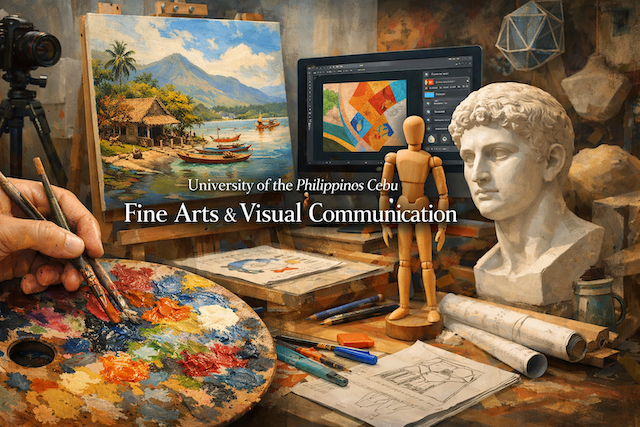
University of the Philippines Cebu (UP Cebu) – Fine Arts and Visual Communication
Contents
- University of the Philippines Cebu (UP Cebu) – Fine Arts and Visual Communication
- Overview of UP Cebu and Its Creative Education Tradition
- Fine Arts and Visual Communication at UP Cebu: Program Structure
- Core Areas of Study in Fine Arts
- Visual Communication Specialization Explained
- Curriculum Philosophy and Academic Rigor
- Studio-Based Learning and Critique Culture
- Facilities and Creative Spaces at UP Cebu
- Faculty and Mentorship
- Admission Process and Talent Screening
- Student Life and Creative Community
- Career Paths for Graduates
- Strengths of Studying Fine Arts at UP Cebu
- Challenges and Expectations
- Why Choose UP Cebu for Fine Arts and Visual Communication
- Conclusion
- FAQs (Frequently Asked Questions)
- What is UP Cebu’s Fine Arts and Visual Communication program about?
- How is Visual Communication different from a general Fine Arts track?
- What kinds of skills will students build in this program?
- Is the program more theory-based or more hands-on?
- What is the critique culture like, and why is it important?
- How competitive is admission to UP Cebu for this field?
- What should be included in a portfolio if one is required?
- Do students need to be good at drawing before entering the program?
- What kinds of careers can graduates pursue after UP Cebu?
- How can students maximize their experience while studying at UP Cebu?
University of the Philippines Cebu (UP Cebu) – Fine Arts and Visual Communication
Overview of UP Cebu and Its Creative Education Tradition
The University of the Philippines Cebu (UP Cebu) is one of the constituent units of the University of the Philippines System, the country’s premier public university network. Known for its strong academic foundation, critical thinking culture, and commitment to public service, UP Cebu has steadily built a reputation not only in the sciences and social sciences, but also in creative and design-oriented disciplines.
Within this context, UP Cebu’s Fine Arts and Visual Communication programs stand out as academically rigorous, concept-driven, and socially grounded. These programs are designed for students who want more than technical training—students who aim to understand art, design, and visual media as tools for communication, cultural expression, and social engagement.
Located in Lahug, Cebu City, UP Cebu offers a learning environment that blends urban creative energy with the university’s long-standing tradition of intellectual depth and national relevance.
Fine Arts and Visual Communication at UP Cebu: Program Structure
UP Cebu offers creative programs under the Bachelor of Fine Arts (BFA) framework, with Visual Communication as a core specialization. The curriculum is structured to balance theory, studio practice, research, and community-oriented projects.
Rather than focusing solely on commercial outcomes, the program emphasizes conceptual development, design thinking, cultural analysis, and ethical practice. Students are trained to become reflective artists and designers who can engage critically with society through visual media.
The program typically progresses from foundational art skills to advanced, discipline-specific studio courses, culminating in a thesis or capstone project.
Core Areas of Study in Fine Arts
The Fine Arts component of the program builds a strong artistic foundation. Students are trained in traditional and contemporary art practices, ensuring they develop both technical proficiency and conceptual clarity.
Key areas include drawing, painting, sculpture, and mixed media. These courses focus on form, composition, color theory, material exploration, and visual analysis. Students are encouraged to experiment with different media while grounding their work in art history and theory.
Fine Arts courses also emphasize critique sessions, where students learn to articulate ideas, defend creative decisions, and respond constructively to feedback—an essential skill for professional artists and designers.
Visual Communication Specialization Explained
Visual Communication at UP Cebu is a design-focused specialization that explores how images, typography, layout, and multimedia convey meaning. The program goes beyond surface-level aesthetics and trains students to think strategically about communication goals, audiences, and cultural context.
Students study graphic design, information design, branding, illustration, photography, and basic motion graphics. Visual storytelling, semiotics, and user-centered design principles are integrated into studio projects.
Unlike purely software-driven programs, UP Cebu’s Visual Communication track prioritizes idea development, research, and critical thinking before execution. Digital tools are treated as instruments—not substitutes—for conceptual clarity.
Curriculum Philosophy and Academic Rigor
UP Cebu’s Fine Arts and Visual Communication programs are known for their academic depth. Courses are structured to challenge students intellectually as well as creatively. Readings in art theory, design criticism, Philippine art history, and cultural studies are integral parts of the curriculum.
Students are expected to contextualize their work within social, political, and historical frameworks. This approach produces graduates who are not only visually skilled but also capable of meaningful discourse about their work and its impact.
Because of this rigor, the program is demanding. Time management, self-discipline, and resilience are essential qualities for success.
Studio-Based Learning and Critique Culture
A defining feature of the program is its studio-based learning model. Most major courses revolve around hands-on projects that simulate real-world creative processes while maintaining academic depth.
Students spend significant time developing concepts, creating drafts, refining outputs, and presenting their work for critique. Faculty members and peers actively participate in discussions, offering analytical and constructive feedback.
This critique culture helps students sharpen their visual judgment, communication skills, and confidence—qualities essential for careers in art, design, and creative leadership.
Facilities and Creative Spaces at UP Cebu
UP Cebu provides functional studio spaces, classrooms, and shared facilities for Fine Arts and Visual Communication students. These include drawing and painting studios, digital labs, and multipurpose spaces for exhibitions and presentations.
While facilities may be more modest compared to private design schools, the strength of UP Cebu lies in its academic mentorship, collaborative environment, and access to interdisciplinary resources across the UP System.
Students are encouraged to maximize available resources, collaborate across disciplines, and seek external opportunities such as exhibitions, internships, and creative residencies.
Faculty and Mentorship
The faculty members handling Fine Arts and Visual Communication at UP Cebu are practicing artists, designers, and scholars. Many are actively involved in exhibitions, research, cultural work, and creative advocacy within and beyond Cebu.
This dual role as educators and practitioners allows faculty to provide mentorship that is both theoretically grounded and practically relevant. Students benefit from instructors who challenge them to refine their ideas, question assumptions, and develop a strong personal voice.
Mentorship at UP Cebu often extends beyond the classroom, with faculty guiding students through thesis development, portfolio preparation, and career direction.
Admission Process and Talent Screening
Admission to UP Cebu is highly competitive. Students must first qualify through the University of the Philippines College Admission Test (UPCAT), which assesses academic readiness across multiple disciplines.
For Fine Arts and Visual Communication, additional talent screening or portfolio evaluation may be required. This ensures that admitted students possess not only academic capability but also creative potential and commitment.
Aspiring applicants are encouraged to prepare a strong portfolio that demonstrates originality, technical skill, and conceptual thinking rather than polished commercial work alone.
Student Life and Creative Community
Fine Arts and Visual Communication students at UP Cebu are part of an intellectually vibrant and socially engaged campus community. Student organizations, art collectives, and cultural groups provide platforms for collaboration, exhibitions, and advocacy.
Cebu City’s growing creative scene also plays a role in student life. Galleries, design studios, cultural events, and independent art spaces offer opportunities for exposure and networking.
UP Cebu students are often involved in socially responsive projects, using art and design to address community issues, cultural preservation, and public awareness campaigns.
Career Paths for Graduates
Graduates of UP Cebu’s Fine Arts and Visual Communication programs pursue diverse career paths. Many enter creative industries such as graphic design, branding, advertising, illustration, photography, and multimedia production.
Others work in cultural institutions, museums, NGOs, and government agencies, applying visual communication skills to education, advocacy, and public information. Some graduates become independent artists, exhibiting locally and internationally.
Because of the program’s strong conceptual and analytical focus, graduates are also well-prepared for graduate studies, research, teaching, and interdisciplinary careers that combine art, design, and social sciences.
Strengths of Studying Fine Arts at UP Cebu
One of the key strengths of UP Cebu is its emphasis on critical thinking and social relevance. Students are trained to see art and design not merely as commercial tools but as forms of inquiry and cultural expression.
The prestige of the University of the Philippines name also carries significant weight, both locally and internationally. UP graduates are widely recognized for their intellectual discipline, adaptability, and leadership potential.
Additionally, as a public university, UP Cebu offers comparatively affordable tuition, making high-quality creative education accessible to a broader range of students.
Challenges and Expectations
The program is not without challenges. The academic workload is heavy, and expectations are high. Students must balance studio production with readings, research papers, and theoretical discussions.
Facilities and resources may require students to be resourceful and proactive, especially when compared to private institutions with more advanced equipment. However, many students view this as an opportunity to develop independence and creative problem-solving skills.
Success in the program requires passion, perseverance, and a willingness to engage deeply with both art and ideas.
Why Choose UP Cebu for Fine Arts and Visual Communication
UP Cebu is an ideal choice for students who want a serious, intellectually grounded approach to art and design. It is particularly suited for those who value conceptual depth, cultural awareness, and social responsibility alongside technical skill.
Rather than producing trend-driven designers, UP Cebu aims to develop thoughtful creatives who can contribute meaningfully to society, culture, and discourse.
For students seeking a Fine Arts and Visual Communication education that challenges the mind as much as the eye, UP Cebu remains one of the most respected options in the Philippines.
Conclusion
The University of the Philippines Cebu offers a Fine Arts and Visual Communication program rooted in academic excellence, creative rigor, and social relevance. Through a balance of studio practice, theory, and critical engagement, students are prepared to become artists and designers who think deeply and act responsibly.
For aspiring creatives who want their work to matter beyond aesthetics, UP Cebu provides an environment where art and communication are treated as powerful tools for understanding and shaping the world.
FAQs (Frequently Asked Questions)
What is UP Cebu’s Fine Arts and Visual Communication program about?
UP Cebu’s Fine Arts and Visual Communication offering is designed for students who want to develop strong creative skills while also learning how visual work communicates ideas in cultural, social, and professional contexts. It blends studio-based training with academic study, so you are expected to create artworks and design outputs, reflect on them critically, and explain the thinking behind your choices. The program typically covers foundations such as drawing and design principles, then moves into more specialized areas like graphic design, illustration, photography, and other visual media. It is suited for students who want more than software training and who are interested in concept development, research, and critique.
How is Visual Communication different from a general Fine Arts track?
Fine Arts tends to focus more on personal expression, artistic exploration, and the development of works such as drawings, paintings, sculptures, or mixed media pieces. Visual Communication, on the other hand, is centered on intentional messaging—how visuals guide understanding for specific audiences. While both areas require creativity and technique, Visual Communication often involves projects such as posters, brand identities, publications, information graphics, or campaigns. At UP Cebu, the approach commonly emphasizes concept and context first, then execution. You learn not only how to make something look good, but how to make it meaningful and effective.
What kinds of skills will students build in this program?
Students typically build a combination of creative, technical, and analytical skills. On the creative side, you develop composition, color sense, typography awareness, and visual storytelling. On the technical side, you strengthen drawing fundamentals and learn production workflows for print and digital outputs. On the analytical side, you practice research, concept writing, and critique participation. These skills matter because the program expects you to justify design decisions, respond to feedback, and improve your work through iteration. Over time, students also gain portfolio-building skills, presentation confidence, and professional habits such as meeting deadlines and managing multiple projects.
Is the program more theory-based or more hands-on?
It is both, but many students experience it as heavily hands-on because studio courses require consistent output. At the same time, UP Cebu’s academic culture includes reading, writing, and critical discussion, especially in courses connected to art history, design theory, and cultural studies. A typical term can involve producing major design plates or artworks while also completing research-based tasks. This mix is intentional: you learn to create with purpose and to place your work within broader contexts. If you are looking for a purely vocational course focused only on software, the workload and structure may feel different from what you expect.
What is the critique culture like, and why is it important?
Critique is a structured discussion where students present works-in-progress or finished outputs, then receive feedback from instructors and classmates. This is common in art and design education, and it can feel intense at first. However, critique is one of the fastest ways to grow creatively because it trains you to see what works, what does not, and why. You also learn how to explain your concept, defend decisions, and accept corrections without taking them personally. In professional creative work, you will often present ideas to clients or teams, so critique culture prepares you for real-world collaboration and revision cycles.
How competitive is admission to UP Cebu for this field?
UP Cebu is generally competitive because entry to the University of the Philippines system requires strong academic qualification. Applicants typically need to pass the UP College Admission Test (UPCAT) or the relevant admissions process in place at the time of application. For art- and design-related tracks, there may also be additional screening such as a portfolio review, interview, or talent evaluation depending on current department policies. Because requirements can change, applicants should check UP Cebu’s official announcements for the most accurate steps, deadlines, and materials to prepare.
What should be included in a portfolio if one is required?
If a portfolio is requested, prioritize work that shows fundamentals and thinking rather than only finished, polished pieces. Include drawings from observation, studies of form and light, design explorations, and a few works that reflect personal ideas. If you have graphic design or layout samples, add them, but make sure they demonstrate clarity and intention. It helps to show process: sketches, drafts, and iterations can prove how you develop a concept. Avoid copying popular styles without originality. A smaller set of strong works is usually better than many weak ones. Present your portfolio neatly, with short captions explaining the goal of each piece.
Do students need to be good at drawing before entering the program?
Strong drawing ability is helpful, especially for early foundation courses, but many students improve rapidly once they begin formal training. What matters most is willingness to practice consistently. Drawing is not only about realism; it trains observation, composition, and visual problem-solving—skills that support both Fine Arts and Visual Communication. If you feel behind, you can prepare by practicing basic forms, perspective, gesture drawing, and simple still-life studies before the semester starts. The program will expect effort and growth, so discipline and curiosity can be as important as natural talent.
What kinds of careers can graduates pursue after UP Cebu?
Graduates may pursue roles in graphic design, branding, advertising, illustration, photography, publication design, and creative content production. Some work in cultural institutions, education, NGOs, or public communication roles where visual materials support advocacy and information campaigns. Others build independent paths as artists, freelancers, or creative entrepreneurs. Because UP Cebu emphasizes analysis and context, graduates can also be well-positioned for graduate studies, research, teaching, or interdisciplinary work combining design with social development, community projects, or media production.
How can students maximize their experience while studying at UP Cebu?
Students can maximize their learning by treating each project as portfolio material and by documenting process carefully. Join critiques actively, ask for feedback early, and revise work multiple times rather than rushing at the deadline. Build relationships with mentors and classmates, since collaboration is a major part of the creative industry. Also explore Cebu’s creative community by attending exhibitions, talks, and events when possible. Finally, develop a routine for skill-building outside class—practice drawing, study typography, analyze design systems, and learn how to present your work clearly. Consistent practice is often what separates a good portfolio from a great one.
Cebu Universities: Arts and Design – Schools Offering Fine Arts, Fashion, and Multimedia Design

How to Register for eTravel Philippines (2025 Guide)
Step-by-step guide to completing your eTravel registration before arriving in the Philippines, with images and tips.

Night Market in Cebu – Things You Don’t Know About Cebu Life
Discover the hidden charm of Cebu’s night markets, from street food stalls to local life tips you won’t find in tourist guides.

How to Use ChatGPT for IELTS Preparation: A Complete Guide
Learn how to prepare for IELTS using ChatGPT — including strategies for Writing, Reading, Listening, Speaking, and grammar support.

How to Build a Website Without Coding Using ChatGPT
Discover how to build your own website using AI—no coding skills needed. From structure planning to SEO and design, let ChatGPT guide you.