2026年1月10日
3D ACADEMY offers affordable English study programs in Cebu, Philippines – perfect for beginners, professionals, and exam takers.

3D UNIVERSAL ENGLISH INSTITUTE INC
info.3d-universal.com
8:00-17:00(Mon-Fri)
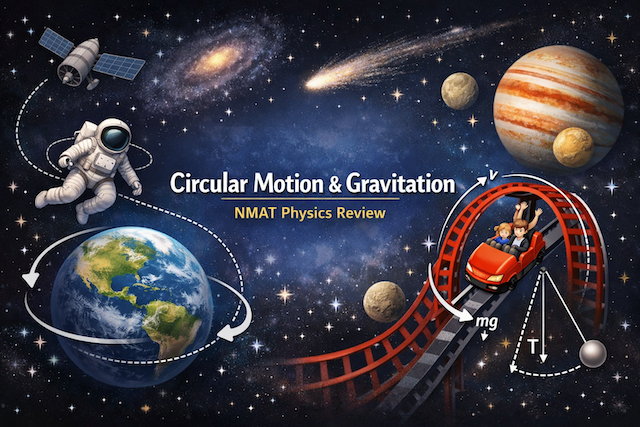
Circular Motion and Gravitation: NMAT Physics Review
Contents
- Circular Motion and Gravitation: NMAT Physics Review
- Why This Topic Matters for the NMAT
- Key Concepts You Must Know
- Uniform Circular Motion: The Geometry of Turning
- Angular Variables and Their Relationships
- Period, Frequency, and Speed in a Circle
- Centripetal Force: Net Inward Force, Not a Separate Force
- Common NMAT Circular Motion Scenarios
- 1) Object on a String (Horizontal Circle)
- 2) Car Turning on a Flat Road
- 3) Banked Curves
- 4) Vertical Circular Motion (Roller Coasters, Loops)
- Newton’s Universal Law of Gravitation
- Gravitational Field and Weight
- Orbits: Gravity as the Centripetal Force
- Escape Speed
- Gravitational Potential Energy and Total Energy
- Free-Fall, Satellites, and “Weightlessness”
- How to Solve NMAT Problems Faster
- Common Mistakes to Avoid
- Quick NMAT Formula List
- Final Takeaways
- Problem Sets with Answer Keys: Circular Motion and Gravitation (NMAT Physics)
- Problem Set 1: Core Circular Motion Skills
- Problems
- Answer Key
- Problem Set 2: Vertical Circular Motion
- Problems
- Answer Key
- Problem Set 3: Gravitation Fundamentals
- Problems
- Answer Key
- Problem Set 4: Orbital Motion and Energy
- Problems
- Answer Key
- Problem Set 5: Mixed NMAT-Style Applications
- Problems
- Answer Key
Circular Motion and Gravitation: NMAT Physics Review
Why This Topic Matters for the NMAT
Circular motion and gravitation show up frequently on the NMAT because they combine core ideas from Newton’s laws, forces, energy, and kinematics into highly testable situations. Questions often look simple—an object moving in a circle, a satellite orbiting Earth, or a planet attracting a moon—but they reward clear thinking about what forces act, which direction they point, and what quantities stay constant. If you can confidently draw force diagrams and connect them to acceleration and motion, you will handle most NMAT-level problems in this area.
Key Concepts You Must Know
- Uniform circular motion: motion at constant speed along a circular path, but with acceleration toward the center.
- Centripetal acceleration: the acceleration needed to keep an object moving in a circle, always directed inward.
- Centripetal force: not a new kind of force; it is the net inward force causing centripetal acceleration.
- Newton’s law of gravitation: every mass attracts every other mass; gravitational force depends on masses and distance.
- Orbital motion: a gravitationally bound system in which gravity supplies the needed centripetal force.
- Energy and potential: gravitational potential energy differs from near-Earth approximations; orbit energy links to radius.
Uniform Circular Motion: The Geometry of Turning
Even if the speed of an object is constant, its velocity is changing because velocity includes direction. In uniform circular motion, the direction changes continuously, so there must be an acceleration. This acceleration points toward the center of the circular path and is called centripetal acceleration.
A key relationship for centripetal acceleration is:
- ac = v2 / r
Where v is tangential speed and r is radius of the circle. This formula is one of the most important in NMAT physics for circular motion.
Angular Variables and Their Relationships
Circular motion can be described using angular measures:
- Angular displacement (θ) in radians
- Angular velocity (ω) in rad/s
- Angular acceleration (α) in rad/s²
Radian measure is crucial because it directly links angle to arc length:
- s = rθ
Key relationships:
- v = rω
- at = rα (tangential acceleration, if speed changes)
- ac = rω2 (another form of centripetal acceleration)
Uniform circular motion means ω is constant and α = 0, but ac is still not zero because direction changes.
Period, Frequency, and Speed in a Circle
Two common ways to describe circular motion timing are:
- Period (T): time for one full revolution (seconds per revolution)
- Frequency (f): number of revolutions per second (Hz)
They are related by:
- f = 1 / T
Tangential speed can be written using T:
- v = 2πr / T
And angular velocity:
- ω = 2π / T = 2πf
On the NMAT, problems often give either rpm (revolutions per minute) or frequency and require you to convert to ω or v. Remember: convert minutes to seconds when needed.
Centripetal Force: Net Inward Force, Not a Separate Force
The inward acceleration requires a net inward force:
- Fc = mac = mv2/r = mrω2
The most important NMAT mindset: centripetal force is the net radial force. The actual forces could be tension, friction, normal force components, gravity, or combinations. You must identify which real forces point toward (or away from) the center and take their net.
Common NMAT Circular Motion Scenarios
1) Object on a String (Horizontal Circle)
If a mass moves in a circle on a string in a horizontal plane, the tension typically provides the inward force:
- T = mv2/r (if tension is the only radial force)
If the string is angled (conical pendulum), tension has both vertical and horizontal components. Vertical component balances weight; horizontal component supplies centripetal force. Many NMAT questions test this vector decomposition idea.
2) Car Turning on a Flat Road
For a car turning on a flat road, static friction provides the centripetal force:
- Ffric ≤ μsN
- mv2/r ≤ μsmg
This leads to a maximum safe speed:
- vmax = √(μsgr)
Notice mass cancels. This is a classic NMAT insight: heavier cars do not automatically have a higher turning speed limit on the same road if μs is the same.
3) Banked Curves
Banking tilts the normal force so that part of it points inward. If designed for a “no-friction” speed, the centripetal force comes from the horizontal component of the normal force. NMAT questions may ask which direction friction acts if the car goes too fast or too slow.
General idea:
- Too fast: car tends to slide outward/up the bank; friction acts down the slope.
- Too slow: car tends to slide inward/down the bank; friction acts up the slope.
4) Vertical Circular Motion (Roller Coasters, Loops)
In vertical circles, speed often changes due to gravity, so energy conservation may be used. The radial direction changes around the loop, so the force equation must be written carefully at different points.
At the top of the loop, centripetal acceleration is downward (toward the center). If the object is inside a track, both gravity and normal force may point toward the center (downward). The radial equation at the top commonly becomes:
- mg + N = mv2/r
At the bottom, centripetal acceleration is upward, so the net upward force equals mv²/r:
- N – mg = mv2/r
A classic NMAT condition for “just maintaining contact” at the top is N = 0:
- mg = mv2/r ⇒ v = √(gr)
This helps you see why loops require sufficient speed at the top.
Newton’s Universal Law of Gravitation
Gravitation describes an attractive force between two masses:
- F = G(m1m2)/r2
Where G is the universal gravitational constant and r is the distance between the centers of the two masses. The force is always attractive and acts along the line joining their centers.
NMAT problems commonly test proportional reasoning:
- If distance doubles, force becomes one-fourth.
- If one mass triples, force triples.
- If both masses double, force becomes four times.
Gravitational Field and Weight
A gravitational field describes force per unit mass:
- g = F/m = GM/r2
Near Earth’s surface, we often approximate g as constant (~9.8 m/s²), but at higher altitudes g decreases with r². On the NMAT, you may be asked how weight changes as you move away from Earth:
- Weight W = mg = (GMm)/r2
So weight decreases with altitude, but it never becomes exactly zero unless extremely far away (in the idealized model).
Orbits: Gravity as the Centripetal Force
For a satellite in a circular orbit around a planet, gravitational force provides the centripetal force:
- GMm/r2 = mv2/r
Cancel m and solve for orbital speed:
- v = √(GM/r)
This formula is extremely useful: the orbital speed depends on the central mass M and orbital radius r, not on the satellite mass.
You can also find the orbital period by combining v = 2πr/T:
- T = 2π √(r3/GM)
This tells you that as orbital radius increases, period increases strongly (with r3/2). This is consistent with Kepler’s third law for circular orbits.
Escape Speed
Escape speed is the minimum speed needed to escape a planet’s gravitational pull without further propulsion (ignoring air resistance). It comes from energy considerations:
- vesc = √(2GM/r)
It is related to orbital speed:
- vesc = √2 × vorb
NMAT questions may test conceptual understanding: escape speed depends on the planet’s mass and the starting distance from its center, not on the spacecraft mass.
Gravitational Potential Energy and Total Energy
Near Earth, we use U = mgh as an approximation for small height changes. In universal gravitation, potential energy relative to infinity is:
- U = -GMm/r
The negative sign is important: the system is bound, and you must add energy to separate the masses to infinity. For circular orbits:
- K = (1/2)mv2 = (1/2)GMm/r
- U = -GMm/r
- Total Energy E = K + U = – (1/2)GMm/r
So the total energy of a circular orbit is negative. A more negative energy means a more tightly bound orbit (smaller r).
Free-Fall, Satellites, and “Weightlessness”
Astronauts in orbit feel “weightless” not because gravity is zero, but because they are in continuous free-fall around Earth. In a spacecraft, both the astronaut and the craft accelerate toward Earth at the same rate, so there is no normal force pressing them against a surface. On the NMAT, remember:
- Weightlessness means apparent weight (normal force) is near zero.
- Gravity is still acting and provides centripetal acceleration for the orbit.
How to Solve NMAT Problems Faster
- Start with a diagram: draw the circle, label the center, and mark inward radial direction.
- Draw forces: identify real forces (tension, friction, normal, weight). Then decide which ones contribute inward.
- Use the correct acceleration: for uniform circular motion, a = v²/r inward. For vertical loops, speed may change, so use energy plus radial force equations at specific points.
- Watch units: rpm to rad/s, km to m, minutes to seconds.
- Look for cancellations: in orbit, satellite mass cancels; in flat turning, car mass cancels.
- Check direction carefully: “toward center” changes around the path in vertical motion.
Common Mistakes to Avoid
- Thinking centripetal force is a separate force: it is the net radial force.
- Using mgh for large altitude changes: use U = -GMm/r when dealing with orbital distances.
- Mixing up speed and velocity: speed can be constant while velocity changes.
- Forgetting that acceleration exists in uniform circular motion: direction change implies acceleration.
- Sign errors in vertical circles: always define inward direction at the point you are analyzing.
Quick NMAT Formula List
- ac = v2/r = rω2
- Fc = mv2/r = mrω2
- v = rω
- ω = 2π/T = 2πf
- v = 2πr/T
- F = Gm1m2/r2
- g = GM/r2
- vorb = √(GM/r)
- T = 2π √(r3/GM)
- vesc = √(2GM/r)
- U = -GMm/r
- Eorbit = – (1/2)GMm/r
Final Takeaways
To master circular motion and gravitation for the NMAT, focus on three habits: (1) always identify the inward direction and write radial force equations clearly, (2) memorize and understand the small set of high-value formulas (ac = v²/r, F = GMm/r², vorb = √(GM/r)), and (3) practice interpreting physical meaning—especially “weightlessness,” orbital motion, and vertical circular motion conditions. With these tools, you can solve both conceptual and computational NMAT problems with speed and accuracy.
Problem Sets with Answer Keys: Circular Motion and Gravitation (NMAT Physics)
Problem Set 1: Core Circular Motion Skills
Problems
- A stone is whirled in a horizontal circle of radius 0.80 m at a constant speed of 6.0 m/s.
What is its centripetal acceleration? - A 0.50 kg mass moves in a circle of radius 0.40 m with speed 3.0 m/s.
What net inward (centripetal) force is required? - A fan rotates at 300 rpm. What is its angular speed in rad/s?
- A point on the rim of a wheel has radius 0.25 m. The wheel rotates with angular speed 20 rad/s.
What is the tangential speed of the point? - A car travels around a flat circular track of radius 50 m. The coefficient of static friction is 0.60.
What is the maximum speed the car can have without skidding? (Use g = 9.8 m/s².) - For uniform circular motion, which statement is correct?
- Acceleration is zero because speed is constant.
- Acceleration points tangent to the circle.
- Acceleration points toward the center of the circle.
- Acceleration points away from the center of the circle.
Answer Key
- ac = v²/r = (6.0)² / 0.80 = 36 / 0.80 = 45 m/s²
- Fc = mv²/r = (0.50)(3.0)² / 0.40 = 0.50(9) / 0.40 = 4.5 / 0.40 = 11.25 N
- 300 rpm = 300 rev/min = 5 rev/s.
ω = 2πf = 2π(5) = 10π ≈ 31.4 rad/s - v = rω = (0.25)(20) = 5.0 m/s
- On a flat curve, max centripetal force comes from friction:
μsmg = mv²/r ⇒ v = √(μsgr)v = √(0.60 × 9.8 × 50) = √(294) ≈ 17.1 m/s - Correct: (c) Acceleration points toward the center of the circle.
Problem Set 2: Vertical Circular Motion
Problems
- A 0.20 kg ball moves in a vertical circle of radius 0.50 m. At the top of the circle, its speed is 4.0 m/s.
What is the required centripetal acceleration at the top? - Using the same situation as Problem 1, what is the net inward force at the top of the circle?
- At the bottom of the circle, the ball’s speed is 6.0 m/s (same mass and radius).
What is the centripetal acceleration at the bottom? - A roller coaster car (mass 500 kg) goes through a vertical loop of radius 12 m.
What minimum speed must it have at the top so it just maintains contact with the track? (g = 9.8 m/s².) - An object of mass m moves in a vertical circle. At the top of the circle, which forces can point toward the center?
- Only normal force
- Only gravity
- Gravity and normal force (depending on situation)
- Neither gravity nor normal force
Answer Key
- ac = v²/r = (4.0)² / 0.50 = 16 / 0.50 = 32 m/s² (downward toward center)
- Fnet,in = mac = (0.20)(32) = 6.4 N
- ac = v²/r = (6.0)² / 0.50 = 36 / 0.50 = 72 m/s² (upward toward center)
- For just maintaining contact at the top: N = 0, so mg = mv²/r ⇒ v = √(gr)v = √(9.8 × 12) = √(117.6) ≈ 10.8 m/s
- Correct: (c) Gravity and normal force can point toward the center (at the top, both may be toward center if inside a loop).
Problem Set 3: Gravitation Fundamentals
Problems
- Two masses, 4.0 kg and 6.0 kg, are separated by 0.50 m.
What is the gravitational force between them? (Use G = 6.67 × 10⁻¹¹ N·m²/kg².) - If the distance between the same two masses in Problem 1 is doubled, how does the gravitational force change?
- It doubles
- It becomes 4 times larger
- It becomes half
- It becomes one-fourth
- A satellite is moved from an orbital radius r to 2r (measured from Earth’s center).
How does the gravitational field g change? - At a distance r from Earth’s center, the gravitational force on a mass m is F.
What is the force at 3r? - Which is true about the gravitational force between two objects?
- It can be repulsive for some masses.
- It acts only when objects are in contact.
- It is always attractive and depends on inverse square of distance.
- It depends on the sum of the masses, not the product.
Answer Key
- F = Gm1m2/r²F = (6.67 × 10⁻¹¹)(4.0)(6.0) / (0.50)²(0.50)² = 0.25, and (4.0)(6.0) = 24
F = (6.67 × 10⁻¹¹)(24) / 0.25 = (6.67 × 10⁻¹¹)(96)
F ≈ 6.40 × 10⁻⁹ N
- Since F ∝ 1/r², doubling distance makes force one-fourth.Correct: (d) It becomes one-fourth.
- g = GM/r². If r → 2r, then g → g/4.It becomes one-fourth of the original.
- F ∝ 1/r². If r → 3r, then F → F/9.Force is F/9.
- Correct: (c) It is always attractive and follows an inverse-square distance dependence.
Problem Set 4: Orbital Motion and Energy
Problems
- A satellite is in a circular orbit where the orbital radius is r.
If the orbital radius increases to 4r, how does the orbital speed change? - For circular orbit, the orbital period is T = 2π√(r³/GM).
If r increases from r to 2r, what happens to the period? - A satellite has orbital speed v at radius r. What is the escape speed from the same radius in terms of v?
- The gravitational potential energy of a satellite is U = -GMm/r.
If r increases, what happens to U?- It becomes more negative
- It becomes less negative (increases toward zero)
- It stays the same
- It becomes positive
- In a circular orbit, which statement is correct?
- The satellite’s mass affects its orbital speed.
- Gravity provides the centripetal force needed for orbit.
- There is no acceleration because speed is constant.
- Potential energy is positive because the satellite is above Earth.
Answer Key
- v = √(GM/r). If r → 4r:v’ = √(GM/4r) = (1/2)√(GM/r) = v/2Orbital speed becomes half.
- T ∝ r3/2. If r → 2r:T’ = T × 23/2 = T × √8 ≈ 2.83TPeriod increases by a factor of √8 (about 2.83 times).
- vesc = √(2GM/r) and v = √(GM/r) ⇒ vesc = √2 vEscape speed is √2 times the orbital speed.
- As r increases, -GMm/r increases toward 0 (less negative).Correct: (b) It becomes less negative (increases toward zero).
- Correct: (b) Gravity provides the centripetal force needed for orbit.
Problem Set 5: Mixed NMAT-Style Applications
Problems
- A 1.2 kg mass is attached to a string and moves in a horizontal circle of radius 0.75 m at 5.0 m/s.
What is the tension in the string (assume tension provides the centripetal force)? - A car rounds a curve of radius 40 m at 20 m/s. What centripetal acceleration is required?
- A satellite orbits Earth at radius r with speed v. If its speed is increased slightly (without changing direction),
which is most likely to happen?- It falls straight down to Earth.
- It moves to a higher, elliptical orbit.
- It stops orbiting and remains at the same radius.
- Its mass increases.
- At what distance from Earth’s center is the gravitational field half of its surface value?
(Let Earth’s radius be R and assume g ∝ 1/r².) - An astronaut in orbit feels weightless mainly because:
- There is no gravity in space.
- The astronaut is in free-fall with the spacecraft.
- Mass becomes zero in orbit.
- Air resistance cancels gravity.
Answer Key
- T = mv²/r = (1.2)(5.0)² / 0.75 = 1.2(25)/0.75 = 30/0.75T = 40 N
- ac = v²/r = (20)² / 40 = 400/40ac = 10 m/s²
- Increasing speed from a circular orbit generally produces an elliptical orbit with a higher apogee.Correct: (b) It moves to a higher, elliptical orbit.
- g(r) = GM/r², and g(R) = GM/R².
Set g(r) = (1/2)g(R):GM/r² = (1/2)(GM/R²) ⇒ 1/r² = 1/(2R²) ⇒ r² = 2R² ⇒ r = √2 RDistance is √2 R from Earth’s center. - Correct: (b) The astronaut is in free-fall with the spacecraft.
NMAT Study Guide: Complete Preparation Guide for Medical School in the Philippines

How to Register for eTravel Philippines (2025 Guide)
Step-by-step guide to completing your eTravel registration before arriving in the Philippines, with images and tips.

Night Market in Cebu – Things You Don’t Know About Cebu Life
Discover the hidden charm of Cebu’s night markets, from street food stalls to local life tips you won’t find in tourist guides.

How to Use ChatGPT for IELTS Preparation: A Complete Guide
Learn how to prepare for IELTS using ChatGPT — including strategies for Writing, Reading, Listening, Speaking, and grammar support.

How to Build a Website Without Coding Using ChatGPT
Discover how to build your own website using AI—no coding skills needed. From structure planning to SEO and design, let ChatGPT guide you.