2026年1月10日
3D ACADEMY offers affordable English study programs in Cebu, Philippines – perfect for beginners, professionals, and exam takers.

3D UNIVERSAL ENGLISH INSTITUTE INC
info.3d-universal.com
8:00-17:00(Mon-Fri)
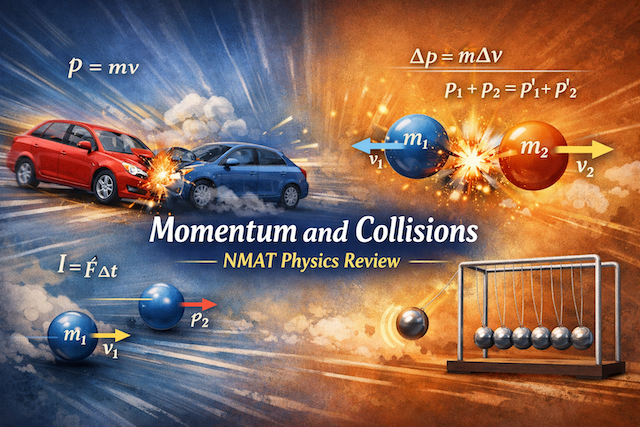
Momentum and Collisions: NMAT Physics Review
Contents
- Momentum and Collisions: NMAT Physics Review
- What Is Momentum?
- Units of Momentum
- Impulse and Its Relationship to Momentum
- Law of Conservation of Momentum
- Conditions for Momentum Conservation
- Types of Collisions
- Elastic Collisions
- Inelastic Collisions
- Perfectly Inelastic Collisions
- One-Dimensional Collisions
- Two-Dimensional Collisions
- Center of Mass and Momentum
- Recoil and Explosion Problems
- Applications of Momentum and Collisions
- Common NMAT Traps and Mistakes
- NMAT Problem-Solving Strategy
- Key Takeaways for NMAT Physics
- Momentum and Collisions: Problem Sets with Answer Keys (NMAT Physics)
- Problem Set 1: Momentum Basics and Impulse
- Answer Key 1
- Problem Set 2: One-Dimensional Collisions (Momentum Conservation)
- Answer Key 2
- Problem Set 3: Perfectly Inelastic Collisions (Stick Together)
- Answer Key 3
- Problem Set 4: Kinetic Energy and Collision Concepts
- Answer Key 4
- Problem Set 5: Mixed NMAT-Style Word Problems
- Answer Key 5
Momentum and Collisions: NMAT Physics Review
Momentum and collisions are core topics in NMAT Physics that frequently appear in conceptual questions,
numerical problems, and real-life applications. A strong understanding of momentum, impulse, and collision
types allows NMAT examinees to solve problems efficiently and avoid common traps. This review provides a
comprehensive explanation of momentum principles, conservation laws, collision analysis, and NMAT-focused
problem-solving strategies.
What Is Momentum?
Momentum is a vector quantity that describes the motion of an object. It depends on both mass and velocity,
making it a more complete measure of motion than velocity alone.
Definition:
Momentum (p) is defined as:
p = mv
where m is the mass of the object and v is its velocity.
Because velocity is a vector, momentum also has both magnitude and direction. This directional nature is
critical when solving collision problems involving multiple objects.
Units of Momentum
In the International System of Units (SI), momentum is measured in:
kg·m/s
Momentum can also be expressed as newton-seconds (N·s), since:
1 N·s = 1 kg·m/s
This equivalence becomes important when discussing impulse, which is closely related to momentum.
Impulse and Its Relationship to Momentum
Impulse describes the effect of a force acting over a time interval. In many NMAT problems, impulse is used
to analyze collisions and sudden changes in motion.
Impulse (J):
J = FΔt
where F is the applied force and Δt is the time interval during which the force acts.
Impulse is directly related to the change in momentum:
J = Δp = mvf − mvi
This relationship is known as the impulse-momentum theorem. It is frequently tested in NMAT physics questions
that involve stopping distances, safety devices, or impact forces.
Law of Conservation of Momentum
The law of conservation of momentum is one of the most important principles in collision problems.
Statement:
If no external force acts on a system, the total momentum of the system remains constant.
Mathematically:
Total momentum before interaction = Total momentum after interaction
This law applies to all types of collisions—elastic, inelastic, and perfectly inelastic—as long as the system
is isolated.
Conditions for Momentum Conservation
Momentum is conserved when:
- The system is isolated (no external forces)
- External forces are negligible compared to internal forces
- The time interval of interaction is very short
In NMAT problems, surfaces are often assumed to be frictionless, and air resistance is neglected to allow
momentum conservation.
Types of Collisions
Collisions are interactions between objects that occur over a very short time interval. They are classified
based on whether kinetic energy is conserved.
Elastic Collisions
In an elastic collision:
- Momentum is conserved
- Kinetic energy is conserved
Elastic collisions are idealized and rarely occur in everyday life, but they are common in physics problems,
especially those involving particles or ideal objects.
Example systems include gas molecules and idealized billiard balls.
Inelastic Collisions
In an inelastic collision:
- Momentum is conserved
- Kinetic energy is not conserved
Some kinetic energy is transformed into heat, sound, or deformation. Most real-world collisions fall into
this category.
Perfectly Inelastic Collisions
A perfectly inelastic collision is a special case of inelastic collision where:
- The objects stick together after the collision
- Momentum is conserved
- Kinetic energy loss is maximum
These problems are very common in NMAT exams because they involve straightforward momentum conservation and
simple algebra.
One-Dimensional Collisions
In one-dimensional (1D) collisions, all motion occurs along a straight line. These are the most common type
of collision problems in NMAT.
For two objects:
m1u1 + m2u2 = m1v1 + m2v2
where:
- u = initial velocity
- v = final velocity
Always choose a consistent direction as positive to avoid sign errors.
Two-Dimensional Collisions
In two-dimensional (2D) collisions, objects move in different directions after impact. Momentum must be
conserved separately in each perpendicular direction.
Momentum conservation equations:
- Total momentum in x-direction before = after
- Total momentum in y-direction before = after
These problems often involve vector components and trigonometry, which can be challenging but are less
frequently tested in NMAT compared to 1D collisions.
Center of Mass and Momentum
The center of mass of a system behaves as if all the system’s mass were concentrated at that point.
The velocity of the center of mass remains constant if no external force acts on the system.
This concept reinforces the conservation of momentum and helps explain collision behavior in multi-object
systems.
Recoil and Explosion Problems
Recoil and explosion problems are applications of momentum conservation.
In an explosion:
- The initial momentum is usually zero
- Fragments move apart with equal and opposite total momentum
These problems are common in NMAT and often test conceptual understanding rather than heavy computation.
Applications of Momentum and Collisions
Momentum concepts are widely applied in real life:
- Vehicle safety systems (airbags, seatbelts)
- Sports collisions
- Rocket propulsion
- Ballistics and impact analysis
NMAT questions often describe real-world scenarios to test conceptual application rather than formula
memorization.
Common NMAT Traps and Mistakes
NMAT physics questions are designed to test clarity of understanding. Common mistakes include:
- Forgetting that momentum is a vector
- Assuming kinetic energy is conserved in all collisions
- Ignoring direction signs
- Applying momentum conservation when external forces are present
Carefully reading the problem statement and identifying the type of collision is essential.
NMAT Problem-Solving Strategy
To solve momentum and collision problems efficiently:
- Identify the system and check if momentum is conserved
- Determine the type of collision
- Choose a reference direction
- Write momentum equations clearly
- Solve algebraically before substituting numbers
Practicing these steps consistently will significantly improve accuracy and speed in NMAT physics.
Key Takeaways for NMAT Physics
Momentum and collisions form a high-yield topic in NMAT Physics. Mastery of conservation laws, impulse,
collision types, and vector reasoning provides a strong advantage in solving exam questions.
With regular practice and conceptual clarity, these problems become systematic and predictable, making them
one of the most scoring areas in the NMAT Physics section.
Momentum and Collisions: Problem Sets with Answer Keys (NMAT Physics)
Problem Set 1: Momentum Basics and Impulse
- A 2.0 kg cart moves to the right at 5.0 m/s. What is its momentum?
- A 0.50 kg ball moving at 12 m/s is brought to rest in 0.20 s. Find:
(a) the change in momentum, and (b) the average force applied. - A 1.5 kg object initially at rest experiences an impulse of 9.0 N·s to the left.
What is its final velocity? - A 1000 kg car moving at 20 m/s applies brakes and stops in 5.0 s.
What is the average braking force (magnitude)? - A force of 40 N acts on a body for 0.15 s. If the body’s initial momentum is 6.0 kg·m/s to the right
and the force acts to the left, what is the final momentum?
Answer Key 1
- p = mv = (2.0)(5.0) = 10 kg·m/s (to the right)
- (a) Δp = m(vf − vi) = 0.50(0 − 12) = −6.0 kg·m/s (opposite the initial direction)
(b) Favg = Δp/Δt = (−6.0)/(0.20) = −30 N (30 N opposite the motion) - J = Δp = mv (since initial p = 0).
v = J/m = (−9.0)/1.5 = −6.0 m/s (6.0 m/s to the left) - Δp = m(0 − 20) = 1000(−20) = −20000 kg·m/s
Favg = Δp/Δt = (−20000)/5.0 = −4000 N
Magnitude: 4000 N - J = FΔt = (−40)(0.15) = −6.0 N·s
pf = pi + J = 6.0 + (−6.0) = 0 kg·m/s
Problem Set 2: One-Dimensional Collisions (Momentum Conservation)
- A 3.0 kg object moving at 4.0 m/s to the right collides head-on with a 1.0 kg object moving at 2.0 m/s
to the left. After collision, the 3.0 kg object moves at 2.0 m/s to the right.
Find the final velocity of the 1.0 kg object. - A 0.20 kg puck moving at 6.0 m/s to the right collides with a stationary 0.30 kg puck.
After collision, the 0.20 kg puck moves at 1.5 m/s to the right. Find the final speed of the 0.30 kg puck. - Two carts move on a frictionless track. Cart A (2.0 kg) moves right at 3.0 m/s,
cart B (4.0 kg) moves right at 1.0 m/s. They collide and stick together.
What is their common velocity after collision? - A 5.0 kg block at rest explodes into two pieces. One piece of mass 2.0 kg flies to the right at 6.0 m/s.
What is the velocity of the other piece? - A 1.0 kg ball moving at 8.0 m/s to the right collides with a stationary 1.0 kg ball.
If the collision is perfectly elastic, what are the final velocities of the two balls?
Answer Key 2
- Take right as positive.
Initial momentum: p_i = 3(4) + 1(−2) = 12 − 2 = 10
Final momentum: p_f = 3(2) + 1(v2) = 6 + v2
Set equal: 10 = 6 + v2 → v2 = 4.0 m/s (to the right) - p_i = 0.20(6.0) + 0.30(0) = 1.2
p_f = 0.20(1.5) + 0.30(v) = 0.30 + 0.30v
1.2 = 0.30 + 0.30v → 0.90 = 0.30v → v = 3.0 m/s - Perfectly inelastic: stick together.
p_i = 2(3) + 4(1) = 6 + 4 = 10
Total mass: 2 + 4 = 6
v = p_i/(m_total) = 10/6 = 1.67 m/s (to the right) - Initial momentum is zero (at rest before explosion).
Let the second piece have mass 3.0 kg and velocity v.
0 = 2(6) + 3(v) → 0 = 12 + 3v → v = −4.0 m/s
So it moves at 4.0 m/s to the left. - In a 1D perfectly elastic collision between equal masses where one is initially at rest,
the moving object stops and the stationary object takes its speed.
Final velocities: v1 = 0 m/s, v2 = 8.0 m/s (to the right)
Problem Set 3: Perfectly Inelastic Collisions (Stick Together)
- A 1.0 kg cart moving at 7.0 m/s collides with a 2.0 kg cart moving at 1.0 m/s in the same direction.
They stick together. Find their final velocity. - A 0.40 kg lump of clay moving at 5.0 m/s hits and sticks to a 0.60 kg block at rest on a frictionless surface.
What is the final velocity of the combined mass? - A 1200 kg car moving at 18 m/s rear-ends a 1000 kg car moving at 10 m/s. They lock together after impact.
Find their speed immediately after collision. - A 2.0 kg object moving at 3.0 m/s to the right sticks to a 1.0 kg object moving at 2.0 m/s to the left.
Find the final velocity and its direction. - A bullet of mass 0.010 kg traveling at 400 m/s embeds in a 2.0 kg wooden block initially at rest.
What is the block+bullet speed right after the collision?
Answer Key 3
- p_i = 1(7) + 2(1) = 7 + 2 = 9
Total mass = 3
v = 9/3 = 3.0 m/s (same direction) - p_i = 0.40(5.0) + 0 = 2.0
Total mass = 1.0
v = 2.0/1.0 = 2.0 m/s - p_i = 1200(18) + 1000(10) = 21600 + 10000 = 31600
Total mass = 2200
v = 31600/2200 = 14.36 m/s - Take right as positive:
p_i = 2(3) + 1(−2) = 6 − 2 = 4
Total mass = 3
v = 4/3 = 1.33 m/s (to the right) - p_i = 0.010(400) = 4.0
Total mass = 2.010 kg
v = 4.0/2.010 = 1.99 m/s (approximately)
Problem Set 4: Kinetic Energy and Collision Concepts
- A 2.0 kg ball moving at 6.0 m/s has what kinetic energy?
- Two 1.0 kg carts collide and stick together. One cart moves at 4.0 m/s, the other is at rest.
Find the kinetic energy before and after collision, then determine how much kinetic energy is lost. - Which type of collision results in the maximum loss of kinetic energy:
elastic, inelastic, or perfectly inelastic? - A 0.50 kg object moving at 10 m/s undergoes a perfectly elastic collision and rebounds with the same speed.
Compare the magnitude of momentum before and after. - A truck and a car collide. Total momentum is conserved but kinetic energy decreases.
What type of collision is this?
Answer Key 4
- K = (1/2)mv2 = (1/2)(2.0)(6.02) = 36 J
- Initial KE: K_i = (1/2)(1)(42) = 8 J
Final velocity: v = (1·4 + 1·0)/(2) = 2 m/s
Final KE: K_f = (1/2)(2)(22) = 4 J
KE lost: 8 − 4 = 4 J - Perfectly inelastic collision
- Momentum magnitude before: p = mv = 0.50(10) = 5.0 kg·m/s
After rebound, speed is the same, so momentum magnitude is still 5.0 kg·m/s
(direction changes, but magnitude is unchanged). - Inelastic collision
Problem Set 5: Mixed NMAT-Style Word Problems
- A 0.25 kg ball is hit, changing its velocity from 2.0 m/s to 14 m/s in the same direction.
If contact time is 0.050 s, find the average force exerted on the ball. - A 60 kg skater initially at rest pushes off a 40 kg skater. After pushing, the 60 kg skater moves left at 2.0 m/s.
Find the velocity of the 40 kg skater. - A 2.0 kg cart moving right at 5.0 m/s collides elastically with a 1.0 kg cart at rest.
After collision, the 2.0 kg cart moves at 1.0 m/s to the right.
Find the final velocity of the 1.0 kg cart (use momentum conservation). - A 0.020 kg bullet moving at 300 m/s passes through a 1.0 kg block initially at rest and exits at 100 m/s
(same direction). Find the block’s speed immediately after the bullet exits (ignore friction). - A 0.50 kg ball moving at 8.0 m/s to the right collides head-on with a 0.50 kg ball moving at 4.0 m/s to the left.
If they stick together, find their velocity after collision.
Answer Key 5
- Δp = m(vf − vi) = 0.25(14 − 2) = 0.25(12) = 3.0 kg·m/s
Favg = Δp/Δt = 3.0/0.050 = 60 N - Initial momentum = 0.
Take right as positive; left is negative.
0 = 60(−2.0) + 40(v)
0 = −120 + 40v → v = 3.0 m/s (to the right) - p_i = 2(5) + 1(0) = 10
p_f = 2(1) + 1(v) = 2 + v
10 = 2 + v → v = 8.0 m/s (to the right) - Momentum conservation (block + bullet):
p_i = 0.020(300) = 6.0
Final momentum: p_f = 0.020(100) + 1.0(v) = 2.0 + v
6.0 = 2.0 + v → v = 4.0 m/s (block to the right) - Perfectly inelastic; stick together. Take right positive.
p_i = 0.50(8.0) + 0.50(−4.0) = 4.0 − 2.0 = 2.0
Total mass = 1.0 kg
v = 2.0/1.0 = 2.0 m/s (to the right)
NMAT Study Guide: Complete Preparation Guide for Medical School in the Philippines

How to Register for eTravel Philippines (2025 Guide)
Step-by-step guide to completing your eTravel registration before arriving in the Philippines, with images and tips.

Night Market in Cebu – Things You Don’t Know About Cebu Life
Discover the hidden charm of Cebu’s night markets, from street food stalls to local life tips you won’t find in tourist guides.

How to Use ChatGPT for IELTS Preparation: A Complete Guide
Learn how to prepare for IELTS using ChatGPT — including strategies for Writing, Reading, Listening, Speaking, and grammar support.

How to Build a Website Without Coding Using ChatGPT
Discover how to build your own website using AI—no coding skills needed. From structure planning to SEO and design, let ChatGPT guide you.