2026年4月3日
3D ACADEMY offers affordable English study programs in Cebu, Philippines – perfect for beginners, professionals, and exam takers.

3D UNIVERSAL ENGLISH INSTITUTE INC
info.3d-universal.com
8:00-17:00(Mon-Fri)
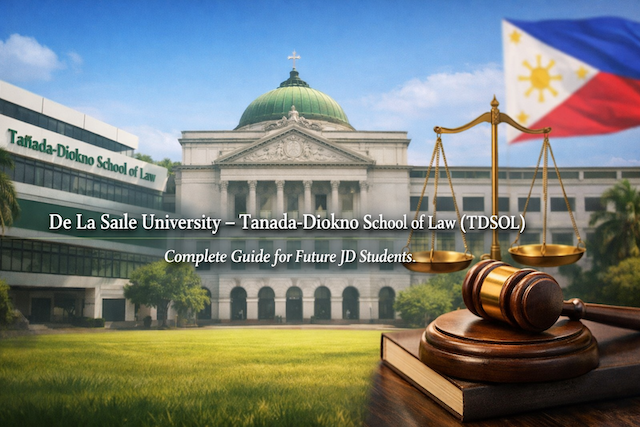
De La Salle University – Tañada-Diokno School of Law (TDSOL): Complete Guide for Future JD Students
Contents
- De La Salle University – Tañada-Diokno School of Law (TDSOL): Complete Guide for Future JD Students
- Overview: What is DLSU Tañada-Diokno School of Law?
- Mission and Educational Philosophy
- Juris Doctor (JD) Program Overview
- Who Should Consider Studying at TDSOL?
- Admission Requirements and Eligibility
- DLSU Juris Doctor Aptitude Test (JDAT)
- Effective Preparation for Law School Admission
- Clinical Legal Education and Advocacy Training
- Campus Environment and Class Locations
- Student Life and Extracurricular Opportunities
- Tuition, Fees, and Financial Planning
- Career Paths After Graduation
- Is TDSOL the Right Law School for You?
- FAQs (Frequently Asked Questions)
- What is De La Salle University – Tañada-Diokno School of Law (TDSOL)?
- Is TDSOL the same as DLSU College of Law?
- What degree does TDSOL offer?
- Who can apply to the JD program?
- Do I need to take an entrance exam like the JDAT?
- How should I prepare for the JD entrance exam and interviews?
- Where are classes held for TDSOL?
- Is TDSOL suitable for working students?
- Does TDSOL emphasize human rights and public service?
- Will I get practical training, not just lectures?
- How much should I budget for law school?
- What careers can I pursue after completing the JD?
- What makes a student successful at TDSOL?
De La Salle University – Tañada-Diokno School of Law (TDSOL): Complete Guide for Future JD Students
Overview: What is DLSU Tañada-Diokno School of Law?
De La Salle University – Tañada-Diokno School of Law (TDSOL) is the official law school of De La Salle University (DLSU), one of the Philippines’ most respected private universities. The school is known for its strong emphasis on values-based legal education, integrating academic rigor with ethical formation rooted in the Lasallian tradition.
The law school was named in honor of Lorenzo “Ka Tanny” Tañada and Jose “Ka Pepe” Diokno, two of the most influential figures in Philippine legal history and human rights advocacy. Their legacy shapes the school’s mission of producing lawyers committed not only to excellence, but also to justice, integrity, and public service.
Mission and Educational Philosophy
TDSOL distinguishes itself through its focus on holistic formation. Beyond mastering legal doctrines, students are encouraged to reflect on the social impact of law and their responsibility as future legal professionals. The school promotes a vision of law as a tool for protecting human dignity, advancing social justice, and empowering marginalized communities.
This approach appeals to students who view law not merely as a profession, but as a vocation—one that requires moral grounding, empathy, and a commitment to service alongside intellectual competence.
Juris Doctor (JD) Program Overview
The primary academic offering of TDSOL is the Juris Doctor (JD) program, a non-thesis professional degree designed to prepare students for legal practice and the Philippine Bar Examination. The program follows the standard four-year law curriculum mandated in the Philippines, covering all major fields of law.
Students undertake intensive coursework in constitutional law, civil law, criminal law, labor law, commercial law, taxation, remedial law, legal ethics, and other foundational subjects. The non-thesis format places greater emphasis on coursework, examinations, skills training, and practical legal exposure rather than academic research writing.
Who Should Consider Studying at TDSOL?
TDSOL is particularly suitable for students who:
- Seek a values-oriented legal education grounded in ethics and service
- Are interested in human rights, public interest law, or policy work
- Prefer a structured yet reflective academic environment
- Are prepared for the demands of intensive reading, analysis, and recitations
While the school welcomes students with diverse career goals, its institutional culture strongly resonates with those who aspire to use law as a means of social transformation.
Admission Requirements and Eligibility
Applicants to the JD program must hold a bachelor’s degree from a recognized college or university. As with most Philippine law schools, the degree may come from any academic discipline, provided that all documentary requirements are satisfied.
Typical application requirements include academic transcripts, identification documents, application forms, and other materials specified by the university. Application periods are announced for each academic year, and deadlines are strictly enforced.
DLSU Juris Doctor Aptitude Test (JDAT)
Admission to TDSOL requires taking the DLSU Juris Doctor Aptitude Test (JDAT). This entrance examination is designed to assess an applicant’s readiness for legal education, focusing on skills such as reading comprehension, logical reasoning, analytical thinking, and written communication.
The JDAT is usually administered on campus, with limited online testing options depending on the academic year and university policies. Applicants are advised to prepare well in advance, as the test reflects the cognitive demands of law school rather than rote memorization.
Effective Preparation for Law School Admission
Prospective applicants can improve their chances of success by adopting law-school-ready habits early. These include developing strong reading endurance, practicing structured argumentation, and managing time effectively under pressure.
Rather than focusing solely on entrance exam content, applicants benefit from cultivating discipline and consistency—qualities that are essential for surviving and succeeding in law school.
Clinical Legal Education and Advocacy Training
TDSOL emphasizes experiential learning through clinical legal education and advocacy-oriented training. Students are exposed to practical legal work that enhances their understanding of how law operates in real-life contexts.
Through clinics and advocacy programs, students develop essential skills such as client interviewing, legal drafting, case analysis, and ethical decision-making. These experiences help bridge the gap between theory and practice.
Campus Environment and Class Locations
De La Salle University is traditionally based along Taft Avenue in Manila, a central academic and commercial corridor. However, in recent years, law classes and activities have also been associated with facilities in Bonifacio Global City (BGC), Taguig.
Because class venues may vary depending on year level and academic arrangements, students are encouraged to confirm the specific location of their classes before enrolling. Location considerations are important, as commuting time can significantly affect study efficiency and overall well-being.
Student Life and Extracurricular Opportunities
Life at TDSOL extends beyond lectures and examinations. Students have opportunities to participate in various organizations and activities that support personal and professional growth, including:
- Moot court and oral advocacy competitions
- Legal research and writing initiatives
- Community outreach and legal aid programs
- Leadership and faith-based student organizations
Engagement in these activities helps students build confidence, networks, and practical skills that are valuable throughout their legal careers.
Tuition, Fees, and Financial Planning
Tuition and fees at TDSOL vary by academic year and course load. In addition to tuition, students should budget for books, printing, transportation, meals, and living expenses.
Law school also involves opportunity costs, particularly for working students who may need to reduce employment hours. Careful financial planning is essential to sustain four years of legal education without undue stress.
Career Paths After Graduation
Graduates of the JD program pursue a wide range of career paths, including litigation, corporate practice, government service, compliance, policy development, and public interest work. The skills developed at TDSOL—especially critical thinking, ethical reasoning, and advocacy—are transferable across many legal and non-legal professions.
For those aiming to take the Philippine Bar Examination, consistent preparation throughout law school is crucial. Strong foundations built in the early years often determine long-term success.
Is TDSOL the Right Law School for You?
Choosing a law school is a deeply personal decision. TDSOL is best suited for students who value mission-driven education and are willing to engage deeply with both the intellectual and moral dimensions of legal practice.
If you are motivated by justice, service, and ethical leadership—and are prepared for the rigor of law school—De La Salle University – Tañada-Diokno School of Law offers an environment where you can grow into a principled and capable legal professional.
FAQs (Frequently Asked Questions)
What is De La Salle University – Tañada-Diokno School of Law (TDSOL)?
De La Salle University – Tañada-Diokno School of Law (TDSOL) is the law school of De La Salle University (DLSU) in the Philippines. It offers a Juris Doctor (JD) program and promotes a Lasallian approach to legal education that emphasizes academic rigor, ethical formation, and service to society. The school name reflects the legacy of Lorenzo “Ka Tanny” Tañada and Jose “Ka Pepe” Diokno, widely associated with public service, civil liberties, and human rights advocacy in Philippine history.
Is TDSOL the same as DLSU College of Law?
Yes. TDSOL refers to the law school under DLSU. In many contexts, you may still see references to “DLSU College of Law,” especially in older announcements, alumni documents, or third-party directories. Over time, the institution has been associated with the Tañada-Diokno name, which highlights the school’s identity and mission. If you are confirming details such as admissions requirements, deadlines, testing instructions, or class locations, rely on the most current DLSU and TDSOL official announcements.
What degree does TDSOL offer?
TDSOL’s core program is the Juris Doctor (JD), which is the standard professional degree for law practice in the Philippines. The JD curriculum typically spans multiple years and includes foundational legal subjects such as Constitutional Law, Civil Law, Criminal Law, Remedial Law, Commercial Law, Taxation, Labor Law, Legal Ethics, and Legal Writing. The JD is designed to build both substantive legal knowledge and the analytical skills needed for law school performance and eventual bar preparation.
Who can apply to the JD program?
Applicants are generally expected to hold a bachelor’s degree from a recognized institution. The applicant’s undergraduate major may vary, since law school admissions commonly accept graduates from diverse fields. However, each intake may have specific documentary requirements, application steps, and deadlines. International applicants or applicants with non-traditional academic backgrounds should review official instructions carefully and prepare documents early, especially transcripts and certifications that may take time to request and process.
Do I need to take an entrance exam like the JDAT?
In many admissions cycles, applicants are required to take an aptitude-style entrance test often referred to as a Juris Doctor Aptitude Test (JDAT) or a similar assessment administered by DLSU. The goal is usually to measure readiness for the demands of legal education, including reading comprehension, logical reasoning, critical thinking, and written communication. Because testing formats can change (for example, on-site versus online options), confirm the testing mode, schedule, and guidelines for your specific application cycle.
How should I prepare for the JD entrance exam and interviews?
A smart preparation plan focuses on skills rather than memorizing legal concepts. Build stamina for long reading passages, practice identifying main arguments quickly, and answer logic-based questions under time pressure. For interviews (if required), be ready to explain your motivation for studying law, your long-term career direction, and how you plan to manage the workload. It also helps to demonstrate maturity, ethical awareness, and a clear understanding that law school requires consistent discipline and strong time management.
Where are classes held for TDSOL?
DLSU is historically associated with its Manila campus, but law school activities and class venues may also be connected to facilities in other business districts depending on the academic year and program arrangements. Because locations can change based on scheduling, year level, and administrative decisions, applicants should verify class venues once they receive enrollment instructions or official orientation materials. Planning your commute and housing options around your expected class location can significantly affect your study efficiency and quality of life.
Is TDSOL suitable for working students?
Many law students in the Philippines balance work and studies, but it is demanding. The feasibility depends on your job flexibility, commute time, and ability to protect study hours daily. If you work full-time, consider whether you can consistently allocate time for reading, case briefing, outlining, and exam preparation. A realistic plan often includes reducing work hours, switching to flexible schedules, or selecting roles that allow predictable evenings and weekends. Law school performance is strongly tied to routine and sustained focus.
Does TDSOL emphasize human rights and public service?
TDSOL is often described as mission-driven and values-oriented, and many prospective students are attracted by its emphasis on ethical leadership, service, and social responsibility. This may appear in the school culture, formation activities, advocacy exposure, and the way professional identity is discussed in orientation and institutional messaging. Even if you plan to enter corporate practice, training in ethics and social responsibility can strengthen your professional decision-making and long-term credibility as a lawyer.
Will I get practical training, not just lectures?
Modern JD programs increasingly include skills training such as legal writing, drafting, advocacy, and clinical exposure. Practical experiences can help you understand how laws affect real people, improve your communication skills, and prepare you for internships and early legal work. The specific structure of clinics, advocacy programs, and experiential learning requirements can vary by year, so it is best to check current program descriptions and student guidance materials for the most accurate expectations.
How much should I budget for law school?
Your budget should include tuition and university fees plus books, printing, transport, meals, and device needs (a reliable laptop is essential for writing and research). Many students underestimate “hidden costs,” such as commuting time, health-related expenses from stress, and the opportunity cost of reduced income if you need to work fewer hours. A practical approach is to create a semester-based budget, set aside emergency funds, and plan for heavier spending periods such as exam weeks and major requirements.
What careers can I pursue after completing the JD?
After earning a JD, graduates may pursue careers in litigation, corporate practice, government, compliance, policy, academia, and public interest work. Many graduates aim to take the Philippine Bar Examination as a pathway to full legal practice. Career outcomes are shaped not only by grades but also by writing ability, internships, advocacy experience, professional networks, and the reputation you build through consistent performance and ethical conduct throughout law school.
What makes a student successful at TDSOL?
Successful students typically have strong habits: daily reading discipline, consistent outlining, strategic time blocking, and the ability to learn from recitations and feedback without losing confidence. They also protect basic health routines and build supportive peer networks. If you want to thrive, focus on systems—repeatable study routines and clear weekly goals—rather than relying on last-minute motivation. Law school rewards consistency, clarity of thinking, and professional maturity over time.
Complete List of Medical Schools in the Philippines (All 78 MD Programs)
Best Medical Schools in the Philippines (Local & International Rankings)

How to Register for eTravel Philippines (2025 Guide)
Step-by-step guide to completing your eTravel registration before arriving in the Philippines, with images and tips.

Night Market in Cebu – Things You Don’t Know About Cebu Life
Discover the hidden charm of Cebu’s night markets, from street food stalls to local life tips you won’t find in tourist guides.

How to Use ChatGPT for IELTS Preparation: A Complete Guide
Learn how to prepare for IELTS using ChatGPT — including strategies for Writing, Reading, Listening, Speaking, and grammar support.

How to Build a Website Without Coding Using ChatGPT
Discover how to build your own website using AI—no coding skills needed. From structure planning to SEO and design, let ChatGPT guide you.