2026年3月30日
3D ACADEMY offers affordable English study programs in Cebu, Philippines – perfect for beginners, professionals, and exam takers.

3D UNIVERSAL ENGLISH INSTITUTE INC
info.3d-universal.com
8:00-17:00(Mon-Fri)
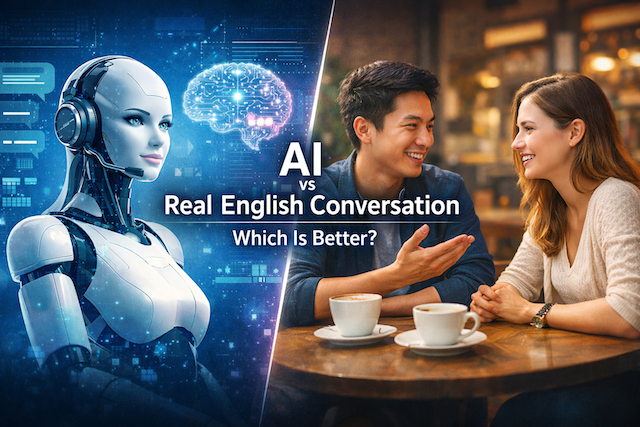
AI vs Real English Conversation: Which Is Better?
Contents
- AI vs Real English Conversation: Which Is Better?
- Introduction
- What Is AI English Conversation?
- What Is Real English Conversation?
- Key Differences Between AI and Real Conversation
- Advantages of AI English Conversation
- Disadvantages of AI English Conversation
- Advantages of Real English Conversation
- Disadvantages of Real English Conversation
- Which Is Better? The Real Answer
- The Best Strategy: Combine Both
- Example Learning Plan
- Common Mistakes to Avoid
- Conclusion
- FAQs (Frequently Asked Questions)
- Is AI conversation really useful for improving spoken English?
- Can AI replace real English conversation completely?
- Which is better for beginners: AI or real conversation?
- What are the main weaknesses of AI conversation practice?
- How can I use AI and real conversation together effectively?
- How often should I practice with AI if I want to improve speaking fast?
AI vs Real English Conversation: Which Is Better?
Introduction
In recent years, artificial intelligence has rapidly transformed the way people learn English. From AI chatbots to speech recognition tools, learners now have access to unlimited conversation practice anytime, anywhere. At the same time, traditional methods—especially real-life English conversations with native or fluent speakers—remain highly valued and widely recommended.
This raises an important question: Which is better—AI-based English conversation or real human interaction?
The answer is not as simple as choosing one over the other. Both methods offer unique advantages and limitations, and understanding these differences is essential for building an effective English learning strategy.
In this article, we will explore the strengths and weaknesses of both AI and real English conversation, compare them across key factors, and help you decide how to use each method effectively.
What Is AI English Conversation?
AI English conversation refers to practicing speaking with artificial intelligence tools such as:
- ChatGPT and other conversational AI
- AI-powered language learning apps (e.g., Elsa Speak, Speak, Duolingo Max)
- Voice-based assistants with speech recognition
- AI tutors with feedback systems
These tools simulate human conversation using natural language processing and can respond instantly to user input.
Key Features of AI Conversation
- Available 24/7
- Instant feedback (grammar, pronunciation, fluency)
- Customizable topics and difficulty levels
- No fear of judgment or embarrassment
- Scalable and cost-effective
AI creates a controlled and supportive environment for learners, especially beginners.
What Is Real English Conversation?
Real English conversation involves interacting with actual people, such as:
- Native speakers
- English teachers
- Language exchange partners
- Colleagues or friends
- People in real-world environments (travel, work, daily life)
This type of conversation is unpredictable and dynamic, reflecting how English is used in real situations.
Key Features of Real Conversation
- Natural speaking speed and accents
- Emotional and social interaction
- Cultural context and nuance
- Real-time pressure and spontaneity
- Exposure to authentic language use
Real conversation is often considered the ultimate goal of language learning.
Key Differences Between AI and Real Conversation
To understand which is better, let’s compare them across several important dimensions.
1. Availability and Convenience
AI Conversation
AI is always available. You can practice anytime—early morning, late night, or during short breaks. There’s no need to schedule sessions or find a partner.
Real Conversation
Real conversations require coordination. You need to find a partner, schedule time, and sometimes pay for lessons.
Verdict:
AI is significantly more convenient and accessible.
2. Learning Environment
AI Conversation
AI provides a low-pressure environment. You can make mistakes freely without feeling embarrassed. This is especially helpful for beginners.
Real Conversation
Real conversations can be stressful. Fear of making mistakes or being judged can reduce confidence and limit speaking practice.
Verdict:
AI is better for building confidence and reducing anxiety.
3. Feedback Quality
AI Conversation
AI tools can give instant, structured feedback on:
- Grammar mistakes
- Pronunciation
- Sentence structure
- Vocabulary usage
Some tools even provide detailed corrections and suggestions.
Real Conversation
Feedback depends on the person. Many native speakers do not correct mistakes unless asked, and even teachers may not provide immediate detailed corrections during natural conversation.
Verdict:
AI often provides more consistent and immediate feedback.
4. Naturalness of Conversation
AI Conversation
Although AI has improved significantly, it may still:
- Sound slightly unnatural
- Avoid complex emotional responses
- Miss subtle context or humor
Real Conversation
Humans use:
- Slang and idioms
- Emotional tone and body language
- Interruptions and overlapping speech
- Cultural references
This creates a much richer and more realistic communication experience.
Verdict:
Real conversation is far more natural and authentic.
5. Listening and Comprehension Skills
AI Conversation
AI usually speaks clearly and at a controlled pace. This is ideal for beginners but may not reflect real-world difficulty.
Real Conversation
Real speakers use different accents, speeds, and speaking styles. This helps develop strong listening skills but can be challenging.
Verdict:
Real conversation is better for advanced listening skills.
6. Adaptability and Personalization
AI Conversation
AI can instantly adapt to your level, goals, and preferences. You can:
- Choose topics (business, travel, daily life)
- Adjust difficulty
- Repeat practice as needed
Real Conversation
Human partners may not always match your level or learning needs.
Verdict:
AI is more flexible and personalized.
7. Cultural and Social Learning
AI Conversation
AI can explain culture, but it does not truly experience it. Emotional and social nuances may be limited.
Real Conversation
You learn:
- Social norms
- Humor and sarcasm
- Cultural expectations
- Real-life communication styles
Verdict:
Real conversation is essential for cultural understanding.
Advantages of AI English Conversation
Unlimited Practice
You can practice as much as you want without worrying about time, cost, or availability.
Safe Learning Space
No embarrassment, no pressure—ideal for beginners and shy learners.
Immediate Feedback
Helps correct mistakes quickly and improve faster.
Structured Learning
AI can guide you step-by-step, making it easier to track progress.
Cost-Effective
Many AI tools are free or cheaper than hiring tutors.
Disadvantages of AI English Conversation
Lack of Real Emotion
AI cannot fully replicate human emotions or social interaction.
Limited Real-World Complexity
Conversations may feel simplified compared to real-life situations.
Over-Reliance Risk
Learners may become too comfortable with AI and struggle in real conversations.
Advantages of Real English Conversation
Authentic Communication
You experience real language as it is used in everyday life.
Cultural Exposure
You learn how language connects with culture and social context.
Improved Listening Skills
You adapt to different accents, speeds, and speaking styles.
Real Interaction Skills
You develop turn-taking, reacting, and expressing emotions naturally.
Disadvantages of Real English Conversation
Limited Availability
Finding consistent partners can be difficult.
High Cost
Lessons with teachers or tutors can be expensive.
Anxiety and Pressure
Many learners feel nervous speaking with real people.
Inconsistent Feedback
Not all partners provide useful corrections.
Which Is Better? The Real Answer
The truth is: neither AI nor real conversation is “better” on its own.
They serve different purposes and complement each other.
AI Is Better For:
- Beginners
- Daily practice
- Building confidence
- Improving grammar and pronunciation
- Structured learning
Real Conversation Is Better For:
- Intermediate to advanced learners
- Developing fluency
- Understanding natural speech
- Cultural communication
- Real-world interaction
The Best Strategy: Combine Both
The most effective approach is to use AI and real conversation together.
Step 1: Practice with AI Daily
Use AI to:
- Warm up speaking
- Practice vocabulary
- Improve pronunciation
- Build sentence structure
Example routine (15–30 minutes):
- 5 minutes: small talk with AI
- 10 minutes: topic-based conversation
- 5 minutes: feedback and correction review
Step 2: Apply Skills in Real Conversations
Use real interaction to:
- Test your fluency
- Handle unexpected responses
- Improve listening skills
- Gain confidence in real situations
Even 1–2 real conversations per week can make a big difference.
Example Learning Plan
Beginner
- 90% AI practice
- 10% real conversation
Focus: confidence and basic speaking skills
Intermediate
- 60% AI practice
- 40% real conversation
Focus: fluency and communication
Advanced
- 30% AI practice
- 70% real conversation
Focus: natural expression and cultural understanding
Common Mistakes to Avoid
Only Using AI
This can limit your ability to handle real conversations.
Only Using Real Conversation
Without structured practice, progress may be slow and frustrating.
Ignoring Feedback
Whether from AI or humans, feedback is essential for improvement.
Fear of Making Mistakes
Mistakes are necessary for learning—both in AI and real conversations.
Conclusion
So, AI vs real English conversation—which is better?
The answer depends on your goals, level, and learning style. AI offers convenience, structure, and a safe environment, while real conversation provides authenticity, cultural insight, and real-world communication skills.
Instead of choosing one over the other, the smartest approach is to combine both.
Use AI to practice consistently and build confidence. Then, use real conversations to apply what you’ve learned in authentic situations.
By leveraging the strengths of both methods, you can accelerate your progress and become a more confident, fluent English speaker.
FAQs (Frequently Asked Questions)
Is AI conversation really useful for improving spoken English?
Yes, AI conversation can be very useful for improving spoken English, especially for learners who need regular practice. One of the biggest advantages of AI is accessibility. You can practice anytime without needing to schedule a lesson or find a speaking partner. This makes it easier to build a daily habit, which is essential for language improvement.
AI tools are also helpful because they allow repeated practice. If you want to talk about the same topic several times, review the same vocabulary, or practice similar question patterns, AI can support that without getting tired or impatient. This is especially useful for beginners who need extra repetition before they feel confident.
Another benefit is that many AI tools provide immediate corrections or suggestions. They can help you notice grammar mistakes, awkward phrasing, unclear pronunciation, or limited vocabulary. That kind of fast feedback can improve your awareness and make self-study more efficient.
However, AI is most useful when you treat it as a practice tool rather than a complete replacement for human communication. It helps you prepare, organize your thoughts, and speak more often, but you still need some exposure to real people if you want to become fully comfortable in natural conversation.
Can AI replace real English conversation completely?
No, AI cannot completely replace real English conversation. Although AI has become much more advanced, human interaction still offers things that AI cannot fully reproduce. Real conversations include emotions, spontaneity, interruptions, humor, body language, and cultural nuance. These elements are important because real communication is not only about correct grammar. It is also about reacting naturally, understanding social context, and building connection with another person.
When you speak with real people, you are exposed to different speaking speeds, accents, personalities, and communication styles. You also learn how to manage uncertainty. Sometimes people speak unclearly, change topics quickly, or use expressions you have never heard before. Dealing with those situations helps you become a practical communicator in the real world.
AI can support your progress by helping you rehearse and improve specific skills, but it does not fully recreate the unpredictability of real life. For this reason, learners should see AI as a powerful supplement rather than a total substitute. The best long-term strategy is to combine the convenience of AI with the authenticity of human conversation.
Which is better for beginners: AI or real conversation?
For many beginners, AI is the better starting point. Beginners often struggle with nervousness, lack of vocabulary, and fear of making mistakes. AI creates a low-pressure environment where learners can speak freely without worrying about being judged. This makes it easier to start practicing early, even with limited English ability.
Another reason AI works well for beginners is that it can be adjusted to a simpler level. Learners can ask for basic questions, slow responses, easy vocabulary, or repeated explanations. That kind of control is extremely helpful in the early stages of language learning.
That said, beginners should not avoid real conversation forever. Once they build some confidence through AI practice, they should gradually start talking to real people as well. Even short conversations with a tutor, exchange partner, or classmate can help bridge the gap between practice and real communication.
So, if you are a beginner, AI is often the easiest and most comfortable place to begin. But over time, it should become a stepping stone toward human interaction rather than the final goal.
What are the main weaknesses of AI conversation practice?
AI conversation practice has many strengths, but it also has important limitations. One major weakness is that AI conversations can feel too controlled or too smooth. In real life, people interrupt each other, misunderstand things, use incomplete sentences, and react emotionally. AI often provides cleaner and more structured exchanges than what learners will face in actual situations.
Another limitation is emotional depth. Real communication includes empathy, personal experience, humor, and subtle social cues. AI can imitate some of these, but it does not truly experience them. As a result, learners may not fully develop the social side of communication if they rely only on AI.
There is also the risk of becoming too comfortable. If learners only practice with AI, they may get used to predictable responses and then feel overwhelmed when they speak with real people. Human conversation often requires quick reactions and tolerance for confusion, which AI may not train strongly enough on its own.
Finally, not all AI feedback is perfect. Learners should remember that AI suggestions can still be limited or occasionally unnatural, so it is wise to compare them with trusted learning materials or real teacher feedback when possible.
How can I use AI and real conversation together effectively?
The best way to use AI and real conversation together is to let each one do what it does best. Use AI for frequent, low-pressure practice and use real conversation for authentic communication experience. This combination gives you both consistency and realism.
For example, you can use AI during the week to practice speaking about common topics such as work, travel, hobbies, study goals, or daily routines. Ask the AI to correct your sentences, suggest better vocabulary, and generate follow-up questions. This helps you prepare useful language in advance.
Then, when you have a chance to speak with a real person, try to use the expressions you practiced. After that real conversation, return to AI and review what was difficult. You can explain where you got stuck, ask for better ways to express your ideas, and practice similar situations again.
This cycle is very effective because it connects preparation, performance, and review. AI helps you rehearse, real conversation helps you apply your skills, and AI helps you reflect and improve afterward. That is why many learners make faster progress when they combine both methods instead of depending on only one.
How often should I practice with AI if I want to improve speaking fast?
If you want to improve speaking quickly, consistency matters more than long study sessions. Practicing with AI for 15 to 30 minutes a day is often more effective than doing one very long session once a week. Daily speaking helps your brain become more comfortable producing English in real time.
A simple routine works well. You can start with a few minutes of small talk, then move into one main topic such as business English, daily life, travel, interviews, or exam speaking practice. After that, review corrections and repeat a few improved answers aloud. This type of focused repetition builds fluency over time.
If possible, add real conversation once or twice a week. Even one short session with a real person can show you what still feels difficult. Then you can use AI again to target those weaknesses.
The most important point is regular practice. AI is powerful because it removes many barriers that usually stop people from speaking. If you use it consistently and combine it with real-world speaking opportunities, your English conversation skills can improve much faster.
How to Improve English Speaking Using AI Apps (Complete Guide 2026)

How to Register for eTravel Philippines (2025 Guide)
Step-by-step guide to completing your eTravel registration before arriving in the Philippines, with images and tips.

Night Market in Cebu – Things You Don’t Know About Cebu Life
Discover the hidden charm of Cebu’s night markets, from street food stalls to local life tips you won’t find in tourist guides.

How to Use ChatGPT for IELTS Preparation: A Complete Guide
Learn how to prepare for IELTS using ChatGPT — including strategies for Writing, Reading, Listening, Speaking, and grammar support.

How to Build a Website Without Coding Using ChatGPT
Discover how to build your own website using AI—no coding skills needed. From structure planning to SEO and design, let ChatGPT guide you.