2026年3月30日
3D ACADEMY offers affordable English study programs in Cebu, Philippines – perfect for beginners, professionals, and exam takers.

3D UNIVERSAL ENGLISH INSTITUTE INC
info.3d-universal.com
8:00-17:00(Mon-Fri)
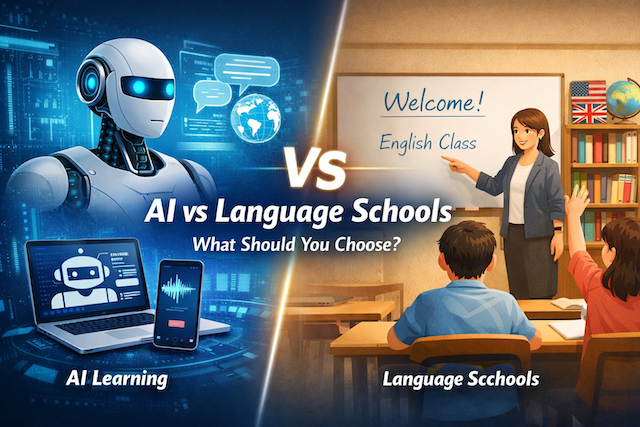
AI vs Language Schools: What Should You Choose?
Contents
- AI vs Language Schools: What Should You Choose?
- Introduction
- What Is AI Language Learning?
- What Are Language Schools?
- Advantages of AI Language Learning
- Disadvantages of AI Language Learning
- Advantages of Language Schools
- Disadvantages of Language Schools
- AI vs Language Schools: Key Differences
- Who Should Choose AI Learning?
- Who Should Choose Language Schools?
- The Best Option: Combining AI and Language Schools
- Realistic Learning Outcomes
- Final Thoughts
- FAQs (Frequently Asked Questions)
- Is AI better than a language school for learning English?
- Can AI really help improve speaking skills?
- Are language schools still worth it in the age of AI?
- Who should choose AI instead of a language school?
- Who should choose a language school instead of AI?
- Is AI cheaper than attending a language school?
- Can I combine AI and a language school?
- What should I choose if my main goal is fluency?
AI vs Language Schools: What Should You Choose?
Introduction
Learning a new language—especially English—has never been more accessible than it is today. With the rapid advancement of artificial intelligence, learners now have the option to practice speaking, writing, and listening anytime, anywhere. At the same time, traditional language schools continue to offer structured programs, immersive environments, and human interaction that many learners still value.
This raises an important question: Should you learn a language using AI tools or attend a language school?
The answer is not one-size-fits-all. Your ideal choice depends on your goals, budget, learning style, and timeline. In this article, we will break down the key differences between AI-based learning and language schools, explore their pros and cons, and help you decide which path is best for you.
What Is AI Language Learning?
AI language learning refers to using artificial intelligence tools—such as ChatGPT, speech recognition apps, and language platforms—to practice and improve your language skills.
These tools can simulate conversations, correct your grammar, provide instant feedback, and even adapt to your learning level. Many learners use AI for speaking practice, vocabulary building, pronunciation improvement, and test preparation (IELTS, TOEFL, PTE, etc.).
Key Features of AI Learning
- 24/7 availability
- Instant feedback
- Personalized learning experience
- Low or no cost
- Flexible learning pace
AI essentially acts as a virtual tutor that is always available whenever you need it.
What Are Language Schools?
Language schools are traditional educational institutions where students learn a language in a structured environment. These schools can be located in your home country or abroad (such as in the Philippines, UK, USA, or Australia).
They offer classes taught by human teachers, often combined with group activities, cultural immersion, and real-life communication practice.
Key Features of Language Schools
- Structured curriculum
- Face-to-face interaction
- Certified teachers
- Classroom environment
- Immersive experience (especially abroad)
Language schools provide a more traditional and social learning environment compared to AI tools.
Advantages of AI Language Learning
1. Flexibility and Convenience
One of the biggest advantages of AI is flexibility. You can practice anytime—early morning, late at night, or during short breaks.
There is no need to commute, schedule classes, or adjust your lifestyle. This is especially useful for busy professionals, students, or digital nomads.
2. Cost-Effective Learning
AI tools are significantly cheaper than language schools. Many platforms are free or require only a small monthly subscription.
Compared to thousands of dollars for tuition, accommodation, and travel in a language school, AI offers a budget-friendly alternative.
3. Unlimited Practice Opportunities
With AI, you can practice as much as you want without feeling embarrassed or judged.
- Repeat conversations multiple times
- Ask unlimited questions
- Practice speaking without pressure
This is particularly helpful for beginners who feel nervous speaking in front of others.
4. Personalized Learning
AI adapts to your level and learning style. You can focus on specific areas such as:
- Business English
- Exam preparation
- Daily conversation
- Pronunciation
You are not forced to follow a fixed curriculum—you learn what you need.
5. Immediate Feedback
AI provides instant corrections for grammar, vocabulary, and sentence structure.
This helps you learn faster because you can immediately understand your mistakes and improve.
Disadvantages of AI Language Learning
1. Lack of Real Human Interaction
AI cannot fully replicate human communication. Real conversations involve emotions, cultural nuances, body language, and unpredictable responses.
You may become comfortable with AI but struggle in real-life situations.
2. Limited Speaking Realism
Although AI conversations are improving, they are still controlled environments.
Real conversations are often messy, fast, and complex—something AI cannot perfectly simulate.
3. Motivation Challenges
Without a structured schedule or teacher, it can be difficult to stay consistent.
Many learners start strong but lose motivation over time.
4. No Physical Immersion
AI cannot provide real-world exposure such as:
- Talking to locals
- Navigating daily life in English
- Experiencing cultural differences
These are critical for achieving fluency.
Advantages of Language Schools
1. Real Communication Practice
Language schools provide real human interaction, which is essential for developing fluency.
You engage in:
- Group discussions
- Role-playing activities
- Real conversations with teachers and classmates
This helps you build confidence and adaptability.
2. Structured Learning Environment
A clear curriculum ensures that you progress step by step.
You don’t have to think about what to study next—the school guides you through the process.
3. Professional Guidance
Experienced teachers can:
- Identify your weaknesses
- Provide tailored feedback
- Correct pronunciation in real time
This human element is difficult to replace with AI.
4. Immersive Experience
Studying abroad offers full immersion.
You are surrounded by the language 24/7, which accelerates learning significantly.
Daily situations—ordering food, asking directions, socializing—become part of your practice.
5. Accountability and Discipline
Scheduled classes and assignments help you stay consistent.
You are more likely to stick to your learning plan compared to self-study.
Disadvantages of Language Schools
1. High Cost
Language schools can be expensive, especially if you study abroad.
Costs may include:
- Tuition fees
- Accommodation
- Flights
- Living expenses
This can easily reach thousands of dollars.
2. Fixed Schedule
You must follow a set timetable, which may not fit your lifestyle.
Missing classes can slow your progress.
3. Less Flexibility
You cannot always focus on your personal goals.
For example, if you want to improve business English, you may still need to follow general lessons.
4. Class Size Limitations
In group classes, speaking time may be limited.
You may not get as much individual attention as you want.
AI vs Language Schools: Key Differences
Learning Style
- AI: Self-paced, flexible, personalized
- Language School: Structured, guided, teacher-led
Cost
- AI: Low-cost or free
- Language School: High investment
Interaction
- AI: Simulated conversations
- Language School: Real human communication
Immersion
- AI: Limited
- Language School: High (especially abroad)
Motivation
- AI: Requires self-discipline
- Language School: Built-in accountability
Who Should Choose AI Learning?
AI is ideal for learners who:
- Have a limited budget
- Prefer flexible schedules
- Want to practice daily conversation
- Feel shy speaking with others
- Need supplementary practice
It is especially effective for:
- Beginners building confidence
- Intermediate learners improving fluency
- Test takers practicing speaking
Who Should Choose Language Schools?
Language schools are best for learners who:
- Want rapid improvement
- Need real-world communication skills
- Prefer structured learning
- Thrive in social environments
- Can invest time and money
They are particularly suitable for:
- Students preparing for study abroad
- Professionals needing business communication
- Learners aiming for near-native fluency
The Best Option: Combining AI and Language Schools
Instead of choosing one over the other, the most effective strategy is to combine both.
How to Combine Them
Before attending a language school:
- Use AI to build basic skills
- Practice speaking and vocabulary
- Gain confidence
During your studies:
- Use AI for daily review
- Practice conversations outside class
- Reinforce what you learned
After finishing school:
- Continue using AI to maintain fluency
- Practice regularly to avoid forgetting
This hybrid approach maximizes efficiency and results.
Realistic Learning Outcomes
It’s important to set realistic expectations.
- AI alone can significantly improve your confidence and accuracy
- Language schools accelerate real-world communication skills
- Combining both leads to the fastest and most balanced progress
Fluency is not just about knowing grammar—it’s about using the language naturally in real situations.
Final Thoughts
Choosing between AI and language schools depends on your personal situation.
If you value flexibility, affordability, and convenience, AI is an excellent tool. It allows you to practice consistently and improve at your own pace.
If you prioritize real interaction, immersion, and structured learning, language schools offer an environment that AI cannot fully replicate.
However, the most powerful approach is not choosing one over the other—but using both strategically.
AI can prepare you, support you, and extend your learning, while language schools provide the human experience and immersion necessary for true fluency.
In today’s world, the smartest learners don’t choose between AI and traditional methods—they combine them to create the most effective learning system possible.
FAQs (Frequently Asked Questions)
Is AI better than a language school for learning English?
AI is not automatically better than a language school, but it can be a better choice for some learners. If you need flexibility, low cost, and daily practice at any time, AI can be extremely useful. You can practice speaking, writing, vocabulary, and grammar whenever you want without commuting or following a class schedule. This makes AI attractive for busy adults, self-motivated learners, and students who want to improve steadily from home.
However, language schools still offer advantages that AI cannot fully replace. A school gives you real interaction with teachers and classmates, a structured learning path, and a more serious study environment. If your goal is fast improvement in communication, especially in speaking and listening under real conditions, a language school may be stronger. In short, AI is powerful for convenience and repetition, while language schools are stronger for human interaction and guided progress.
Can AI really help improve speaking skills?
Yes, AI can help improve speaking skills, especially for learners who need frequent practice. Many people struggle because they do not have a speaking partner, feel shy, or cannot afford private lessons. AI solves part of this problem by allowing unlimited conversation practice. You can repeat the same topic many times, ask for corrections, and practice common situations such as self-introductions, interviews, travel conversations, or test questions.
AI is especially useful for building confidence. If you are nervous about making mistakes, practicing with AI can reduce that fear. It also helps you notice grammar errors, unnatural phrases, and weak vocabulary choices. Still, AI speaking practice has limits. Real conversations are faster, less predictable, and more emotional than AI-based chats. So while AI is excellent for training and preparation, learners should also include real speaking opportunities if they want strong communication skills in everyday life.
Are language schools still worth it in the age of AI?
Yes, language schools are still worth it for many learners. Even though AI tools are improving quickly, schools provide important benefits that go beyond correction and practice. In a language school, students learn through direct human interaction. They ask spontaneous questions, hear different speaking styles, and adapt to real conversations in real time. These experiences are difficult for AI to fully copy.
Language schools are also valuable because they create structure. Many learners fail not because they lack tools, but because they lack consistency. A school gives you a fixed schedule, a curriculum, homework, and teacher support. This can be especially helpful if you need discipline or if you are preparing for study abroad, work, or immigration. AI may reduce the need for some traditional study methods, but it has not made quality language schools unnecessary. Instead, it has changed the role of schools, making them even more valuable for real-life communication, immersion, and accountability.
Who should choose AI instead of a language school?
AI is a strong choice for learners who need a flexible and affordable option. If you have a full-time job, irregular schedule, or limited budget, AI can fit into your life much more easily than a formal course. It is also ideal for learners who prefer self-study and want to focus on very specific goals, such as improving pronunciation, preparing for an interview, or practicing IELTS speaking topics.
AI may also be the right choice if you are shy. Some learners feel embarrassed when speaking in front of a teacher or classmates. Practicing with AI first can make speaking less stressful and help you become more confident before joining real conversations. That said, AI works best for people who can stay motivated on their own. Without discipline, even the best tool becomes ineffective. So AI is most suitable for independent learners who are willing to practice consistently and actively review feedback.
Who should choose a language school instead of AI?
A language school is often the better option for learners who need structure, guidance, and real communication practice. If you find it difficult to study alone or stay consistent, a school environment can help you develop better habits. Teachers can explain difficult points, correct mistakes immediately, and adjust lessons based on your progress. This kind of support can save time and reduce confusion.
Schools are also ideal for learners who want immersion. If you study in an English-speaking environment or in a place where English is used daily, you are forced to apply what you learn outside the classroom. This can accelerate progress in a way that self-study cannot easily match. In addition, students who are preparing for university, work abroad, or professional communication often benefit from live feedback and interaction. If your goal is serious communication ability rather than casual practice, a language school may be the more effective investment.
Is AI cheaper than attending a language school?
In most cases, yes. AI-based language learning is far cheaper than attending a language school. Many AI tools are free, while others require only a monthly subscription. Even paid AI platforms usually cost much less than tuition, transportation, accommodation, materials, and living expenses connected to a traditional school, especially if that school is overseas.
This lower cost is one of the biggest reasons AI has become so popular. Learners can access corrections, practice, and personalized exercises without making a large financial commitment. However, lower cost does not always mean better value for everyone. A language school may be more expensive, but it may also deliver faster improvement for learners who need structure and real interaction. So the better question is not only which one is cheaper, but which one gives you the best return based on your goals and learning style.
Can I combine AI and a language school?
Yes, and for many learners, this is the smartest strategy. AI and language schools are not enemies. They can work together very effectively. For example, before starting classes, you can use AI to build basic vocabulary, practice simple speaking, and improve your confidence. This can make your first weeks in school much easier.
During your course, AI can act as your extra study partner. You can review class material, practice conversations related to what you learned, and ask for additional explanations after class. After finishing school, AI can help you maintain your level by giving you daily practice without the cost of ongoing classes. In many cases, the best results come from combining the strengths of both: the convenience and repetition of AI with the human interaction and structure of a language school.
What should I choose if my main goal is fluency?
If fluency is your main goal, the best choice usually depends on what kind of fluency you want and how quickly you want to improve. AI can help you develop speaking habits, sentence-building ability, vocabulary recall, and confidence. It is excellent for daily repetition and for reducing hesitation. If used seriously, it can produce meaningful improvement.
But real fluency usually requires exposure to unpredictable human communication. You need to understand different accents, react naturally, manage misunderstandings, and keep conversations going in real time. That is where language schools or real human interaction become very important. For most learners, the strongest path to fluency is a combination: use AI for daily training and use real classes, tutors, or immersion for authentic communication. Fluency grows fastest when practice is both frequent and real.
How to Improve English Speaking Using AI Apps (Complete Guide 2026)

How to Register for eTravel Philippines (2025 Guide)
Step-by-step guide to completing your eTravel registration before arriving in the Philippines, with images and tips.

Night Market in Cebu – Things You Don’t Know About Cebu Life
Discover the hidden charm of Cebu’s night markets, from street food stalls to local life tips you won’t find in tourist guides.

How to Use ChatGPT for IELTS Preparation: A Complete Guide
Learn how to prepare for IELTS using ChatGPT — including strategies for Writing, Reading, Listening, Speaking, and grammar support.

How to Build a Website Without Coding Using ChatGPT
Discover how to build your own website using AI—no coding skills needed. From structure planning to SEO and design, let ChatGPT guide you.