2026年3月30日
3D ACADEMY offers affordable English study programs in Cebu, Philippines – perfect for beginners, professionals, and exam takers.

3D UNIVERSAL ENGLISH INSTITUTE INC
info.3d-universal.com
8:00-17:00(Mon-Fri)
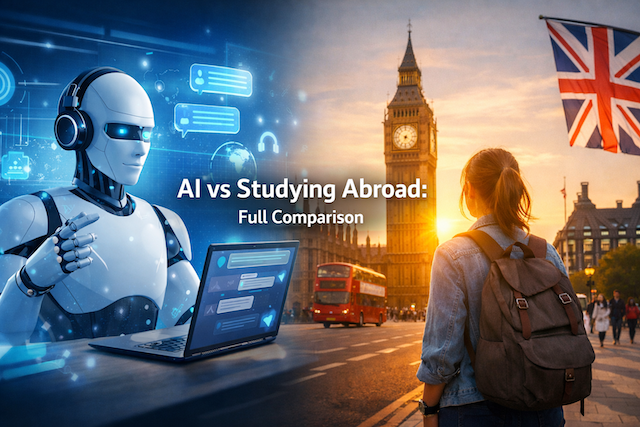
AI vs Studying Abroad: Full Comparison
Contents
- AI vs Studying Abroad: Full Comparison
- Introduction
- What Is AI-Based English Learning?
- What Is Studying Abroad?
- Cost Comparison
- Speaking Practice and Fluency
- Learning Speed and Efficiency
- Flexibility and Convenience
- Cultural Experience
- Motivation and Discipline
- Personalization and Feedback
- Real-World Preparedness
- Long-Term Impact
- Who Should Choose AI?
- Who Should Choose Studying Abroad?
- Can You Combine Both?
- Final Verdict: Which Is Better?
- Conclusion
- FAQs (Frequently Asked Questions)
- Is AI better than studying abroad for learning English?
- Can AI help me become fluent in English without going abroad?
- Why do some people still prefer studying abroad over AI tools?
- Is AI cheaper than studying abroad?
- Does studying abroad guarantee better English results?
- How should I choose between AI and studying abroad?
AI vs Studying Abroad: Full Comparison
Introduction
In recent years, the way people learn English has changed dramatically. With the rapid development of artificial intelligence (AI), learners now have access to powerful tools that can simulate conversations, correct grammar instantly, and provide personalized learning experiences. At the same time, studying abroad has long been considered one of the most effective ways to achieve fluency through real-world immersion.
So, which is better: AI or studying abroad?
The answer is not as simple as choosing one over the other. Both options offer unique advantages and limitations, and the best choice depends on your goals, budget, lifestyle, and learning preferences.
In this article, we will provide a full comparison between AI-based English learning and studying abroad, covering key factors such as cost, effectiveness, speaking ability, flexibility, and long-term outcomes.
What Is AI-Based English Learning?
AI-based English learning refers to using artificial intelligence tools such as ChatGPT, speech recognition apps, and AI tutors to practice and improve language skills.
These tools can:
- Simulate real conversations
- Provide instant grammar corrections
- Offer pronunciation feedback
- Create personalized learning plans
- Adapt to your level and pace
Unlike traditional methods, AI is available 24/7 and can be used anywhere, making it highly accessible for learners worldwide.
What Is Studying Abroad?
Studying abroad involves traveling to an English-speaking country (or a country with English-language education) to learn English through immersion.
This typically includes:
- Attending language schools
- Living in dormitories or with host families
- Interacting with native speakers daily
- Experiencing a different culture
Studying abroad is often considered the “gold standard” of language learning because it forces learners to use English in real-life situations.
Cost Comparison
AI Learning Costs
One of the biggest advantages of AI is affordability.
Typical costs:
- Many AI tools are free or low-cost
- Premium subscriptions range from $10 to $50 per month
- No travel or accommodation expenses
Overall, AI learning is extremely cost-efficient and accessible to almost anyone.
Studying Abroad Costs
Studying abroad is significantly more expensive.
Typical expenses include:
- Tuition fees: $1,000–$3,000+ per month
- Accommodation: $500–$1,500 per month
- Flights and visa fees
- Daily living expenses
A short-term program (1–3 months) can easily cost several thousand dollars, while long-term programs can reach tens of thousands.
Conclusion on Cost
AI is clearly the winner in terms of cost. If budget is a major concern, AI provides an affordable alternative to traditional immersion.
Speaking Practice and Fluency
AI for Speaking Practice
AI has made huge improvements in speaking practice.
Advantages:
- Unlimited conversation practice
- No fear of embarrassment
- Instant feedback on grammar and vocabulary
- Customizable scenarios (interviews, travel, business, etc.)
However, limitations include:
- Lack of real human emotions
- Limited unpredictability
- No real social pressure
Studying Abroad for Speaking
Studying abroad provides real-world communication.
Advantages:
- Daily interaction with real people
- Exposure to different accents and speaking styles
- Natural conversations in unpredictable situations
- Emotional and cultural context
Challenges:
- Fear or anxiety when speaking
- Limited speaking opportunities depending on environment
- Possible reliance on native language if surrounded by same-country peers
Conclusion on Speaking
Studying abroad offers more authentic speaking experience, but AI provides more consistent and low-pressure practice. Ideally, combining both yields the best results.
Learning Speed and Efficiency
AI Learning Speed
AI is highly efficient because:
- It adapts to your level instantly
- You can focus on weak areas
- No time wasted on commuting or schedules
- Immediate corrections accelerate learning
You can practice intensively every day without constraints.
Studying Abroad Learning Speed
Studying abroad can be fast, but depends on:
- Your effort and mindset
- Your environment (English-only vs same-language community)
- Quality of the school
Some learners improve rapidly, while others plateau if they stay in comfort zones.
Conclusion on Efficiency
AI often wins in efficiency because of personalization and consistency. Studying abroad can be powerful, but results vary greatly.
Flexibility and Convenience
AI Flexibility
AI is unmatched in flexibility:
- Available anytime, anywhere
- No fixed schedule
- Learn at your own pace
- Easily integrated into daily routine
You can study for 10 minutes or 3 hours depending on your availability.
Studying Abroad Flexibility
Studying abroad is less flexible:
- Fixed class schedules
- Visa restrictions
- Time commitment (weeks or months)
- Requires relocation
It demands a major life adjustment.
Conclusion on Flexibility
AI is clearly superior in flexibility and convenience.
Cultural Experience
AI Learning
AI cannot provide cultural immersion. While it can simulate scenarios and explain cultural norms, it lacks real-life experience.
Studying Abroad
This is where studying abroad excels.
Benefits include:
- Experiencing daily life in another country
- Understanding cultural nuances
- Building global perspectives
- Developing independence
These experiences go beyond language learning and contribute to personal growth.
Conclusion on Culture
Studying abroad is unmatched when it comes to cultural experience.
Motivation and Discipline
AI Learning
AI requires self-discipline.
Challenges:
- No external pressure
- Easy to procrastinate
- Lack of structured environment
However, motivated learners can make significant progress.
Studying Abroad
Studying abroad provides:
- Structured schedules
- Social accountability
- Immersive environment
These factors naturally increase motivation and consistency.
Conclusion on Motivation
Studying abroad offers stronger external motivation, while AI depends on internal discipline.
Personalization and Feedback
AI Personalization
AI excels in personalization:
- Tailored lessons
- Instant corrections
- Adaptive difficulty
- Continuous feedback
It can function like a private tutor.
Studying Abroad Feedback
Feedback depends on:
- Teacher quality
- Class size
- Individual attention
In group classes, personalized feedback may be limited.
Conclusion on Feedback
AI often provides more consistent and personalized feedback than traditional classrooms.
Real-World Preparedness
AI Learning
AI helps with:
- Structured conversations
- Vocabulary building
- Grammar accuracy
But it may not fully prepare learners for:
- Fast-paced conversations
- Slang and informal language
- Social dynamics
Studying Abroad
Studying abroad prepares you for real-world situations:
- Ordering food
- Making friends
- Handling unexpected situations
- Understanding natural speech
Conclusion on Preparedness
Studying abroad better prepares learners for real-life communication.
Long-Term Impact
AI Learning Impact
AI is excellent for:
- Continuous improvement
- Daily practice
- Maintaining fluency
It can be used indefinitely at low cost.
Studying Abroad Impact
Studying abroad creates:
- Strong foundational experience
- Confidence boost
- Life-changing memories
However, without continued practice, skills may decline over time.
Conclusion on Long-Term Impact
AI is better for long-term consistency, while studying abroad provides a strong initial boost.
Who Should Choose AI?
AI is ideal for:
- Budget-conscious learners
- Busy professionals
- Self-motivated individuals
- Beginners who need confidence
- Learners without access to native speakers
If you prefer flexibility and affordability, AI is a powerful solution.
Who Should Choose Studying Abroad?
Studying abroad is ideal for:
- Learners seeking full immersion
- Those who want cultural experience
- People who struggle with self-discipline
- Students preparing for international careers
- Learners aiming for rapid real-world adaptation
If you want a life-changing experience, studying abroad is worth considering.
Can You Combine Both?
Yes—and this is actually the most effective approach.
A smart strategy:
- Use AI before studying abroad to build basic skills
- Study abroad to gain real-world experience
- Continue using AI afterward to maintain and improve
This hybrid approach maximizes both efficiency and authenticity.
Final Verdict: Which Is Better?
There is no universal “better” option.
- Choose AI if you want affordability, flexibility, and consistent practice
- Choose studying abroad if you want immersion, cultural experience, and real-world communication
However, the best results often come from combining both.
AI is transforming language learning, but it does not fully replace the human and cultural elements of studying abroad. At the same time, studying abroad alone is no longer the only path to fluency.
The future of English learning lies in using AI strategically—whether you stay at home or travel abroad.
Conclusion
The debate between AI and studying abroad is not about choosing one over the other, but understanding how each method fits your goals.
AI offers accessibility, efficiency, and personalization, making it a revolutionary tool for modern learners. Studying abroad provides immersion, cultural depth, and real-life communication that AI cannot fully replicate.
By understanding the strengths and limitations of both, you can create a learning strategy that works best for you—and ultimately achieve true English fluency.
FAQs (Frequently Asked Questions)
Is AI better than studying abroad for learning English?
AI is not automatically better than studying abroad, but it can be a better option for some learners depending on their goals, budget, and lifestyle. AI is usually more affordable, more flexible, and easier to access every day. You can practice speaking, writing, grammar, pronunciation, and vocabulary at any time without traveling or changing your daily routine. This makes AI a practical solution for learners who want regular English practice from home.
Studying abroad, however, offers a level of real-life immersion that AI still cannot fully reproduce. When you live in another country, you must use English in daily situations such as shopping, commuting, asking for help, and meeting new people. These real interactions can build confidence and adaptability in ways that feel more natural and emotionally meaningful.
In reality, the better choice depends on what you need most. If you want convenience and low cost, AI may be better. If you want cultural immersion and real-world communication, studying abroad may be better. For many learners, the strongest approach is to use both.
Can AI help me become fluent in English without going abroad?
Yes, AI can help you make major progress in English fluency without going abroad, especially if you use it consistently and actively. Many learners improve their speaking, listening, vocabulary, and sentence formation by practicing with AI every day. AI can simulate conversations, correct mistakes instantly, explain grammar simply, and generate endless practice topics based on your level.
That said, fluency is not only about knowing words and grammar. It also involves responding naturally, understanding different speaking styles, handling unexpected situations, and feeling comfortable in real conversations. AI can support these skills to a certain extent, but it may not fully replace the experience of talking to real people in unpredictable environments.
So yes, AI can take you very far, especially when used well. But to become truly comfortable in real-world English, it is helpful to also include human interaction, such as online speaking partners, tutors, group classes, or travel experience if possible.
Why do some people still prefer studying abroad over AI tools?
Many people still prefer studying abroad because it provides immersion, structure, and real human interaction. Even though AI tools are powerful, studying abroad places learners in situations where English becomes part of everyday life. They hear it in shops, schools, transport, restaurants, and conversations with classmates or local residents. This constant exposure helps learners think faster and react more naturally.
Another reason is motivation. Some learners find it easier to stay committed when they are in a physical school environment with teachers, classmates, and clear schedules. Being surrounded by English also creates a sense of urgency that can push learners to grow faster.
Studying abroad also offers cultural learning and personal development. Learners often gain independence, confidence, and broader perspectives while living in a new place. These benefits are difficult to duplicate through a screen. Even if AI is highly useful, some people want an experience that changes both their language ability and their life outlook.
Is AI cheaper than studying abroad?
Yes, AI is generally much cheaper than studying abroad. Many AI tools are free or available through low monthly subscription fees. Even premium platforms are usually far less expensive than airfare, tuition, accommodation, insurance, visa costs, and daily living expenses in another country. For learners on a tight budget, AI makes English practice much more accessible.
Studying abroad often requires a major financial commitment. Even short programs can cost a significant amount when all expenses are included. In contrast, AI can be used from home with only an internet connection and a device. This allows learners to invest in daily practice without the heavy financial pressure of relocation.
Cost does not always decide which method is better, but it matters. If affordability is one of your top priorities, AI is usually the clear winner. It gives learners the chance to practice consistently over a long period of time without spending as much money.
Does studying abroad guarantee better English results?
No, studying abroad does not guarantee better results. Many people assume that going overseas automatically leads to fluency, but this is not always true. A learner’s progress still depends on effort, habits, mindset, and the environment they create. Some students go abroad and improve quickly because they speak English often, make local friends, and challenge themselves. Others spend a lot of time with people from their own country and use their native language most of the day.
In other words, immersion creates opportunity, but not automatic success. If a learner avoids real interaction or stays inside a comfort zone, studying abroad may be less effective than expected. Meanwhile, a highly motivated learner using AI every day may make faster progress than someone abroad who practices very little.
Studying abroad can be powerful, but it works best when learners actively use the environment around them. The results come from action, not just location.
How should I choose between AI and studying abroad?
You should choose based on your goals, budget, schedule, and learning style. If you need affordable, flexible, and personalized practice, AI is probably the better starting point. It works well for busy adults, independent learners, and students who want to improve from home. It is also useful if you want to prepare before taking a language course or traveling overseas later.
If you want cultural immersion, real-life communication, and a more structured environment, studying abroad may be a better fit. It is especially valuable for learners who want a life experience in addition to language training.
You do not always need to choose only one. A practical strategy is to use AI first to build a strong foundation, then study abroad later if you want deeper immersion. You can also continue using AI after your overseas experience to maintain your progress. The best method is the one you can continue consistently and use with purpose.
How to Improve English Speaking Using AI Apps (Complete Guide 2026)

How to Register for eTravel Philippines (2025 Guide)
Step-by-step guide to completing your eTravel registration before arriving in the Philippines, with images and tips.

Night Market in Cebu – Things You Don’t Know About Cebu Life
Discover the hidden charm of Cebu’s night markets, from street food stalls to local life tips you won’t find in tourist guides.

How to Use ChatGPT for IELTS Preparation: A Complete Guide
Learn how to prepare for IELTS using ChatGPT — including strategies for Writing, Reading, Listening, Speaking, and grammar support.

How to Build a Website Without Coding Using ChatGPT
Discover how to build your own website using AI—no coding skills needed. From structure planning to SEO and design, let ChatGPT guide you.