2026年3月30日
3D ACADEMY offers affordable English study programs in Cebu, Philippines – perfect for beginners, professionals, and exam takers.

3D UNIVERSAL ENGLISH INSTITUTE INC
info.3d-universal.com
8:00-17:00(Mon-Fri)
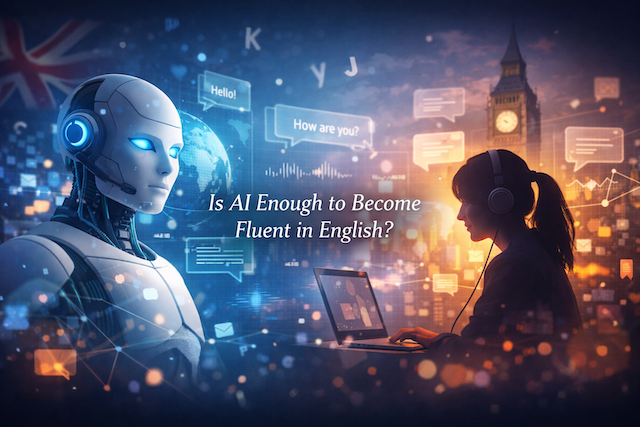
Is AI Enough to Become Fluent in English?
Contents
- Is AI Enough to Become Fluent in English?
- Introduction
- What Does “Fluency” Really Mean?
- What AI Does Extremely Well
- Where AI Falls Short
- Can You Become Fluent Using Only AI?
- The Ideal Approach: AI + Real Practice
- Common Mistakes When Using AI
- How Fast Can AI Help You Become Fluent?
- The Future of AI in Language Learning
- Final Verdict
- Conclusion
- FAQs (Frequently Asked Questions)
- Can AI really help me become fluent in English?
- Is AI alone enough to become fully fluent in English?
- What kind of English practice can AI provide?
- What are the biggest advantages of learning English with AI?
- What are the limitations of AI for English fluency?
- How should I use AI if I want to improve my speaking skills?
- Can AI help with pronunciation and listening too?
- What is the best strategy: AI only or AI plus real-world practice?
Is AI Enough to Become Fluent in English?
Introduction
Artificial Intelligence (AI) has transformed the way people learn languages, especially English. With tools like ChatGPT, speech recognition apps, AI tutors, and real-time translation systems, learners now have access to resources that were unimaginable just a decade ago. You can practice speaking anytime, get instant feedback, and simulate conversations without needing a human partner.
But an important question remains: Is AI alone enough to become truly fluent in English?
The short answer is: AI is powerful, but not always sufficient on its own. In this article, we will explore what AI can do, where it falls short, and how you can use it effectively to achieve real fluency.
What Does “Fluency” Really Mean?
Before evaluating AI, we need to define fluency. Many learners misunderstand this concept.
Fluency is not just:
- Knowing thousands of words
- Understanding grammar rules
- Passing an exam
True fluency means:
- Speaking naturally without long pauses
- Understanding real conversations at normal speed
- Expressing ideas clearly and confidently
- Adapting language depending on context
Fluency is about communication, not perfection.
This distinction is important because AI tools often focus on correctness, while real-life communication involves emotion, nuance, and unpredictability.
What AI Does Extremely Well
AI has several major advantages that make it one of the best language learning tools available today.
1. Unlimited Practice Anytime
One of the biggest barriers to learning English is the lack of practice opportunities. AI removes this completely.
You can:
- Practice conversations 24/7
- Repeat the same scenario multiple times
- Learn at your own pace
Unlike human partners, AI never gets tired or impatient. This consistency is incredibly valuable for building confidence.
2. Instant Feedback
AI can instantly correct:
- Grammar mistakes
- Sentence structure
- Vocabulary usage
- Pronunciation (with voice tools)
For example, if you say:
“I go to shopping yesterday”
AI can immediately correct it to:
“I went shopping yesterday.”
This real-time feedback accelerates learning dramatically.
3. Personalized Learning
AI adapts to your level. It can:
- Simplify language for beginners
- Provide advanced expressions for higher-level learners
- Focus on specific goals (IELTS, business English, travel English)
This level of customization is difficult to achieve in traditional classrooms.
4. Safe Environment for Practice
Many learners feel embarrassed speaking English in front of others. AI creates a judgment-free environment.
You can:
- Make mistakes freely
- Try new expressions
- Build confidence gradually
This psychological safety is crucial, especially for beginners.
5. Exposure to Diverse Topics
AI can simulate conversations on almost any topic:
- Business meetings
- Travel situations
- Casual conversations
- Academic discussions
This helps learners expand vocabulary and adapt to different contexts.
Where AI Falls Short
Despite its strengths, AI has limitations that prevent it from fully replacing real-world interaction.
1. Lack of Real Human Emotion
AI can simulate conversations, but it does not truly feel emotions.
Real communication includes:
- Tone and emotion
- Cultural nuances
- Subtle reactions
For example:
A real person might show confusion, excitement, or sarcasm in ways that AI cannot fully replicate.
Fluency requires understanding these emotional layers.
2. Predictability of Conversations
AI conversations are often structured and predictable.
In real life:
- People interrupt
- Conversations change direction suddenly
- Accents vary widely
- Background noise exists
These unpredictable elements are essential for developing real-world listening and speaking skills.
3. Limited Cultural Context
Language is deeply connected to culture.
AI may not fully teach:
- Humor and idioms in real context
- Social norms
- Cultural references
For example:
Understanding jokes or sarcasm often requires cultural awareness, not just vocabulary.
4. Passive Learning Risk
Some learners rely too much on AI corrections without actively thinking.
For example:
- Copying AI responses instead of creating your own
- Accepting corrections without understanding why
This can slow down long-term progress.
5. No Real Communication Pressure
In real conversations, there is pressure:
- You must respond quickly
- You cannot pause for long
- You must handle misunderstandings
AI allows unlimited time, which can create a gap between practice and real-life performance.
Can You Become Fluent Using Only AI?
Technically, it is possible to reach a high level using AI alone, especially if you:
- Practice consistently
- Speak actively (not just read/write)
- Challenge yourself with complex conversations
However, complete fluency usually requires real-world interaction.
Why?
Because fluency is not just about language knowledge—it is about real communication under real conditions.
AI can take you to an advanced level, but without human interaction, you may struggle with:
- Natural conversation flow
- Understanding accents
- Handling unexpected responses
The Ideal Approach: AI + Real Practice
The most effective strategy is to combine AI with real-world practice.
Step 1: Build Foundation with AI
Use AI for:
- Daily speaking practice
- Grammar correction
- Vocabulary expansion
- Structured conversation exercises
This builds confidence and accuracy.
Step 2: Transition to Real Conversations
Then gradually include:
- Language exchange partners
- Online speaking sessions
- Real-life conversations
This introduces unpredictability and emotional context.
Step 3: Simulate Real Scenarios with AI
Before real interactions, use AI to prepare:
Examples:
- Job interview practice
- Travel conversations
- Presentations
This reduces anxiety and improves performance.
Step 4: Reflect and Improve
After real conversations:
- Review mistakes with AI
- Practice corrected sentences
- Repeat scenarios
This creates a powerful feedback loop.
Common Mistakes When Using AI
To maximize results, avoid these common mistakes.
1. Only Reading Instead of Speaking
Fluency requires speaking. Always:
- Say answers out loud
- Practice pronunciation
- Use voice-based AI tools
2. Over-Reliance on AI Corrections
Do not just accept corrections. Ask:
- Why is this wrong?
- What is the rule?
- Can I use this in another sentence?
3. Avoiding Difficulty
Many learners stay in their comfort zone.
Instead:
- Practice challenging topics
- Use advanced vocabulary
- Simulate real-life stress
4. Inconsistent Practice
AI works best with daily use.
Even 20–30 minutes per day can lead to significant progress over time.
How Fast Can AI Help You Become Fluent?
The speed depends on:
- Your starting level
- Daily practice time
- Learning method
With consistent AI-based practice:
- Beginner to intermediate: 3–6 months
- Intermediate to advanced: 6–12 months
However, reaching natural fluency usually requires real-world exposure.
The Future of AI in Language Learning
AI is improving rapidly. Future developments may include:
- More realistic voice interactions
- Better emotional understanding
- Real-time conversation simulations with higher unpredictability
As AI evolves, the gap between AI practice and real-life communication will continue to shrink.
But even then, human interaction will likely remain an essential part of true fluency.
Final Verdict
So, is AI enough to become fluent in English?
AI is powerful enough to take you very far—but not all the way on its own.
It excels at:
- Practice
- Feedback
- Personalization
- Confidence building
But it cannot fully replace:
- Real human interaction
- Emotional communication
- Cultural understanding
Conclusion
AI has revolutionized English learning, making it more accessible, flexible, and efficient than ever before. For many learners, it can serve as a primary tool to build strong speaking skills and confidence.
However, fluency is ultimately about real communication with real people.
The best path forward is not choosing between AI and human interaction—but combining both strategically.
If you use AI wisely and consistently, while gradually introducing real-world practice, you can achieve true fluency faster than ever before.
The key is simple:
Use AI to prepare. Use people to master.
FAQs (Frequently Asked Questions)
Can AI really help me become fluent in English?
Yes, AI can help you make major progress toward fluency in English. It can provide daily conversation practice, grammar correction, vocabulary support, pronunciation feedback, and personalized learning activities. For many learners, AI removes the biggest barrier in language learning: the lack of a practice partner. You can use AI anytime, repeat the same lesson as often as you want, and focus on your weak points without feeling embarrassed. This makes AI especially useful for beginners and intermediate learners who need more speaking exposure.
However, AI is most effective when it is used as a tool for active learning. If you only read AI responses without speaking, thinking, or creating your own sentences, your progress will be limited. AI can guide you, but you still need to do the real work of practicing and building communication habits.
Is AI alone enough to become fully fluent in English?
AI alone can help you reach a strong level of English, but for most people, it is not enough for complete fluency. True fluency includes more than grammar and vocabulary. It also involves understanding emotions, reacting naturally, handling interruptions, catching humor, and communicating with real people in unpredictable situations. AI can simulate many of these things, but it still cannot fully replace the complexity of human interaction.
If your goal is practical fluency for travel, work, study, or daily conversation, AI can take you very far. But if you want natural, confident, real-world fluency, it is better to combine AI practice with actual conversations, listening to native and non-native speakers, and exposure to real communication.
What kind of English practice can AI provide?
AI can support many types of English practice. You can use it for speaking practice, role plays, interview preparation, pronunciation work, grammar review, vocabulary expansion, and writing correction. It can act like a teacher, conversation partner, debate partner, or examiner depending on your goals. For example, you can ask AI to simulate a restaurant conversation, a job interview, a business meeting, or an IELTS speaking test.
It is also useful for reviewing mistakes. After you speak or write, AI can show you more natural ways to express your ideas. This helps you learn not only what is wrong, but also how to sound smoother and more confident in English.
What are the biggest advantages of learning English with AI?
The biggest advantage is convenience. AI is available anytime, so you do not need to wait for a class or find a speaking partner. Another major advantage is instant feedback. Instead of waiting for a teacher to review your work, you can get corrections immediately. AI is also flexible. It can adapt to your level, your goals, and your interests, whether you want to improve business English, travel English, or exam speaking skills.
Another benefit is confidence. Many learners are afraid of making mistakes in front of people. AI creates a low-pressure environment where you can practice freely. This allows you to build speaking habits and reduce anxiety before moving into real conversations.
What are the limitations of AI for English fluency?
AI has clear limitations. It does not fully recreate real human emotion, spontaneous reactions, or social pressure. Real conversations are often messy. People speak quickly, use slang, interrupt each other, change topics suddenly, and speak with different accents. AI practice is helpful, but it can feel more organized and predictable than real life.
Another limitation is cultural understanding. Fluency is not just about language accuracy. It also includes knowing when something sounds polite, casual, funny, serious, or awkward. AI can explain these things, but real-world experience is still important for truly understanding them.
How should I use AI if I want to improve my speaking skills?
The best way is to use AI actively, not passively. Speak out loud instead of typing all your answers. Ask AI to correct your grammar, improve your vocabulary, and suggest more natural expressions. You can also ask it to challenge you with follow-up questions so the conversation feels less controlled and more realistic.
It is also smart to practice the same topic in different ways. For example, first explain your opinion in simple English, then try again using more advanced vocabulary. This repeated practice builds fluency much faster than just reading explanations.
Can AI help with pronunciation and listening too?
Yes, many AI-powered tools can help with pronunciation and listening. Voice tools can analyze how clearly you pronounce words and highlight sounds that need improvement. Some apps also compare your speech to native patterns, which can help you notice stress, rhythm, and intonation problems.
For listening, AI can generate conversations, summarize audio, explain difficult expressions, and create listening practice based on your level. Still, it is important to listen to real English from videos, podcasts, interviews, and everyday conversations because real speech includes accents, speed changes, and natural expressions that are hard to simulate perfectly.
What is the best strategy: AI only or AI plus real-world practice?
The best strategy is AI plus real-world practice. Use AI to build your foundation, improve accuracy, and practice every day. Then use real conversations to develop flexibility, confidence, and natural communication skills. This combination is powerful because AI gives you unlimited preparation, while real people give you authentic experience.
A practical method is simple: practice with AI daily, then apply what you learn in live conversations whenever possible. After that, return to AI to review mistakes and strengthen weak areas. This cycle can speed up your progress and make your English much more natural over time.
How to Improve English Speaking Using AI Apps (Complete Guide 2026)

How to Register for eTravel Philippines (2025 Guide)
Step-by-step guide to completing your eTravel registration before arriving in the Philippines, with images and tips.

Night Market in Cebu – Things You Don’t Know About Cebu Life
Discover the hidden charm of Cebu’s night markets, from street food stalls to local life tips you won’t find in tourist guides.

How to Use ChatGPT for IELTS Preparation: A Complete Guide
Learn how to prepare for IELTS using ChatGPT — including strategies for Writing, Reading, Listening, Speaking, and grammar support.

How to Build a Website Without Coding Using ChatGPT
Discover how to build your own website using AI—no coding skills needed. From structure planning to SEO and design, let ChatGPT guide you.