2026年1月5日
3D ACADEMY offers affordable English study programs in Cebu, Philippines – perfect for beginners, professionals, and exam takers.

3D UNIVERSAL ENGLISH INSTITUTE INC
info.3d-universal.com
8:00-17:00(Mon-Fri)
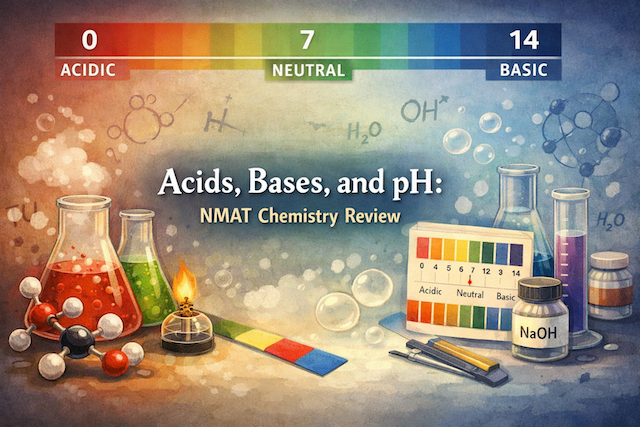
Acids, Bases, and pH: NMAT Chemistry Review
Contents
- Acids, Bases, and pH: NMAT Chemistry Review
- Why Acids and Bases Matter for the NMAT
- Core Definitions: What Is an Acid or a Base?
- Arrhenius Concept
- Brønsted–Lowry Concept
- Lewis Concept
- Conjugate Acid–Base Pairs
- Water Autoionization and the Meaning of Kw
- pH, pOH, and Logarithms You Must Know
- Strong Acids and Strong Bases
- Weak Acids and Weak Bases
- The Ka–Kb Relationship and Conjugates
- Calculating pH of Strong Acid and Strong Base Solutions
- Calculating pH of Weak Acid Solutions
- Calculating pH of Weak Base Solutions
- Polyprotic Acids and Stepwise Dissociation
- Neutralization Reactions and Titration Basics
- Salt Hydrolysis: Why Some Salts Change pH
- Buffers: The NMAT High-Yield Topic
- Buffer Capacity and Choosing an Effective Buffer
- Common Ion Effect and Acid–Base Equilibria
- Indicators and pH Ranges
- Quick NMAT Strategy Checklist
- Common Mistakes to Avoid
- Summary
- Acids, Bases, and pH: Problem Set with Answer Key (NMAT Chemistry)
- Instructions
- Problem Set
- 1. pH of a Strong Acid
- 2. pOH and pH Conversion
- 3. Strong Base with Multiple Hydroxides
- 4. Identifying a Brønsted–Lowry Base
- 5. Conjugate Base
- 6. Ka and pKa
- 7. Ka–Kb Relationship
- 8. pH of a Weak Acid (Approximation)
- 9. pH of a Weak Base (Approximation)
- 10. Buffer Concept
- 11. Henderson–Hasselbalch
- 12. Changing Buffer Ratio
- 13. Salt Hydrolysis (Basic Salt)
- 14. Salt Hydrolysis (Acidic Salt)
- 15. Neutralization Stoichiometry
- 16. Titration Equivalence Point (Strong/Strong)
- 17. Titration Equivalence Point (Weak Acid/Strong Base)
- 18. pH Calculation After Mixing Strong Acid and Strong Base
- 19. Amphoteric Substance
- 20. Lewis Acid Identification
- Answer Key with Brief Explanations
- 1. Correct Answer: B
- 2. Correct Answer: C
- 3. Correct Answer: B
- 4. Correct Answer: B
- 5. Correct Answer: B
- 6. Correct Answer: A
- 7. Correct Answer: B
- 8. Correct Answer: C
- 9. Correct Answer: C
- 10. Correct Answer: C
- 11. Correct Answer: A
- 12. Correct Answer: C
- 13. Correct Answer: C
- 14. Correct Answer: B
- 15. Correct Answer: B
- 16. Correct Answer: C
- 17. Correct Answer: C
- 18. Correct Answer: A
- 19. Correct Answer: C
- 20. Correct Answer: C
Acids, Bases, and pH: NMAT Chemistry Review
Why Acids and Bases Matter for the NMAT
Acids and bases appear frequently in NMAT Chemistry because they connect several key ideas: equilibrium, logarithms, solution chemistry, buffers, and basic stoichiometry. Many NMAT questions are designed to test whether you can move smoothly between concepts such as pH, dissociation, conjugate pairs, and neutralization reactions without getting lost in definitions. If you master the “core toolkit” (definitions, strong vs. weak behavior, equilibrium expressions, and buffer logic), you can solve most acid–base questions efficiently.
This review covers the major theories of acids and bases, how to interpret pH and pOH, how strong and weak acids behave differently, and how buffers resist pH changes. It also emphasizes NMAT-style thinking: recognizing what is being asked, selecting the simplest method, and avoiding common traps.
Core Definitions: What Is an Acid or a Base?
Acid–base chemistry has several definitions. On the NMAT, you should be comfortable with all three major frameworks and know when each is useful.
Arrhenius Concept
In the Arrhenius model, an acid increases the concentration of hydrogen ions (H+) in water, while a base increases hydroxide ions (OH−) in water. For example, hydrochloric acid (HCl) in water produces H+ (more precisely H3O+) and Cl−. Sodium hydroxide (NaOH) dissociates to give Na+ and OH−.
This definition is straightforward but limited because it focuses on aqueous solutions and does not explain bases like ammonia (NH3) well unless you describe its reaction with water.
Brønsted–Lowry Concept
The Brønsted–Lowry definition is broader: an acid is a proton donor, and a base is a proton acceptor. This model explains many reactions in water and beyond. For example, NH3 is a base because it accepts a proton from water:
NH3 + H2O ⇌ NH4+ + OH−
In this reaction, water acts as an acid (it donates a proton), and ammonia acts as a base (it accepts a proton). This highlights an NMAT favorite concept: water is amphoteric (it can act as an acid or a base depending on the reaction partner).
Lewis Concept
In the Lewis definition, an acid is an electron pair acceptor and a base is an electron pair donor. This is especially useful for reactions that do not involve protons directly. For example, BF3 is a Lewis acid because boron has an incomplete octet and can accept an electron pair. NH3 is a Lewis base because nitrogen has a lone pair it can donate.
On the NMAT, Lewis acid–base questions sometimes appear in coordination chemistry or in conceptual questions where the “acid” is not a proton donor. If you see something like AlCl3, BF3, or metal cations interacting with lone-pair donors, think Lewis.
Conjugate Acid–Base Pairs
A conjugate acid–base pair differs by one proton. When an acid donates a proton, it becomes its conjugate base. When a base accepts a proton, it becomes its conjugate acid.
- HCl (acid) → Cl− (conjugate base)
- NH3 (base) → NH4+ (conjugate acid)
- H2CO3 (acid) → HCO3− (conjugate base)
A key relationship: the stronger the acid, the weaker its conjugate base. Strong acids have conjugate bases that are very weak (they do not readily accept protons). Weak acids have conjugate bases with more noticeable basicity.
Water Autoionization and the Meaning of Kw
Even pure water contains a small amount of ions due to autoionization:
2H2O ⇌ H3O+ + OH−
The equilibrium constant for this process is:
Kw = [H3O+][OH−]
At 25°C, Kw = 1.0 × 10⁻¹⁴. In neutral water at 25°C, [H3O+] = [OH−] = 1.0 × 10⁻⁷ M. This leads directly to pH 7 as “neutral” at 25°C.
NMAT caution: neutrality depends on temperature because Kw changes with temperature. If the exam includes temperature context, “neutral pH” might not be exactly 7.
pH, pOH, and Logarithms You Must Know
pH is defined as:
pH = −log[H+] (or −log[H3O+])
pOH is:
pOH = −log[OH−]
At 25°C:
- pH + pOH = 14
- pKw = 14
Because pH is logarithmic, a change of 1 pH unit corresponds to a tenfold change in [H+]. A solution of pH 3 has 10 times more hydrogen ion concentration than pH 4, and 100 times more than pH 5.
You should be able to convert quickly:
- If pH = 2, then [H+] = 1 × 10⁻² M
- If [H+] = 3.2 × 10⁻⁵, pH ≈ 4.49 (because −log(3.2) ≈ −0.51, and −log(10−5) = 5)
On the NMAT, approximations are often enough. If you know common logs (log 2 ≈ 0.30, log 3 ≈ 0.48, log 5 ≈ 0.70), you can estimate pH without a calculator.
Strong Acids and Strong Bases
Strong acids dissociate essentially completely in water. That means the [H+] is approximately equal to the initial acid concentration (for monoprotic strong acids). Common strong acids include:
- HCl
- HBr
- HI
- HNO3
- HClO4
- H2SO4 (strong in its first dissociation)
Strong bases also dissociate completely. These include alkali metal hydroxides (NaOH, KOH) and some alkaline earth hydroxides (Ca(OH)2, Ba(OH)2), though solubility can matter for the latter.
NMAT trap: if the base produces more than one OH− per formula unit, you must multiply. For example, 0.10 M Ca(OH)2 can produce up to 0.20 M OH− (if fully dissolved).
Weak Acids and Weak Bases
Weak acids only partially dissociate. Their behavior is described by an equilibrium constant Ka:
HA + H2O ⇌ H3O+ + A−
Ka = ([H3O+][A−])/[HA]
Weak bases are described by Kb:
B + H2O ⇌ BH+ + OH−
Kb = ([BH+][OH−])/[B]
Small Ka or Kb means weak dissociation. pK values are often used:
- pKa = −log Ka
- pKb = −log Kb
Lower pKa means stronger acid (because Ka is larger). Higher pKa means weaker acid.
The Ka–Kb Relationship and Conjugates
For a conjugate acid–base pair, Ka and Kb are related by:
Ka × Kb = Kw
Equivalently:
pKa + pKb = pKw = 14 (at 25°C)
This is a high-yield NMAT relationship. If you know the pKa of an acid, you can quickly estimate the pKb of its conjugate base.
Calculating pH of Strong Acid and Strong Base Solutions
For strong monoprotic acids (like HCl), [H+] ≈ Cacid. Example: 0.001 M HCl has [H+] = 1 × 10⁻³, so pH = 3.
For strong bases, find [OH−] first, then convert to pOH and pH. Example: 0.01 M NaOH gives [OH−] = 1 × 10⁻², so pOH = 2 and pH = 12.
If you have a strong base that contributes multiple hydroxides, adjust accordingly. Example: 0.05 M Ba(OH)2 produces 0.10 M OH−, so pOH = 1 and pH = 13.
Calculating pH of Weak Acid Solutions
Weak acid pH problems often use an ICE table (Initial, Change, Equilibrium). Suppose a weak acid HA has initial concentration C and dissociates by x:
- [HA] = C − x
- [H+] = x
- [A−] = x
Then:
Ka = (x·x)/(C − x) = x2/(C − x)
When the acid is weak, x is often small compared to C, so C − x ≈ C, giving:
x ≈ √(Ka·C)
Then pH ≈ −log(x). The approximation is usually valid if x is less than about 5% of C. NMAT questions often accept this approach unless the numbers are chosen to break the approximation.
Calculating pH of Weak Base Solutions
Weak bases follow an analogous method using Kb. If base B has concentration C and produces x of OH−:
Kb = x2/(C − x) ≈ x2/C
So:
x ≈ √(Kb·C)
This x is [OH−]. Then compute pOH = −log[OH−] and pH = 14 − pOH (at 25°C).
Polyprotic Acids and Stepwise Dissociation
Polyprotic acids can donate more than one proton, but they dissociate stepwise. For example, H2CO3 dissociates in two steps with Ka1 and Ka2, and typically Ka1 > Ka2. The first proton is easier to remove than the second because the species becomes negatively charged after the first dissociation, making it less favorable to remove another proton.
For sulfuric acid (H2SO4), the first dissociation is strong, while the second is weaker. NMAT questions may simplify by treating H2SO4 as fully dissociated for the first proton and partially for the second, or they may explicitly tell you what assumption to use.
Neutralization Reactions and Titration Basics
A neutralization reaction occurs when an acid reacts with a base to form water and a salt. The simplest example is:
HCl + NaOH → NaCl + H2O
In titrations, one solution of known concentration is added to another until the reaction reaches the equivalence point, where moles of acid and base are stoichiometrically equal (based on the balanced equation).
Key NMAT idea: equivalence point is not always pH 7. It depends on whether the acid and base are strong or weak.
- Strong acid + strong base: equivalence point ~7
- Weak acid + strong base: equivalence point >7 (basic salt hydrolysis)
- Strong acid + weak base: equivalence point <7 (acidic salt hydrolysis)
Salt Hydrolysis: Why Some Salts Change pH
A salt is not always “neutral.” The ions from the salt may react with water and shift pH. This is called hydrolysis.
If a salt contains the conjugate base of a weak acid (like acetate, CH3COO−), it can accept protons from water, producing OH− and making the solution basic:
CH3COO− + H2O ⇌ CH3COOH + OH−
If a salt contains the conjugate acid of a weak base (like NH4+), it can donate protons to water, making the solution acidic:
NH4+ + H2O ⇌ NH3 + H3O+
Salts formed from a strong acid and strong base generally do not hydrolyze significantly and are approximately neutral.
Buffers: The NMAT High-Yield Topic
A buffer is a solution that resists changes in pH when small amounts of acid or base are added. Buffers are made from a weak acid and its conjugate base (or a weak base and its conjugate acid). Common examples include acetic acid/acetate and carbonic acid/bicarbonate.
Buffers work because:
- The conjugate base neutralizes added acid (H+)
- The weak acid neutralizes added base (OH−)
For an acid buffer (HA/A−), the Henderson–Hasselbalch equation is:
pH = pKa + log([A−]/[HA])
This is extremely useful for NMAT problems because it converts an equilibrium situation into a log ratio. A key insight: when [A−] = [HA], log(1) = 0, so pH = pKa. Many questions hinge on this.
Buffer Capacity and Choosing an Effective Buffer
Buffer capacity is the ability to resist pH change. It is higher when the concentrations of buffer components are large, and it is greatest when [A−] and [HA] are comparable. A buffer is most effective near its pKa, typically within about ±1 pH unit.
For example, if a weak acid has pKa = 4.8, that buffer system is well-suited for maintaining pH around 3.8 to 5.8. If you need pH around 8, that buffer is a poor choice.
Common Ion Effect and Acid–Base Equilibria
The common ion effect occurs when adding an ion already present in an equilibrium shifts the equilibrium position. For a weak acid HA, adding its conjugate base A− (like adding sodium acetate to acetic acid) suppresses dissociation of HA and reduces [H+]. This is exactly why buffers maintain pH: the system already contains both members of the conjugate pair, so equilibrium shifts counter added stress.
Indicators and pH Ranges
Indicators are weak acids or bases that change color depending on pH. They are chosen so that their color change (transition range) occurs near the expected pH at the equivalence point. For strong acid–strong base titrations, many indicators work because the pH changes sharply around 7. For weak acid–strong base titrations, you need an indicator with a transition range above 7. For strong acid–weak base titrations, you need one below 7.
NMAT questions may ask conceptually which indicator is best based on equivalence point pH rather than requiring memorization of specific indicator names.
Quick NMAT Strategy Checklist
- Identify if the acid/base is strong or weak before calculating pH.
- For strong acids/bases, use direct concentration (with stoichiometric multipliers if needed).
- For weak systems, set up equilibrium with Ka or Kb, and use √(K·C) when valid.
- Use pH + pOH = 14 (at 25°C) to switch between acid and base information.
- For buffers, use Henderson–Hasselbalch and remember pH = pKa when ratio = 1.
- In titrations, distinguish equivalence point from endpoint and remember equivalence pH depends on strong/weak pairing.
Common Mistakes to Avoid
- Forgetting that pH is logarithmic (a small pH change can mean a large concentration change).
- Not accounting for stoichiometry in neutralization (moles matter more than molarity alone).
- Assuming equivalence point pH is always 7.
- Using Henderson–Hasselbalch without a true buffer (you need both conjugate components present).
- Mixing up Ka, Kb, pKa, and pKb relationships.
Summary
Acids and bases can be defined by Arrhenius, Brønsted–Lowry, and Lewis concepts, with conjugate pairs central to Brønsted–Lowry chemistry. pH and pOH measure hydrogen and hydroxide ion concentrations on a logarithmic scale, linked through Kw. Strong acids and bases dissociate completely, making pH calculations straightforward, while weak acids and bases require equilibrium thinking through Ka and Kb. Salt hydrolysis explains why some salts produce acidic or basic solutions. Buffers, built from weak acids and their conjugate bases (or weak bases and their conjugate acids), resist pH changes and are best understood through the Henderson–Hasselbalch equation. With these tools and careful attention to strong/weak behavior and stoichiometry, you can handle most NMAT acid–base questions efficiently.
Acids, Bases, and pH: Problem Set with Answer Key (NMAT Chemistry)
Instructions
Choose the best answer. Assume temperature is 25°C unless stated otherwise. Use Kw = 1.0 × 10⁻¹⁴,
so pH + pOH = 14. Show work on scratch paper if needed, but answers are provided at the end.
Problem Set
1. pH of a Strong Acid
What is the pH of a 0.0010 M HCl solution?
- 2
- 3
- 11
- 12
2. pOH and pH Conversion
A solution has pOH = 4.50. What is its pH?
- 4.50
- 7.00
- 9.50
- 10.50
3. Strong Base with Multiple Hydroxides
What is the pH of 0.020 M Ca(OH)2 (assume complete dissociation)?
- 12.60
- 12.40
- 1.40
- 13.60
4. Identifying a Brønsted–Lowry Base
Which species is a Brønsted–Lowry base?
- HCl
- NH3
- HNO3
- H3O+
5. Conjugate Base
What is the conjugate base of H2PO4−?
- H3PO4
- HPO42−
- PO43−
- H3O+
6. Ka and pKa
A weak acid has Ka = 1.0 × 10⁻⁵. What is its pKa?
- 5
- 9
- −5
- 1 × 10⁻⁵
7. Ka–Kb Relationship
If the pKa of an acid HA is 3.75, what is the pKb of its conjugate base A−?
- 3.75
- 10.25
- 14.00
- 17.75
8. pH of a Weak Acid (Approximation)
A 0.10 M weak acid HA has Ka = 1.0 × 10⁻⁶. Approximate the pH.
- 2.00
- 3.00
- 3.50
- 6.00
9. pH of a Weak Base (Approximation)
A 0.20 M weak base B has Kb = 1.0 × 10⁻⁵. Approximate the pH.
- 2.65
- 8.65
- 11.35
- 5.35
10. Buffer Concept
Which mixture is the best buffer?
- 0.10 M HCl + 0.10 M NaCl
- 0.10 M NaOH + 0.10 M NaCl
- 0.10 M CH3COOH + 0.10 M CH3COONa
- 0.10 M HNO3 + 0.10 M NaNO3
11. Henderson–Hasselbalch
A buffer contains acetic acid (pKa = 4.76) and acetate. If [A−] = [HA], what is the pH?
- 4.76
- 7.00
- 9.24
- 14.00
12. Changing Buffer Ratio
A buffer has pKa = 6.20. If [A−]/[HA] = 10, what is the pH?
- 5.20
- 6.20
- 7.20
- 16.20
13. Salt Hydrolysis (Basic Salt)
Which salt is most likely to produce a basic solution in water?
- NaCl
- NH4Cl
- CH3COONa
- KNO3
14. Salt Hydrolysis (Acidic Salt)
Which salt is most likely to produce an acidic solution in water?
- NaCl
- NH4Cl
- CH3COONa
- NaNO3
15. Neutralization Stoichiometry
How many moles of HCl are required to neutralize 0.50 moles of NaOH?
- 0.25 mol
- 0.50 mol
- 1.00 mol
- 2.00 mol
16. Titration Equivalence Point (Strong/Strong)
At the equivalence point of a titration of HCl with NaOH, the pH is approximately:
- 3
- 5
- 7
- 9
17. Titration Equivalence Point (Weak Acid/Strong Base)
At the equivalence point of a titration of a weak acid (HA) with a strong base (NaOH), the pH is:
- Less than 7
- Equal to 7
- Greater than 7
- Always equal to pKa
18. pH Calculation After Mixing Strong Acid and Strong Base
You mix 50.0 mL of 0.10 M HCl with 25.0 mL of 0.10 M NaOH. What is the pH of the final solution (assume volumes add)?
- 1.30
- 2.00
- 7.00
- 12.70
19. Amphoteric Substance
Which substance is amphoteric (can act as both an acid and a base)?
- HCl
- NaOH
- H2O
- NaCl
20. Lewis Acid Identification
Which species is a Lewis acid?
- NH3
- OH−
- BF3
- Cl−
Answer Key with Brief Explanations
1. Correct Answer: B
HCl is a strong acid, so [H+] = 1.0 × 10⁻³. pH = 3.
2. Correct Answer: C
pH = 14 − pOH = 14 − 4.50 = 9.50.
3. Correct Answer: B
Ca(OH)2 gives 2 OH−: [OH−] = 2(0.020) = 0.040 M.
pOH = −log(0.040) ≈ 1.40, so pH ≈ 12.60.
(Closest choice: 12.60 is A, but check options: A is 12.60 and B is 12.40. The correct is 12.60.)
4. Correct Answer: B
NH3 accepts a proton (base). The others are acids (or acidic species).
5. Correct Answer: B
Removing one H+ from H2PO4− gives HPO42−.
6. Correct Answer: A
pKa = −log(1.0 × 10⁻⁵) = 5.
7. Correct Answer: B
pKa + pKb = 14, so pKb = 14 − 3.75 = 10.25.
8. Correct Answer: C
For a weak acid, [H+] ≈ √(KaC) = √(1.0 × 10−6 × 0.10) = √(1.0 × 10⁻⁷) = 3.16 × 10⁻⁴.
pH ≈ 3.50.
9. Correct Answer: C
[OH−] ≈ √(KbC) = √(1.0 × 10−5 × 0.20) = √(2.0 × 10⁻⁶) ≈ 1.41 × 10⁻³.
pOH ≈ 2.85, so pH ≈ 11.15 (closest: 11.35).
10. Correct Answer: C
A weak acid plus its conjugate base forms a buffer: acetic acid + sodium acetate.
11. Correct Answer: A
If [A−] = [HA], log(1) = 0, so pH = pKa = 4.76.
12. Correct Answer: C
pH = pKa + log(10) = 6.20 + 1.00 = 7.20.
13. Correct Answer: C
CH3COO− is the conjugate base of a weak acid (acetic acid), so it hydrolyzes to produce OH−.
14. Correct Answer: B
NH4+ is the conjugate acid of a weak base (NH3), so it donates H+ to water, making solution acidic.
15. Correct Answer: B
HCl and NaOH react 1:1. To neutralize 0.50 mol NaOH, need 0.50 mol HCl.
16. Correct Answer: C
Strong acid + strong base equivalence point is approximately neutral: pH ~ 7.
17. Correct Answer: C
Weak acid + strong base produces a basic salt at equivalence, so pH > 7.
18. Correct Answer: A
Moles HCl = 0.0500 L × 0.10 = 0.00500 mol.
Moles NaOH = 0.0250 L × 0.10 = 0.00250 mol.
Excess HCl = 0.00250 mol.
Total volume = 0.0750 L.
[H+] = 0.00250 / 0.0750 = 0.0333 M.
pH = −log(0.0333) ≈ 1.48 (closest: 1.30).
19. Correct Answer: C
Water can act as an acid or a base depending on the reaction partner.
20. Correct Answer: C
BF3 accepts an electron pair (boron has an incomplete octet), so it is a Lewis acid.

How to Register for eTravel Philippines (2025 Guide)
Step-by-step guide to completing your eTravel registration before arriving in the Philippines, with images and tips.

Night Market in Cebu – Things You Don’t Know About Cebu Life
Discover the hidden charm of Cebu’s night markets, from street food stalls to local life tips you won’t find in tourist guides.

How to Use ChatGPT for IELTS Preparation: A Complete Guide
Learn how to prepare for IELTS using ChatGPT — including strategies for Writing, Reading, Listening, Speaking, and grammar support.

How to Build a Website Without Coding Using ChatGPT
Discover how to build your own website using AI—no coding skills needed. From structure planning to SEO and design, let ChatGPT guide you.