2026年1月5日
3D ACADEMY offers affordable English study programs in Cebu, Philippines – perfect for beginners, professionals, and exam takers.

3D UNIVERSAL ENGLISH INSTITUTE INC
info.3d-universal.com
8:00-17:00(Mon-Fri)
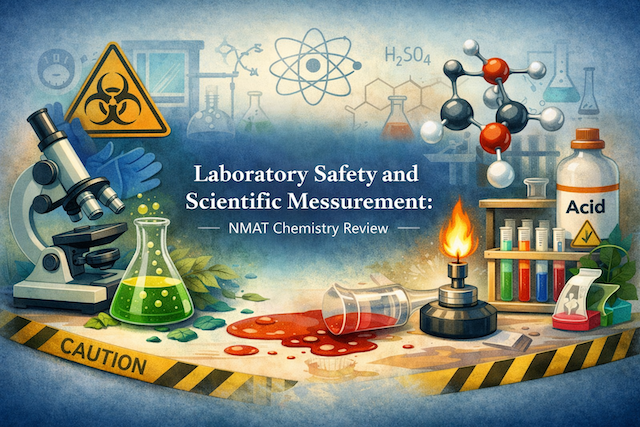
Laboratory Safety and Scientific Measurement: NMAT Chemistry Review
Contents
- Laboratory Safety and Scientific Measurement: NMAT Chemistry Review
- Why Laboratory Safety Matters in Chemistry
- Core Principles of Laboratory Safety
- Personal Protective Equipment and Proper Attire
- Common Chemical Hazards and How to Handle Them
- Laboratory Symbols and Hazard Communication
- Safe Laboratory Practices and Behavior
- Emergency Procedures: Spills, Burns, and Exposure
- Heat, Glassware, and Physical Hazards
- Introduction to Scientific Measurement
- SI Units and Common Chemistry Units
- Dimensional Analysis and Unit Conversions
- Significant Figures and Measurement Reporting
- Scientific Notation and Order of Magnitude
- Common Measuring Instruments and Their Uses
- Meniscus Reading and Avoiding Parallax Error
- Precision, Uncertainty, and Proper Rounding
- Accuracy in Solution Preparation and Concentration Measurements
- Good Laboratory Records and Data Integrity
- NMAT-Style Takeaways
- Problem Set: Laboratory Safety and Scientific Measurement
- Answer Key
Laboratory Safety and Scientific Measurement: NMAT Chemistry Review
Why Laboratory Safety Matters in Chemistry
Chemistry is a practical science. Even when the NMAT (National Medical Admission Test) focuses on concepts and problem solving, many questions assume you understand how laboratory work is done safely and accurately. Laboratory safety is not only about avoiding accidents; it also protects the validity of results. A contaminated sample, a mislabeled bottle, or an incorrect measurement can lead to wrong conclusions, which in real life could harm patients and waste resources. For NMAT Chemistry, you should be comfortable with standard safety rules, common hazard symbols, basic emergency responses, and the correct use of laboratory equipment.
Core Principles of Laboratory Safety
Laboratory safety is built on prevention. The safest experiment is one where hazards are identified in advance and controlled through proper technique. You should remember these key principles:
- Know the hazards before you start: Read labels, instructions, and safety data information. Identify whether chemicals are corrosive, toxic, flammable, oxidizing, or reactive.
- Use the right protective equipment: Lab coats, safety goggles, gloves, and closed-toe shoes protect you from common exposures.
- Work with clean organization: Keep your workspace uncluttered. Label containers clearly and never use an unlabeled chemical.
- Follow standard procedures: Do not improvise with unknown chemicals or equipment setups.
- Report and respond quickly: Small spills and minor incidents can become serious if ignored.
Personal Protective Equipment and Proper Attire
Personal Protective Equipment (PPE) acts as a barrier between you and chemical or physical hazards. The NMAT may ask about what type of PPE is appropriate in a given scenario.
- Safety goggles: Protect the eyes from splashes and fumes. Regular eyeglasses are not enough.
- Gloves: Protect skin from corrosive or toxic chemicals. Different glove materials resist different chemicals, but in basic contexts, gloves are assumed to reduce exposure risk.
- Lab coat/apron: Protect clothing and skin from spills.
- Closed-toe shoes and long pants: Reduce injury risk from spills or broken glass.
- Tied-back hair and no loose accessories: Prevent contamination and reduce fire/entanglement risk.
Common Chemical Hazards and How to Handle Them
Many laboratory accidents involve common chemical categories. Understanding how they behave helps you select safe handling and storage methods.
- Corrosive substances: Strong acids (e.g., HCl, H2SO4) and bases (e.g., NaOH) can burn skin and damage tissues. Always add acid to water when diluting to reduce splattering risk.
- Flammable liquids: Organic solvents like ethanol, acetone, and ether can ignite easily. Keep them away from open flames and hot surfaces.
- Toxic substances: Some chemicals can harm the body if inhaled, ingested, or absorbed through skin. Use proper ventilation and avoid direct contact.
- Oxidizing agents: Chemicals like hydrogen peroxide (concentrated) or potassium permanganate can intensify fires by providing oxygen or promoting oxidation reactions.
- Reactive chemicals: Certain substances react violently with water, acids, or other chemicals. Proper storage and separation are essential.
Laboratory Symbols and Hazard Communication
In many labs, hazard communication uses standardized pictograms and labels. While the NMAT may not require memorizing every symbol, you should recognize the major categories:
- Flame: Flammable substances.
- Corrosion: Corrosive to skin/metal.
- Skull and crossbones: Acute toxicity (dangerous even in small amounts).
- Exclamation mark: Irritant or harmful substances (less severe than skull symbol).
- Environment: Hazardous to aquatic life and ecosystems.
A practical NMAT takeaway: safety labels provide quick guidance for PPE, handling, storage, and disposal.
Safe Laboratory Practices and Behavior
Good technique prevents accidents. These habits also improve measurement accuracy because they minimize contamination and human error.
- No eating or drinking: Prevent accidental ingestion of chemicals.
- No mouth pipetting: Use a pipette bulb or pipettor to avoid chemical ingestion.
- Never smell chemicals directly: If instructed to identify an odor, use wafting (fanning vapors toward the nose).
- Keep containers closed: Reduces evaporation, contamination, and fumes.
- Use fume hoods when needed: Volatile or toxic fumes should be handled with ventilation.
- Dispose of waste properly: Do not pour unknown chemicals into the sink. Separate sharps, broken glass, and chemical waste according to rules.
Emergency Procedures: Spills, Burns, and Exposure
NMAT items sometimes test basic emergency logic. The correct response depends on the hazard and exposure route.
- Chemical spill on skin: Rinse immediately with plenty of water for several minutes; remove contaminated clothing if necessary and safe to do so.
- Chemical in eyes: Use an eyewash station and flush continuously; seek help right away.
- Small bench spill: Alert others, contain if trained, and follow spill kit procedures. For unknown or dangerous spills, evacuate and notify the supervisor.
- Fire: Turn off heat sources if safe, use a fire extinguisher for small fires, and stop-drop-roll if clothing catches fire. Many labs use safety showers for larger exposures.
A key point: quick rinsing with water is often the first step for corrosive exposure because dilution reduces damage.
Heat, Glassware, and Physical Hazards
Not all hazards are chemical. Many lab injuries come from burns, cuts, or improper handling of equipment.
- Hot plates and Bunsen burners: Keep flammables away. Use tongs or heat-resistant gloves for hot objects.
- Glassware: Check for cracks before use. Broken glass should go into a designated glass disposal container, not regular trash.
- Centrifuges: Balance samples to prevent damage and accidents.
- Sharps: Needles, blades, and broken glass require specialized disposal.
Introduction to Scientific Measurement
Scientific measurement is about producing values that are accurate, precise, and clearly reported. In NMAT Chemistry, measurement is essential for calculations in stoichiometry, solutions, gas laws, and thermochemistry. You need to know common units, conversions, significant figures, and how instruments influence precision.
Two ideas are central:
- Accuracy: How close a measurement is to the true value.
- Precision: How close repeated measurements are to each other.
A set of measurements can be precise but not accurate (consistent but shifted away from the true value), or accurate on average but not precise (scattered results).
SI Units and Common Chemistry Units
The International System of Units (SI) provides standard units used in science. NMAT questions often assume familiarity with these:
- Mass: kilogram (kg) as SI base, but grams (g) are widely used in lab contexts.
- Length: meter (m), with common subunits like centimeter (cm) and millimeter (mm).
- Time: second (s).
- Temperature: kelvin (K) is SI; Celsius (°C) is common. Conversions may appear: K = °C + 273.15.
- Amount of substance: mole (mol).
- Volume: liter (L) is common; 1 L = 1000 mL = 1000 cm3.
- Pressure: pascal (Pa) is SI; atm, mmHg (torr), and kPa are common in gas law problems.
Dimensional Analysis and Unit Conversions
Dimensional analysis is the standard method for unit conversion. It uses conversion factors arranged so units cancel logically. NMAT Chemistry frequently includes conversion steps, so you should be comfortable setting them up clearly.
Example logic (no need to memorize this exact one): converting 2.50 L to mL uses the factor 1000 mL / 1 L. Multiply 2.50 L by (1000 mL / 1 L) to get 2500 mL.
Common conversions to know:
- 1 kg = 1000 g
- 1 m = 100 cm = 1000 mm
- 1 L = 1000 mL
- 1 mL = 1 cm3
- Temperature: K = °C + 273.15
Significant Figures and Measurement Reporting
Significant figures (sig figs) communicate the precision of a measurement. They prevent you from implying more certainty than your instrument allows. NMAT questions often test rounding and sig fig rules in calculations.
- Non-zero digits are always significant.
- Zeros between non-zero digits are significant (e.g., 1002 has four sig figs).
- Leading zeros are not significant (e.g., 0.0032 has two sig figs).
- Trailing zeros are significant only if a decimal point is present (e.g., 2.50 has three sig figs; 2500 without a decimal is ambiguous).
In operations:
- Multiplication/division: answer has the same number of sig figs as the factor with the fewest sig figs.
- Addition/subtraction: answer has the same number of decimal places as the term with the fewest decimal places.
Scientific Notation and Order of Magnitude
Scientific notation expresses very large or very small numbers in the form a × 10n, where 1 ≤ a < 10. This format makes calculations simpler and reduces mistakes with zeros. In NMAT contexts, you may use scientific notation for concentration, Avogadro’s number, gas constants, or very small masses.
Order of magnitude estimates are also useful. If a value is about 3 × 10⁵, its order of magnitude is 105. Estimation can help you catch unrealistic answers during test time.
Common Measuring Instruments and Their Uses
Knowing which tool gives which level of accuracy is important. Some instruments are designed for rough measurements, while others are for precise analytical work.
- Beaker: used for holding and mixing liquids; volume markings are approximate and not ideal for precise measurement.
- Graduated cylinder: designed for measuring liquid volume more accurately than a beaker; read the meniscus at eye level.
- Volumetric flask: used to prepare solutions of a specific, accurate volume (e.g., making 250.0 mL of a solution).
- Pipette (volumetric or graduated): transfers measured volumes accurately; commonly used in titrations and solution preparation.
- Burette: delivers variable volumes precisely, especially in titration experiments.
- Balance: measures mass. Analytical balances provide high precision; top-loading balances are less precise but faster.
- Thermometer: measures temperature; accuracy depends on calibration and scale resolution.
Meniscus Reading and Avoiding Parallax Error
For liquids in glassware, the surface forms a curve called a meniscus. For water and most aqueous solutions, the meniscus is concave, and you read the bottom of the curve. For mercury, the meniscus is convex, and you read the top. NMAT questions commonly focus on the concave meniscus.
Parallax error happens when you read a scale from an angle rather than straight on. To avoid it, keep your eye level with the meniscus or the measurement line.
Precision, Uncertainty, and Proper Rounding
Every measurement has uncertainty due to instrument limitations and human reading error. A simple rule is that you can typically estimate one digit beyond the smallest marked division on an analog scale. For example, if a graduated cylinder has marks every 1 mL, you may estimate to the nearest 0.1 mL.
When rounding, do so at the end of multi-step calculations to reduce rounding error. However, report the final answer with the correct significant figures based on your measured inputs.
Accuracy in Solution Preparation and Concentration Measurements
Many NMAT Chemistry problems involve molarity (M), defined as moles of solute per liter of solution. Accurate solution preparation depends on precise mass measurement and precise final volume measurement.
- Weigh solute accurately using an appropriate balance.
- Dissolve completely before filling to the final mark.
- Use a volumetric flask for accurate final volume.
- Mix thoroughly to ensure uniform concentration.
Errors in preparation often come from incomplete dissolution, overshooting the volume mark, or misreading the meniscus.
Good Laboratory Records and Data Integrity
Reliable measurements are not just about equipment; they require careful documentation. In real science and clinical settings, data integrity is essential. Good records allow other people (and your future self) to reproduce work and check calculations.
- Label everything: include chemical name, concentration, date, and initials when appropriate.
- Record measurements immediately: do not rely on memory.
- Write units every time: a number without a unit is incomplete.
- Keep calculations transparent: show conversion factors and assumptions.
NMAT-Style Takeaways
To succeed in NMAT Chemistry, connect safety and measurement to problem solving. Safety awareness helps you interpret realistic lab scenarios, while measurement skills support accurate numerical work.
- Match the instrument to the required precision (beaker vs graduated cylinder vs volumetric flask).
- Use correct unit conversions and dimensional analysis to prevent mistakes.
- Apply significant figures and rounding rules consistently.
- Recognize common hazards (corrosive, flammable, toxic) and basic response actions.
- Read meniscus properly and avoid parallax error for volume measurements.
If you master these fundamentals, you will be faster and more confident with NMAT chemistry computations and practical reasoning questions.
Problem Set: Laboratory Safety and Scientific Measurement
- A student accidentally spills a small amount of dilute hydrochloric acid on their hand. What is the most appropriate immediate action?
- Which piece of laboratory equipment provides the most accurate measurement for preparing exactly 250.0 mL of a solution?
- A chemical label shows a flame symbol. What is the primary hazard associated with this chemical?
- Which of the following situations best demonstrates high precision but low accuracy?
- Why is mouth pipetting prohibited in chemistry laboratories?
- A graduated cylinder has markings every 1 mL. To what decimal place should measurements normally be recorded?
- Which unit is most appropriate for reporting the amount of substance in chemistry calculations?
- A student measures the mass of a sample several times and gets 5.01 g, 5.02 g, and 5.01 g. The true mass is 5.20 g. How should these results be described?
- Which safety practice is most important when working with flammable organic solvents?
- When reading the volume of water in a graduated cylinder, where should the measurement be taken?
- How many significant figures are there in the number 0.00450?
- A balance can measure mass up to the nearest 0.01 g. What is the correct way to report a mass measured as 12.3 g?
- Which SI unit is used for temperature in scientific calculations?
- A student converts 2.0 L to milliliters. Which conversion factor is correct?
- Which situation requires the use of a fume hood?
Answer Key
- Rinse the affected area immediately with plenty of water for several minutes to dilute and remove the acid.
- A volumetric flask.
- The chemical is flammable and can easily ignite.
- Repeated measurements that are very close to each other but far from the true value.
- Because it can lead to accidental ingestion of toxic or corrosive chemicals.
- To the nearest 0.1 mL.
- The mole (mol).
- The measurements are precise but not accurate.
- Keeping them away from open flames and heat sources.
- At the bottom of the concave meniscus at eye level.
- Three significant figures.
- 12.30 g, indicating the instrument’s precision to two decimal places.
- Kelvin (K).
- Multiply by 1000 mL / 1 L.
- Handling chemicals that produce toxic, irritating, or volatile fumes.

How to Register for eTravel Philippines (2025 Guide)
Step-by-step guide to completing your eTravel registration before arriving in the Philippines, with images and tips.

Night Market in Cebu – Things You Don’t Know About Cebu Life
Discover the hidden charm of Cebu’s night markets, from street food stalls to local life tips you won’t find in tourist guides.

How to Use ChatGPT for IELTS Preparation: A Complete Guide
Learn how to prepare for IELTS using ChatGPT — including strategies for Writing, Reading, Listening, Speaking, and grammar support.

How to Build a Website Without Coding Using ChatGPT
Discover how to build your own website using AI—no coding skills needed. From structure planning to SEO and design, let ChatGPT guide you.