
AI Study Abroad Guide
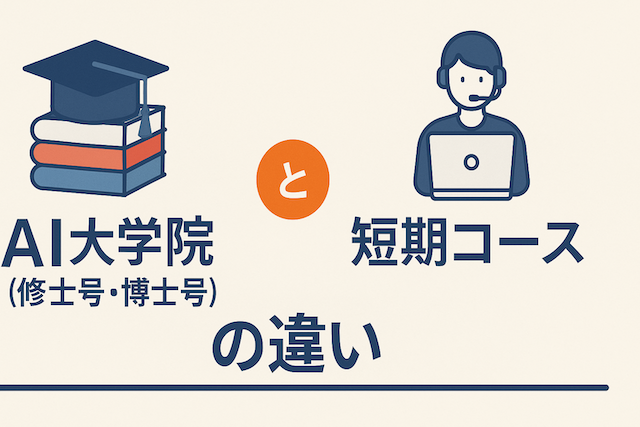
Differences Between AI Graduate School (Master's/PhD) and Short-Term Courses
01
Introduction
The importance of AI (artificial intelligence) grows year by year, and more and more people around the world are looking to study AI professionally. When aiming for career advancement, a job change, or a path as a researcher, not a few people face a choice: “Should I study systematically in an AI graduate school (master's or doctoral degree)?” or “Should I acquire practical skills through a short course or bootcamp?”
The two differ greatly in the depth of what you learn, the time and cost involved, and how your career opens up after completion. This article sorts out the differences between AI graduate school and short courses and clarifies the characteristics of each and the type of person each suits. Use it as a reference for finding the best way to learn for your own career goals.
02
Differences in Learning Content and Depth
AI Graduate School (Master's/PhD)
- **Emphasis on theory and research** Systematically master foundational subjects such as mathematics (linear algebra, statistics, optimization), algorithms, and machine learning theory.
- **Application and practice** In master's programs, you develop the ability to apply theory to real-world problems through project-based classes and industry-academia collaborative research.
- **Doctoral programs** You set your own research theme, write a dissertation, and become someone who creates new knowledge and methods in the AI field.
Short-Term Courses
- **Emphasis on practical skills** The focus is on data analysis with Python and R and building AI models using frameworks such as TensorFlow and PyTorch.
- **Results in a short time** Rather than digging deeply into existing theory, the aim is to acquire skills that are “immediately useful on the job.”
- **Based on applied case studies** Many courses offer training in implementing machine learning and deep learning using business cases and real data.
03
Differences in Study Duration and Flexibility
AI Graduate School (Master's/PhD)
- **Master's degree**: Usually a full-time program of 1-2 years. You need to set aside substantial time for classes, research, and projects.
- **Doctoral degree**: A long-term program of about 3-6 years. Original research and writing a dissertation are required, and strong commitment is demanded.
- **Flexibility**: Full-time attendance is basically assumed, and it is often difficult for working adults to keep working at the same time.
Short-Term Courses
- **Duration**: Programs that finish in a few weeks to a few months are common.
- **Format**: Flexible options such as online, evening, and weekend classes are available, making it easy to learn even for working adults.
- **Immediate impact**: Because you can get results in a short time, these courses suit preparation for a job change or career change.
04
Differences in Cost
AI Graduate School (Master's/PhD)
- **Tuition**: At well-known universities in the West and Asia, tuition can run to several million yen per year, and in some cases several million to tens of millions of yen over the entire program.
- **Living expenses**: If you study abroad, you need local living expenses (rent, food, insurance, etc.) in addition to tuition. Depending on the city, this can be a heavy burden.
- **Support systems**: In some cases you can receive scholarships or salary support as a research assistant (RA) or teaching assistant (TA).
Short-Term Courses
- **Cost**: Available for roughly tens of thousands to several hundred thousand yen. Overwhelmingly cheaper than graduate school.
- **Additional costs**: Because many courses are taken online, the burden of living expenses is small, and even for in-person courses the stay is limited to a few months.
- **Cost-effectiveness**: Because you can acquire practical skills in a short time, the return on your investment comes quickly.
05
Impact on Your Career
AI Graduate School (Master's/PhD)
- **Path to specialist roles**: Directly leads to positions requiring advanced expertise, such as research roles, university faculty, and R&D departments of major companies.
- **International career**: A master's or doctoral degree is a qualification recognized internationally and is advantageous for building a career at global companies and research institutions.
- **Long-term credibility**: Once earned, a degree proves your expertise permanently and becomes a long-term career asset.
Short-Term Courses
- **Upskilling and job change**: Effective for moving into roles that require people who can contribute immediately, such as data analyst or AI engineer.
- **Application to your current job**: While working in a business or IT role, introducing AI skills lets you contribute to greater operational efficiency and to driving new projects.
- **Limitations**: If you aim for a research career or an academic path, a short course alone is not enough.
06
Differences in Who Each Suits
People Suited to AI Graduate School (Master's or Doctoral Degree)
- **People with a strong interest in research and theory**: Interested in creating new algorithms and AI technologies.
- **People who want to build a long-term specialist career**: Aiming to work in research roles, as university faculty, or in R&D departments.
- **People seeking an internationally recognized degree**: Want to build a career at global companies or academic institutions.
- **People who can invest time and money**: Can commit to study lasting several years and to high tuition and living expenses.
People Suited to Short Courses
- **Working adults who want to acquire skills in a short time**: Want to use AI in their current workplace or apply it to a job change.
- **People who value practice-oriented learning**: Prioritize skills that make them immediately useful, such as programming and data analysis.
- **People who want to learn while keeping costs down**: Aim for career advancement with an investment of tens of thousands to several hundred thousand yen.
- **People who want a flexible learning style**: Want to study in the evenings or online while balancing work and family.
07
Summary
AI graduate school (master's or doctoral degree) and short courses are both effective ways to grow in the AI field, but their purposes and goals differ greatly.
- **Graduate school** is best for those who want a deep understanding of research and theory and want to build a career as a specialist or in academia. It requires a long-term investment, but in return you gain expertise and international recognition.
- **Short courses** suit those who want to acquire practical skills in a short time and who, as working adults, want to broaden their careers quickly. Their appeal lies in low cost and immediate impact.
The final choice depends on whether you want to master AI as “an object of research” or use it as “a practical tool.” Use the comparison laid out in this article as a reference and choose the way of learning that fits your career goals.
08
Should I choose AI graduate school (master's or doctoral degree) or a short course?
If your goal is “research or advanced specialist roles (R&D, academia),” graduate school has the advantage; if your goal is “acquiring practical skills in a short time or changing careers,” a short course is the stronger option. Choose based on the time and money you can invest and the level you want to reach.
09
What are the admission requirements for graduate school? Is it all right if I do not have a science background?
Many programs require mathematics (linear algebra, calculus, statistics), programming, and English proficiency. Even if you come from a humanities background, you can catch up through foundational courses, bridge courses, and a portfolio.
10
What are the requirements for short courses? Can I take one with no experience?
There are many courses for beginners, with a wide range from introductory to intermediate levels. What you need is basic PC skills, basic mathematical literacy, and enough time to study.
11
What is the difference between a master's and a doctorate?
A master's is a program of 1-2 years that builds applied ability and expertise; a doctorate is a 3-6 year program that trains researchers to create new knowledge through original research.
12
How does the learning content differ? (Graduate school vs. short course)
Graduate school goes deep systematically, from theory and research to large-scale projects. Short courses focus on implementation and solving practical problems with Python and frameworks (e.g., PyTorch, TensorFlow).
13
Which is better, online or in person?
In-person has the advantage if you value research facilities and collaborative research; online is convenient if you value balancing work or low cost. Hybrid formats are also increasing.
14
How should I think about cost-effectiveness (ROI)?
Graduate school is a high-cost, long-term investment, but you can expect to recoup it in long-term specialist or management roles. Short courses are low-cost with a short payback period, suited to upgrading your current job or giving an early boost to a job change.
15
What Are the Options for Scholarships and Funding?
Graduate school may offer scholarships, RA/TA positions, and company sponsorship. For short courses, installment payments, education loans, and corporate learning subsidies are common.
16
How do career outcomes differ?
Graduate school: research roles, research engineer, algorithm development, university faculty, etc. Short courses: data analyst, junior ML engineer, entry-level MLOps, applying AI in business roles, etc.
17
Do I need a portfolio or papers?
For short courses, GitHub or Kaggle work and reproducing real work projects are effective. In graduate school, master's and doctoral theses, peer-reviewed papers, and the results of research projects are evaluated.
18
Can I learn AI even if I am not good at math?
Yes. For short courses, start with implementation, then intuition, then theory as needed. If you are aiming for graduate school, strengthen linear algebra, probability and statistics, and optimization before enrolling.
19
How Much English Do You Need?
Graduate school requires strong English in both classes and papers (reading, writing, presentations). Short courses are sometimes offered in Japanese, but being able to read English materials widens your options.
20
Can I do internships or take part in research while enrolled?
Graduate school offers abundant internships through industry-academia collaboration and laboratories. Even with short courses, you can choose programs that include career support or hands-on work on company problems.
21
Is a “stepwise route” from a short course to graduate school possible?
Yes. Some people build foundations and a portfolio in a short course, clarify the field they want to pursue, strengthen their portfolio for applications, and then move on to a master's or doctorate.
22
How do I judge the quality of a program?
Check the track record of faculty and mentors, the specificity of the syllabus, graduates' career paths, research output and industry-academia collaboration, career support, the code review system, and the alumni network.
23
Which is better if I study while working?
Short courses and part-time or online master's programs are realistic. A full-time doctorate is hard to combine with work, so you need a planned leave of absence and a financial plan.
24
How much study time should I set aside?
Short courses: about 10-20 hours per week (varies with the amount of assignments). Master's: the equivalent of 30-40 hours per week. Doctorate: basically full-time equivalent, depending on research progress.
25
How are they valued in the job market?
A graduate degree is highly effective as proof of long-term expertise. A short course supports a first job change or internal transfer with “immediately usable skills plus work samples.”
26
What if I am not research-oriented but want to work with advanced models?
It is a good idea to choose an applied master's (professional master's) or, even among short courses, an intermediate-to-advanced track (focused on MLOps, LLM applications, RAG, evaluation and deployment).
27
What is a checklist for choosing a program without regrets?
- Fit with your learning goal (research or practice)
- Specificity of required courses and projects
- Quality and track record of mentors/faculty
- Career support (employer partnerships, interview preparation)
- Alumni network and community
- Total cost including tuition, time, and living expenses
- Evaluation methods (code review, thesis, presentation)
28
Related article
29
Recommended Courses
Course
Business English Course
A course for intensively learning practical business English: presentations, meetings, emails, negotiations, and more. You can build English skills useful in the global business scene after AI study abroad, matched to your level across 6 levels.
See moreCourseOne-on-One Intensive Course
A fully one-on-one system with no group classes. English preparation before AI study abroad and discussion practice on technical topics can be intensively trained to match your level.
See moreThe first step in IELTS preparation is choosing the right environment
With one-on-one classes and real-format mock exams, we help you reach your target score by the most direct route.