
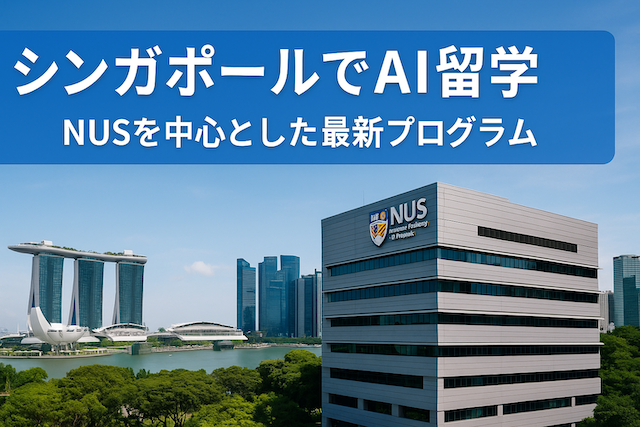
AI Study Abroad Guide
AI Study Abroad in Singapore: The Latest Programs, Centered on NUS
01
Introduction
In recent years, artificial intelligence (AI) has been dramatically changing the way society and business operate. In Asia in particular, countries are actively working to develop AI talent and strengthen their research foundations, and Singapore is attracting attention as a leader.
The National University of Singapore (NUS) is a top school that consistently ranks high in world university rankings and is also highly regarded in AI research and education. It offers programs for specialized study of AI, data science, and machine learning, and through partnerships with industry and government, it enables practical, future-oriented learning.
Singapore also uses English as an official language, is safe, and as a multicultural society has systems in place to welcome international students. It is therefore an ideal destination for students who want to study AI in an international environment and build a global career.
This article explains in detail the latest AI programs available in Singapore, centered on NUS, as well as partnerships with industry and the appeal of life as an international student.
02
Features of the AI Programs at NUS
1. An interdisciplinary approach
NUS's AI education is not confined to computer science alone but is integrated with diverse fields such as medicine, business, engineering, and the social sciences. A distinctive feature is its emphasis on viewing AI not merely as a technology but as a tool for solving challenges facing society as a whole.
2. A practice-oriented curriculum
NUS provides education that values practice as well as theory. Through case studies, project-based classes, and joint research with industry, students can hone skills that are immediately useful in the workplace.
3. World-class reputation
NUS consistently ranks among the top in Asia in the QS World University Rankings and places high globally, particularly in computer science. Its presence stands out from the number of citations of its AI-related research papers and the abundance of international joint research.
4. A global network
Outstanding students and researchers gather from around the world, so you can study AI from a multicultural perspective. In addition, through exchange programs and international joint research projects, the environment is directly tied to building a global career.
03
Main AI-Related Courses and Programs
Master of Computing (AI Specialization)
One of NUS's flagship graduate programs, with a specialization dedicated to the AI field.
- Systematic study of machine learning, deep learning, natural language processing, computer vision, and more
- Both practice-oriented and research-oriented tracks are available, so you can choose according to your career goals
- Includes courses on AI ethics and social impact, allowing a balanced study of technology and ethics
Master of Science in Data Science and Machine Learning
A program focused on data science, which underpins AI.
- Broadly covers statistics, big data processing, and machine learning algorithms
- A curriculum directly connected to diverse application fields such as business, finance, and healthcare
- Acquire job-ready skills through internships and industry collaboration projects
PhD Program (AI/Computer Science)
A doctoral program for engaging in cutting-edge AI research.
- Take part in research themes such as next-generation algorithm development, real-world deployment of AI, and AI ethics and regulation
- Able to join joint research with researchers and companies gathered from around the world
- Builds a foundation for a future career as a researcher, university faculty member, or in a company's R&D department
Short intensive and specialized courses
NUS also offers short courses in AI and data science for working adults. They are popular with people who want to learn the latest AI skills while working, and many participants come from Singapore's industries.
04
NUS and Industry Collaboration
A central role in the AI Singapore project
The Singapore government is promoting AI Singapore as a national project, and NUS plays a core role in it. In this project, industry, research institutions, and educational institutions work as one to apply AI technology to society and industry. Through this framework, students can take part in real problem-solving projects and gain practical experience.
Strong partnerships with global companies
Technology companies such as Google, Microsoft, IBM, and Grab have research bases in Singapore, offering abundant opportunities for joint research and internships with NUS. Students can gain practical experience while tackling frontline challenges and link it directly to their careers after graduation.
Connection to the startup ecosystem
NUS has incubation facilities on campus and supports AI-related startups. Even international students can take part in entrepreneurship projects, opening opportunities to commercialize research results. This provides experience of returning innovation to the real world, beyond academic research.
Rich internships and practicums
NUS's curriculum incorporates practical training in industry, and even master's students can take part in AI projects through corporate internships. By working on business challenges specific to the Asian market, you can grow into a person with international competitiveness.
05
The Appeal of AI Study Abroad in Singapore
1. An environment to study in English
English is one of Singapore's official languages, and classes at major universities, including NUS, are all conducted in English. Being able to learn cutting-edge AI in English makes it an ideal environment for students aiming for a global career.
2. Safe and comfortable student life
Singapore, with its good public safety and well-developed infrastructure, is a very reassuring place to study abroad. A highly developed public transport network makes daily life convenient. The diverse food culture, where you can enjoy cuisine from around the world, is also a big benefit for international students.
3. Learning in a multicultural society
Singapore is a society in which cultures, mainly Chinese, Malay, and Indian, coexist. By studying while interacting with multinational students and researchers, you can gain a global perspective on applying AI and the ability to understand other cultures.
4. Career opportunities after graduation
The Singapore government actively promotes the development and acceptance of AI talent, so there are abundant opportunities to work for local companies after study abroad. Demand for AI talent is rising in tech companies, financial institutions, and healthcare in particular, directly connecting to international career building.
5. The strength of being a hub for Asia
Singapore has established itself as Asia's financial and technology hub, and the experience and connections gained here hold great value, particularly in the Southeast Asian market. The network built through study abroad will be useful for future research and business.
06
Summary
AI study abroad in Singapore is an ideal choice that combines **academic strength, ties with industry, and a comfortable living environment**. NUS in particular, as a leading research university in Asia, has earned a global reputation in AI education and research.
- An interdisciplinary curriculum directly tied to practice
- A practical learning environment in partnership with industry and government
- Education in English and a reassuring living base
- Abundant career opportunities after graduation
With these elements combined, AI study abroad in Singapore goes beyond simply earning a degree and becomes **an investment directly tied to building a global career**.
Centered on NUS, Singapore is expected to remain at the forefront of AI education and research in Asia. For those who want to be active internationally in the AI field, Singapore is undoubtedly a study-abroad destination worth watching.
07
What AI-related programs can I study at NUS?
Representative options are the Master of Computing (AI specialization), the MSc in Data Science & Machine Learning, and AI/Computer Science PhDs. Short intensive courses for working adults are also available.
08
What do the programs cover?
Machine learning, deep learning, natural language processing, computer vision, MLOps, AI ethics, and more. You also develop practical ability through case studies and industry-academia collaboration projects.
09
What is the language of instruction? What are the English requirements?
Classes are in English. For applications, English scores such as TOEFL or IELTS may be required. The required scores differ by program, so check the latest admission guidelines.
10
What educational background is required for admission?
A bachelor's degree in a related field such as computer science, engineering, mathematics, statistics, or data science (for a master's, a bachelor's foundation plus strong grades is desirable). Related research and work experience, projects, and a paper or GitHub portfolio are advantageous.
11
Is the GRE required?
It differs by program. Even where it is not required, submitting it is sometimes recommended to improve competitiveness.
12
What Are the Approximate Tuition and Living Costs?
Tuition varies by program and enrollment format. Living costs differ by type of housing (student dorm, condominium, room rental). Check official information for the latest tuition and cost examples.
13
Are There Scholarships or Financial Support?
Options include university, government, and corporate scholarships, research assistantships (RA), teaching assistantships (TA), and compensation from industry-academia projects. Some have early application deadlines, so prepare with time to spare.
14
Are There Internship or Industry-Academia Collaboration Opportunities?
There is a wide range of practical opportunities, including joint research and practical projects with AI Singapore, tech companies (e.g., Google, Microsoft, Grab), and research institutes, as well as startup support through on-campus incubation.
15
What about jobs and careers after graduation?
ML engineer, data scientist, MLOps/platform, product analytics, research (R&D), and more. Singapore has high demand for AI talent, making it an environment that easily leads to an international career.
16
What about student visas and work regulations?
A Student Pass is required for study. Under certain conditions, you may be able to do internships or apply for a work pass after graduation. Be sure to check the latest immigration regulations in official sources.
17
What are the application schedule and deadlines?
One to two intakes per year are typical. Slots in popular programs fill up early, so start preparing transcripts, English scores, recommendation letters, essays, and portfolio ahead of time.
18
What should a portfolio include?
Compile materials that convey reproducibility and impact, such as GitHub repositories, research notes, Kaggle achievements, papers and preprints, implementation demos, and contributions to products (metric improvements and A/B test results).
19
Is it suited to research-oriented or practice-oriented people?
It accommodates both. For a research orientation, emphasize research matching with faculty and publication record; for a practice orientation, emphasize the quality and results of projects and internships.
20
Can I learn AI ethics and responsible AI?
The curriculum may include courses on AI ethics, legal regulation, bias, and safety, and you can deepen your understanding of implementation through real industry projects.
21
How should I choose housing?
On-campus dorms offer good value and a sense of community, while off-campus options (HDB, condominium, shared housing) prioritize commuting and daily convenience. Competition intensifies just before the term starts, so securing housing early is key.
22
Can non-native English speakers keep up in class?
Yes. Strengthening academic writing, technical speaking, and the basics of statistics, linear algebra, and Python in advance will make your studies smoother.
23
What are the points of comparison with other universities and cities?
English-speaking environment, safety, accessibility to the Southeast Asian market, density of industry-academia collaboration, and the level of living infrastructure. Compatibility with your research theme and supervisor is also important.
24
What initial preparations should I make after being accepted?
Student Pass application, securing housing, enrolling in insurance, course consultation, visiting laboratories, laptop environment (GPU/cloud), setting up data and paper management tools, and refreshing mathematics, probability, and optimization.
25
What is a checklist to avoid failure?
- Clarify your purpose (research/practice/entrepreneurship)
- Confirm the match with faculty and research themes
- Plan backward from application requirements and deadlines
- Funding plan and applying for multiple scholarships
- Strengthen English, mathematics, and programming in advance
- Update and visualize your portfolio (quantify results)
- List candidate companies for internships/projects
26
Related article
27
Recommended Courses
Course
Business English Course
A course for intensively learning practical business English: presentations, meetings, emails, negotiations, and more. You can build English skills useful in the global business scene after AI study abroad, matched to your level across 6 levels.
See moreCourseOne-on-One Intensive Course
A fully one-on-one system with no group classes. English preparation before AI study abroad and discussion practice on technical topics can be intensively trained to match your level.
See moreThe first step in IELTS preparation is choosing the right environment
With one-on-one classes and real-format mock exams, we help you reach your target score by the most direct route.